Insect Media Wired
Wired (UK) ran a story about Insect Media, discussing some of the themes of the book but also more widely the topic of animals and technology. Indeed, I don’t think the relation to animals is only metaphorical (who could claim it is when we are thinking of using spider silk for optical fibre communications and computer chips). There are much more interesting things that can be thought about in terms of the ecology of media, nature and subjectivity.
But I don’t think insects are hackers or that we should say that telegraphy is the Victorian email (like Tom Standage hinted at in his book The Victorian Internet). The connection happens on other levels. There is definitely a historical geneaology of insects, animals, nature and technology, and it ranges from modes of thought concerning technological, scientific culture to the material basis of technology. The fascination with entomology introduced already in the mid 19th century (oh well, and earlier for sure) a mindset which started to see in the microscopic an inspirational realm of movement, communication, sensation, and affect.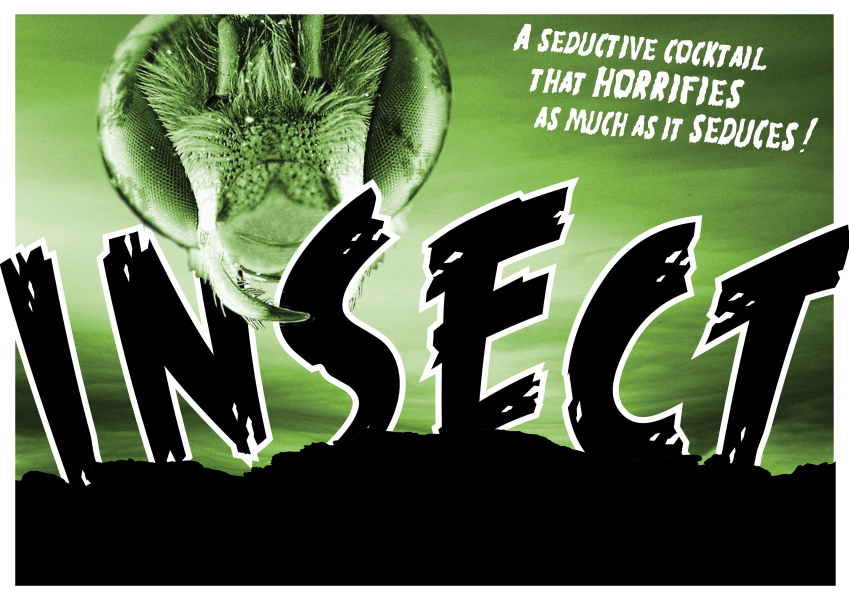
Part of that was carried over into Science Fiction and some trails are to be found in 20th century thoughts concerning architecture, media, technological arts from avantgarde cinema to later embodied media arts and robotics. It ranges from the algorithmic thinking inspired by ant trails, pheromones and collectivities to the visual sphere of animation, at least in the 1980s and artificial life type computer graphics objects with ‘relational intelligence’ of sorts, like boids: flocking behaviour, swarming.
Hence, remember the computer animation pioneer Craig Reynolds’ words:
“I would like to thank flocks, herds, and schools for existing: nature is the ultimate source of inspiration for computer graphics and animation.”
Noise Matters
Greg Hainge has a new book out on noise – Noise Matters. As part of the launch, Greg has written a short position statement on noise and asked a number of theorists and practitioners to respond. I was among those, and here briefly my brief intervention on noise, a response to Greg’s position statement on ontology of noise.
Noise
You don’t need an etymology book in your hand to know that noise connects to nausea. Just turn up your stereo loud enough and persist. Loudness turned into noise can make your bowels turn, and sickness overtake your body. A classic function of media: disorientation of the senses. Noise can clear out the room when you want it to. You can clear spaces, push people away if you want. Or make someone wish they were not in the space, when you debilitate their possibility of saying no to sound. Connecting it to psychoanalytic theories of sensation, sound is hard to resist.
Noise connects to contemporary politics, as is well argued by a range of scholars from Steve Goodman to Suzanne Cuzick. Such cultural theory-musicologists as Milla Tiainen have convincingly argued about the multiplicity of sounds that constitute bodies as collectivities of becoming. The continuum between sound-noise is the axis through which to understand the political constitution of contemporary bodies and collectivities. What holds bodies together is affect, but that glue is also a force of push and pull.
What is interesting about noise is that it is emblematic of the emergence of technical media culture. Noise too has a history, and not only in the aesthetic or even urban development sense. Noise has an engineering oriented media archaeology. Imagine the sounds and noises Denis Kaufman, better known as Dziga Vertov, created at the Petrograd Psychoneurological Institute, in the Laboratory of Hearing.
Engineering noise is related to the wider communication theory issue formally formulated in the 1940s: communication takes place always in the presence of noise. Any kind of consideration of the ontology of noise is at least an implicit nod to the fact that noise becomes measurable in the age of technical media. It becomes an issue of epistemology, in a manner that bypasses the semantic understanding of noise. We are not dealing with meaning, but with various frequencies and patterns that define the world of information and sound. Both information and sound are ontologically time-critical: they unfold in time, and in ways that are not only experiential in the sense that phenomenology taught us, but speculative. There is noise everywhere, as Hainge points out, referring to Bogost and the black noise of objects. Even humans are “noisy narrowband devices” as Licklider coined us in comparison to computers.
“Message or Noise?” This was a shorter text by Michel Foucault, and picked up by the media archaeologist Wolfgang Ernst, who has been one of the theorists keen to rescue noise and signals from meaning-based approaches. Instead, in the age of information, even human perception becomes conditioned by the events of signal processing and signal-to-noise ratio in the transmission of mediatic content. This argument by Ernst resonates with a range of material media theory emphases of recent years, including that of Friedrich Kittler. In the age of technical media, we are able to record pure noise as obediently as the harmonious meaningful phrases of poetry, and transmission takes place in a careful engineering of that aforementioned ratio: signal to noise. Hence, it is not a question of message or noise, just that of messages in noise. And noise in messages.
Neural on WiMA
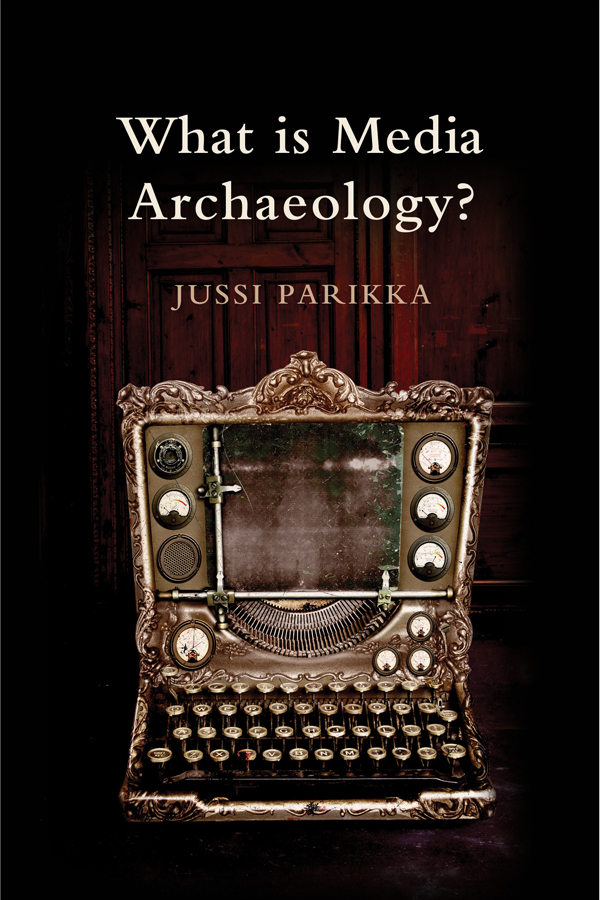 Neural – one of my favourite publications in the media arts, theory and sound field – published a short review of my What is Media Archaeology? Read it now online.
Beyonce and I (or Spam in the Can)
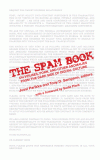
The Independent wrote a piece on spam, and I was interviewed as well. The main driver for the story is Finn Brunton’s forthcoming book on the same topic (and I can reveal that it is a great study). I also consider it a highpoint of my academic career that I am in the same story with Beyonce. Sort of.
Ernst on Time-Critical Media: A mini-interview
One of my interests of the recent times has been “microtemporality”. This interest has been spurred both by Wolfgang Ernst’s media archaeological theory and publications such as Axel Volmar’s 2009 edited volume on time-critical media. Indeed, notions of microtemporality offer ways to understand the technical conditioning of social/cultural processes on a level that is irreducible to the phenomenological. With different emphases to those of Ernst’s I know that for instance Katherine Hayles is nowadays looking at algorithmic trading from the temporal perspective too and Mark Hansen is from a more Whitehead perspective investigating ubiquitous media environments and that what escapes conscious cognition. See also Shintaro Miyazaki on these topics through the concept of Algorhythmics in Computational Culture.
In the midst of my own research into different temporalities that media archaeology offers, as well as network times/politics, I wanted to conduct a mini-interview with Wolfgang Ernst. Hence, please find below Wolfgang Ernst, responding to my question “what is time-critical media and microtemporality?”
Wolfgang Ernst:
“Technological media have a distinct quality: They are in their medium-being only in operation (“under current”). This specificity makes them especially sensitive to micro-temporal intrusion, irritation and manipulation – much more than previous cultural techniques like alphabetic writing which became time-critical only when electrically coded into telegraphy.
It was Gotthold Ephraim Lessing who in his treatise on the comparative aesthetics of poetry and visual arts Laokoon in 1766 identified what the called the “pregnant moment” in the representation of action. In electronic television the exact synchronisation, thus timing, of signals becomes crucial for the human aisthesis of image perception indeed. With techno-mathematical computing where minimal temporal moments become critical for the success of the whole process of internal calculation and human-machine communication (“interrupt”), time-criticality becomes a new object of epistemological attention in the economy of knowledge. When culture is rather counted than narrated, time-criticality needs to be focussed by process-oriented (thus dynamic) media archaeology.
Time-criticality in its media-technological context does not refer to a philosophical or critique of contemporary politics or ethics but rather to a special class of events where exact timing and the temporal momentum is “decisive” for the processes to take place and succeed at all. In its ancient Greek sense, crisis refers to the chances of decision, with its temporal form being an impulse rather than a duration or narrative – kairotic time. Kairos – the ancient Greek god of the decisive moment – becomes proverbial in post-modern just-in-time production in both industry and technologies, as well as in deadly situations like antiaircraft prediction in Second World War.
In its etymological roots, “time” itself refers to divisions of continuity, to the cutting edge. Apart from its long aesthetic tradition, the cultural impact of time-criticality escalates with (and within) technological media, starting from photographic exposure time which almost shrank towards zero. Signals which are operated with electronic speed can hardly be followed by human consciousness like, for example, symbols (printed letters) in textual reading. When signal transfer happens below human sensation, it can be spotted only by time-critical observation. For subliminal events the true archaeologist of time-critical knowledge are technical media themselves; only with the emergence of hightly sensitive measuring instruments since the 19th century time-critical processes like the runtime of signals within human nerves became analyzable at all.”
A Hefty Companion
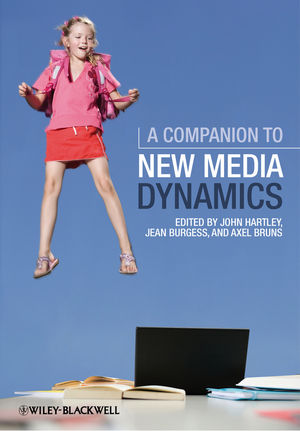 A Companion to New Media Dynamics is out now. And admittedly, it is quite expensive. But try to get your library to order a copy, as it does contain some really handy chapters on media culture, networks, politics of platforms, mobility, and more! I just finished reading a nice Sean Cubitt-piece (on media studies and new media studies), and will continue with some of the other great looking texts.
I co-wrote with Tony Sampson a piece on spam, network virality and contemporary capitalism and marketing: “Learning from Network Dysfunctionality: Accidents, Enterprise and Small Worlds of Infection”. It continues our joint interests into networks as well as viral capitalism, but with a specific Tardean twist.
Emoticon, 1881
This article on Rhizome inspired me to post this picture relating to a sort of a media archaeology of emoticons — before the digital, before mass communication over networks, and demonstrated as a form of “typographical art”. This one is from the Puck magazine, 1881.
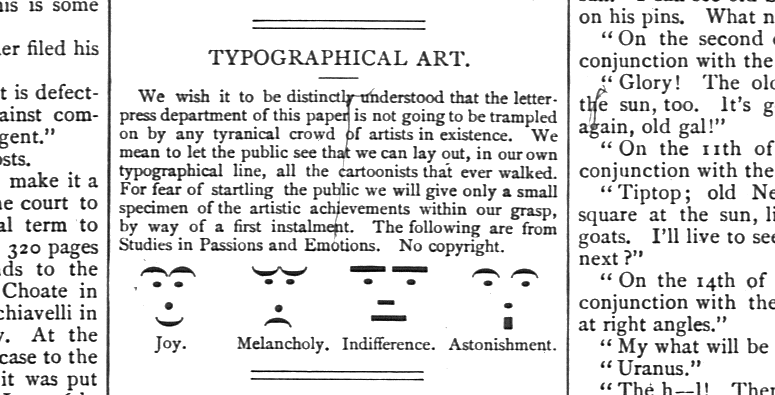
For a more in-depth excavation of emoticons, we should look at the various work on categorisation of emotions across humans and animals that was a key topic of research also in the 19th century. It relates to the importance of the face before the facebook.
How about the face, expression and emotion more generally? For instance Charles Darwin was interested in the evolutionary aspects of faces and expressions, and at the centre of much interest lies a curious book by the neurologist Guillaume-Benjamin Duchenne de Boulogne: The Mechanism of Human Facial Expression, or an Electro-physiological Analysis of the Expression of the Passions Applicable to the Practice of the Fine Arts (1862)
Duchenne worked at the Salpêtrière hospital which later became known for its hysteric (female) patients, and the variety of new media based experiments and empirical methods by Charcot. In Duchenne’s work, the face, the expression was something that was the shared ground between humans and animals in these experiments.
Duchenne was in the 1860s using photography as a method to tap into the animal forces of the face. Photography offered him a way to capture the formal features of expressions. The patients were the models. Yet, two different time scales clashed. Photographic processes demanded a lot of time and holding the face still was difficult –Duchenne was using as his models mentally and physically ill patients. Instead of making photographic process quicker, he slowed down the body. By applying electrodes in right places of the face, the subject froze and kept the expression long enough – 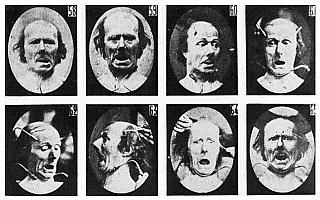 it became more than a fleeting expression, and an index for scientific purposes (indeed, Darwin was using these photographs, see Phillip Prodger’s Darwin’s Camera, Oxford University Press, 2009, 81-83).
For his own research and visualisation purposes, Darwin used engravings made from the photographs, where the electrodes were removed. This made the expressive faces slightly more natural, of course. An enforced typology of the face and emotion.
A Video Review of Insect Media
Why don’t we in academia use more other forms of expression than the written word?
Here is a video review (alongside with the transcript in the following link) of Insect Media, published in the journal Itineration: Cross-Disciplinary Studies in Rhetoric, Media and Culture.
A Media Archaeological Office
Not every professor has an office like this. Peep into Erkki Huhtamo’s (UCLA) media archaeological office through this video, and get a taster of his enthusiasm as a collector: zoetropes, mutoscopes, kinetoscope. It demonstrates the curiosity cabinets of media history but also the need to train specialists who are able to maintain these instruments as part of the living heritage of media cultures outside the mainstream. The devices prompt us to ask questions concerning difference: how different media culture could be, and has been.
The video is a good insight to the just released Huhtamo book on the moving panorama: Illusions in Motion, just out from MIT Press.








 Machinology