Archive
The memoirs of an aspiring lichenologist
Rebecca Birch’s voice draws the hand drawing the landscape. It tells stories of trips and meetings, people and things. The projection of her unfolding drawing/narrating tells the story of her artwork in (auto)ethnographic style, and becomes an art performance itself. Birch’s work was recognized in Art Review’s March issue as one of the Future Greats and the magazine organised a party for her – addresses to a lichen covered stick.
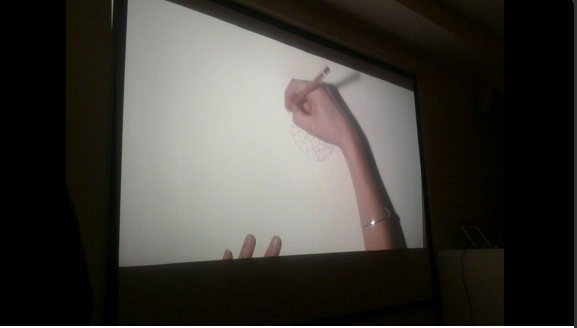
A lichen covered stick was part of a particular roadtrip-performance-screening -project of Birch’s, and became the theme of the evening too. I was invited to be one of the speakers – addressing this assemblage and offering variations on the theme and Birch’s art. Below a short text based on my talk, one of several talks/performances alongside Francesco Pedraglio, Erica Scourti, Karen Di Franco and a playlist provided by Bram Thomas Arnold.
Imagine this talk voiced by an alter ego — a part real, part imagined Finnish lichenologist from the late 19th century, in his hallucinations of a future ecocatastrophy, and past earth times since the carboniferous era.
The memoirs of an aspiring lichenologist: media & ecology
In his short text about Rebecca Birch, Oliver Basciano gives us an image of her art works and refers to the capture of light as much as shadow through the role of the camera itself comparable to that stick covered in lichen.
“[the stick] acts as a sort of MacGuffin around which collaboration and conversation circle within the hermetic confines of a car. With this, one can perhaps understand the videocamera as taking a similar role – giving Birch the opportunity to embed herself in a community or situation that would remain closed otherwise”
Indeed, the stick persists as a thematic motif; it resides there as a silent interlocutor. The closed technological environment of the car hosts both human chatter as well as this stick of nature smuggled as part of the roadtrip.

The camera, the visual registers and works with light as well as lack of it – the shadow, darkness. In the context of lichen, consider another perspective too. Focus on the lichen as the first element that registers light, sound, movement, chemistry around it. It participates in Birch’s work so that it’s not only the camera, which registers the sounds and visions, but the lichen, a symbiotic organism itself. This refers to the scientific context of lichens as bioindicators – they register the changing chemical balance of the world. In short, lichen is a medium – a medium of storage, an inscription surface that slowly but meticulously and with the patience of non-human thing pays attention to the growth in air pollution. It’s symbiotic status is symbiotic in more than the biological way: it is involved in the material-aesthetic unfolding of ecologies social and nature.
It was a Finn, Wilhelm Nylander, who discovered in the 1880s details about the possibilities of using lichen as biodetectors; through experiments exposing lichen to chemical elements such as iodine and hypochlorite Nylander found out that one can “read” nature through this natural element. It meant a discovery of an important feature that tells a different story; it is less a narrative than a sensory registering of the environmental change that technological culture brought about gradually since the 19th century: atmospheric pollution, leaving its silent mark.
Lichen has over the years and years observed to be full of life and circuited as part of different ecologies. They have been not just objects of our attention, addressed by narratives and images but became part of the modern cycle of industrialised life. They silently observe our chatter, listen in, as well as through their earless senses know what we are doing to our surroundings. They provide housing for spiders and insects, but also some of lichens are (re)sourced as part of the high-tech industries for pharmaceuticals (antiobiotics) and cosmetics (sunscreen).
This participation in multiple ecologies, a cycle of different duration is a fascinating topic considering both our theme today as well as the broader discussions of past years concerning the anthropocene. In short, it is the discussion that started in contexts of geology and environmental debate about categorising our epoch as the Anthropocene – a geological period following the Holocene and branded by the massive impact humans, agriculture, geoengineering, and in general the scientific-technological culture has had on the planet. And now, it has gathered the wider scientific and arts/humanities community as part of the discussions that reflect a different , growing perspective to the environmental.
The anthropocene -and the obsceneties accelerating it as the anthrobscene – can be unfolded through lichen. In a rather important move, such Macguffins tell a hidden story of change. The technological culture in which nature becomes entangled with the human induced scientific changes. Visual, oral narratives give an image of this change. We tell stories of our nature, our interactions in ecology, in the environment with media which stores the remains of the planet as part of our human narratives- roadtrips, conversations, social events, accidental meetings, small details, landscapes – drawn by Birch in her performance that remediates the earlier.
In other words, lichen is besides a conversation piece also a medium. It saves this story through its biological means as storage that in our hands becomes memory – the scientific-aesthetic context of memory read through lichen. Even pollution becomes a sort of a mediated environment, like with photochemical smog. The lichenologist Nylander was on to something, more than observations about lichen. A lichenologist plays homage to the conversations lichen shares as it tells the story of a slow change since the coal pollution (sulphur dioxide) of England since the 18th and 19th century to the contemporary air of nitrogen compounds. So besides the conversation going on in Rebecca Birch’s car, there is this silent partner always present, as it has been for a longer while, and now also articulated in the visual arts/ecology-mix of an evening – Addressing the stick, but also: the lichen as the address which receives transmissions of industrial modern culture.
***
Nb. The party was sponsored by Absolut Vodka, with signature drinks:

Photochemical Smog as New Media
Perhaps photochemical smog is the only true new visual media of post World War II technological culture. It represents the high achievements in science and technology, combined with (synthetic) chemistry and sunlight. It modulates the light like advanced visual media should and embeds us in its augmented reality as we suck it into our lungs.
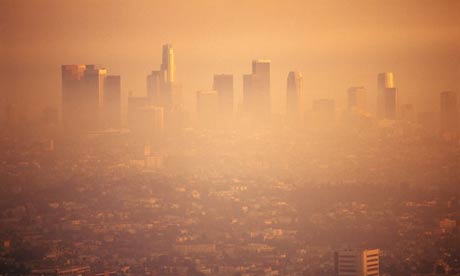 It encapsulates the mediatic cities of Los Angeles and Beijing, as encompassing surely as Hollywood’s machinery. Just like the material basis of technical media of more conventional kind – such as photography and film – it is chemical based. It is media the same as any photochemical process is about how light gets absorbed on our planet’s atoms and molecules.
But it’s new media, particular to the modern industrial age and the chemical reactions of more recent history. It feeds of industrial pollution and modern transport. It is about the screen as well – how the sunlight is offered this massive living chemical molecular screen on which to project its energetic images. A molecular aesthetics of an ecology of a dying planet.

A Geology of Media
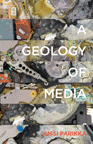
I am pleased to announce that I have signed a contract with University of Minnesota Press for a new book tentatively called A Geology of Media.
Planned for 2015, A Geology of Media forms the third, final part of the media ecology-trilogy. It started with Digital Contagions: A Media Archaeology of Computer Viruses (2007) and continued with Insect Media (2010). This book on the geophysics and the non-organic ground of media complements the earlier takes by offering a media materialism from the point of view of geological resources, electronic waste and media arts. Through engaging with several contemporary art and technology projects it provides a media theoretical argument: to think of materiality of media beyond the focus on machines and technologies by focusing on what they consist of: the chemistry and geological materials of media, from metals to dust.
In short, I am interested to see if what pejoratively sometimes is called “hardware fetishism” is not hard enough, and even media and cultural theorists need to focus on the rocks and crust that make technical media possible. Earth history of deep times mixes with media history, which becomes a matter of not only thousands, but millions of years of non-linear history (to modify Manuel Delanda’s original idea). This way media materialism becomes a way to entangle media technologies, environmental issues and themes of global labour. Perhaps instead of the Anthropocene, we should just refer to the Anthropobscene.
I’ve been in recent talks and short posts been addressing the geological in media, and my piece in The Atlantic offered a short preview of what’s to come. In addition, below a very tentative table of contents. This project (and the Erkki Kurenniemi book I am working on with Joasia Krysa) will keep me busy for a while.
A Geology of Media
Preface
1) Introduction: Grounds of Media/Culture
2) An Alternative Deep Time of the Media
3) Psychogeophysics of Technology
4) Dust and the Exhausted Planet
5) Media Fossils
Afterwords: Half-Life
Appendix:
“Zombie Media”, by Garnet Hertz and Jussi Parikka
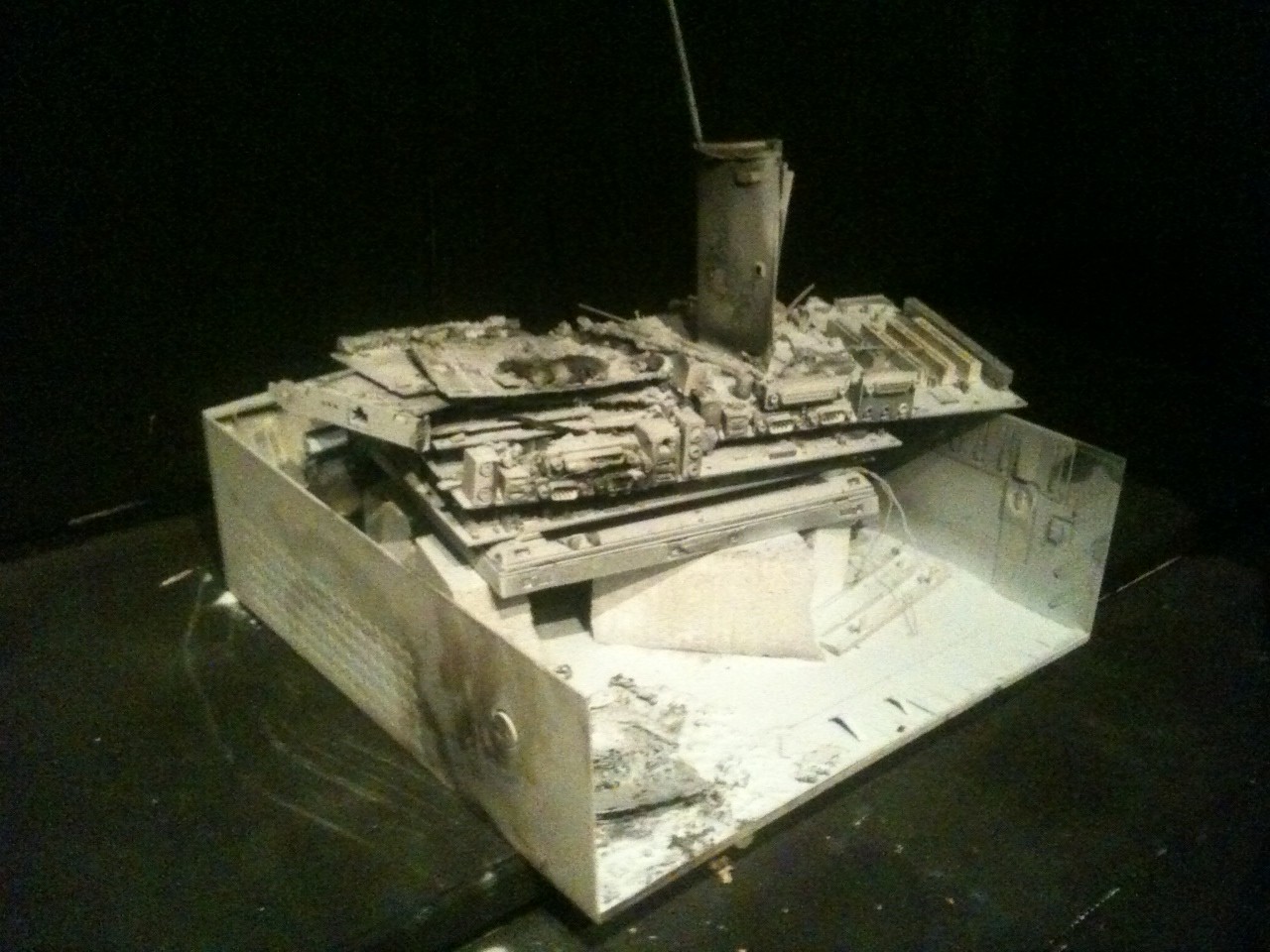
From the Crystal World-project (Howse, Jordan, Kemp)
The Anthropobscene: The Elemental Media Condition
Winchester School of Art are one of the partners of the transmediale-festival, which takes place again in January/February 2014 in Berlin. This short text below is a sort of a trailer to our bit for the event: the text is co-written by myself and Ryan Bishop and the the contribution to tm14 is likewise co-curated by us. The text gives an indication of some of the themes we will discuss during the festival and conference week, and it draws on some of our work on these topics: Ryan’s writing on the four elements and contemporary aesthetics, and my work-in-progress book project on “geology of media” and what I pitch as the anthropobscene – a new geological era catalysed by the corporate capitalist measures of depletion and exploitation.
Ryan Bishop and Jussi Parikka:
The Elemental Media Condition
Ever since such early geologists as James Hutton and Charles Lyell voiced a distance from biblical time, the Earth has had a proper history. The natural historical durations of the Earth have, despite academic disciplinary divisions, always intertwined with human history. In the current moment, the complex interactions of the two seem more prescient than ever. To follow in the footsteps of Dipash Chakrabarty, the horizon of the anthropocene forces historians to think of durations of nature as entangled with social history, and the historiographical functions of temporality need to be considered alongside such vectors that acknowledge the work of capitalism as a specific epoch. In this sense, we would like to refer not only to the anthropocene as the debated new geological era in scientific classification, but also what can be called the anthropobscene. This portmanteau word combines anthropocene with obscene, thus highlighting the vicious exploitative actions of corporations, governments and other agencies operating on different levels: from human individuals to multigovernmental organisations and transnational corporations. In much the same manner that Jean Baudrillard reconfigured the subject-object relationship placed within a scene as a network-screen relationship in the obscene, the anthropobscene reconstitutes the relationship between human scales of intervention into those of the geological. Thus, amongst other things, it refers to the obscenity of heavy pollution of the earth and the air, bringing back discussions of the four elements as found in the Pre-Socratic thinker Empedocles, whose writings strike both ancient and contemporary chords. Cultural theorists, such as Gary Genosko, have voiced an urgency for a renewed consideration of the elements.
For Empedocles, humans, nature and the universe contain the same elements. Flesh and blood are composed of approximately equal parts of earth, fire, water, and aether: the four elements that constitute the universe. The entire material world for Empedocles comes from the mixture and amounts of these four elements, the mixing of which he likens to paints on an artist’s palette with their different effects due to combinatory portions. This insight of multiple and diverse substances generated through combinations and proportionality becomes a cornerstone of modern science and chemistry. The harmony of Love and the discord of Strife result from the proportionality of the elements with each constantly changing and warring with the others. The Empedoclean elements of this cosmogony and in nature constitute both media and content. They make, transform and destroy at the same time.
Empedocles’ writings use physics to derive an understanding of ethico-political, even moral, laws. In the teaching of Empedocles the problem of substances as they present themselves to us takes a specific form: how do the Many come from One and One from Many? The primary and ultimately determinate forces behind the various manipulations, combinations and transformations of the elements in Empedocles are in the standard translations Love and Strife, which move in cycles of harmony and disharmony that reign over all of nature, including humans, fish, beasts and birds. But the elements are not simply passive recipients of the forces of Love and Strife. They can and do themselves act as causal agents, influencing the waxing or waning of Love or Strife.
Contemporary media culture can be opened up through such a consideration of elements. Indeed, as the philosopher Erich Hörl has argued, the technological is one crucial condition for the discourse – and practical existence – of this hypothetical anthroposcene – and anthropobscene, we might add. For artists such as Robert Smithson in truly Empedoclean fashion, the tectonic realms of the Earth and the mind are interconnected. Smithson’s account amounts to a critique of the McLuhan-focussed idea of technology as extensions of Man. Instead, for Smithson, writing in 1968 in Artforum, it is elemental. One is here tempted to think it is elemental in the sense of the Pre-Socratic four elements, as well as elemental in the sense that those elements are more crucial than ever for a consideration of the biopolitical condition. Such aspects range from the materiality of data mining to environmental exploitation.
tm14 Afterglow: trash and to trash
Transmediale has released its theme for 2014: afterglow. It refers to the feeling of “after”, “post” the digital enthusiasm that branded the past decades, and now somebody needs to pick up the trash. The theme summons connotations of trash, waste and other aftereffects of the digital, both material and immaterial.
Winchester School of Art is happy again to be official partner of the transmediale-festival and participate in curation of some of the academic content. Below more info on transmediale-theme – and a link to the call for works.
 afterglow
The digital revolution is over again and this time “YOU” lost.
In the wastelands of its aftermath, what is still burning?
With the theme afterglow, transmediale 2014 suggests that in a world where resources (human, bodily, material, environmental, economic …) are more and more used up, the digital does not any longer stand up to its promise of antiseptic high-tech worlds and opportunities for all. On the contrary, digital culture is more and more becoming a post-apocalyptic wasteland ruled by a few powerful clan leaders. Still, digital culture is full of things that shine and glow, both promising and uncanny: from social media to big data. On the one hand, this afterglow can be seen as an extreme expression of the wasteful state of digital culture (excess, overload, endless repetition, pre-emption of meaning, exploitation), but on the other hand, as “one man’s trash is another man’s treasure”, this afterglow is also providing the transition to new forms of being. If we are living in a post-digital culture, then afterglow is what characterises its aesthetics and politics during the transition to new cultural forms that are still unknown to us.
In the 2014 edition of the transmediale festival, the idea of an afterglow of digital culture is taken as an opportunity to speculate on positions that lead beyond the digital: not beyond the digital in a literal sense as in doing away with digital technology, but beyond the digital as a metaphysical character that overcodes all forms of existence. Even a supposedly critical term like “post-digital” is in this sense only promoting an idea of the contemporary and of the future as predetermined by the digital. Instead of revelling in the hypes of the post-digital, we invite the contributors of transmediale 2014 to reflect on this afterglow: to exploit our nostalgia for the pre-digital through the use of trashed technologies, ideas and narratives and/or to imagine new modes of existence and new modalities of critical intervention, by junking the afterglow of digital culture.
“We have never been human”
“We have never been human: between animality and techne” is the new special issue of Angelaki. It is released just now and features a range of exciting articles –  thanks to Ron Broglio for his work in getting this edited together.
I wrote a piece with a bizarre title “Insects and canaries” that has a certain sense of hybridity to it. It even started as one word, Insectcanaries (see also, Spiderpig).
More seriously, it is about visual and non-visual cultures of the eco crisis, and aesthetic epistemologies and ontologies of it all. It also elaborates on the term “medianatures” that I have been using recently. An abstract below.
This text focuses on how to think the visual culture of disappearance – more closely, disappearance of animals. It takes as its starting point the Ernst Jünger novel The Glass Bees from 1957 in order to start an excavation into obsolescence, animals and the ecological crisis. The aesthetic themes of visibility/invisibility are entangled with the ecological questions of disappearance and pollution. This sort of media ecological question is unravelled, furthermore, with examples concerning the mass extinction of bees, also discussed in Lenore Malen’s video installation The Animal That I Am (2009–10). In this way, it argues for a media theoretical understanding of the visual culture of ecocrisis as well as the complex question of epistemology of such a visibility/invisibility.
The Air of Data: An Alternative Steampunk
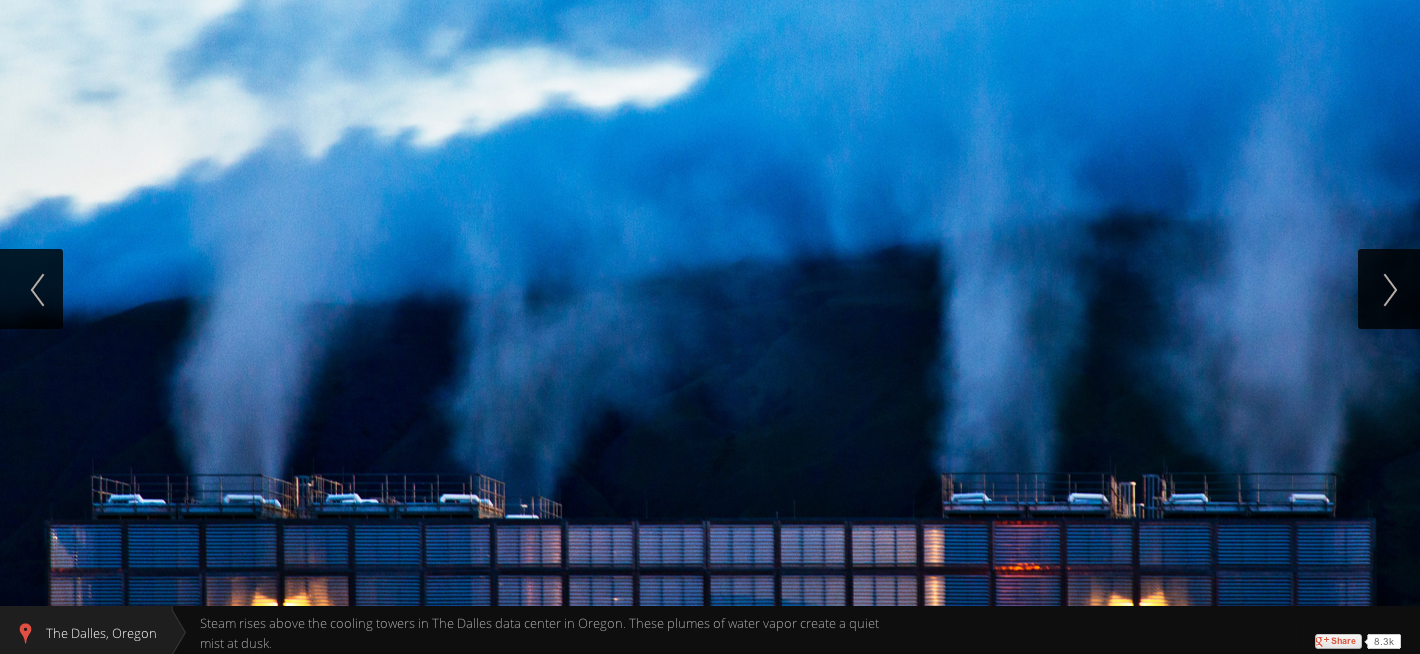
There are no clouds, just data centres. But suddenly they tickled the science-fictional nerve again when Google released its “inside view” to their factories of data: it has colours! The rather glitzy pictures showed this seeming transparency and the spatial sense of data management. Besides space, it’s about the elements. Air, water plays a crucial role.

In a great phrase in Andrew Blum’s book Tubes, a Facebook data centre manager (Ken Pratchett) sums it up: “This has nothing to do with clouds. It has everything to do with being cold.” Cool, cold data is not just a linguistic or visual metaphor, despite that elegant modernism that still lives inside the architectures of data places: Mondrian as data. Instead, it has to do with climate control. Ecology. Air. Coolness is not a media theoretical attitude in this context but a media management issue that ties the earth to the escape velocity of data.
Data needs air. “Cool outside air is let into the building through adjustable louvers near the roof; deionized water is sprayed into it; and fans push the conditioned air down onto the data center floor” , explains Blum. Coolness of cyberpunk transforms into coolness of building’s climate control. Fans surround the terabytes of data. Pratchett continues about the building: “The air hits this concrete floor and roils left and right. This whole building is like the Mississippi River. There’s a huge amount of air coming in, but moving really slowly.”
It’s important to notice the persistence of issues of ecology from air to the soil as well as non-cognitive work: that we still talk of factories and rather physical processes having to do with our hardware and how we manage and work with data in its material level.
Blum: “The cloud is a building. It works like a factory. Bits come in, they get massaged and put together in the right way and sent out.”
A different sort of steam punk for the 21st century.
Media & Materiality: A New Issue of Artnodes
The new issue of Artnodes is dedicated to matter. In the wake of different discussions concerning new materialism, speculative realism, objects and processes, I am glad to see this issue out: it takes a more mediatic and experimental view to some of these theoretical themes! Thanks to Jamie Allen and Pau Alsina for getting it done and published.
The issue papers are in Spanish, Catalan and English.
My little text on “new materialism of dust” is a follow-up and extension of the one in Depletion Design. It continues the same theme, and now has inspired me to write a longer essay on dust that will be published in Russian as a stand-alone booklet. The English draft of that is available on Academia.edu.
Krems – A Teaching Gig
Imagine the title as a film title, a sort of an academic-action genre. In this case, it includes no high velocity chases, or submachine guns, but hopefully great students and good conversations. In other words, next weekend I am visiting Krems in Austria and teaching two half a day seminars. The first one is on Insect Media-related topics, the second day is more on Medianatures, ie. electronic waste and materiality.
More on the very cool MA in MediaArtHistories programme here. And soon to follow, another MA related notice but on our WSA new MA in Global Media Management!
Exhumation as Artistic Methodology
This is the short intro/intervention, from my second Transmediale 2012-talk on the Search for a Method-panel, organized by Timothy Druckrey, involving in addition to me Inke Arns, Siegfried Zielinski and Wolfgang Ernst. The images are from the Crystal World workshop, also Transmediale 2012.
In order to kick off the panel and discussions, we were asked to pick examples of current media artistic practices, and proceed from there.
My thoughts were soon obviously on some themes and problems that I had been occupied with. More or less, such have included speculative materialities, work often dealing with the various spectra of hearing and seeing, of light and sound, of electromagnetism; works that map the non-solid based materialities that are increasingly important in order to understand how bodies react, and are governed, managed, experienced, in urban and technological settings.
Hence, I might have wanted to address Will Schrimshaw’s Atmospheric Research and Subliminal Frequencies. To me, the project is a mapping of the subconscious affective, embodied states where architectural arrangements are as important as the informational ecology; it maps the events that happen below the threshold of consciousness, for instance through ambient light as a regulator of “hormone secretion, body temperature, sleep and alertness”. As such, it is a practice based excavation into the physiological and technological constitution of experience, but also the possibilities of producing and governing experience; something related to my earlier talk on the “media archaeology of cognitive capitalism”.
Or then, another possibility would be to have looked at the various projects and the work of Critical Engineer, as expressed by Julian Oliver, in the manifesto co-written with Gordan Savičić and Danja Vasiliev. The notion of the artist-engineer might not be new, having a longer history in terms of media arts, but at the same time the manifesto and works capture something crucial about the methodology of such a practitioner, through an expanded understanding of what the machine is (across devices, bodies, agents, forces and networks, as the Manifesto lists) and how that expanded notion of the machine lends itself to a work of exposing; imbalance and deception become driving forces in a mapping of such relations, often in work that engages with wireless network technologies, rethinking visual and urban media, and more. The various projects at Weise7/Labor8 exhibition downstairs, at Transmediale 2012, are good examples.
Without being just software studies, such Critical Engineering engages with code, but in the manner how it regulates, governs, manages and in the right hands, distorts, perverts, misguides, cheats. This list that sounds a whole lot like from Matthew Fuller’s and Andy Goffey’s evil media theory.
So far, the two themes that emerge show the need to 1) account for such materialities that are not directly, necessarily humanly perceptible but completely real; and 2), the need to account for practices of perversion. Altering and corrupting as more interesting technical methods than just the smooth operationality often mistaken as the essence of technological practices.
Instead, I want to briefly to mention the work of Microresearch Lab/Martin Howse, Jonathan Kemp and Ryan Jordan, and especially the 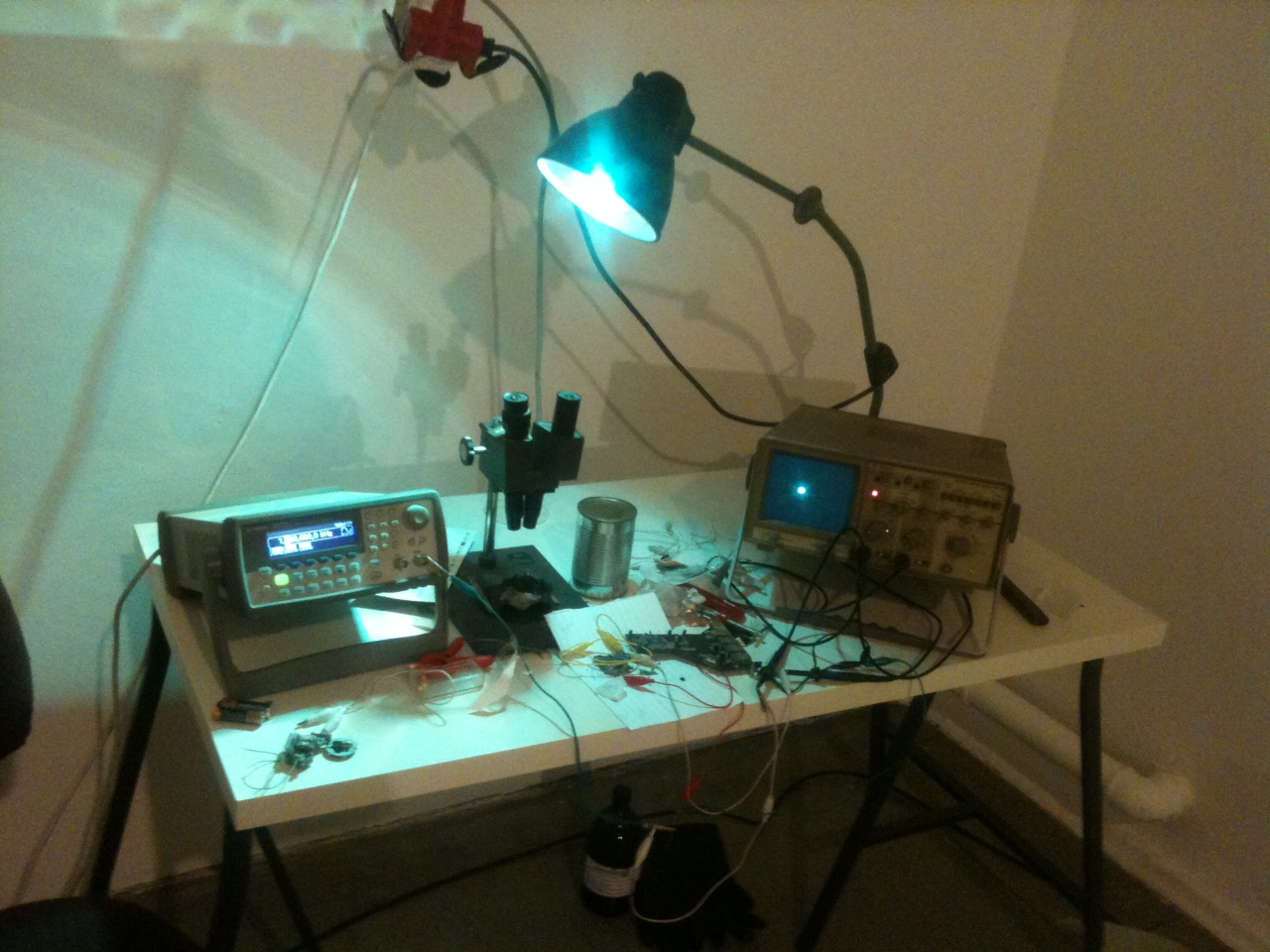 Recrystallization and Decrystallization workshops that took place in London and Berlin last year, and now during Transmediale The Crystal World Open laboratory.
The workshops used various methods to crack open and chemically process information technology in order to expose and address such constitutive processes what referred to as crystallisation. The term was partly adopted from J.G.Ballard, continuing an even earlier style of artistic practice of the Microresearch Lab, where software and hardware practices find a resonance with fiction, paranoid, speculative narratives of writers such as Thomas Pynchon (always dear to anyone interested in the 20th century articulations of power, science and engineering). As for crystallisation, with a nod towards Ballard indeed, the notion of the crystal becomes a conceptual lead in terms of a speculative materialism, described in these words:
“recrystallization was convened around the premise that while life itself starts from aperiodic crystals that encode infinite futures within a small number of atoms, the digital crystallization of the flesh by capital limits these futures to the point of exhaustion.
If computers and the minerals from which they are made are considered as equally crystalline, then their recrystallization is only possible through the introduction of vigorous and noisy positive feedback loops. “

In terms of media art histories, dead media and other theoretical and methodological approaches, the work of de- and recrystallization involved such techniques as “earth computing, mineral precipitation, high heat synthetic geology and inductive crystallography, DIY semi-conductor fabrication, water crystal cryptography, anthropocenic fossilizations, kirlian photography, hi-voltage fulgurite construction ”; Listing such, however, one however has to note quite soon that well, it is not exactly media archaeology as we used to think about it. Having said that, the notion of media archaeology in creative computing and related perspectives is taking us increasingly to such techniques as computer forensics, digital archaeology, and other modes of disgorging machines where art practices meet up with DIY and perhaps indeed critical engineering.
Speculative (media) archaeologies work crudely – but crude only in the sense of hacking open, disgorging, salvaging, melting, chemically processing in order to extract the minerals and such that on a material level compose our information technology. With an increasing political economic interest in the long networks of media production and discarded media, we have a better spatial understanding of the grim labour, electronic waste and other neo-colonialist emphasis of digital economy. The workshops tapped into this field directly as well, using such practices that mimicked human labour in extraction of valuable components and material from abandoned technology. What I want to propose is that such projects are emblematic of speculative media archaeologies and such artistic practices that combine a poetic-technological take on deep times, but ones that are such in a material sense too – not just written histories, but archaeologies of soil and history of the earth. Such speculative crypto histories of the earth refer to the concrete sedimentations of minerals and rocks, that act as re-sources for further development.
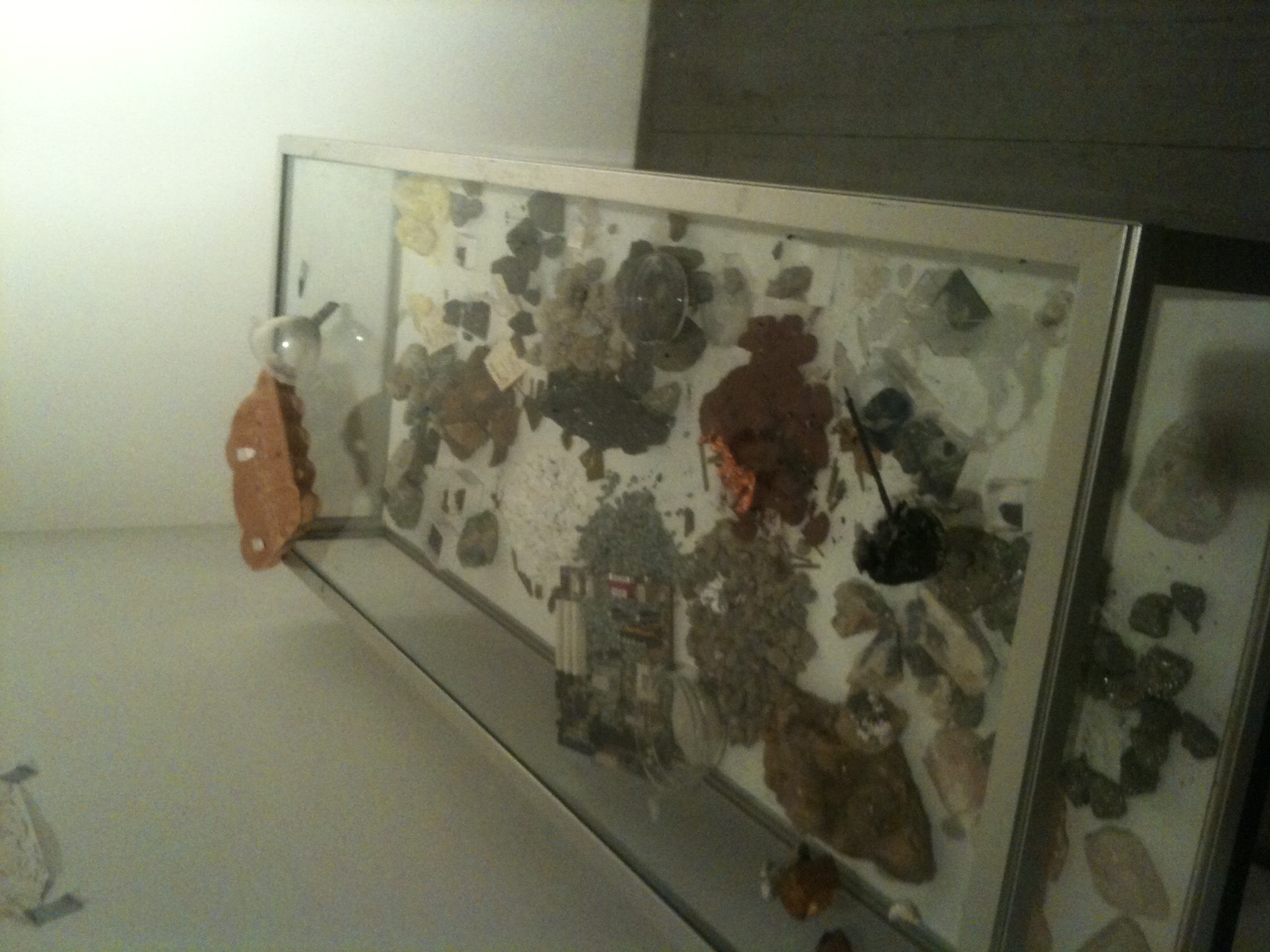
The Crystal World mineral cabinet
Where such methods fit in terms of media art vocabularies might remain unclear, but it is certain that they extend the practices often discussed in media art (histories) into a resonance with speculative materialism, new materialism, media archaeology but executed in highly original ways. We can talk of crystal materialities; materialities of minerals, information technology, and materialities of dangerous inhuman labour.
Indeed, to briefly elaborate on “exhumation” as a parallel concept to that more often mentioned of autopsy (also voiced by Tim Druckrey in his opening words) I will make a detour through Reza Negarestani. Cyclonopedia – a work of theory-fiction – speculates about the petropolitical deep layer, the living soil of Middle east, and we can point towards the work of Microresearch lab and these workshops as chemical and material deep layers that go two ways: not just the route of media archaeology interested in obsolescence, abandoned tech, and things old; but the other sort of descent too, to adopt Michel Foucault’s idea, perhaps implicitly part of some methodologies of media art histories and media archaeology. I am referring to a descent inside the machine, into the technical infrastructures, layers, city-like scapes of circuits and components. This kind of technical exposes a material, abstract level of connections, affordances and capacities. In such a methodology, the topology extends across materialities –from the fictional narrativisation to the hardware materiality and the long duration of mineral elements that entangle with that of human energy exploited for the excavation.
As a topological figure, and interested in this poetic and speculative materialism, allow me to end through a longer reference to Negarestani. What if such speculative media archaeologies and artistic methodologies are something that share methods with archaeologists but also with “cultists, worms and crawling entities”; not just a sublimated view of technological progress, but an interested in scars and half-lifes, of multiplication of surfaces, and creation of vermiculation; a new hole into solid, contained bodies of consumer technology.
“If archeologists, cultists, worms and crawling entities almost always undertake an act of exhumation (surfaces, tombs, cosmic corners, dreams, etc.), it is because exhumation is equal to ungrounding, incapacitating surfaces ability to operate according to topologies of the whole, or on a mereotopological level. In exhumation, the distribution of surfaces is thoroughly undermined and the movements associated with them are derailed; the edge no longer belongs to the periphery, anterior surfaces come after all other surfaces, layers of strata are displaced and perforated, peripheries and the last protecting surfaces become the very conductors of invasion. Exhumation is defined as a collapse and trauma introduced to the solid part by vermiculate activities; it is the body of solidity replaced by the full body of trauma. As in disinterment — scarring the hot and cold surfaces of a grave — exhumation proliferates surfaces through each other. Exhumation transmutes architectures into excessive scarring processes, fibroses of tissues, membranes and surfaces of the solid body.”
This transmutation, and distribution of new surfaces is where such familiar notions of art and culture theory vocabulary as trauma are transported into material methodologies in order to excavate the stratification of such as part of mixed materials. The “novel crystal earth geologies” extend the work of material recovery and reuse into “psychophysical distortions and contingencies” in a gesture which elaborates an enthusiasm for multiple ecologies. Media art practices that are not merely to be fitted into media art histories and genres, but themselves create new openings to times and spaces of media objects, components, times.







 Machinology