Archive
Photochemical Smog as New Media
Perhaps photochemical smog is the only true new visual media of post World War II technological culture. It represents the high achievements in science and technology, combined with (synthetic) chemistry and sunlight. It modulates the light like advanced visual media should and embeds us in its augmented reality as we suck it into our lungs.
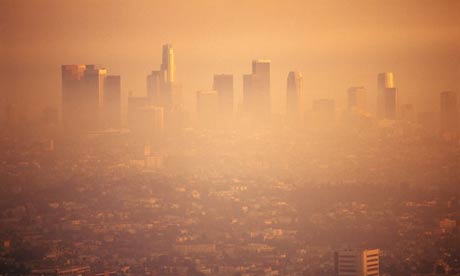 It encapsulates the mediatic cities of Los Angeles and Beijing, as encompassing surely as Hollywood’s machinery. Just like the material basis of technical media of more conventional kind – such as photography and film – it is chemical based. It is media the same as any photochemical process is about how light gets absorbed on our planet’s atoms and molecules.
But it’s new media, particular to the modern industrial age and the chemical reactions of more recent history. It feeds of industrial pollution and modern transport. It is about the screen as well – how the sunlight is offered this massive living chemical molecular screen on which to project its energetic images. A molecular aesthetics of an ecology of a dying planet.

The Anthropobscene: The Elemental Media Condition
Winchester School of Art are one of the partners of the transmediale-festival, which takes place again in January/February 2014 in Berlin. This short text below is a sort of a trailer to our bit for the event: the text is co-written by myself and Ryan Bishop and the the contribution to tm14 is likewise co-curated by us. The text gives an indication of some of the themes we will discuss during the festival and conference week, and it draws on some of our work on these topics: Ryan’s writing on the four elements and contemporary aesthetics, and my work-in-progress book project on “geology of media” and what I pitch as the anthropobscene – a new geological era catalysed by the corporate capitalist measures of depletion and exploitation.
Ryan Bishop and Jussi Parikka:
The Elemental Media Condition
Ever since such early geologists as James Hutton and Charles Lyell voiced a distance from biblical time, the Earth has had a proper history. The natural historical durations of the Earth have, despite academic disciplinary divisions, always intertwined with human history. In the current moment, the complex interactions of the two seem more prescient than ever. To follow in the footsteps of Dipash Chakrabarty, the horizon of the anthropocene forces historians to think of durations of nature as entangled with social history, and the historiographical functions of temporality need to be considered alongside such vectors that acknowledge the work of capitalism as a specific epoch. In this sense, we would like to refer not only to the anthropocene as the debated new geological era in scientific classification, but also what can be called the anthropobscene. This portmanteau word combines anthropocene with obscene, thus highlighting the vicious exploitative actions of corporations, governments and other agencies operating on different levels: from human individuals to multigovernmental organisations and transnational corporations. In much the same manner that Jean Baudrillard reconfigured the subject-object relationship placed within a scene as a network-screen relationship in the obscene, the anthropobscene reconstitutes the relationship between human scales of intervention into those of the geological. Thus, amongst other things, it refers to the obscenity of heavy pollution of the earth and the air, bringing back discussions of the four elements as found in the Pre-Socratic thinker Empedocles, whose writings strike both ancient and contemporary chords. Cultural theorists, such as Gary Genosko, have voiced an urgency for a renewed consideration of the elements.
For Empedocles, humans, nature and the universe contain the same elements. Flesh and blood are composed of approximately equal parts of earth, fire, water, and aether: the four elements that constitute the universe. The entire material world for Empedocles comes from the mixture and amounts of these four elements, the mixing of which he likens to paints on an artist’s palette with their different effects due to combinatory portions. This insight of multiple and diverse substances generated through combinations and proportionality becomes a cornerstone of modern science and chemistry. The harmony of Love and the discord of Strife result from the proportionality of the elements with each constantly changing and warring with the others. The Empedoclean elements of this cosmogony and in nature constitute both media and content. They make, transform and destroy at the same time.
Empedocles’ writings use physics to derive an understanding of ethico-political, even moral, laws. In the teaching of Empedocles the problem of substances as they present themselves to us takes a specific form: how do the Many come from One and One from Many? The primary and ultimately determinate forces behind the various manipulations, combinations and transformations of the elements in Empedocles are in the standard translations Love and Strife, which move in cycles of harmony and disharmony that reign over all of nature, including humans, fish, beasts and birds. But the elements are not simply passive recipients of the forces of Love and Strife. They can and do themselves act as causal agents, influencing the waxing or waning of Love or Strife.
Contemporary media culture can be opened up through such a consideration of elements. Indeed, as the philosopher Erich Hörl has argued, the technological is one crucial condition for the discourse – and practical existence – of this hypothetical anthroposcene – and anthropobscene, we might add. For artists such as Robert Smithson in truly Empedoclean fashion, the tectonic realms of the Earth and the mind are interconnected. Smithson’s account amounts to a critique of the McLuhan-focussed idea of technology as extensions of Man. Instead, for Smithson, writing in 1968 in Artforum, it is elemental. One is here tempted to think it is elemental in the sense of the Pre-Socratic four elements, as well as elemental in the sense that those elements are more crucial than ever for a consideration of the biopolitical condition. Such aspects range from the materiality of data mining to environmental exploitation.
Deep Times and Geology of Media
“Yes I will” – “No, it is not something worthwhile”.
I’ve been going back and forth for a while whether I will try to expand my ideas concerning “geology of media” into some sort of a book or not. Without having reached a conclusion, I have however been giving talks on the topic the past times. Here is one – as video – from Bochum from the very good General Ecology-event Erich Horl organised.
“We have never been human”
“We have never been human: between animality and techne” is the new special issue of Angelaki. It is released just now and features a range of exciting articles –  thanks to Ron Broglio for his work in getting this edited together.
I wrote a piece with a bizarre title “Insects and canaries” that has a certain sense of hybridity to it. It even started as one word, Insectcanaries (see also, Spiderpig).
More seriously, it is about visual and non-visual cultures of the eco crisis, and aesthetic epistemologies and ontologies of it all. It also elaborates on the term “medianatures” that I have been using recently. An abstract below.
This text focuses on how to think the visual culture of disappearance – more closely, disappearance of animals. It takes as its starting point the Ernst Jünger novel The Glass Bees from 1957 in order to start an excavation into obsolescence, animals and the ecological crisis. The aesthetic themes of visibility/invisibility are entangled with the ecological questions of disappearance and pollution. This sort of media ecological question is unravelled, furthermore, with examples concerning the mass extinction of bees, also discussed in Lenore Malen’s video installation The Animal That I Am (2009–10). In this way, it argues for a media theoretical understanding of the visual culture of ecocrisis as well as the complex question of epistemology of such a visibility/invisibility.
The Air of Data: An Alternative Steampunk
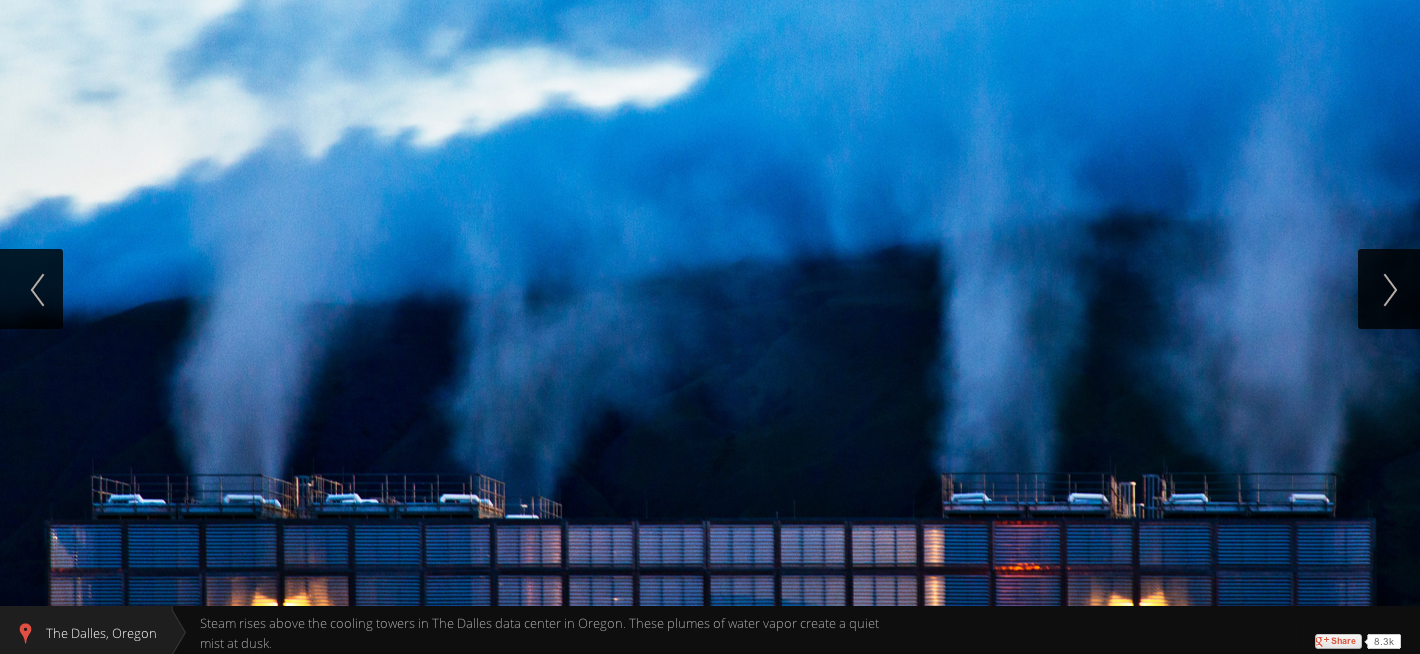
There are no clouds, just data centres. But suddenly they tickled the science-fictional nerve again when Google released its “inside view” to their factories of data: it has colours! The rather glitzy pictures showed this seeming transparency and the spatial sense of data management. Besides space, it’s about the elements. Air, water plays a crucial role.

In a great phrase in Andrew Blum’s book Tubes, a Facebook data centre manager (Ken Pratchett) sums it up: “This has nothing to do with clouds. It has everything to do with being cold.” Cool, cold data is not just a linguistic or visual metaphor, despite that elegant modernism that still lives inside the architectures of data places: Mondrian as data. Instead, it has to do with climate control. Ecology. Air. Coolness is not a media theoretical attitude in this context but a media management issue that ties the earth to the escape velocity of data.
Data needs air. “Cool outside air is let into the building through adjustable louvers near the roof; deionized water is sprayed into it; and fans push the conditioned air down onto the data center floor” , explains Blum. Coolness of cyberpunk transforms into coolness of building’s climate control. Fans surround the terabytes of data. Pratchett continues about the building: “The air hits this concrete floor and roils left and right. This whole building is like the Mississippi River. There’s a huge amount of air coming in, but moving really slowly.”
It’s important to notice the persistence of issues of ecology from air to the soil as well as non-cognitive work: that we still talk of factories and rather physical processes having to do with our hardware and how we manage and work with data in its material level.
Blum: “The cloud is a building. It works like a factory. Bits come in, they get massaged and put together in the right way and sent out.”
A different sort of steam punk for the 21st century.
Depletion Design
A collection that looks really exciting: Depletion Design: A Glossary of Network Ecologies, edited by Carolin Wiedemann & Soenke Zehle. I was happy to be involved with a tiny text on dust and new materialism. A lot of my recent writing and interests have had to do with depletion, exhaustion, and things dead or discarded – as with zombie media. More things (texts) grim and grey forthcoming.
You can download the book here. Below a blurb about its contents.
“We, or so we are told, are running out of time, of time to develop alternatives to a new politics of emergency, as constant crisis has exhausted the means of a politics of representation too slow for the state of exception, too ignorant of the distribution of political agency, too focused on the governability of financial architectures. But new forms of individual and collective agency already emerge, as we learn to live, love, work within the horizon of depletion, to ask what it means to sustain ourselves, each other, again. Of these and other knowledges so created, there can no longer be an encyclopedia; a glossary, perhaps.”
Contributors: Marie-Luise Angerer (Cyborg), Franco ‘Bifo’ Berardi (Exhaustion, Soul Work), David M. Berry (On Terminality), Zach Blas (Queer Darkness), Drew S. Burk (Grey Ecology), Gabriella Coleman (Anonymous), Heidi Rae Cooley (Ecologies of Practice), Sebastian Deter- ding (Playful Technologies, Persuasive Design), Jennifer Gabrys (Natural History, Salvage), Johannes Grenzfurthner & Frank A. Schneider (Hackerspace), Eric Kluitenberg (Sustainable Immobility), Boyan Manchev (Disorganisation, Persistence), Lev Manovich (Software), Sonia Matos (Wicked Problems), Timothy Morton (Ecology without Nature), Jason W. Moore (Cri- sis), Anna Munster (Digital Embodiment), Brett Neilson (Fracking), Sebastian Olma (Biopoli- tics, Creative Industries, Vitalism), Luciana Parisi (Algorithmic Architecture), Jussi Parikka (Dust Matter), Judith Revel (Common), Ned Rossiter (Dirt Research), Sean Smith (Informa- tion Bomb), Hito Steyerl (Spam of the Earth).
An Interview with Martin Howse
This is another interview, and audio recording now available, that I did in Berlin in 2011. It is my chat with Martin Howse, of microresearch, and the project(s) together with Jonathan Kemp and Ryan Jordan: decrystallisation, recrystallisation and the later Crystal Worlds in Berlin and London. We talk of what the crystal project means, ideas related to art methods, and ending up with evil media.
Related readings of The Crystal World exhibition: Howse and Kemp in Mute Magazine, and Matthew Fuller in the same magazine: “The Garden of Earthly Delights.”
Apologies for a bit lousy quality of the sound in my recording.
A Call for An Alternative Deep Time of the Media
I am here recapping some ideas from an earlier post, but I wanted to flag this as a separate theme…
I want to pick up on Siegfried Zielinski’s notion of deep time of the media — not straightforwardly media archaeological, but an anarchaeological call for methodology of deep time research into technical means of hearing and seeing. In Zielinski’s vision, which poetically borrows from Stephen Jay Gould’s paleontological epistemology at least in its vision, the superficiality of media cultural temporality is exposed with antecedents, hidden ideas, false but inspiring paths of earlier experimenters from Empedocles to Athanius Kircher, Johann Wilhelm Ritter to Cesare Lombroso.
Zielinski’s excavations are not content to stay within the regime of media archaeology, but want to uncover a non-linear layering of variations. Indeed, in a manner that seems to be borrowing from a Deleuze-Guattarian ontology of nomadism and the primacy of variation (I don’t however think that Z makes the link to DG explicit), Zielinski’s methodology is in this sense a refusal of any master plans of media development and a plea against both the drive towards psychopathia medialis (the standardization and uniformity as well as illusions of teleology). Instead, the paleontological conceptualisation of a media history of variations finds surprising case studies of aberrants paths for hearing and seeing, of optics and acoustics, of technical means of guiding, misguiding, educating and mocking the senses.
And yet, as an alternative deep time, I suggest that instead of male heroes, we approach a more geologically tuned deep time – deep in various senses, down to mineral excavation, and picking up some themes of media ecological sort. I want to speculate with a more geologically oriented notion of depth of media that is interested in truly deep times – of thousands, millions, billions of years and in depth of the earth; A media excavation into the mineral and raw material basis of technological development, through which to present some media historical arguments as to how one might adopt a material perspective in terms of ecological temporality.
For instance for the European Union, the future of information technology has to be planned starting from a material level up: The EU does not hold much in terms of critical raw material resources when it comes to advanced technology that are identified crucial for a longer term socio-economic change. Obviously, such issues are always voiced with a concern for the geopolitical-economic consequences. In short, this refers to the crucial status of China, Russia, Brazil, Congo and for instance South-Africa as producers of raw materials, and an alternative material future of technological culture. This connects to a realisation: the materiality of information technology starts from the soil, and underground – 500 meters, and preferably (for the mining companies) lower as the earth’s crust is dozens of kilometres deep.
Cobalt —- Lithium-ion batteries, synthetic fuels
Gallium —- Thin layer photovoltaics, IC, WLED
Indium —– Displays, thin layer photovoltaics
Tantalum —- Micro capacitors, medical technology
Antimony —– ATO, micro capacitors
Germanium —– Fibre optic cable, IR optical technologies
Niobium —– Micro capacitors, ferroalloys
Neodymium —- Permanent magnets, laser technology[1]
From animals to nature as a resource, a material ecology for media is an increasingly important topic. This is the double bind that relates media technologies to ecological issues; on the one hand, acting as raw material for the actual hardware, from cables to cell phones; on the other hand, as an important epistemological framework whether in relation to mapping of climate change or in terms of further resources for exploitation, as in the recent proposal not just for Internet of Things – but Internet of Underwater Things.
Perhaps an alternative sort of a deep time of the media is needed – one that does not excavate deep times of human inventions, successful or just imagined, but deep times of animal and geological sort, and the cultural techniques that are affiliated with such non-human regimes? This could be a further advance to consolidate the work of media ecology and zootechnics (cf. Sebastian Vehlken’s recent work in this area, as well as Insect Media).
[1] European Union Critical Raw Materials Analysis, By the European Commission Raw Materials Supply Group, July 30, 2010. Executive Summary by Swiss Metal Assets, October 1, 2011, under www.swissmetalassets.com (24.7.2012).
Zombie Media in Leonardo
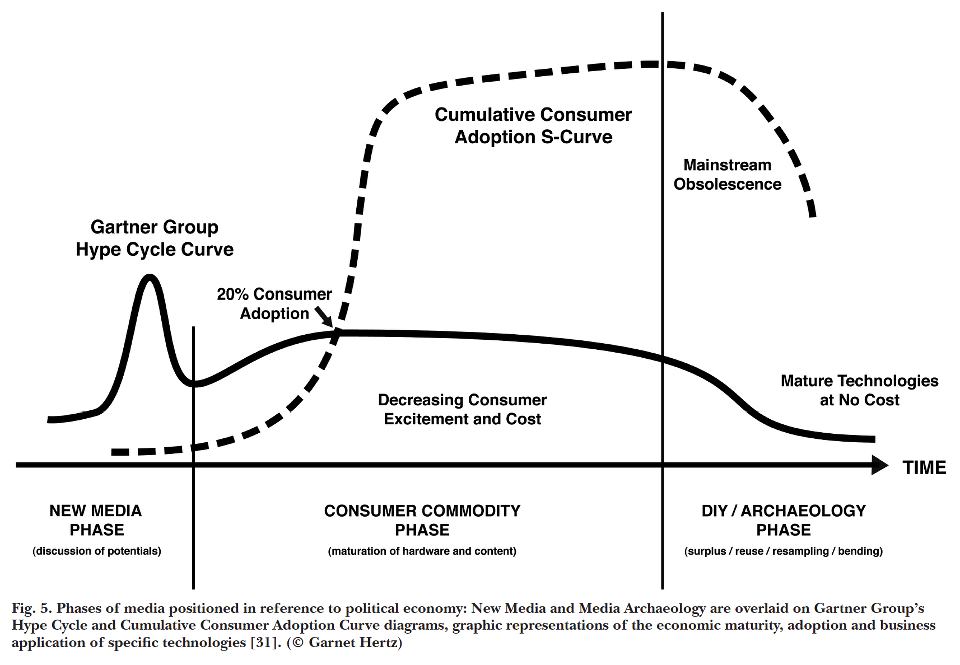
The circuit bended and definitely (re)modified fruits of our collaboration with Garnet Hertz are out. True, “Zombie Media” has been circulating as an unborn living dead text for a longer while, ever since it was part of the Transmediale 2010 Theory Award competition — but now it is finally officially out in Leonardo (vol. 45, no 5)!
Working with someone like Garnet is a pure joy, and demonstrates why collaboration is good for you: you learn a lot. A lot lot.
As a teaser to the longer “Zombie Media: Circuit Bending Media Archaeology into an Art Method”-article, please find below the short “manifesto” on “Five Principles of Zombie Media” we co-wrote for the Defunct/Refunct-catalogue (PDF).
———-
Zombie media addresses the living deads of media culture. As such, it is clearly related
to the earlier calls to investigate “dead media” by Bruce Sterling and others: to map
the forgotten, out-of-use, obsolete and declared dysfunctional technologies in order
to understand better the nature of media cultural development. And yet, we want to
point to a further issue when it comes to abandoned media: the amount of discarded
electronic media is not only the excavation ground for quirky media archaeological
interests, but one of the biggest threats for ecology in terms of the various toxins they
are leaking back to nature. A discarded piece of media technology is never just discarded
but part of a wider pattern of circulation that ties the obsolete to recycling centers,
dismantling centres in Asia, markets in Nigeria, and so forth – a whole global political
ecology of different sorts where one of the biggest questions is the material toxicity of
our electronic media. Media kills nature as they remain as living deads.
Hence, we believe that media archaeology – the media theoretical stance interested
in forgotten paths and quirky ideas of past media cultures – needs to become more
political, and articulate its relation to design practices more clearly. We are not the only
ones that have made that call recently – for instance Timothy Druckrey writes:
“The mere rediscovery of the forgotten, the establishment of oddball paleontologies, of
idiosyncratic genealogies, uncertain lineages, the excavation of antique technologies or
images, the account of erratic technical developments, are, in themselves, insufficient to
the building of a coherent discursive methodology.” [2]
We would want to add that in addition to developing discursive methodologies, we
need to develop methodologies that are theoretically rich as well as practice-oriented –
where ontologies of technical media meet up with innovative ideas concerning design
in an ecological context.
As such, the other part of the zombie media call is the work of reappropriation
through circuit bending and hardware hacking methodologies – to extend the media
archaeological as well as ecosophic interest into design issues. By actively repurposing
things considered dead – things you find from your attic, the second hand market, or
amongst waste – the zombiefication of media is to address the planned obsolescence of
media technologies which is part of their material nature. In reference to contemporary
consumer products, planned obsolescence takes many forms. It is not only an ideology,
or a discourse, but more accurately takes place on a micropolitical level of design:
difficult to replace batteries in personal MP3 audio players, proprietary cables and
chargers that are only manufactured for a short period of time, discontinued customer
support, or plastic enclosures impossible to open without breaking them. Whether you
can open up things – the famous black boxes of media culture characterized by iPhones
and iPads – is one of the biggest political and ecological questions facing our media
theory and practices too.
As a manifesto, five points of zombie media stand out:
1/ We oppose the idea of dead media. Although death of media may be useful as a tactic to
oppose dialog that only focuses on the newness of media, we believe that media never
dies. Media may disappear in a popular sense, but it never dies: it decays, rots, reforms,
remixes, and gets historicized, reinterpreted and collected. It either stays as a residue
in the soil and in the air as concrete dead media, or is reappropriated through artistic,
tinkering methodologies.
2/ We oppose planned obsolescence. As one corner stone in the mental ecology of
circulation of desires, planned obsolescence maintains ecologically unsupportable
death drive that is destroying our milieus of living.
3/ We propose a depunctualization of media and the opening, understanding and hacking
of concealed or blackboxed systems: whether as consumer products or historical
archives.
4/ We propose media archaeology as an artistic methodology that follows in the traditions
of appropriation, collage and remixing of materials and archives. Media archaeology
has been successful in excavating histories of dead media, forgotten ideas, sidekicks and
minor narratives, but now its time to develop it from a textual method into a material
methodology that takes into account the political economy of contemporary media
culture.
5/ We propose that reuse is an important dynamic of contemporary culture, especially
within the context of electronic waste. “If it snaps shut, it shall snap open.” We agree in
that open and remix culture should be extended to physical artifacts.
Exhumation as Artistic Methodology
This is the short intro/intervention, from my second Transmediale 2012-talk on the Search for a Method-panel, organized by Timothy Druckrey, involving in addition to me Inke Arns, Siegfried Zielinski and Wolfgang Ernst. The images are from the Crystal World workshop, also Transmediale 2012.
In order to kick off the panel and discussions, we were asked to pick examples of current media artistic practices, and proceed from there.
My thoughts were soon obviously on some themes and problems that I had been occupied with. More or less, such have included speculative materialities, work often dealing with the various spectra of hearing and seeing, of light and sound, of electromagnetism; works that map the non-solid based materialities that are increasingly important in order to understand how bodies react, and are governed, managed, experienced, in urban and technological settings.
Hence, I might have wanted to address Will Schrimshaw’s Atmospheric Research and Subliminal Frequencies. To me, the project is a mapping of the subconscious affective, embodied states where architectural arrangements are as important as the informational ecology; it maps the events that happen below the threshold of consciousness, for instance through ambient light as a regulator of “hormone secretion, body temperature, sleep and alertness”. As such, it is a practice based excavation into the physiological and technological constitution of experience, but also the possibilities of producing and governing experience; something related to my earlier talk on the “media archaeology of cognitive capitalism”.
Or then, another possibility would be to have looked at the various projects and the work of Critical Engineer, as expressed by Julian Oliver, in the manifesto co-written with Gordan Savičić and Danja Vasiliev. The notion of the artist-engineer might not be new, having a longer history in terms of media arts, but at the same time the manifesto and works capture something crucial about the methodology of such a practitioner, through an expanded understanding of what the machine is (across devices, bodies, agents, forces and networks, as the Manifesto lists) and how that expanded notion of the machine lends itself to a work of exposing; imbalance and deception become driving forces in a mapping of such relations, often in work that engages with wireless network technologies, rethinking visual and urban media, and more. The various projects at Weise7/Labor8 exhibition downstairs, at Transmediale 2012, are good examples.
Without being just software studies, such Critical Engineering engages with code, but in the manner how it regulates, governs, manages and in the right hands, distorts, perverts, misguides, cheats. This list that sounds a whole lot like from Matthew Fuller’s and Andy Goffey’s evil media theory.
So far, the two themes that emerge show the need to 1) account for such materialities that are not directly, necessarily humanly perceptible but completely real; and 2), the need to account for practices of perversion. Altering and corrupting as more interesting technical methods than just the smooth operationality often mistaken as the essence of technological practices.
Instead, I want to briefly to mention the work of Microresearch Lab/Martin Howse, Jonathan Kemp and Ryan Jordan, and especially the 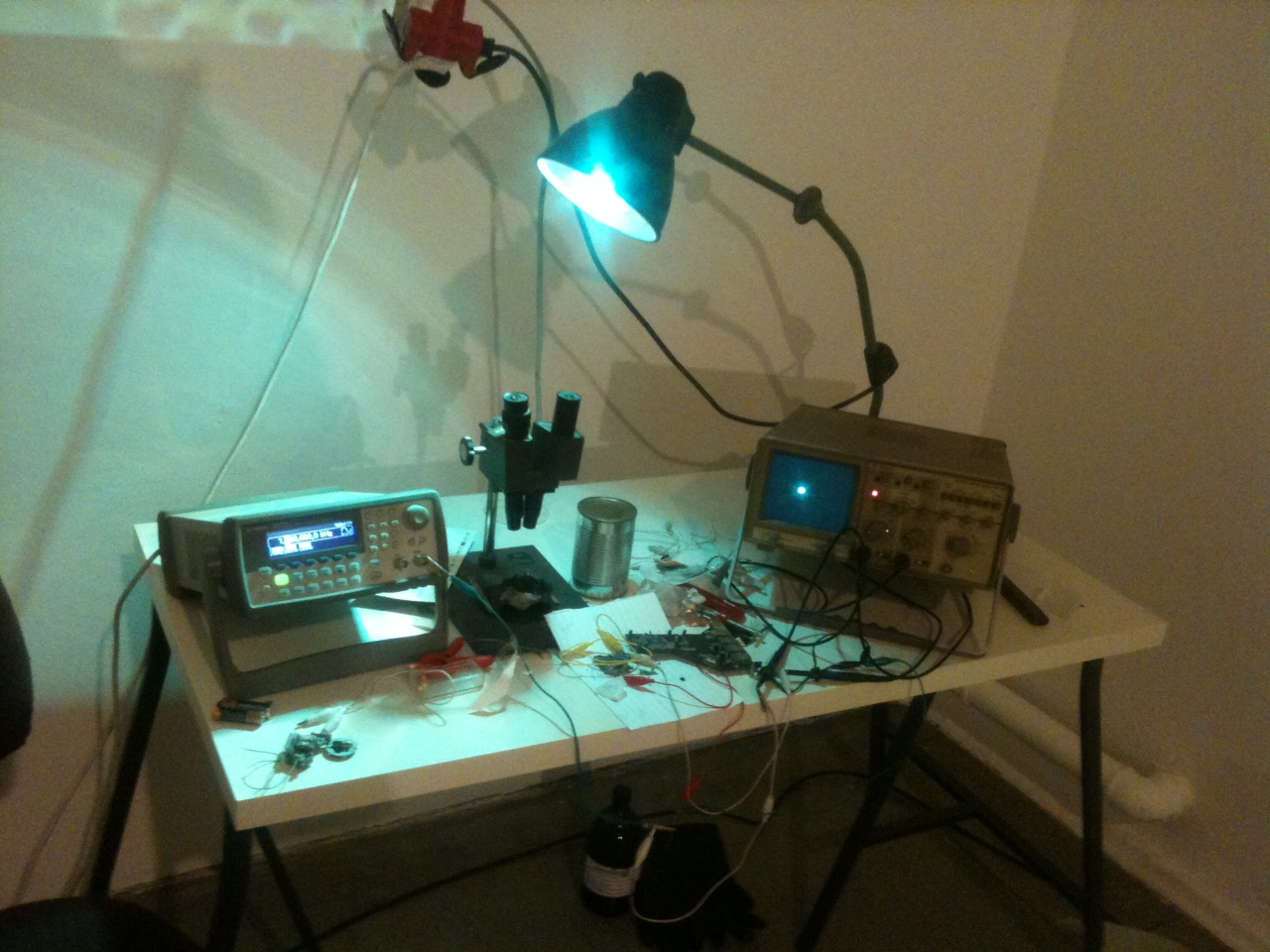 Recrystallization and Decrystallization workshops that took place in London and Berlin last year, and now during Transmediale The Crystal World Open laboratory.
The workshops used various methods to crack open and chemically process information technology in order to expose and address such constitutive processes what referred to as crystallisation. The term was partly adopted from J.G.Ballard, continuing an even earlier style of artistic practice of the Microresearch Lab, where software and hardware practices find a resonance with fiction, paranoid, speculative narratives of writers such as Thomas Pynchon (always dear to anyone interested in the 20th century articulations of power, science and engineering). As for crystallisation, with a nod towards Ballard indeed, the notion of the crystal becomes a conceptual lead in terms of a speculative materialism, described in these words:
“recrystallization was convened around the premise that while life itself starts from aperiodic crystals that encode infinite futures within a small number of atoms, the digital crystallization of the flesh by capital limits these futures to the point of exhaustion.
If computers and the minerals from which they are made are considered as equally crystalline, then their recrystallization is only possible through the introduction of vigorous and noisy positive feedback loops. “

In terms of media art histories, dead media and other theoretical and methodological approaches, the work of de- and recrystallization involved such techniques as “earth computing, mineral precipitation, high heat synthetic geology and inductive crystallography, DIY semi-conductor fabrication, water crystal cryptography, anthropocenic fossilizations, kirlian photography, hi-voltage fulgurite construction ”; Listing such, however, one however has to note quite soon that well, it is not exactly media archaeology as we used to think about it. Having said that, the notion of media archaeology in creative computing and related perspectives is taking us increasingly to such techniques as computer forensics, digital archaeology, and other modes of disgorging machines where art practices meet up with DIY and perhaps indeed critical engineering.
Speculative (media) archaeologies work crudely – but crude only in the sense of hacking open, disgorging, salvaging, melting, chemically processing in order to extract the minerals and such that on a material level compose our information technology. With an increasing political economic interest in the long networks of media production and discarded media, we have a better spatial understanding of the grim labour, electronic waste and other neo-colonialist emphasis of digital economy. The workshops tapped into this field directly as well, using such practices that mimicked human labour in extraction of valuable components and material from abandoned technology. What I want to propose is that such projects are emblematic of speculative media archaeologies and such artistic practices that combine a poetic-technological take on deep times, but ones that are such in a material sense too – not just written histories, but archaeologies of soil and history of the earth. Such speculative crypto histories of the earth refer to the concrete sedimentations of minerals and rocks, that act as re-sources for further development.
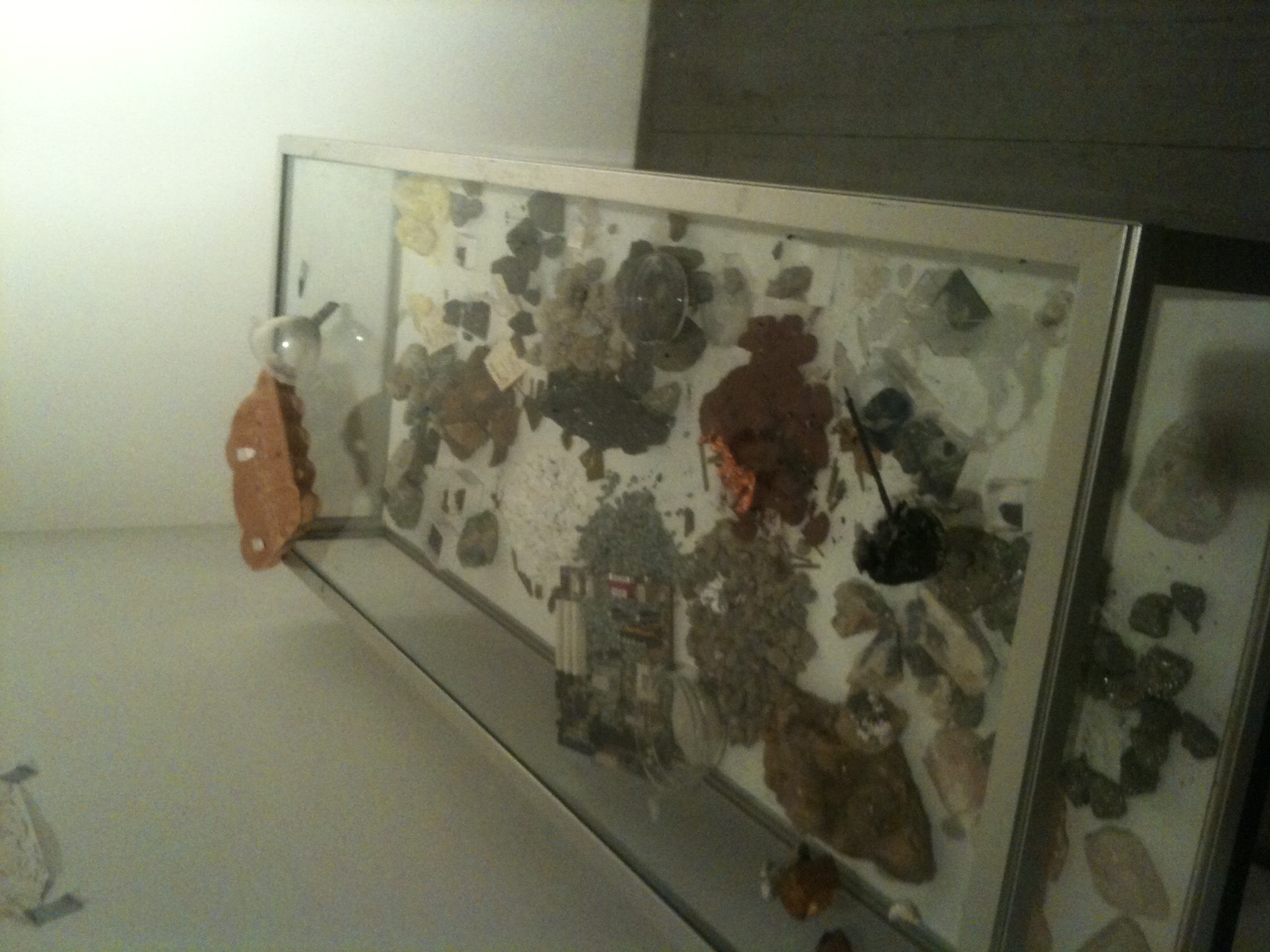
The Crystal World mineral cabinet
Where such methods fit in terms of media art vocabularies might remain unclear, but it is certain that they extend the practices often discussed in media art (histories) into a resonance with speculative materialism, new materialism, media archaeology but executed in highly original ways. We can talk of crystal materialities; materialities of minerals, information technology, and materialities of dangerous inhuman labour.
Indeed, to briefly elaborate on “exhumation” as a parallel concept to that more often mentioned of autopsy (also voiced by Tim Druckrey in his opening words) I will make a detour through Reza Negarestani. Cyclonopedia – a work of theory-fiction – speculates about the petropolitical deep layer, the living soil of Middle east, and we can point towards the work of Microresearch lab and these workshops as chemical and material deep layers that go two ways: not just the route of media archaeology interested in obsolescence, abandoned tech, and things old; but the other sort of descent too, to adopt Michel Foucault’s idea, perhaps implicitly part of some methodologies of media art histories and media archaeology. I am referring to a descent inside the machine, into the technical infrastructures, layers, city-like scapes of circuits and components. This kind of technical exposes a material, abstract level of connections, affordances and capacities. In such a methodology, the topology extends across materialities –from the fictional narrativisation to the hardware materiality and the long duration of mineral elements that entangle with that of human energy exploited for the excavation.
As a topological figure, and interested in this poetic and speculative materialism, allow me to end through a longer reference to Negarestani. What if such speculative media archaeologies and artistic methodologies are something that share methods with archaeologists but also with “cultists, worms and crawling entities”; not just a sublimated view of technological progress, but an interested in scars and half-lifes, of multiplication of surfaces, and creation of vermiculation; a new hole into solid, contained bodies of consumer technology.
“If archeologists, cultists, worms and crawling entities almost always undertake an act of exhumation (surfaces, tombs, cosmic corners, dreams, etc.), it is because exhumation is equal to ungrounding, incapacitating surfaces ability to operate according to topologies of the whole, or on a mereotopological level. In exhumation, the distribution of surfaces is thoroughly undermined and the movements associated with them are derailed; the edge no longer belongs to the periphery, anterior surfaces come after all other surfaces, layers of strata are displaced and perforated, peripheries and the last protecting surfaces become the very conductors of invasion. Exhumation is defined as a collapse and trauma introduced to the solid part by vermiculate activities; it is the body of solidity replaced by the full body of trauma. As in disinterment — scarring the hot and cold surfaces of a grave — exhumation proliferates surfaces through each other. Exhumation transmutes architectures into excessive scarring processes, fibroses of tissues, membranes and surfaces of the solid body.”
This transmutation, and distribution of new surfaces is where such familiar notions of art and culture theory vocabulary as trauma are transported into material methodologies in order to excavate the stratification of such as part of mixed materials. The “novel crystal earth geologies” extend the work of material recovery and reuse into “psychophysical distortions and contingencies” in a gesture which elaborates an enthusiasm for multiple ecologies. Media art practices that are not merely to be fitted into media art histories and genres, but themselves create new openings to times and spaces of media objects, components, times.








 Machinology