Digital Memory and the Archive is out!
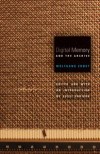
 Good news for the start of 2013: the volume of Wolfgang Ernst writings Digital Memory and the Archive is out! The book is soon available in bookstores. The collection that I edited is the first to introduce this very important German media theorist whose style of media archaeology is highly exciting and provocative. Ernst is one of the significant names in the German media studies landscape, and represents one of the directions where theory is going in the post-Friedrich Kittler world.
Ernst’s interest in media archaeology is very material, and insists on the agency of the machine. His theories are interested in material epistemologies and the operationality of old media devices. Media devices govern our ways of seeing and hearing, but also our modes of knowledge. Hence, Ernst’s media theory is a way to understand the change in our archival logic in software culture. But it’s not only about the digital and not only about archives. Indeed, his writings on the sonic and in general media arts are important insights into a meticulous material media theory that represents a unique way to understand the persistence of history and time. Ernst writes his theory through mediatic paths: from television to internet cultures, media arts to archival institutions, Hertzian discoveries to sound.
The collection has a longer introduction by me, as well as the section introductions that I wrote. Ernst was kind enough to write his own preface to this English edition of his writings where he pitches the idea of cross-Atlantic influences and meditation on what is happening in media studies at the moment. An inspiring read. Or in Wendy Chun’s words, quoting her endorsement:
“Digital Memory and the Archive offers the most compelling and insightful account published to date of how and why objects matter. Moving beyond textual analysis, its careful, theoretically rigorous engagement with the relic—the physicality of the archive—promises to change the direction of the digital humanities. Thanks to this book, we will all now be addressing the microtemporality of archives and the mechanics of remaining. Finally, a definitive collection in English of one of the most brilliant and influential media archaeologists.”
Below you will find the short blurb from the publisher University of Minnesota Press website as well as the table of contents.
In the popular imagination, archives are remote, largely obsolete institutions: either antiquated, inevitably dusty libraries or sinister repositories of personal secrets maintained by police states. Yet the archive is now a ubiquitous feature of digital life. Rather than being deleted, e-mails and other computer files are archived. Media software and cloud storage allow for the instantaneous cataloging and preservation of data, from music, photographs, and videos to personal information gathered by social media sites.
In this digital landscape, the archival-oriented media theories of Wolfgang Ernst are particularly relevant. Digital Memory and the Archive, the first English-language collection of the German media theorist’s work, brings together essays that present Ernst’s controversial materialist approach to media theory and history. His insights are central to the emerging field of media archaeology, which uncovers the role of specific technologies and mechanisms, rather than content, in shaping contemporary culture and society.
Ernst’s interrelated ideas on the archive, machine time and microtemporality, and the new regimes of memory offer a new perspective on both current digital culture and the infrastructure of media historical knowledge. For Ernst, different forms of media systems—from library catalogs to sound recordings—have influenced the content and understanding of the archive and other institutions of memory. At the same time, digital archiving has become a contested site that is highly resistant to curation, thus complicating the creation and preservation of cultural memory and history.
Contents of Wolfgang Ernst, Digital Memory and the Archive
Archival Media Theory: An Introduction to Wolfgang Ernst’s Media Archaeology , by Jussi Parikka
Media Archaeology as a Trans-Atlantic Bridge, Wolfgang Ernst
Part I. The Media Archaeological Method
1. Let There Be Irony: Cultural History and Media Archaeology in Parallel Lines
2. Media Archaeography: Method and Machine versus History and Narrative of Media
Part II. From Temporality to the Multimedial Archive
3. Underway to the Dual System: Classical Archives and Digital Memory
4. Archives in Transition: Dynamic Media Memories
5. Between Real Time and Memory on Demand: Reflections on Television
6. Discontinuities: Does the Archive Become Metaphorical in Multi-Media Space?
Part III. Microtemporal Media
7. Telling versus Counting: A Media-Archaeological Point of View
8. Distory: 100 Years of Electron Tubes, Media-Archaeologically Interpreted vis-à-vis 100 Years of Radio
9. Towards a Media Archaeology of Sonic Articulations
10. Experimenting Media‐Temporality: Pythagoras, Hertz, Turing
Appendix. Archive Rumblings: An Interview with Wolfgang Ernst , by Geert Lovink
WSA and transmediale partnership
Winchester School of Art, and our research centre in Global Futures is happy to announce a new partnership with the transmediale-organisation and festival in Berlin! This coming year’s theme is Back When Pluto Was a Planet (BWPWAP) and we are besides participating with a panel and a range of other talks also already thinking ahead to the future years with the great folks of tm. They have a great track record of working with universities, including Aarhus and now Leuphana. I could not be more excited about this link to Berlin – tm has been one of those festivals /conferences that get my mind actually working. And it’s socially such a good spot to catch up with lots of people. One of the most exciting things happening in our field of critical arts/media/practice/theory at the moment. And Berlin is great.
Below the more official press release.
WSA to collaborate with a leading European festival for art and digital culture
The Winchester School of Art (WSA) has formed a new partnership with the organisers of one of Europe’s most significant festivals for art and digital culture.
The WSA, part of the University of Southampton, will engage academics and students in a wide range of activities with transmediale, the world-renowned festival and year-round project based in Berlin.
From Winchester, the key activities will be co-ordinated through the WSA’s Centre for Global Futures in Art Design & Media which shares a number of areas of mutual interest with transmediale across the fields of media arts, cultural theory and politics, aesthetics and digital culture.
Future activities linking the WSA and transmediale related to these shared interests shared research projects, joint workshops, curatorial developments related to transmediale and its all-year platform “reSource transmedial culture,” various educational platforms and events, and WSA’s participation in the planning activities and events leading towards transmediale festivals and the reSource activities.
Academics and students are already making plans to participate in transmediale from February 2013. WSA and transmediale are also keen to involve students as an active part of the partnership and establish a long-term link that represents the Winchester scholars’ interest in digital culture, media and critical contemporary arts. It also consolidates important high-level links the School has with Europe.
“We’re very excited by the prospects and benefits that working with transmediale will bring to the Winchester School of Art,” said Professor Ryan Bishop, Co-Director of the Winchester Centre for Global Futures in Art Design & Media. “The activities supported by transmediale offer an important interface between academic research, the arts and the general public which creates a perfect fit with the ethos and activities of our own Centre. In return, the WSA is perfectly positioned to facilitate additional collaborative links across partner institutions, providing a dynamic network of researchers working on related and complementary concerns which we believe will benefit everyone involved in organising and participating in transmediale each year.”
The artistic director of transmediale, Kristoffer Gansing reinforced this perspective by saying that “For transmediale, the collaboration with WSA and the Centre for Global Futures represents a great opportunity to develop new activities within a burgeoning international research setting. “ Stressing the transdisciplinary nature of the festival, “the combination of art and research is central to our critical approach to media art and digital culture” Gansing continued, adding that he is “hoping for new creative approaches to joint presentations of artistic and academic research between the two institutions.”
Each year, transmediale presents new positions in the fields of art, culture and technology to an audience of more than 20,000 visitors who experience an extensive range of exhibitions, conferences, screenings, performances and publications. transmediale’s broad cultural appeal and high artistic quality is recognised by the German federal government which supports the festival through its programme for beacons of contemporary culture.
Critically concerned with art and design practices of making, thinking and representation, the WSA engages in education and enterprise, exploring the contribution of media, materials and technologies to the improvement of human societies globally. In addition to producing world class research and engaging in educational possibilities, the WSA’s Centre for Global Futures hosts a wide array of issue-based activities that centre around globally relevant topics such as the environment, society, politics, art and demographics. By involving high profile academics, artists, curators and filmmakers, the Centre is creating a platform for the local and regional communities to engage in these areas.
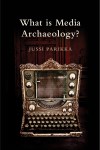
What is Media Archaeology, beta definition ver. 0.9
What is Media Archaeology? gives no direct answer to the question that it poses. Instead, it gives a map – a cartography of how to see the field of media archaeology defined by various theories and directions, that help us to go to places – and think things. However, I remember trying to think through definitions of media archaeology – a useful task to bring clarity. I originally doodled something like this for my working blog for that WiMA book, but let’s return to that now. This thinking aloud was partly triggered by my soon to be new colleague Sunil Manghani’s question…so how does media archaeology differ from media history.
Here is one attempt to give a definition – sort of coordinates, although this does not exhaust the richness of MA and its various traditions.
Media archaeology can be understood as a heterogeneous set of theories and methods that investigate media history through its alternative roots, forgotten paths, neglected ideas and machines. It explicitly challenges the supposed newness of digital culture. Media archaeology gives new ideas to understand media cultural temporality. The definitions have ranged from emphasising the recurring nature of media cultural discourses (Huhtamo) to media archaeology as an-archaeology, or variantology (Zielinski) which in its excavation of the deep time layers of our means of seeing and hearing tries to find an alternative route to dismantle the fallacy of linear development.
Furthermore, I see media archaeology as a joint history & theory venture in which temporal excavation of media functions as a theoretical force as well; it can be characterised as a reading of old media and new media in parallel lines. Media archaeology is decisively non-linear, and rigorously theoretical in its media historical interest of knowledge. In a Benjaminian vein, it abandons historicism when by it is meant the idea that the past is given and out there waiting for us to find it; instead, it believes in the radical assembling of history, and histories in the plural, but so that it is not only a subset of cultural historical writing. Instead, media archaeology needs to insist both on the material nature of its enterprise – that media are always articulated in material, also in non-narrative frameworks whether technical media such as photography, or algorithmic media features such as databases and software networks – and that the work of assembling temporal mediations takes place in an increasingly varied and distributed network of institutions, practices and technological platforms.
Indeed, what media archaeology investigates are also the practical rewirings of time, as is done in media artistic and creative practice work, through archives digital and traditional, as well as DIY and circuit bending which recycle, and remix obsolete technology as much as they investigate aesthetic and political economic conditions of technical media.
Media archaeology takes place in artistic labs, laboratories where hardware and software are hacked and opened, but also in in conceptual labs for experimenting with concepts and ideas.
So as you can see, it moves into certain material characteristics that I want to keep close to media archaeology. It does not mean that this it the only to approach MA. For instance, here is what Huhtamo wrote.
The Photosculptural Hypothesis
 3-2-1- A whistle blows and 24 shutters go “click”. Again, with a different model, head help up straight and still by a support.
3-2-1 the whistle blows. Click-click-click-click…
It’s image making but not just photography – instead, it provides an alternative route for histories of media; instead of a preference for the centrality of the seriality of the moving image, try starting from the cybernetic. “The cybernetic hypothesis”, as Alex Galloway coined it in his talk at the Winchester Centre for Global Futures that was a kick-starter for the project.
The whistle, the 24 cameras, set around a circular studio, a rotunda on which a stool for the model – an assemblage that connects the early 1860s with the 2012 reconstruction inside which I too sat to be photographed, and to be sculpted from those 24 shots. Originally this was Francois Willeme’s photosculpture, a curious arrangement and a patent from 1860s Paris that defined what Galloway calls one early model for parallel media.
Winchester School of Art Fine Art undergraduate students took up the original blueprints and the idea as their own model for a project led by Ian Dawson and Louisa Minkin and produced a fantastic remake of the Willeme-device. Inspired by Alex Galloway’s talk, and partly framed as a media archaeological project, it presents indeed a very inspiring way to address sculpture, parallel imaging and informational culture. Like so many media archaeological art works, it suggests how you can presence old media ideas – often not very mainstream – in current settings; like taking an alternative viewpoint not only to media art history, but also to current image cultures.
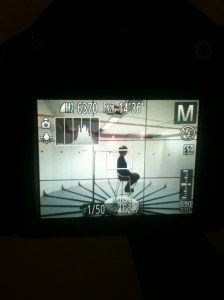
The photosculpture – which indeed as sculptural mediates the imaging into physical three dimensional objects and presents a sort of an archaeology of 3-D digital imaging/modelling – shifts our perceptual coordinates. It forces itself as a rather (in a good way) weird part of the cultures of digital imaging with its historically “out-dated” way of understanding media. That is the beauty of the device and the arrangement; it is a historical and media archaeological exercise in practice-led activity that investigates the conditions of visuality and perhaps even cybernetic culture, as Galloway claims.
“A sculptor and the sun will become collaborators working together to fashion in 48 hours busts or statues of a hitherto unknown fidelity of such great boldness in outline and admirable likeness.” Those were the words of the journalist Henri de Parviel, describing the original piece by Willeme. You can see how it describes the emerging business in quickly produced, sculpted visuality – a bust in “admirable likeness” in no time! The WSA project taps into the way in which visual technologies were starting to be mobilized into consumer products and services, but old media ideas can be cheap R&D too (to use the phrase by Garnet Hertz) for artistic ideas and reappropriations, and engage with the multiple medialities that our media technologies consist of: it’s not only about the photographic visuals, nor just sculpture, nor just a genealogy of the informatics, but a folding of various medialities. Even a single technological assemblage and practice can contain so much, as the project demonstrated. Media are never about single objects, devices or apparata – but a multiplicity of techniques and technologies assembled. Hence, a hands on assembling is itself a process of thinking through this multiplicity of media and arts apparata in order to get a sense of the delicate materialities and techniques which they enable, and how they are themselves enabled.
(For further reference, a film from 1939 from the Pathe archives, with Marcus Adams in his studio demonstrating the photosculpture)
The Dark Side
Another (what I am sure is going to be a) great event organized by the Center for 21st Century Studies at University of Wisconsin in Milwaukee: The Dark Side of the Digital.
Think of it less as the Dark Side à la Star Wars, but instead rephrase Pink Floyd’s Dark Side of the Moon, the very last words of the album, after the final pulsations.. “There is no dark side really. Matter of fact, it’s all dark.”
Depletion Design
A collection that looks really exciting: Depletion Design: A Glossary of Network Ecologies, edited by Carolin Wiedemann & Soenke Zehle. I was happy to be involved with a tiny text on dust and new materialism. A lot of my recent writing and interests have had to do with depletion, exhaustion, and things dead or discarded – as with zombie media. More things (texts) grim and grey forthcoming.
You can download the book here. Below a blurb about its contents.
“We, or so we are told, are running out of time, of time to develop alternatives to a new politics of emergency, as constant crisis has exhausted the means of a politics of representation too slow for the state of exception, too ignorant of the distribution of political agency, too focused on the governability of financial architectures. But new forms of individual and collective agency already emerge, as we learn to live, love, work within the horizon of depletion, to ask what it means to sustain ourselves, each other, again. Of these and other knowledges so created, there can no longer be an encyclopedia; a glossary, perhaps.”
Contributors: Marie-Luise Angerer (Cyborg), Franco ‘Bifo’ Berardi (Exhaustion, Soul Work), David M. Berry (On Terminality), Zach Blas (Queer Darkness), Drew S. Burk (Grey Ecology), Gabriella Coleman (Anonymous), Heidi Rae Cooley (Ecologies of Practice), Sebastian Deter- ding (Playful Technologies, Persuasive Design), Jennifer Gabrys (Natural History, Salvage), Johannes Grenzfurthner & Frank A. Schneider (Hackerspace), Eric Kluitenberg (Sustainable Immobility), Boyan Manchev (Disorganisation, Persistence), Lev Manovich (Software), Sonia Matos (Wicked Problems), Timothy Morton (Ecology without Nature), Jason W. Moore (Cri- sis), Anna Munster (Digital Embodiment), Brett Neilson (Fracking), Sebastian Olma (Biopoli- tics, Creative Industries, Vitalism), Luciana Parisi (Algorithmic Architecture), Jussi Parikka (Dust Matter), Judith Revel (Common), Ned Rossiter (Dirt Research), Sean Smith (Informa- tion Bomb), Hito Steyerl (Spam of the Earth).
Carnal Knowledge: Towards a New Materialism Through the Arts
Some years ago, probably in 2008 or so, I remember pitching with another writer a book proposal to a publisher. It would have been a short introduction to “new materialism”, a theoretical wave that argued/s for there to be much more in the world than representations, signifying structures and ideologies — that non-human things exist, independently of us, and that for us to understand matter and embodiment, we need to see it as active, dynamic and stemming from the primacy of relations. Well, the proposal did not get too far. The other reviewer was more or less puzzled about the whole existence of the term, writing that it was just invented for the purposes of the proposal and did not have currency outside in academic debates — in other words, new materialism does not exist (despite the proposal flagging that it is not only Manuel Delanda who had used the term but also Rosi Braidotti, with significant theoretical debates in material feminisms of for instance Grosz and Barad, and of course theoretical ideas since Lawrence Grossberg to the very different ideas of matter and the non-human by Latour and even Kittler!).
 Only within months books with “new materialism” in their title, or with allusions to it, like Jane Bennett’s Vibrant Matter, started to come out and even more strongly identify a field and a wave of interest. This theoretical discourse has been recently continued with publications such as New Materialism: Interviews & Cartographies. For me, it is important to really understand the multiplicity in debates concerning matter, the real and non-human — something that at times get understood very narrowly and in a very recent context, despite the longer roots of such ideas. Dolphjin and van der Tuin write nicely that “Our proposition is that new materialism is itself a distinctive trend, both in feminist theory and in cultural theory more broadly, and a device or tool for opening up theory formation.” (100)
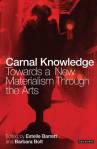
Another book discussing new materialism – especially in art theory and practice – is now out. Edited by Barbara Bolt and Estelle Barrett Carnal Knowledge: Towads a New Materialism Through the Arts engages with a range of practices and artistic media, from painting to video, film to dance in order to elaborate new vocabularies of materiality. I have not seen the whole book yet, but I myself co-authored a piece on dance — on a fantastic choreography performed by himself, Tero Saarinen: a modulation of Stravinsky’s Rite of Spring, now called Hunt. The media artist Marita Liulia did the visuals. The piece is explosive. The angle of the text is on dynamics of movement, primacy of relations and biopolitics of dance.

#code2k12
I am not the most qualified person to analyse the political economy and at times slightly exaggerated role of conferences; I do not really too often go to the big ones where the whole system of recruitment and other sort of social/affective work of academia happens. I am sure there are loads of management books on such topics and their importance. Not that I have anything against being social – just being a Finn you have to limit it a bit, not to get exhausted with the overwhelming number of people that would amount to the total number of a small Finnish village easily. However, at times events really strike a chord – like Code at the Swinburne University of Technology, Melbourne: a fantastic combination of academic quality and lovely people.
I am a firm believer in that the more interesting academic benefit of such events is not hearing someone speak, but that you are able to meet and talk outside the sessions; whether casual chattering or on the topic of the presentation. This is hardly a surprise. But it is not only the meet & greet networking silly management culture that we are persuaded to pursue, but actually having some affective pleasure from finding out that academics are not completely subsumed into corporate climb-the-ladder assholism.
Of course, talks can be really good in triggering ideas. What I mean by that is at least my own prespective that I have often trouble in immediately summarizing someone’s talk in its entirety, and instead I get nuggets, something that triggers an idea. In this sense as well, Code was a success.
The event was not focused down solely on software culture or critical code studies despite the frequent references to Chun, Galloway and Kittler – and some other usual suspects. I perceived something of an expanded notion of code in the sense that through the theme, a lot of presentations pointed to a broader context of materialities in which code takes place; logistics, management, intermedial relations, aesthetic, and non-computer placed coding of social actions/events like with the Human Fax Machine-experiment. Talks ranged from reddit to Ring(u), cars to Erica T. Carter, commandline to Google, and signal to Simondon. Code had already introduced its own approach to the idea even with a conference reading list!
Besides having the pleasure of listening to the fantastic keynotes by Anna Munster and Christian McCrea, for instance the plenary panel of Melissa Gregg, Ned Rossiter, Soenke Zehle and Mark Coté was the best one can hope for. Brilliant speakers all of whose I work admire a lot, and the topics were nicely resonating. For instance Gregg’s take on the Getting Things Done (GTD) software was something that illuminates what I tried to just briefly address in my own keynote on Cultural Techniques of Cognitive Capitalism (more on that later in a separate blog post): the entanglement of media, management, affect and modes of production in contemporary digital culture. Such practices, techniques and technologies frame the will for more time and freedom, as well as creativity, which ground notions such as cognitive capitalism, and in Gregg’s case she was able to show the deep layers of such ideas of “work smarter, not harder”. Exhaustion, tiredness and fatigue have not disappeared from the gendered worlds of management of office and post-office work. Such affect management and self control are excellent ways of articulating the curious emphasis on the cognitive and affective in relation to modes of production: they hover somewhere between of the tiring and energizing, of repetitive and creative. In this context, see also the Zooming Secretary game that Gregg started with — filing cabinets, telephones and coffee boosts; affective attunement.
It was also pleasure to hear Coté talk of his book project on Data Motility which is one of those great moments when we get someone with a fantastic knowledge of Italian political theory and current media theory talking about a topic of Digital Humanities. DH at times “forgets” the existence of media theory, as well as the longer history of humanities-technology partnering, but at the same time of course we need to be ready to update our theoretical perspectives in relation to new modes of quantities, qualities, and abstractions.
Coté ‘s book promises to be really exciting, offering an insight to data having a self-generated sense of movement as well as being the object of value creation: big social data is the sociality of the data for instance collected on social media, which highlights its polyvalence and social and economic valorisation. According to Coté big social data can be seen constituting a certain mode of humanness that humanities should tackle with. This sort of conditioning is the sort you get from the directions of Leroi-Gourhan and others. But it also points to the direction of debt, an interesting idea Coté suggests: what if we understand our relation with the data collected as one of debt, as analysed by for instance Lazzarato. Big social data in social media contexts is one of endless payments and demands of creating the social through actions, in order to justify our existence.
Both Rossiter and Zehle talked of logistics; Rossiter towards the worlds of media and management, transposition of labour to code & algorithms (which probably would resonate with some insights from Fuller & Goffey’s recent Evil Media) and Zehle in relation to gestures. Indeed, listening the two talks in the same panel made the audience aware of the multiscalar worlds of logistics – from human social affect and gestures, to the abstracted worlds of simulations and games in which management and logistics can be rehearsed.
Even if I mention only some of the papers here, throughout the conference I felt more inspired than in most of the events I visit. As said, this extends to the time outside the actual talks; people are engaged in several interesting projects, which made me actually, and without irony, feel rather ok about being an academic. And in that context, it was less painful to visit the other side of the world, Melbourne, and do two long haul flights within 10 days. I myself talked about some new things I am engaged in – a sort of a project pitch for something that might turn out to be a bigger project event – and gave a “master class” on Media Archaeology & Cultural Techniques.
Downtime
When things break down, they are much more interesting than the gadgets that function, channel and regulate our lives. Broken things might poetically and with a Heideggerian hum say to reveal their essence. This is the other side of the apocalyptic – to be understood as “apo-kalyptein – an uncovering or disclosing of what had previously been hidden.” (Gere 2008: 13)
It is in this sense that we should talk of “downtime” not as an accidental misfortune, a temporary hiccup and denial of service of intentional nature or just infrastructural/hardware failure. Instead, it is part of how media, tech and things just are (in consumer cultures); that they break down, fail in their intended task, and refuse to switch on. Indeed downtime is the time of permanent breaking down, crisis and one is tempted to start unraveling a wider transversal notion of downtime from the microscale of technological circuits to macroscales of economy. But indeed, if it is a transversal notion it cuts across such traditional divisions of micro and macro and forces a different dimensionality. A molecular level of connections which forces the technological to be tightly articulated as part of political economy; an articulation of politics must take into account the technological conditioning of itself – the political action; the (media) technological sustains and operates the processes of subjectification; the social starts from the circuit.
An installation, Downtime (post-domestic fiction), I saw as part of Amber 2012 exhibition in Istanbul, November 2012, plays with the idea of broken down electronic and other gadgets, from scientific measurement units to an old telephone, television, kitchen utensils (a hand mixer) and an old Spectrum ZX computer. The practice relates to the recent years of circuit bending and hardware hacking, as well as critical design/(re)making, from Garnet Hertz to Benjamin Gaulon and glitchers Jon Satrom to Rosa Menkman, and it might be said to relate to zombie media too–repurposing discarded/dysfunctional gadgets.
For the group, “downtime refers to the period of time during which a system remains unavailable or fails to provide or perform its primary function.” The installation covers a wall with its recircuited works, reminescent of for instance ReFunct Media 2.0. Indeed, this is the interesting bit; it is not so much about the object, but the materiality of its dysfunctionality is articulated as a temporal relation; “the period during which…”. Even downtime unfolds as a duration.
I would argue that there is a twisted permanence, or at least a horizon, a duration, of such a downtime that is as significant as its functionality. “Through the active participation of the viewer, the objects are examined within a new context, in terms of how these are kept active and accessible by its reuse and manipulation”, the group writes. We of course need to investigate the wider sense and rationale of why things should be kept active, and the horizon of that. For me, the interesting bit is as said the temporal dimension, and the new materialist discourse and media technological theory needs to be able to tackle with this too. Whether it is about the temporality of the accident, or the break down, downtime — or then the microtemporality Wolfgang Ernst is after (see also Algorhythmics).

Indeed, the accident and downtime is not only an event that disrupts the running of temporality, but incorporates its own duration that we have to understand too. Downtime is a switch concept for notions of time – functional and dysfunctional, and as such tries to act as an anthropological operator for cultural techniques of temporality.
CODE
Folks at Swinburne University, Melbourne have organised quite the event — CODE – A Media, Games & Art Conference. This means my first trip to Australia ever, with that slightly surreal feeling plane trip ahead of me. It is at such moments that you better trust media technological arrangements; the radio and computer controlled cockpit media; and the entertainment media lull in the economy class (see John Johnston’s intro to the Kittler-essay collection Literature, Media, Information Systems).
My talk will be something new I wrote, on “Cultural Techniques of Cognitive Capitalism”. The idea is to do a crosswiring between two traditions; the German media studies type of undertanding of media technologies coupled with the more Italian style political theory of Post-Fordist cultures. The previous has not been so good on the political front, the latter not always been specific enough when talking of media cultures/technologies. Who knows, this talk might form a part of a bigger project that I have been drafting as well.








 Machinology