Archive
Complicity with Anonymous Media
Thomas Pynchon’s Gravity’s Rainbow (1973) and its paranoid military-scientific worlds of technology, sexuality and hallucination became one inspirational figure for a whole wave of media theory. What could we do with Reza Negarestani’s Cyclonopedia (2008) then, which seems to include some similar stylistic elements, of transdisciplinary writing that wanders across rats and soil, petrol(ology) and archaeology to understand Middle-East? From Pynchon’s WWII Europe, to Negarestani’s Middle-East, politics of petrol.
The archaeological method of Negarestani’s Cyclonopedia represents a theory-fiction alternative for media archaeology too. What if we employ the same hallucinatory, inspiring way of investigating the subterranean, the secret, the ground that is not defined by stability but dynamic flux of sediments alive, burrowed by rats, worms and archaeologists? We can call this investigation new materialist because it believes in agency of matter, and multiplicity of things both organic and non-organic. What does this multiplicity mean? It means a microworld that unravels when you zoom close: close enough, and the skin is not a unity, but porous folding, layered, and filled with bacteria. The soil is not stable, but a constantly slowly pulsating topology, with its own affordances, and indeed, again, bacteria and other forms of life. Same applies to everything, even metal, or as Deleuze and Guattari would say, especially to metal. In their metallurgical thinking, it is the body without organs, here better understood through the idea of what flows through everything – metallurgical cosmology. This is why they insist on the relatedness of machinic phylum and metal – and why they say that everything is a machine (not because it would be modelled on any already existing machine or technology!)
“Even the waters, the grasses and varieties of wood, the animals are populated by salts or mineral elements. Not everything is metal, but metal is everywhere.” (DG)
In Cyclonopedia, the character Parsani calls the approach to the subterranean “bacterial archaeology” – an archaeology that starts from the non-human agents and microscopic attraction points within matter. And the matter extends to politics, society, and power:
“Bacterial Archeology. It is imperative for Parsani, in his approach to the Middle East, to make clear that everything related to the Middle East emerges, moves, diffuses, escalates and engenders itself through and out of the holey Hezar’to (A Thousand Insides; the Persian word for labyrinth) and the Petrologies of Bacterial Archeology.’”
The earth moves, and hums.
The methodology is that of exhuming, which both archaeologists and rats share.
“If archeologists, cultists, worms and crawling entities almost always undertake an act of exhumation (surfaces, tombs, cosmic comers, dreams, etc.), it is because exhumation is equal to ungrounding, incapacitating surfaces ability to operate according to topologies of the whole, or on a mereotopological level. In exhumation, the distribution of surfaces is thoroughly undermined and the movements associated with them are derailed; the edge no longer belongs to the periphery, anterior surfaces come after all other surfaces, layers of strata are displaced and perforated, peripheries and the last protecting surfaces become the very conductors of invasion. Exhumation is defined as a collapse and trauma introduced to the solid part by vermiculate activities; it is the body of solidity replaced by the full body of trauma. As in disinterment — scarring the hot and cold surfaces of a grave — exhumation proliferates surfaces through each other. Exhumation transmutes architectures into excessive scarring processes, fibroses of tissues, membranes and surfaces of the solid body.”
Just for speculative reasons, let’s use the same logic of thought to our technological excavations and use this as inspiration to think of the exhuming we do with media cultural topics – or machines themselves. One cannot help relating this to the epistemology and hallucinatory methods of Microresearch Lab, where the processes of soil and nature already technological are excavated in order to proliferate new surfaces – like the skin of the machine, that does not stop at the visible surface (interface/cover). It is topological, and folds in to a multiple surfaces, some inside, some abstract, some irrational.
In terms of animality, Cyclonopedia talks about rats as one agency of exhuming, parallel to archaeologists. How about then: Rats as archaeologists, or rats as media theorists? Such animals work less as metaphors than as vectors to think through the non-human force of analysis. To actually end up somewhere else than with more human focused vocabulary of cultural theory and methodology.
Furthermore, can we even extract ideas for archaeological politics – a politics for the military-industrial complex in the age of advanced science and technology?
“Parsani claims that ‘archeology, with it’s ingrained understanding of Hidden Writing, will dominate the politics of future and will be the military science of twenty-first century’.”
OOQ – Object-Oriented-Questions
I can’t claim that I know too much about object oriented philosophy. It’s often more about my friends or colleagues talking about it, enthusiastically for or against. Indeed, I have been one of those who has at best followed some of the arguments but not really dipped too deeply into the debates – which from early on, formed around specific persons, specific arguments, and a specific way of interacting.
Hence, let me just be naïve for a second, and think aloud a couple of questions:
– I wonder if there is a problem with the notion of object in the sense that it still implies paradoxically quite a correlationist, or lets say, human-centred view to the world; is not the talk of “object” something that summons an image of perceptible, clearly lined, even stable entity – something that to human eyes could be thought of as the normal mode of perception. We see objects in the world. Humans, benches, buses, cats, trashcans, gloves, computers, images, and so forth. But what would a cat, bench, bus, trashcan, or a computer “see”, or sense?
– Related to this, what if the world is not an object? What if the non-humans it wants to rescue are not (always) something we could with good conscience call objects? I guess OOP wants to treat everything as an object – across scales, genres and epistemological prejudices – and hence bring a certain flatness to the world – to treat humans and non-humans on equal footing, a project which I am in complete agreement with – but does this not risk paradoxically stripping entities, the world of specificity? For instance, in mediatic contexts, what if we need to account for the non-object based realities of such media technological realities as electromagnetism – that hardly could intuitively be called an object. Would treating such entities as objects be actually just confusing, and lead to imagined concretenesses? This question is motivated by some recent arguments in media theory, insisting that we need more careful vocabularies of the non-object nature of media; for instance Wolfgang Ernst and his discourse concerning time-criticality; Mark B.N. Hansen and his recent ideas stemming from the direction of Whitehead, in connection to ubiquitous media.
– Some people are enthusiastic because object oriented philosophy seems at last to offer a philosophical way of treating the non-human (animals, technology, etc.) on an equal footing to the human. Agencies are extended to a whole lot of entities. But such claims, whether intentionally or not, forget that there is a whole long history of such thought; the most often forgotten is the radical feminist materialism of figures such as Rosi Braidotti and Elizabeth Grosz; this goes nowadays often by the name of new materialism.
– Just a thought: The real is not the same thing as matter. Matter is not always about objects. In an interview, Grosz has briefly hinted that she is not that interested in the concept/category of the real, because that still concerns more closely epistemology. Instead, what concerns her is matter.
– Is object oriented philosophy more akin to epistemology, an operationalization of the world into modular units through which we can question human superiority– instead of it being an ontology? If we want to pay more philosophical respect to the world of non-humans – chemicals, soil, minerals, atmospheric currents and such – should we not read more of scientific research that constantly is the one who talks of such worlds, and actually offers insights into different worlds of durations and stabilities from that of the human? Don’t get me wrong – I might be a naïve observer but not that naïve: of course I know that a lot of sciences are not able to be that self-reflexive, and constantly smuggle in a huge amount of conceptual and other material that makes their epistemology infected with the human/the social, and that science is not a neutral cold gaze that just registers the world. I guess I am just interested in the world – an empiricism, transcendental, radical.
These thoughts are indeed just self-reflections of an amateur while reading object-oriented philosophy, or listening people talk about it – I think I am just trying to figure out why people are so enthusiastic about it.
Announcing Medianatures and Living Books About Life
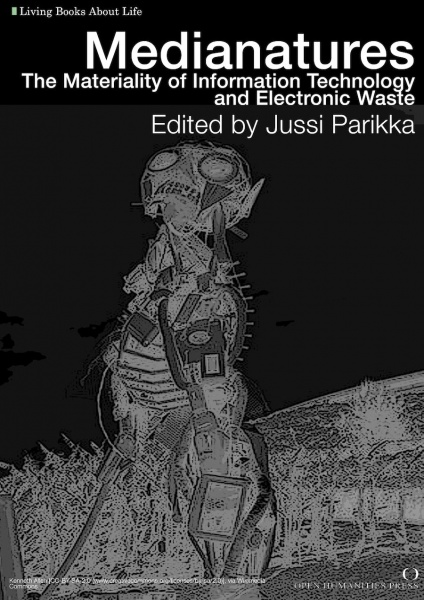 It’s (a)live! Medianatures: The Materiality of Information Technology and Electronic Waste and the whole impressive series of 21 open access books about humanities-science-themes, commissioned by Gary Hall, Joanna Zylinska and Clare Birchall, published by Open Humanities Press and funded by JISC: Living Books About Life.
My edited book was inspired by Sean Cubitt’s (and others, see the Acknowledgements of the introduction) recent research into media and waste, and I owe full thanks to him. What I wanted to investigate was the question of how materiality can be thought through such “bad matter” of waste, and related to for instance energy (consumption). The introduction outlines my approach, and ties it together with some debates in new materialism (this side of the argument is more fully outlined in a short text of mine “New Materialism as Media Theory”, forthcoming very soon in Communication and Critical/Cultural Studies-journal).
The best introduction to the whole project is however found in this press release by Hall, Zylinska and Birchall:
____________
Open Humanities Press publishes twenty-one open access Living Books About Life
LIVING BOOKS ABOUT LIFE
http://www.livingbooksaboutlife.org
The pioneering open access humanities publishing initiative, Open Humanities Press (OHP) (http://openhumanitiespress.org), is pleased to announce the release of 21 open access books in its series Living Books About Life (http://www.livingbooksaboutlife.org).
Funded by the Joint Information Systems Committee (JISC), and edited by Gary Hall, Joanna Zylinska and Clare Birchall, Living Books About Life is a series of curated, open access books about life — with life understood both philosophically and biologically — which provide a bridge between the humanities and the sciences. Produced by a globally-distributed network of writers and editors, the books in the series repackage existing open access science research by clustering it around selected topics whose unifying theme is life: e.g., air, agriculture, bioethics, cosmetic surgery, electronic waste, energy, neurology and pharmacology.
Peter Suber, Open Access Project Director, Public Knowledge, said: ‘This book series would not be possible without open access. On the author side, it takes splendid advantage of the freedom to reuse and repurpose open-access research articles. On the other side, it passes on that freedom to readers. In between, the editors made intelligent selections and wrote original introductions, enhancing each article by placing it in the new context of an ambitious, integrated understanding of life, drawing equally from the sciences and humanities’.
By creating twenty one ‘living books about life’ in just seven months, the series represents an exciting new model for publishing, in a sustainable, low-cost, low-tech manner, many more such books in the future. These books can be freely shared with other academic and non-academic institutions and individuals.
Nicholas Mirzoeff, Professor of Media, Culture and Communication at New York University, commented: ‘This remarkable series transforms the humble Reader into a living form, while breaking down the conceptual barrier between the humanities and the sciences in a time when scholars and activists of all kinds have taken the understanding of life to be central. Brilliant in its simplicity and concept, this series is a leap towards an exciting new future’.
One of the most important aspects of the Living Books About Life series is the impact it has had on the attitudes of the researchers taking part, changing their views on open access and raising awareness of issues around publishers’ licensing and copyright agreements. Many have become open access advocates themselves, keen to disseminate this model among their own scholarly and student communities. As Professor Erica Fudge of the University of Strathclyde and co-editor of the living book on Veterinary Science, put it, ‘I am now evangelical about making work publicly available, and am really encouraging colleagues to put things out there’.
These ‘books about life’ are themselves ‘living’, in the sense they are open to ongoing collaborative processes of writing, editing, updating, remixing and commenting by readers. As well as repackaging open access science research — together with interactive maps and audio-visual material — into a series of books, Living Books About Life is thus involved in rethinking ‘the book’ itself as a living, collaborative endeavour in the age of open science, open education, open data, iPad apps and e-book readers such as Kindle.
Tara McPherson, editor of VECTORS, Journal of Culture and Technology in a Dynamic Vernacular, said: ‘It is no hyperbole to say that this series will help us reimagine everything we think we know about academic publishing. It points to a future that is interdisciplinary, open access, and expansive.’
Funded by JISC, Living Books About Life is a collaboration between Open Humanities Press and three academic institutions, Coventry University, Goldsmiths, University of London, and the University of Kent.
Books:
* Astrobiology and the Search for Life on Mars, edited by Sarah Kember (Goldsmiths, University of London)
* Bioethics™: Life, Politics, Economics, edited by Joanna Zylinska (Goldsmiths, University of London)
* Biosemiotics: Nature, Culture, Science, Semiosis, edited by Wendy Wheeler (London Metropolitan University)
* Cognition and Decision in Non-Human Biological Organisms, edited by Steven Shaviro (Wayne State University)
* Cosmetic Surgery: Medicine, Culture, Beauty, edited by Bernadette Wegenstein (Johns Hopkins University)
* Creative Evolution: Natural Selection and the Urge to Remix, edited by Mark Amerika (University of Colorado at Boulder)
* Digitize Me, Visualize Me, Search Me: Open Science and its Discontents, edited by Gary Hall (Coventry University)
* Energy Connections: Living Forces in Creative Inter/Intra-Action, edited by Manuela Rossini (td-net for Transdisciplinary Research, Switzerland)
* Human Genomics: From Hypothetical Genes to Biodigital Materialisations, edited by Kate O’Riordan (Sussex University)
* Medianatures: The Materiality of Information Technology and Electronic Waste, edited by Jussi Parikka (Winchester School of Art, University of Southampton)
* Nerves of Perception: Motor and Sensory Experience in Neuroscience, edited by Anna Munster (University of New South Wales)
* Neurofutures, edited by Timothy Lenoir (Duke University)
* Partial Life, edited by Oron Catts and Ionat Zurr (SymbioticA, University of Western Australia)
* Pharmacology, edited by Dave Boothroyd (University of Kent)
* Symbiosis, edited by Janneke Adema and Pete Woodbridge (Coventry University)
* Another Technoscience is Possible: Agricultural Lessons for the Posthumanities, edited by Gabriela Mendez Cota (Goldsmiths, University of London)
* The In/visible, edited by Clare Birchall (University of Kent)
* The Life of Air: Dwelling, Communicating, Manipulating, edited by Monika Bakke (University of Poznan)
* The Mediations of Consciousness, edited by Alberto López Cuenca (Universidad de las Américas, Puebla)
* Ubiquitous Surveillance, edited by David Parry (University of Texas at Dallas)
* Veterinary Science: Animals, Humans and Health, edited by Erica Fudge (Strathclyde University) and Clare Palmer (Texas A&M University)
W: http://www.livingbooksaboutlife.org
Open Humanities Press is a non-profit, international Open Access publishing collective specializing in critical and cultural theory. OHP was formed by academics to overcome the current crisis in scholarly publishing that threatens intellectual freedom and academic rigor worldwide. OHP journals are academically certified by OHP’s independent board of international scholars. All OHP publications are peer-reviewed, published under open access licenses, and freely and immediately available online at http://openhumanitiespress.org
It’s All in the Technique
Heads up on what looks like a great little Dossier of German Media Philosophy – in the new issue of Radical Philosophy (169). Indeed, as Eric Alliez in his short (hence telegraphic?) afterwords points out, this is not philosophy of media, as we might tend to think, for instance in the English language academia. It is not so much of philosophy about the media, but how philosophy and media share a certain a priori.
I myself co-edited a collection of Continental Media Philosophy in Finnish in 2008, following this idea of (positive) separatism of a certain German agenda concerning philosophy in the age of media. And it’s not only the slightly worn idea that we need to rethink philosophy because we have the internet, but understanding how the a priori of humanities might actually be technical media. This is not a techno-determinist statement in the a-historical sense, but something that at least tries to account for the birth of modern humanities in the 19th century at the same time technical media was giving us a new ontology (and hence epistemology) of the world.
What is disturbing about this special issue is the generic problem of German academia and often media theory: it’s lack of women. Whereas one could say that the dossier and the conference at Kingston University that preceded it just honestly replicates the situation, it merely replicates the bias. Lack of such people like Sybille Krämer, Marie-Louise Angerer or Eva Horn – or any younger scholars! – is unfortunate, and it seems that this blind spot was transported along with the conference, the translations to Radical Philosophy now.
This of course does not take strength away from some of the texts. Without offering a full-fledged review of the issue, I just want to point out the joy it brings me to read Bernhard Siegert. This time his short text “ The Map Is The Territory” is about something, well, not obvious to media studies: maps. But what the article turns out to be is both an investigation into the epistemological cultural practice, or technique, of map-making, the question of representation and explication what Cultural Techniques are for the German media theorists. As pointed out in a recent e-mail to me, Geoff Winthrop-Young (who is the true expert in these matters) too underlines how important of a concept it is, and represents something that the Anglo-American reception of “German media theory” has still not started to grasp. As such, for the English speaking audience, Siegert’s text is the best entry point to the concept that does not reduce itself to Marcel Mauss’ bodily techniques, nor even completely to Michel Foucault’s ideas of practices (where it however takes a lot of its inspiration).
As Siegert emphasizes, the concept is post-media but not as leaving media behind, but post as in “post-new-media” and wanting to take distance from Internet studies or mass media studies (not a surprise if you are a scholar in the Kittlerian vein). It seems like a mixed bag, the way he outlines it, inclusive of techniques of measurement and time, like calendars, to techniques of hallucination and trance. And yet, as a mixed bag, it resonates closely with what emerged since the 1980s as “German media studies” – often referred to as media archaeology too:
“The concept of cultural techniques thereby took up a feature that had been specific to German media theory since the 1980s. This specific feature set apart German media studies from Anglo-American media studies, as well as from French and German studies of communications let alone sociology, which, under the spell of enlightenment, in principle wanted to consider media only with respect to the public. German media analysis placed at the basis of changes in cultural and intellectual history inconspicuous techniques of knowledge like card indexes, media of pedagogy like the slate, discourse operators like quotation marks, uses of the phonograph in phonetics, or techniques of forming the individual like practices of teaching to read and write. Thus media, symbolic operators and practices were selected out, which are today systematically related to each other by the concept of cultural techniques.” (14)
I think that long quotation was worth it to illuminate the centrality of the concept, which has enjoyed a bit of visibility in the name of such institutions as the Berlin Helmholtz Centre for Cultural Techniques.
In another context, Siegert has called this media archaeological 1980s as a phase of gay science– of exploration and fresh ideas. Indeed, I have to agree on some of his critique that he points towards some of the dogmatic media and cultural studies that already from the beginning know the research results: The Marxists always find the commodity form, and Cultural studies always finds race, gender and class. Interestingly, whereas a lot of Cultural and Media Studies for instance in the Anglo-American world brought with it a suspicion of ontology as something that still smells like the old library books of metaphysics, and a focus on epistemology (preferably linguistically determined, representational, or at least empirical), the emphasis on knowledge and epistemology that one finds in cultural techniques is slightly different. Epistemology is indeed embedded in a range of practices from the body to science (obviously), but at the same time Siegert insists that part of the work of analysis of cultural techniques is to investigate how cultural practices are everywhere – to take his example, for instance no time outside techniques of time. And yet, Siegert does not turn his back on ontology. Let’s quote again: “ This does not imply, however, that writing the history of cultural techniques is meant to be an anti-ontological project. On the contrary, it implies more than it includes a historical ontology, which however does not base that which exists in ideas, adequate reason or an eidos, as was common in the tradition of metaphysics, but in media operations, which work as conditions of possibility for artefacts, knowledge, the production of political or aesthetic or religious actants.” (15) There is no mention of Ian Hacking in this context by Siegert, but for someone with a bit time on their hands, there are possibilities to track some connections to recent years of “new materialism” too.

Don’t worry if its not mass media, it is at least a cultural technique.
When Siegert picks up on Gilbert Simondon, the critique of hylomorphism and embracing the idea of cultural techniques (and as I too have called media archaeology) as Deleuze-Guattarian nomadic science, we are on to the specific emphasis on materiality again. This however is not a materiality determined by a clean-cut causality chains from scientific-engineering solutions, but one that investigates them in a bundle with techniques of various ranges. Across a historical hylomorphic assumption of separation of content and form, things interfere across such regimes – like in maps, materiality infects the content. And as such, the interference offered by some such texts might be a really excellent distraction if you are bored reading the introductions to mass media or introductions to representations of media content, that still fills our media studies understanding.
Dirty Matter
I was asked to write a short forum piece on “new materialism” for Communication and Critical/Cultural Studies-journal and I wrote a piece called “New Materialism as Media Theory: Dirty Matter and Medianatures”. It partly picks up on some of the themes I have been recently talking and writing about, influenced by such scholars as Sean Cubitt. It also articulated – albeit briefly – some points concerning German media theory as new materialism, even if going the quickly to a different direction concerning materiality. Here is a short taster of what’s to come.
The key points of the text were in short: 1) we need to understand how media technologies themselves already incorporate and suggest “new materialism” of non-solids, non-objects and this is part of technical modernity (the age of Hertzian vibrations); 2) we need also to understand bad matter – not just the new materialism that is empowering, but one that is depowering: the matter that is toxic, leaking from abandoned electronic media, attaching to internal organs, skins of low paid workers in developing countries. In this context, “medianatures” is the term I use to theoretically track the continuums from matter to media, and from media back to (waste) matter.
I believe that it is this continuum that is crucial in terms of a developed material understanding of media cultures. Hence, it’s a shame from a new materialist point of view that even such pioneering thinkers as Michel Serres miss this point concerning the weird materialities of contemporary technological culture – weird in the sense that they remain irreducible to either their “hard” contexts and pollution (CO2, toxic materials, minerals, and other component parts) or their “soft” bits – signs, meanings, attractions, desires. In Malfeasance. Appropriation Through Pollution? Trans. Anne-Marie Feenberg-Dibon (Stanford: Stanford University Press 2011), these are the two levels Serres proposes as crucial from an environmental point of view but he ignores the continuum between the two. And yet, signs are transmitted as signals, through cables, in hardware, in a mesh of various components from heavy metals to PVC coatings.
Perhaps a good alternative perspective to Serres’ is found in how both Félix Guattari and Gilles Deleuze conceive of a-signification as a regime of signs beyond signification and meaning: Gary Genosko’s apt example (in: Félix Guattari. A Critical Introduction London: Pluto 2009, 95-99 ) is the case of magnetic stripes on for instance your bank card as a form of automatized and operationalized local power that is not about interpretation, but a different set of signal work. Elaborating signaletic material – electronic signals and software – through a reference to Deleuze’s film theory and a-signification by Bodil Marie Stavning Thomsen is also useful. As she elaborates – and this much we know from years of intensive reading of Deleuze in screen based analyses – Deleuze wanted to include much more than signification into the cinematic impact, and mapped a whole field of a-signifying matter in film: “sensory (visual and sound), kinetic, intensive, affective, rhythmic, tonal, and even verbal (oral and written).” (“The Haptic Interface. On Signal Transmissions and Events” in Interface Criticism. Aesthetics Beyond Buttons, edited by Christian Ulrik Andersen and Søren Bro Pold, Aarhus University Press 2011, 59) What she points out in terms of signal media is as important: after signs come signals, and the media of signals needs a similar move as Deleuze did with film: to carve out the a-signifying material components for digital media too.
Such a-signifying components are rarely content to stay on one level, despite a lot of theory often placing primacy to software, hardware, or some other level. Various levels feed into each other; this relates to what Guattari calls mixed semiotics, and we can here employ the idea of a medianature-continuum. The a-signifying level of signs is embedded in the a-signifying materiality of processes and components.
In short, it’s continuums all the way down (and up again), soft to hard, hardware to signs. In software studies (see: David M. Berry, The Philosophy of Software. Code and Mediation in the Digital Age, Palgrave Macmillan 2011, 95-96), the continuum from the symbol functions on higher levels of coding practices to voltage differences as a “lower hardware level” has been recognized: assembly language needs to be compiled, binary is what the computer “reads”, and yet such binaries take effect only through transistors; and if we really want to be hardcore, we just insist that in the end, it comes back to voltage differences (Kittler’s famous “There is no Software”-text and argument). Such is the methodology of “descent” that Foucault introduced as genealogy, but German media theory takes as a call to open up the machine physically and methodologically to its physics – and which leads into a range of artistic methodologies too, from computer forensics to data carvery. In other words, recognizing the way abstraction works in technical media from voltages and components to the more symbolic levels allows us to track back, as well, from the world of meanings and symbols – but also a-signification – to level of dirty matter.
Do Some Evil
It’s the opposite to “do no evil”, a call to think through the dirty materiality of media. Trick, deceive, bypass, exploit, short-circuit, and stay inattentive.
Hence, it is not only about “evil objects” as I perhaps myself have focused on (in Digital Contagions, and in other places), even if such objects can be vectors for and emblematic of stratagems of evil media. Evil media studies focuses on strategies that are mobilized as practices of theories. These strategies reach across institutions, and hence it is no wonder that Geert Lovink recently flags this as one approach through which to energize media studies.
Or more formally – Evil Media Studies “is a manner of working with a set of informal practices and bodies of knowledge, characterized as stratagems, which pervade contemporary networked media and which straddle the distinction between the work of theory and of practice”, write Andrew Goffey and Matthew Fuller in the chapter by the same name in The Spam Book.
For me, the attraction in Goffey and Fuller’s call is that it is material – material that is dynamic, non-representational, machinating and filled with energies that flow across software, social and aesthetic.
- Bypass Representation
- Exploit Anachronisms
- Stimulate Malignancy
- Machine the Commonplace
- Make the Accidental the Essential
- Recurse Stratagems
- The Rapture of Capture
- Sophisticating Machinery
- What is Good for Natural Language is Good for Formal Language
- Know your Data
- Liberate Determinism
- Inattention Economy
- Brains Beyond Language
- Keep Your Stratagem Secret As Long as Possible
- Take Care of the Symbols, The Sense Will Follow
- The Creativity of Matter
(the list from “Evil Media Studies” by Goffey and Fuller, in The Spam Book: On Porn, Viruses and Other Anomalous Objects From the Dark Side of Digital Culture, eds. Parikka & Sampson, Hampton Press 2009).
Ding to Process – Object (and Non-Object) Oriented Media Studies
(Originally a removal from the manuscript of Media Archaeology and Digital Culture, this short post reworked and posted here:)
With Bruno Latour at the forefront, several theorists in the humanities and social sciences have been pointing out that how through both scientific practices, political decision making, and media technological assemblages, non-humans play a crucial part in constituting the social. In fields such as speculative realism as well as “new materialism” there is an intensive engagement with how to renew our vocabularies of the material with philosophical, cultural and media studies tools.
Latour (2005) outlines this intertwining of matter and things as part of the body politic by the conceptual move from “object-oriented-software” to “object-oriented-democracy.” In fact, the usually non-technological, non-object body politic of modernity that we find from Hobbes onwards is actually filled with such stuff which is the assembly point of concerns, networks and themes political. Such “composite bodies” in foundational meditations of politics such as Hobbes’ are for Latour (2005: 6) actually
thick with things: clothes, a huge sword, immense castles, large cultivated fields, crowns, ships, cities, and an immensely complex technology of gathering, meeting, cohabiting, enlarging, reducing and focusing. In addition to the throng of little people, summed up in the crowned head of the Leviathan, there are objects everywhere.
Whereas Latour’s thoughts have been a crucial node in the recent debates concerning “object-oriented-philosophy” as well (see e.g. Harman 2009: 151-228), we are also able to extend such ideas to a neologism as “object-oriented-media studies.”
What would that mean? Perhaps in a Latourian spirit we could start paying more attention to how objects, or processes that are technologically defined, enable new forms of sociability and action, as well as politics and aesthetics, and for that, we need to understand much more about the circuits, switches, relays, cables, protocols, various levels of software, screen technologies, and electromagnetic fields which are the at times neglected “media” in the middle of our media relations. Such are the “phantoms” (cf. Latour 2005: 28, 31) that constitute, ontologies and conditions for knowledge of technical modernity, but also the way politics and the public is constituted in the liminal zone of objects, things and constructions of the social. Hence, similarly as we for Latour need to include our objects in our politics – and move from Realpolitik to Dingpolitik – perhaps we need more object and technology focused media studies?
And yes, objects do not need to be objects only. Increasingly, this is the way in which we need to rethink materiality – post-objects, post-object vocabularies, and more for instance in terms of processes, or for instance events (I am here thinking of the temporality of the calculational machine called computer, it’s cycles, halts and interrupts). 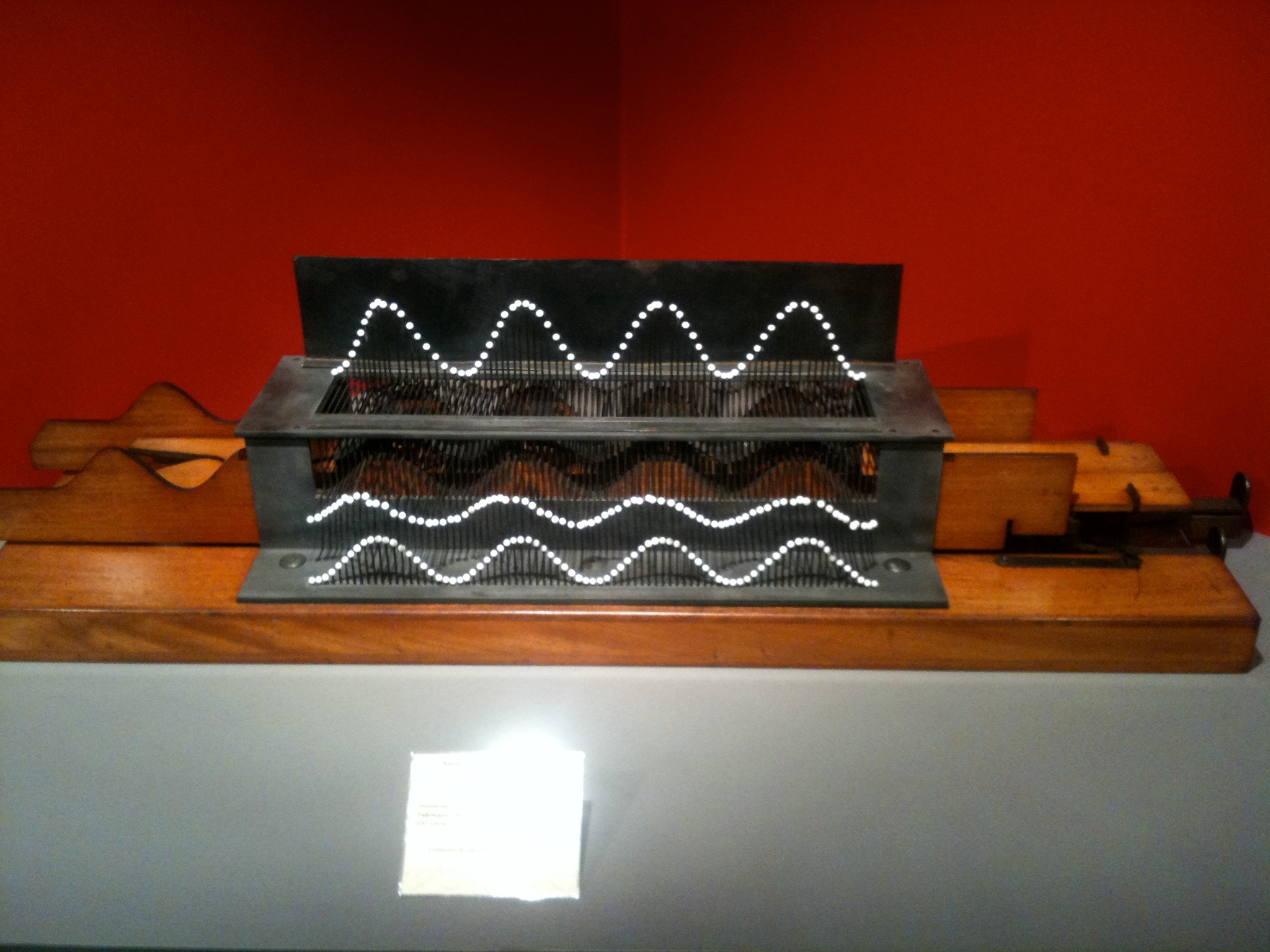
Media archaeology has been one rich curiosity cabinet collection, but how do we approach the non-object worlds of waves and streams, flows and cycles, oscillations and vibrations? Instead of things, it’s these materialities that we should turn to – both in terms of new materialist epistemology, aesthetics, as well as the political task of understanding the aesthetico-technicalities of cognitive capitalism.
Harman, Graham (2009) Prince of Networks. Bruno Latour and Metaphysics (Melbourne: re.press).
Latour, Bruno (2005) “From Realpolitik to Dingpolitik or How to Make Things Public, in Making Things Public – Atmospheres of Democracy, edited by Bruno Latour and Peter Weibel (Cambridge, MA: The MIT Press), 4-31”
ps. check out the recent-ish Mark Hansen talk, relates to process-oriented-media studies.
MediaNatures-talk in Berlin (June 8)
I am giving a talk in Berlin as part of the MediaSoup-colloquium convened by Paul Feigelfeld (Institut für Medienwissenschaft at Humboldt University where I am a visiting research fellow for this Spring and Summer). On June 8, 6 pm (starts 6.15) I will be talking on MediaNatures, abstract below.
Place: Medientheater. Institut für Medienwissenschaft, Humboldt Universität Berlin, Sophienstraße 22A, 10178 Berlin.
MediaNatures
This talk riffs off from Donna Haraway’s influential concept of naturecultures which established one framework to think about the topological continuity from nature to culture. As such, it was an important spark for the discourse on “new materialism” in cultural studies, a form of rethinking materiality in new ways outside a Marxist or a representational framework. Naturecultures – also resonating with a range of positions such as Latour’s – is a way to think through the multiple materialities we encounter in terms of contemporary technological society.
The talk extends naturecultures into a more medium-specific direction with the concept of medianatures. By discussing media materialism and its relation to “new materialist” debates as well as “medium-specificity”, the talk addresses ways to think through the technical and scientific specificity of contemporary media – beyond meaning, representation and the human body, the fact that technical media engage in such processes, speeds, and phenomena that escape the phenomenological human register per se.
Yet, the talk points towards a different kind of reading of media materiality than often found in accounts for instance in media theory. We can question the notion of specificity and argue that there are various specificities from which we can draw upon. While German media theory (acknowledging that the term is in itself not very apt) has been insisting on drawing on materialities that can be directly connected to the important scientific contexts of technical media, we can think through a milieu theory of media: how media establish but also draw on nature, animals and other non-human intensities, forces and potentialities. Instead of thinking nature here in terms of the metaphorics it has offered for a long time for media cultural phenomena, and avoiding proposing any form of purity of nature, I want to look at the continuums of not only naturecultures, but medianatures that is slightly different from the emphasis of media cultures as the “new” environment for us human beings. Instead we approach medianatures as affordances, as intensities, as regimes of affects and relations and as processes of mediatic nature that offer a non-human view to new materialist media theory. Hence, we end up talking about minerals, waste and nature.
New materialism still feels new

Silhouettes of the iconic Haraway and Braidotti
Seeing two such iconic scholars as Donna Haraway and Rosi Braidotti on stage at the same time is always a treat. This was in the context of New Materialism: Naturecultures, a wonderful continuation of last year’s New Materialisms and Digital Culture, and continuing the vibrant discussions surrounding how to think the material as dynamic and alive – and diffractively leaking across disciplinary borders of knowledge, assembling into new theory war machines, intensive encounters, and problematics that themselves offer milieus for fresh thought. Organized by Iris van der Tuin and Rick Dolphjin, the conference featured speakers such as Haraway, Vicky Kirby, Adrian Mackenzie, Milla Tiainen and Melanie Sehgal – as well as yours truly. It’s clear that Haraway was the main feature, starting the whole day with her energetic talk “Playing Cat’s Cradle with Companion Species: Naturecultures-in-the-making.” It drew on the figure of the string – and the Cat’s Cradle game – which visualizes, embodies and is a tool-to-think-with knots knotting, ties engantgling, and relations in-the-making. In other words, companion species and the importance of the “with”. At the same time, all presentations worked towards interesting directions in aesthetics and science of mattering dynamics. My own emphasis was on “medianatures” as a version of “naturecultures” topological continuum.
Again the conference succeeded in moving across science, technology and philosophy, and the importance of material feminisms was present (not only because the event was organized in Utrecht, easily one of the leading gender studies centres of the world). As such, as van der Tuin nicely elaborated in her opening words – new materialisms are transversal at their heart. Next year’s event is organized in Linnköping (with Cecilia Åsberg), and is themed “Genealogies of Matter”. The name already promises even more transversal connections, cartographies of though-movements and forging discussion across different ways of engaging with matter, the real, and things/processes non-human too.
For instance, it would be interesting to articulate something about the relations between the mode of questioning in speculative realism and object-oriented-philosophy and new materialism. With such figures as Shaviro, Delanda and for instance Whitehead (and as always, Deleuze) quoted frequently on “both sides”, it is actually slightly surprising no further discussion has emerged. New materialisms is very strongly affiliated with feminist discussions which is one of its strengths and points towards a different set of politics that engage not solely with ontology – but with labour, sexuality and a range of cultural practices. Of course, its not that OOP is solely about ontology, but its clear that the direction of discussions has been taking it to a different set of questions than new materialism that has a very strong relation to other disciplines outside philosophy too – cultural and gender studies, Science and Technology, as well as media theory, I would add.
Meanwhile, while returning from the Netherlands to Berlin, this advert on Schiphol airport reminded me of what we need to address: the cultures of mobility, at the core of circulations of neoliberal regimes of governing too, articulated together with the seeming lightness of cloud computing, which however is at the core of the new materialities of digital culture – which far from immaterial are embedded in very heavy materialities as their sustaining “background forces”…

Cloud computing takes trust - and energy








 Machinology