Archive
A Fellowship at MECS
I am pretty happy about spending some time in Germany over the summer– and not just any trip, but as Senior Fellow at the Leuphana University Media Cultures of Computer Simulation-centre (MECS). MECS is one of the exciting developments at Leuphana (in Lüneburg) and in Germany, collecting some of the most interesting media theorists, analysts and historians. Led by Claus Pias and Martin Warnke, MECS’s project description tells the story of mutually informing investigations of media culture and science. Indeed, MECS presents itself as part of analysis of changes in scientific methods but also rather fundamental questions as to the nature of scientific knowledge itself. Furthermore, digital media becomes an agent in this transformation. “Digital media develops a medial obstinacy; it generates and at the same time processes problems which in the past were often inaccessible, either by analysis or experimentation.”
MECS’s annual themes for the coming years are found here – for this year, the focus is on Wissen referring to knowledge and the media epistemology of computer simulations, followed next year by Rechnen: to calculate/calculation.
In this context my own project focuses on the double bind of the media epistemological (e.g. sensors) and the environmental questions (such as smog) in a theoretical context of media materialism. I have been interested in how to expand media materialism to a wider set of material questions that include media ecology and the environmental too, partly in the context of Geology of Media. I also need to write a couple of commissioned articles on Friedrich Kittler during the summer. In addition, with Paul Feigelfeld we will edit a short e-issue focusing on Kittler for Theory, Culture & Society.
Medya Jeolojisi
“Medya Jeolojisi“, a Turkish translation of my “Geology of Media”-piece is now available on Birikim online. A big thanks to translators Ezgi Akdağ & Aycan Katıtaş! The short text offers an alternative account of media materiality, and it was originally published in The Atlantic. (Also a Swedish translation is expected).
The short piece is a good teaser trailer to the forthcoming book(s): The Anthrobscene (forthcoming 2014) and Geology of Media (expected Spring 2015).
Photochemical Smog as New Media
Perhaps photochemical smog is the only true new visual media of post World War II technological culture. It represents the high achievements in science and technology, combined with (synthetic) chemistry and sunlight. It modulates the light like advanced visual media should and embeds us in its augmented reality as we suck it into our lungs.
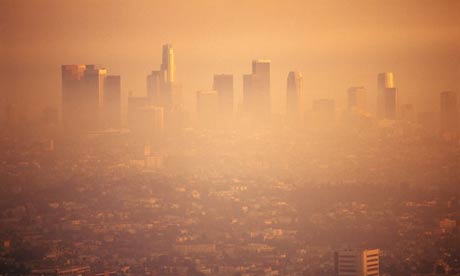 It encapsulates the mediatic cities of Los Angeles and Beijing, as encompassing surely as Hollywood’s machinery. Just like the material basis of technical media of more conventional kind – such as photography and film – it is chemical based. It is media the same as any photochemical process is about how light gets absorbed on our planet’s atoms and molecules.
But it’s new media, particular to the modern industrial age and the chemical reactions of more recent history. It feeds of industrial pollution and modern transport. It is about the screen as well – how the sunlight is offered this massive living chemical molecular screen on which to project its energetic images. A molecular aesthetics of an ecology of a dying planet.

A Geology of Media
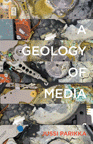
I am pleased to announce that I have signed a contract with University of Minnesota Press for a new book tentatively called A Geology of Media.
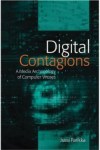
Planned for 2015, A Geology of Media forms the third, final part of the media ecology-trilogy. It started with Digital Contagions: A Media Archaeology of Computer Viruses (2007) and continued with Insect Media (2010). This book on the geophysics and the non-organic ground of media complements the earlier takes by offering a media materialism from the point of view of geological resources, electronic waste and media arts. Through engaging with several contemporary art and technology projects it provides a media theoretical argument: to think of materiality of media beyond the focus on machines and technologies by focusing on what they consist of: the chemistry and geological materials of media, from metals to dust.
In short, I am interested to see if what pejoratively sometimes is called “hardware fetishism” is not hard enough, and even media and cultural theorists need to focus on the rocks and crust that make technical media possible. Earth history of deep times mixes with media history, which becomes a matter of not only thousands, but millions of years of non-linear history (to modify Manuel Delanda’s original idea). This way media materialism becomes a way to entangle media technologies, environmental issues and themes of global labour. Perhaps instead of the Anthropocene, we should just refer to the Anthropobscene.
I’ve been in recent talks and short posts been addressing the geological in media, and my piece in The Atlantic offered a short preview of what’s to come. In addition, below a very tentative table of contents. This project (and the Erkki Kurenniemi book I am working on with Joasia Krysa) will keep me busy for a while.
A Geology of Media
Preface
1) Introduction: Grounds of Media/Culture
2) An Alternative Deep Time of the Media
3) Psychogeophysics of Technology
4) Dust and the Exhausted Planet
5) Media Fossils
Afterwords: Half-Life
Appendix:
“Zombie Media”, by Garnet Hertz and Jussi Parikka
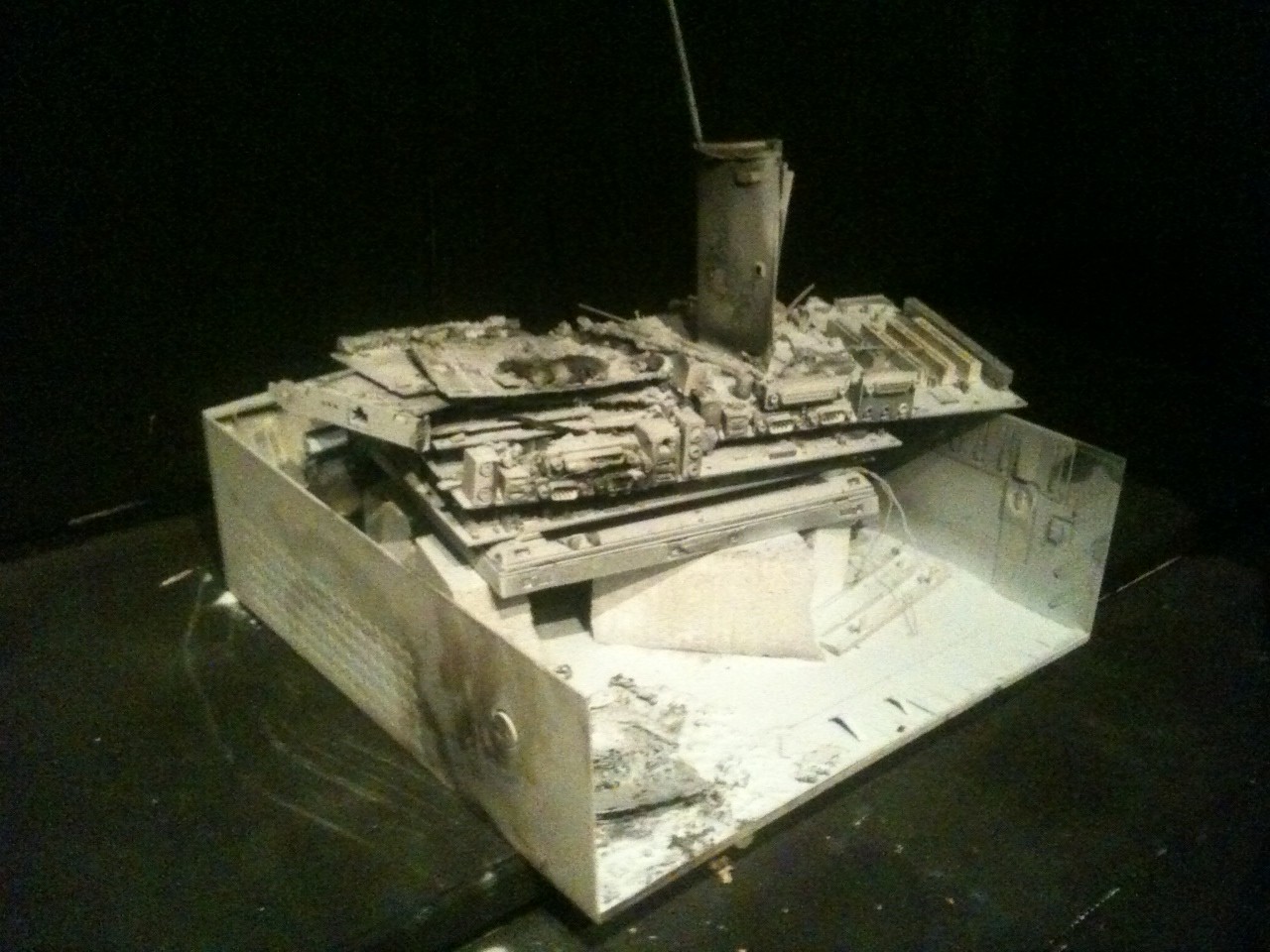
From the Crystal World-project (Howse, Jordan, Kemp)
The Anthropobscene: The Elemental Media Condition
Winchester School of Art are one of the partners of the transmediale-festival, which takes place again in January/February 2014 in Berlin. This short text below is a sort of a trailer to our bit for the event: the text is co-written by myself and Ryan Bishop and the the contribution to tm14 is likewise co-curated by us. The text gives an indication of some of the themes we will discuss during the festival and conference week, and it draws on some of our work on these topics: Ryan’s writing on the four elements and contemporary aesthetics, and my work-in-progress book project on “geology of media” and what I pitch as the anthropobscene – a new geological era catalysed by the corporate capitalist measures of depletion and exploitation.
Ryan Bishop and Jussi Parikka:
The Elemental Media Condition
Ever since such early geologists as James Hutton and Charles Lyell voiced a distance from biblical time, the Earth has had a proper history. The natural historical durations of the Earth have, despite academic disciplinary divisions, always intertwined with human history. In the current moment, the complex interactions of the two seem more prescient than ever. To follow in the footsteps of Dipash Chakrabarty, the horizon of the anthropocene forces historians to think of durations of nature as entangled with social history, and the historiographical functions of temporality need to be considered alongside such vectors that acknowledge the work of capitalism as a specific epoch. In this sense, we would like to refer not only to the anthropocene as the debated new geological era in scientific classification, but also what can be called the anthropobscene. This portmanteau word combines anthropocene with obscene, thus highlighting the vicious exploitative actions of corporations, governments and other agencies operating on different levels: from human individuals to multigovernmental organisations and transnational corporations. In much the same manner that Jean Baudrillard reconfigured the subject-object relationship placed within a scene as a network-screen relationship in the obscene, the anthropobscene reconstitutes the relationship between human scales of intervention into those of the geological. Thus, amongst other things, it refers to the obscenity of heavy pollution of the earth and the air, bringing back discussions of the four elements as found in the Pre-Socratic thinker Empedocles, whose writings strike both ancient and contemporary chords. Cultural theorists, such as Gary Genosko, have voiced an urgency for a renewed consideration of the elements.
For Empedocles, humans, nature and the universe contain the same elements. Flesh and blood are composed of approximately equal parts of earth, fire, water, and aether: the four elements that constitute the universe. The entire material world for Empedocles comes from the mixture and amounts of these four elements, the mixing of which he likens to paints on an artist’s palette with their different effects due to combinatory portions. This insight of multiple and diverse substances generated through combinations and proportionality becomes a cornerstone of modern science and chemistry. The harmony of Love and the discord of Strife result from the proportionality of the elements with each constantly changing and warring with the others. The Empedoclean elements of this cosmogony and in nature constitute both media and content. They make, transform and destroy at the same time.
Empedocles’ writings use physics to derive an understanding of ethico-political, even moral, laws. In the teaching of Empedocles the problem of substances as they present themselves to us takes a specific form: how do the Many come from One and One from Many? The primary and ultimately determinate forces behind the various manipulations, combinations and transformations of the elements in Empedocles are in the standard translations Love and Strife, which move in cycles of harmony and disharmony that reign over all of nature, including humans, fish, beasts and birds. But the elements are not simply passive recipients of the forces of Love and Strife. They can and do themselves act as causal agents, influencing the waxing or waning of Love or Strife.
Contemporary media culture can be opened up through such a consideration of elements. Indeed, as the philosopher Erich Hörl has argued, the technological is one crucial condition for the discourse – and practical existence – of this hypothetical anthroposcene – and anthropobscene, we might add. For artists such as Robert Smithson in truly Empedoclean fashion, the tectonic realms of the Earth and the mind are interconnected. Smithson’s account amounts to a critique of the McLuhan-focussed idea of technology as extensions of Man. Instead, for Smithson, writing in 1968 in Artforum, it is elemental. One is here tempted to think it is elemental in the sense of the Pre-Socratic four elements, as well as elemental in the sense that those elements are more crucial than ever for a consideration of the biopolitical condition. Such aspects range from the materiality of data mining to environmental exploitation.







 Machinology