Archive
OOPhotography
Congratulations to Paul Caplan who yesterday passed his viva very succesfully! These are the important moments of academic incorporeal transformation where one metamorphoses from Mr Caplan to Dr Caplan!
Besides OOO/OOP as its theoretical approach, it is a creative practice PhD, representing a very exciting addition to practice as research that relates to visual culture as well as software studies! See here for a video sample of his work and thinking (Originally in O-Zone: A Journal of Object Oriented Studies):
A Video Review of Insect Media
Why don’t we in academia use more other forms of expression than the written word?
Here is a video review (alongside with the transcript in the following link) of Insect Media, published in the journal Itineration: Cross-Disciplinary Studies in Rhetoric, Media and Culture.
Funding Ethic and the Spirit of Neoliberal Academia
Pekka Himanen, the Finnish consultant, has been in the headlines over the past weeks and months. It all started when an interim report of his project got torn apart in media reviews, for instance in Suomen Kuvalehti and in various other subsequent articles. Basically, the language did not make sense: full of repetition and grammar that sounded like it had gone through google translator, the suggestions of Sininen Kirja, (PDF) “the Blue Book” were besides banal, badly written. The project about possible futures for Finland did not promise much.
Besides the substandard research, what was raised as a question mark was the funding: 700 k for this project for Himanen and Manuel Castells. And what was revealed then was how the funding was obtained: outside the normal funding calls, after a special deal arranged by the Finnish government and Prime Minister Jyrki Katainen. Of course, the PM has rushed to explain: nothing dodgy here, the research agencies were involved and interested. However, for instance Finnish academy begged to differ. Perhaps not direct pressure, but something not very fair play either, it was reported in interviews (see here and here for instance).
There is a range of really good blog posts (in Finnish) out there (for instance here and here), and I have not much to add, just to summarise and point to a wider theme this raises: dodgy funding arrangements in the midst of widespread university funding crises and claims that there just is not enough funding to sustain public universities. This is clearly not the case, but more about allocation: whether the money goes to supporting peer reviewed excellent basic work with students in free and public universities, and research that is respectable, or to consultancy projects, like Himanen’s.
Indeed, as raised for instance in a Filosofia.fi blog post, there are various issues at play. To paraphrase, and summarise:
– the project plan’s budget has unclear expenses that refer to the past, prior to the project
-the plan itself is something I would not accept even from a student: no words on methods, sources or research material; it presents a “comparative perspective” without telling what countries are being compared
– there are basic problems with the personnel of the project, regarding their duties in the project
– the project was not peer reviewed, or gone through any of the normal academic procedures for funding
What it does is an overuse of words “analysis” and “synthesis”.
Welcome to the world of neoliberal academia: a cynical disjuncture between the political economy of research & basic funding and the rhetorics of innovation, futurity, and ethical values ( such as the pet term “dignity” that Himanen spreads frequently). This neoliberal world of academia functions through privatisation of assets, architectures and mechanisms of public funding, channeling them to consultancy projects that are commissioned and tightly linked with political goals.
Interestingly Manuel Castells rushed to the defense of his colleague, professor Himanen (whose CV, it was claimed in an earlier piece of investigative journalism, does not include peer reviewed articles at all): the critics are motivated by envy. Himanen is a genius. But Castells fails to engage with any of the actual critique or even more so, with the actual puzzling core of the whole issue. Instead of political economy of funding, this is a matter of psychological problems of those without funding.
Indeed, in this case this is less about Himanen than about the wider Funding Ethic and the Spirit of Neoliberal Academia. Perhaps that is the book that should have been written instead of his Hacker Ethic and the Spirit of the Information Age. Of course, this issue is not solely about Finland, but we can recognize the same patterns across a range of other countries, including Britain: privatize public funding and commons, engineer the procedures so as to fit that financial channeling and top it up with beautiful rhetorics of ethics, respect, creativity, innovation, sharing and big societies where values are respected. Neoliberalism loves value: both in bank accounts and rhetorics. Terms such as dignity are beautifully empty signifiers that can be customised to fit the purpose.
Digital Culture: Anomalies, Archaeology and Contagion-event (London)
 Digital Culture: Anomalies, Archaeology and Contagion
– a seminar and a book launch at Kings College, London, with Jussi Parikka and Tony D. Sampson
March 20, 2013 – Wednesday at King’s College, London, Strand Campus.
4.30-7.00
Seminar 4.30-5.30 in room K.311 and the book launch 5.30-7.00 in the the Small Somerset Room.
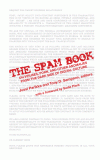
In 2009 Parikka and Sampson coedited The Spam Book, a collection of articles intended to probe the “dark side” of digital culture. The Spam Book addressed a shift from a digital culture very much defined in terms of the economic potential of digital objects and tools toward a discourse describing a space seemingly contaminated by digital waste products, dirt, unwanted, and illicit objects.
In this seminar and the following book launch, Parikka and Sampson discuss emerging ideas and theoretical approaches to digital culture. Parikka’s media archaeological approach and Sampson’s research on virality provide insights into worlds of affect, anomaly and the alternative genealogy from which our network culture emerges. Parikka’s recent book What is Media Archaeology? pitches media archaeology as a multidisciplinary 21st century humanities field that resonates with a range of recent scholarly debates from digital humanities to software studies and digital forensics. Media archaeological excavations and discussions on such theorists as Friedrich Kittler offer an alternative insight to the current digital culture/economy debates in the UK.
Sampson’s approach to digital culture brings together a Deleuzian ontological worldview with the sociology of Gabriel Tarde. His subsequent theory of network contagion does not, as such, restrict itself to memes and microbial contagions derived from biological analogies or medical metaphors. It instead points toward a theory of assemblages of imitation, viral events, and affective contagions. For Sampson, contagion is not necessarily a positive or negative force of encounter; it is how society comes together and relates. Sampson provides an assemblage theory of digital culture concerned with relationality and encounter, helping us to understand digital contagion as a positively sociological event, building from the molecular outward, long before it becomes biological.
Parikka’s media archaeology and Sampson’s contagion theory both figure the importance of a materialist approach to the imaginary and the nonconscious as central to an understanding of digital culture. Hence, the seminar asks the question: what is the nonconscious of digital culture?
The seminar is followed up by a book launch of Parikka’s What is Media Archaeology and Sampson’s Virality: Contagion Theory in the Age of Networks.
Both books are available at the event along with wine.
The event page on Facebook.
Jussi Parikka: What is Media Archaeology? Polity Press: Cambridge, 2012.
Tony D. Sampson: Virality: Contagion Theory in the Age of Networks. University of Minnesota Press: Minneapolis, 2012.
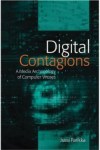
Jussi Parikka is Reader in Media & Design at Winchester School of Art, and author of Digital Contagions (2007) and Insect Media (2010) as well as (co-) editor several edited collections, including The Spam Book (2009), Media Archaeology (2011) and Medianatures (2011). He blogs at htt://jussiparikka.net.
Tony D. Sampson is a London-based academic and writer currently lecturing at the University of East London. A former musician, he studied computer technology and cultural theory before receiving a PhD in sociology from the University of Essex. His research blog is at http://viralcontagion.wordpress.com/
To find the venue:
London, King’s College, Strand Campus.
Directions.
4.30-5.30 in K3.11 on the Strand Campus of KCL.
K3.11 (King’s Building, Third Floor, Room 11)
To find K3.11 you take stairs up from the Second Floor King’s Building at the Strand end of King’s Building. You can ask for directions at the Strand Reception.
From 5.30-7.00 the Small Somerset Room
The Dark Side
Another (what I am sure is going to be a) great event organized by the Center for 21st Century Studies at University of Wisconsin in Milwaukee: The Dark Side of the Digital.
Think of it less as the Dark Side à la Star Wars, but instead rephrase Pink Floyd’s Dark Side of the Moon, the very last words of the album, after the final pulsations.. “There is no dark side really. Matter of fact, it’s all dark.”
Depletion Design
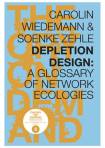
A collection that looks really exciting: Depletion Design: A Glossary of Network Ecologies, edited by Carolin Wiedemann & Soenke Zehle. I was happy to be involved with a tiny text on dust and new materialism. A lot of my recent writing and interests have had to do with depletion, exhaustion, and things dead or discarded – as with zombie media. More things (texts) grim and grey forthcoming.
You can download the book here. Below a blurb about its contents.
“We, or so we are told, are running out of time, of time to develop alternatives to a new politics of emergency, as constant crisis has exhausted the means of a politics of representation too slow for the state of exception, too ignorant of the distribution of political agency, too focused on the governability of financial architectures. But new forms of individual and collective agency already emerge, as we learn to live, love, work within the horizon of depletion, to ask what it means to sustain ourselves, each other, again. Of these and other knowledges so created, there can no longer be an encyclopedia; a glossary, perhaps.”
Contributors: Marie-Luise Angerer (Cyborg), Franco ‘Bifo’ Berardi (Exhaustion, Soul Work), David M. Berry (On Terminality), Zach Blas (Queer Darkness), Drew S. Burk (Grey Ecology), Gabriella Coleman (Anonymous), Heidi Rae Cooley (Ecologies of Practice), Sebastian Deter- ding (Playful Technologies, Persuasive Design), Jennifer Gabrys (Natural History, Salvage), Johannes Grenzfurthner & Frank A. Schneider (Hackerspace), Eric Kluitenberg (Sustainable Immobility), Boyan Manchev (Disorganisation, Persistence), Lev Manovich (Software), Sonia Matos (Wicked Problems), Timothy Morton (Ecology without Nature), Jason W. Moore (Cri- sis), Anna Munster (Digital Embodiment), Brett Neilson (Fracking), Sebastian Olma (Biopoli- tics, Creative Industries, Vitalism), Luciana Parisi (Algorithmic Architecture), Jussi Parikka (Dust Matter), Judith Revel (Common), Ned Rossiter (Dirt Research), Sean Smith (Informa- tion Bomb), Hito Steyerl (Spam of the Earth).
#code2k12
I am not the most qualified person to analyse the political economy and at times slightly exaggerated role of conferences; I do not really too often go to the big ones where the whole system of recruitment and other sort of social/affective work of academia happens. I am sure there are loads of management books on such topics and their importance. Not that I have anything against being social – just being a Finn you have to limit it a bit, not to get exhausted with the overwhelming number of people that would amount to the total number of a small Finnish village easily. However, at times events really strike a chord – like Code at the Swinburne University of Technology, Melbourne: a fantastic combination of academic quality and lovely people.

I am a firm believer in that the more interesting academic benefit of such events is not hearing someone speak, but that you are able to meet and talk outside the sessions; whether casual chattering or on the topic of the presentation. This is hardly a surprise. But it is not only the meet & greet networking silly management culture that we are persuaded to pursue, but actually having some affective pleasure from finding out that academics are not completely subsumed into corporate climb-the-ladder assholism.
Of course, talks can be really good in triggering ideas. What I mean by that is at least my own prespective that I have often trouble in immediately summarizing someone’s talk in its entirety, and instead I get nuggets, something that triggers an idea. In this sense as well, Code was a success.
The event was not focused down solely on software culture or critical code studies despite the frequent references to Chun, Galloway and Kittler – and some other usual suspects. I perceived something of an expanded notion of code in the sense that through the theme, a lot of presentations pointed to a broader context of materialities in which code takes place; logistics, management, intermedial relations, aesthetic, and non-computer placed coding of social actions/events like with the Human Fax Machine-experiment. Talks ranged from reddit to Ring(u), cars to Erica T. Carter, commandline to Google, and signal to Simondon. Code had already introduced its own approach to the idea even with a conference reading list!
Besides having the pleasure of listening to the fantastic keynotes by Anna Munster and Christian McCrea, for instance the plenary panel of Melissa Gregg, Ned Rossiter, Soenke Zehle and Mark Coté was the best one can hope for. Brilliant speakers all of whose I work admire a lot, and the topics were nicely resonating. For instance Gregg’s take on the Getting Things Done (GTD) software was something that illuminates what I tried to just briefly address in my own keynote on Cultural Techniques of Cognitive Capitalism (more on that later in a separate blog post): the entanglement of media, management, affect and modes of production in contemporary digital culture. Such practices, techniques and technologies frame the will for more time and freedom, as well as creativity, which ground notions such as cognitive capitalism, and in Gregg’s case she was able to show the deep layers of such ideas of “work smarter, not harder”. Exhaustion, tiredness and fatigue have not disappeared from the gendered worlds of management of office and post-office work. Such affect management and self control are excellent ways of articulating the curious emphasis on the cognitive and affective in relation to modes of production: they hover somewhere between of the tiring and energizing, of repetitive and creative. In this context, see also the Zooming Secretary game that Gregg started with — filing cabinets, telephones and coffee boosts; affective attunement.
It was also pleasure to hear Coté talk of his book project on Data Motility which is one of those great moments when we get someone with a fantastic knowledge of Italian political theory and current media theory talking about a topic of Digital Humanities. DH at times “forgets” the existence of media theory, as well as the longer history of humanities-technology partnering, but at the same time of course we need to be ready to update our theoretical perspectives in relation to new modes of quantities, qualities, and abstractions.
Coté ‘s book promises to be really exciting, offering an insight to data having a self-generated sense of movement as well as being the object of value creation: big social data is the sociality of the data for instance collected on social media, which highlights its polyvalence and social and economic valorisation. According to Coté big social data can be seen constituting a certain mode of humanness that humanities should tackle with. This sort of conditioning is the sort you get from the directions of Leroi-Gourhan and others. But it also points to the direction of debt, an interesting idea Coté suggests: what if we understand our relation with the data collected as one of debt, as analysed by for instance Lazzarato. Big social data in social media contexts is one of endless payments and demands of creating the social through actions, in order to justify our existence.
Both Rossiter and Zehle talked of logistics; Rossiter towards the worlds of media and management, transposition of labour to code & algorithms (which probably would resonate with some insights from Fuller & Goffey’s recent Evil Media) and Zehle in relation to gestures. Indeed, listening the two talks in the same panel made the audience aware of the multiscalar worlds of logistics – from human social affect and gestures, to the abstracted worlds of simulations and games in which management and logistics can be rehearsed.
Even if I mention only some of the papers here, throughout the conference I felt more inspired than in most of the events I visit. As said, this extends to the time outside the actual talks; people are engaged in several interesting projects, which made me actually, and without irony, feel rather ok about being an academic. And in that context, it was less painful to visit the other side of the world, Melbourne, and do two long haul flights within 10 days. I myself talked about some new things I am engaged in – a sort of a project pitch for something that might turn out to be a bigger project event – and gave a “master class” on Media Archaeology & Cultural Techniques.
CODE
Folks at Swinburne University, Melbourne have organised quite the event — CODE – A Media, Games & Art Conference. This means my first trip to Australia ever, with that slightly surreal feeling plane trip ahead of me. It is at such moments that you better trust media technological arrangements; the radio and computer controlled cockpit media; and the entertainment media lull in the economy class (see John Johnston’s intro to the Kittler-essay collection Literature, Media, Information Systems).
My talk will be something new I wrote, on “Cultural Techniques of Cognitive Capitalism”. The idea is to do a crosswiring between two traditions; the German media studies type of undertanding of media technologies coupled with the more Italian style political theory of Post-Fordist cultures. The previous has not been so good on the political front, the latter not always been specific enough when talking of media cultures/technologies. Who knows, this talk might form a part of a bigger project that I have been drafting as well.
Renew — a CFP: Media Art Histories 2013
Media Art Histories-events are warmly recommended — so heads up for Riga 2013. The themes revolve around obsolescence, media archaeology, environment as well as archives. I am glad also to sit on the Advisory Board of the event!
Call for Abstracts:
Media Art Histories 2013: RENEW
The 5th International Conference on the Histories of Media Art, Science and Technology
Riga, October 8 – 11, 2013
The 5th International Conference on the Histories of Media Art, Science and Technology, Renew, will be hosted by RIXC and held in Riga, Latvia, October 8 – 11, 2013, coinciding with the international festival for new media culture Art+Communication. It will host three days of keynotes, panels and poster sessions on the histories of networked digital, electronic and technological media arts.
Besides general topics of the call, the theme of Renew, Media Art History 2013 addresses current tendencies in sustainability quests from various perspectives. As media art is based on increasingly out-dating technology and it is dependent on energy (electricity) the conference will discuss sustainable approaches towards the issues of producing, preserving and representing media artworks – how to ‘renew’ them through both – tools and histories. By focusing on networked media arts, the Renew conference will cover a broad range of topics to include early communication art (mail, fax, radio, satellite, etc.), net.art and net.radio, open source and network culture, locative media and wireless communities, hybrid networks and electromagnetic art, and last but not least – artistic investigations in sustainability, and future visions of art within the convergence of information and energy technologies.
Proposed topics:
* Histories of networked art and media technologies
* Archiving, preserving and representing new media art
* Media archaeology
* Paradigm shift – from new media to post-media conditions in art
* Writing histories of media art across Eastern Europe and the Baltics
* Revising the geospatial aspects – for writing comparative media art histories
* Resilient networks and emerging ‘techno-ecological’ art practices
* Multifarious potential of expression in media art – ‘new imagery’ of our times
* * *
DEADLINE for abstract proposals: January 25, 2013.
Notification of acceptance will be announced in March 25, 2013.
Individual proposals should consist of a 250-word abstract with title.
Proposals and inquiries regarding submissions should be made on www.mediaarthistory.org web-site.
* * *
Selected papers from the conference will be published in Acoustic Space and other venues. Founded in 1998 by E-Lab as artistic journal for sound art, networked audio experiments and new media culture, since 2007 Acoustic Space comes out as peer-reviewed journal for transdisciplinary research on art, science, technology and society, published by RIXC & Art Research Lab of Liepaja University.
* * *
The conference will be complemented by a variety of affiliated events, including the Art+Communication festival, with a thematically related media art exhibition, experimental film and video screening programme, live performances, concerts and workshops.
* * *
MAH 2013 Renew Conference Chair: Rasa SMITE and Raitis SMITS
Honorary Board: Jasia REICHARDT, Itsuo SAKANE, Peter WEIBEL, Douglas DAVIS, Robert ADRIAN
Renew Conference Advisory Board: Erik KLUITENBERG, Armin MEDOSCH, Inke ARNS, Andrey SMIRNOV, Jussi PARIKKA, Edwin van der HEIDE, Mark TRIBE, Gediminas URBONAS, Marko PELJHAN, Nishant SHAH, Edward SHANKEN, Darko FRITZ, Tatiana BAZZICHELLI, Frieder NAKE
Media Archaeology Lab, Colorado/Boulder
I am honoured to join the Advisory Board of the Media Archaeology Lab (University of Colorado in Boulder). Lori Emerson, the director, has b een working hard on this project that I have been following for a while now. It brings its own pedagogical and research mission as part of the discourse of media labs. Go back, slow down, but in order to do something exciting, it seems to be shouting to the digital calculating power boasting jazzy institutions which are a university senior management’s wet dream. Indeed, it is pitched as “is a place for cross-disciplinary experimental research and teaching using the tools, the software and platforms, from the past.”
As a parallel, I want to point to the Media Archaeological Fundus in Berlin, at the Institute of Media Studies, as one significant, already existing example. With a slightly different pitch, it also uses “media archaeology” as the nodal term through which to articulate its research and pedagogical mission. For it’s director, Wolfgang Ernst, this ties to the idea of “epistemic toys” — toys however only in the German meaning of “Spielzeug”, with a nod towards Heideggerian Zeug. What is significant for the objects in the Berlin Fundus is their epistemological value — media objects as epistemological objects that open up specific knowledges that are irreducible to their cultural techniques, as the introductory text to the Fundus states.
As part of the Colorado/Boulder Media Archaeology Lab, their motto “the past must be lived so that the present can be seen” actually corresponds to some of the ideas about processuality of the Berlin Fundus. I argue that one has to take this motto literally. The past (media technologies) must be experienced in operation, in process, so as to understand their epistemological value, so to speak. That way, to refer back to Ernst, they are able to smuggle a bit of the past as living present — an undercutting theme in media archaeology more widely, as Vivian Sobchak argued in the collection Media Archaeology. This is why we need these kinds of labs, as a form of critical education – and engineering – of past media technologies to understand the current electronic culture.
As part of MAL advisory board, I am in great company; other advisory board members include Matthew Kirschenbaum, Lisa Gitelman and Garnet Hertz, among other great folks. Wonderful initiative!
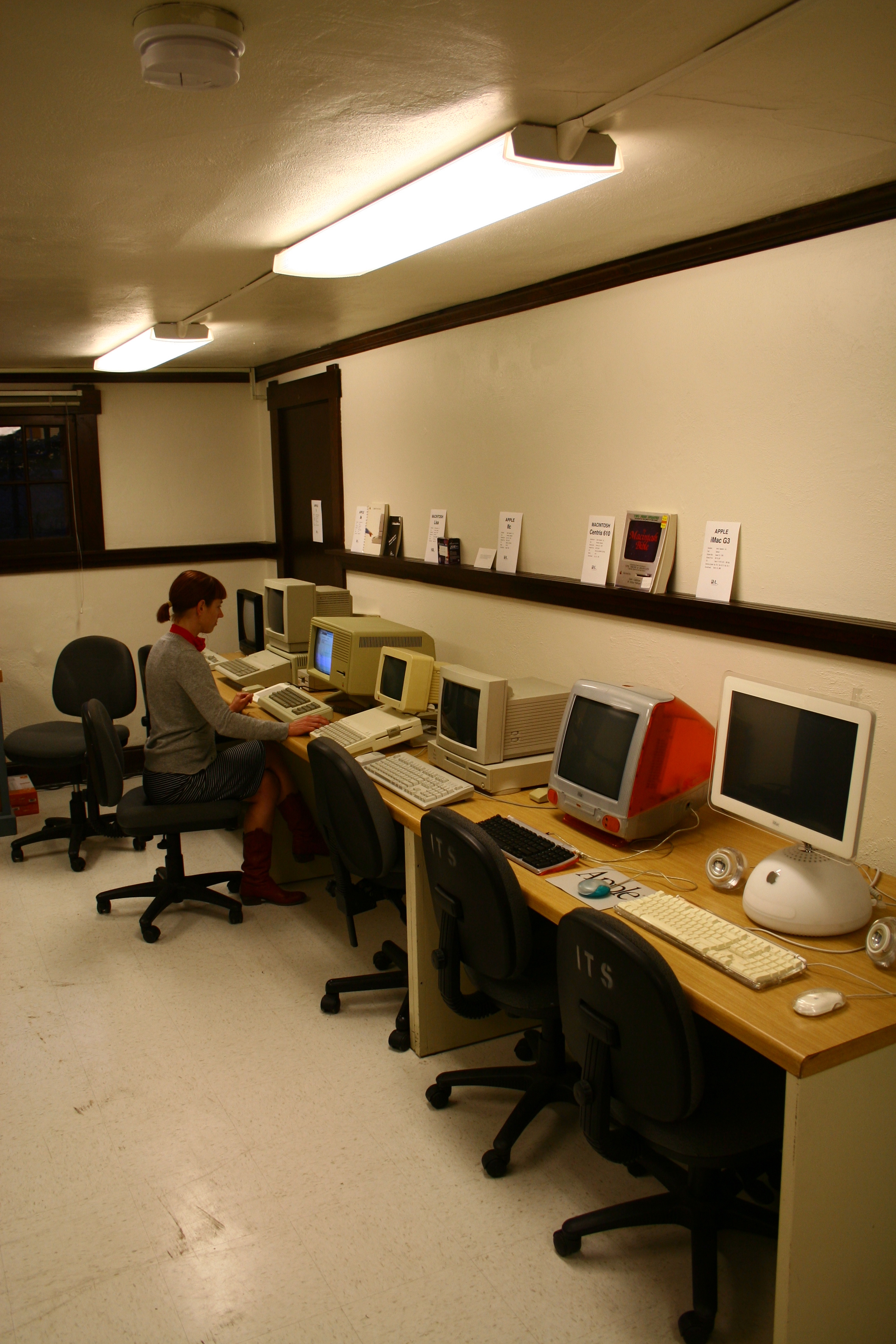
(Images and logo from the MAL lab and their website)









 Machinology