Insect Media – live coding trailer
Courtesy of my friend and the creative music technology and coder wiz Julio D’Escrivan, a live coding sonic video-trailer for Insect Media…
Dirty Matter
I was asked to write a short forum piece on “new materialism” for Communication and Critical/Cultural Studies-journal and I wrote a piece called “New Materialism as Media Theory: Dirty Matter and Medianatures”. It partly picks up on some of the themes I have been recently talking and writing about, influenced by such scholars as Sean Cubitt. It also articulated – albeit briefly – some points concerning German media theory as new materialism, even if going the quickly to a different direction concerning materiality. Here is a short taster of what’s to come.
The key points of the text were in short: 1) we need to understand how media technologies themselves already incorporate and suggest “new materialism” of non-solids, non-objects and this is part of technical modernity (the age of Hertzian vibrations); 2) we need also to understand bad matter – not just the new materialism that is empowering, but one that is depowering: the matter that is toxic, leaking from abandoned electronic media, attaching to internal organs, skins of low paid workers in developing countries. In this context, “medianatures” is the term I use to theoretically track the continuums from matter to media, and from media back to (waste) matter.
I believe that it is this continuum that is crucial in terms of a developed material understanding of media cultures. Hence, it’s a shame from a new materialist point of view that even such pioneering thinkers as Michel Serres miss this point concerning the weird materialities of contemporary technological culture – weird in the sense that they remain irreducible to either their “hard” contexts and pollution (CO2, toxic materials, minerals, and other component parts) or their “soft” bits – signs, meanings, attractions, desires. In Malfeasance. Appropriation Through Pollution? Trans. Anne-Marie Feenberg-Dibon (Stanford: Stanford University Press 2011), these are the two levels Serres proposes as crucial from an environmental point of view but he ignores the continuum between the two. And yet, signs are transmitted as signals, through cables, in hardware, in a mesh of various components from heavy metals to PVC coatings.
Perhaps a good alternative perspective to Serres’ is found in how both Félix Guattari and Gilles Deleuze conceive of a-signification as a regime of signs beyond signification and meaning: Gary Genosko’s apt example (in: Félix Guattari. A Critical Introduction London: Pluto 2009, 95-99 ) is the case of magnetic stripes on for instance your bank card as a form of automatized and operationalized local power that is not about interpretation, but a different set of signal work. Elaborating signaletic material – electronic signals and software – through a reference to Deleuze’s film theory and a-signification by Bodil Marie Stavning Thomsen is also useful. As she elaborates – and this much we know from years of intensive reading of Deleuze in screen based analyses – Deleuze wanted to include much more than signification into the cinematic impact, and mapped a whole field of a-signifying matter in film: “sensory (visual and sound), kinetic, intensive, affective, rhythmic, tonal, and even verbal (oral and written).” (“The Haptic Interface. On Signal Transmissions and Events” in Interface Criticism. Aesthetics Beyond Buttons, edited by Christian Ulrik Andersen and Søren Bro Pold, Aarhus University Press 2011, 59) What she points out in terms of signal media is as important: after signs come signals, and the media of signals needs a similar move as Deleuze did with film: to carve out the a-signifying material components for digital media too.
Such a-signifying components are rarely content to stay on one level, despite a lot of theory often placing primacy to software, hardware, or some other level. Various levels feed into each other; this relates to what Guattari calls mixed semiotics, and we can here employ the idea of a medianature-continuum. The a-signifying level of signs is embedded in the a-signifying materiality of processes and components.
In short, it’s continuums all the way down (and up again), soft to hard, hardware to signs. In software studies (see: David M. Berry, The Philosophy of Software. Code and Mediation in the Digital Age, Palgrave Macmillan 2011, 95-96), the continuum from the symbol functions on higher levels of coding practices to voltage differences as a “lower hardware level” has been recognized: assembly language needs to be compiled, binary is what the computer “reads”, and yet such binaries take effect only through transistors; and if we really want to be hardcore, we just insist that in the end, it comes back to voltage differences (Kittler’s famous “There is no Software”-text and argument). Such is the methodology of “descent” that Foucault introduced as genealogy, but German media theory takes as a call to open up the machine physically and methodologically to its physics – and which leads into a range of artistic methodologies too, from computer forensics to data carvery. In other words, recognizing the way abstraction works in technical media from voltages and components to the more symbolic levels allows us to track back, as well, from the world of meanings and symbols – but also a-signification – to level of dirty matter.
WSA MA Degree Show 2011
My new job at Winchester School of Art – and the students graduating of the 2010-2011 courses – is having its annual Masters Degree show. Chuffed about this. Includes a wide range of expertise from fine art to communication design, (advertising) design management to fashion and textile design.The Degree show kicks of September 1st with a Private View.
WSAMA 2011 launch and private view = 01/09/11 1800-2000 HRS
(Warning: the video has strong flicker).
For more info (and no-flicker), see the blog at http://wsama.wordpress.com/.
The podcasts are back – with a Paul Demarinis interview
Creative Technologies Review
A podcast on technology and creativity, technology mostly misused, unintentionally artistic technology and music technology with the odd splattering of digital economies by Julio d’Escriván and Jussi Parikka.
The Creative Technologies Review podcasts are continuing: we have a new episode online and available on Itunes, and it ranges from discussion about kidneys to Antarctica – and yet, the highlight is the Paul Demarinis-interview. I interviewed Demarinis, well known and rewarded for his various electronic(s) art projects since the 1970s, in Berlin in July. We talked about media archaeology, artistic methods and a whole range of other topics.
What also merits mentioning is the fact that the podcast is now “sponsored” not only by the CoDE-institute but also Winchester School of Art (University of Southampton), who are my new employer. This also means future interviews with exciting artists, theorists and lecturers affiliated with WSA. However, next episode promises more Berlin: an interview with Martin Howse, from the Microresearch lab: so more media archaeological art on its way. Meanwhile, enjoy our chats on selling body parts, talking Antarctica, and Paul Demarinis.
The Physicist of Media Theory – Friedrich Kittler’s Optical Media
Oops. I should have done this a long time ago, but better late than never. Anyhow, it took several years anyway before it came out in English – Friedrich Kittler’s Optical Media (Polity Press 2010, orig. 2002) – so a little delay in writing about the translation does not hurt.
It would be tempting to emphasize the radical alterity of the “Kittler-effect” (as named by Winthrop-Young) in relation to the more standardized and domestic Anglo-American discourses in media and cultural studies. Even the word “studies” is an abomination for Kittler, who is of the German tradition where “sciences” is still the word for humanities too. For Kittler, this is to be taken to its hard core: sciences stand at the centre of arts and humanities in the age of technical media, and a failure to take this into account would be like a bratwurst without sauerkraut. Nice, but not really the real thing.
This is one of the crucial points that a “German perspective” to media studies has promoted: media are not only the mass media of television, newspapers and such, but a technical constellation that at its core is based on scientific principles of coding, channeling and decoding of signals. When Kittler says the lectures (Optical Media is based on a lecture series he gave at Humboldt University, Sophienstrasse, Berlin, in 1999) are an investigation into man-made images, we should remember his earlier predisposition and tendency to talk of the “so-called-man. Kittler is after all a sort of a Foucault of the technical age (as also John Durham Peters in the foreword notes, instead of the usual label of Kittler as the Derrida of the digital age). Man is a temporary solution, a crossroad in the complex practices and epistemologies of knowledge that might (has?) proved to be not so useful anymore when media can communicated to each other without human intervention. Ask your plugged-in Ethernet cable, it knows the amount of data that goes through it without you pushing even a single key (as Wendy Chun reminds us in her Control and Freedom).
Kittler’s hostility towards any human-centred history of invention is well summed up for instance in this quote:
“And when Liesegang edited his Contributions to the Problem of Electrical Television in 1899, thus naming the medium, the principle had already been converted into a basic circuit. Television was and is not a desire of so-called humans, but rather it is largely a civilian byproduct of military electronics. That much should be clear.” (208)
That much should be clear, right? And Kittler is a techno-determinist, right? Well, as Winthrop-Young has in his wonderful little intro Kittler and the Media articulated, this judgment seems to be worse than claiming that someone enjoys strangling cute puppies, and hence needs no more than the accusation – whereas exactly this point needs elaboration. I am not promising to do that in this review, but just a quick point. One thing that we need to remember is that for Kittler, media are about science and engineering, and some of the confusions relate to how people are trying to read and apply him out of those contexts. Calling someone techno-determinist when he has continuously underlined that this is what he does – investigates the engineering aspects of media – is, well, redundant. Naturally this does not solve the whole question, but at least points to something we need to keep in our minds when reading Kittler.
His media theory is not about the media as interpreted, consumed and produced by creative industries, digital humanists, or such, but about the long genealogies of science, engineering and the qualities of matter that allow the event of media to take place. Media is displaced from McLuhanite considerations to “where it is most at home: the field of physics in general and telecommunications in particular.” Kittler is the physicist of media theory.
Optical Media is in that sense reader-friendly (if Kittler ever is) that it takes as its clear methodological point of departure Shannon’s communication theory. Slightly anachronistically Kittler transposes this as a model to understand media history. How coding, channeling and decoding takes places in material channels that are surrounded by noise.
Kittler’s Optical Media has several problematic statements, exaggerations and mistakes too – some of which the translator Anthony Enns has picked up on and made corrective notes. In other ways too, the translation is excellent, and presents us with a Kittler that is smooth to read. Translating Kittler is not easy, and much gets lost in translation but Enns is excellently equipped to present us media theory that is vibrant and readable.
It will be interesting to see how Kittler’s impact will be continued. Despite the rhetorical distanciation from US and UK that one encounters in this Sophienstrasse brand of media theory – which is wary of the Bologna Process of education standardisation in Europe threatening academic freedom, of Anglo-American monetarized neoliberal discourses of knowledge, and the general forgetting of old Europe and its philosophical traditions – recent years of English speaking media studies picked up at least indirectly from material media theory. Such ways of making sense of technical media are visible in software studies, platform studies, digital forensics à la Matthew Kirschenbaum and other recent, exciting theory debates. Kittler is being read. We don’t need a Kittler-jugend as Winthrop-Young has pointed out, but Kittler-effect is hard to escape; the big question is how to take that forward to as innovative directions as Kittler produced.
What is interesting is that the lack of German language in Anglo-American circles has produced a situation where most scholars are reliant on translations (I am glad to see Polity Press putting out Kittler-related literature). Hence, a lot have also missed the “turn” Kittler has taken during the past 10 years from war to love. The writer of post-humna media theory talks about love, sex and Antique Greece in his magnum opus project that could be summed as the attempt to place Jimi Hendrix (Electric Ladyland, And the Gods Made Love) in the age of Homer. The other Homer than a representation analysis of Simpsons’ Homer.
Notes:
1) Disclosure statement: My own new book is also contracted with Polity Press – Media Archaeology and Digital Culture (2012)
2) Friedrich Kittler’s last talk at the Sophienstrasse 22 address, Berlin. The Institutes are moving premises during summer 2011.
Atrocity Media
Reading J.G.Ballard’s The Atrocity Exhibition (1970) as media theory in a similar manner in which Thomas Pynchon was such an  influence to German media theory, and William Burroughs to cyber theory; with Ballard, the exhibition of the mediatic convergence of the inner and outer landscapes in the becoming flesh and spinal of our built environment, and the fabricated artefacts becoming the catalyzer for so much of what we considered “internal” – psychosis, perversions, and other feelings that constitute the everyday. Ballard is wonderful as an archaeologist of the architectures of fragmented bodies that he investigates through a science-media link, both tools of analysis: partial objects, intense focai of desire, parts in massive patterns of data. J.G.Ballard does big data. He establishes the link from media to science as the future source of sexual perversions, and at the centre of the collection of texts lies a world of research based on experiments and statistics. Optimum wound profiles, scientifically measured statistics of the body in arousal, leg positions.
Data – “Why I want to Fuck Ronald Reagan”:
Experimental Test Situation of “Reagan in a series of simulated auto-crashes”: one form of optimization again, this time as therapy:
“Subjects were required to construct the optimum auto-disaster victim by placing a replica of Reagan’s head on the retouched photographs of crash fatalities. In 82 percent of cases massive rear-end collisions were selected with a preference for expressed faecal matter and rectal haemorrhages. Further tests were conducted to the define the optimum model-year. These indicate that a three-year model lapse with child victims provide the maximum audience excitation (confirmed by manufacturer’s studies of the optimum auto-disaster.)”
With Ballard, the crash is of course one way of providing material for the imagination of new sexual perversions – part of social change. His way of mapping the psycho-sexual drives of perversions/desires as part of the political landscape is ingenious, and is as powerful as a Deleuze-Guattarian schizoanalytic mapping. Such mappings do not look for the signifying anchor point, but the productive processuality of where psychosis might stand – as a relay across various regimes of reality.
As a link between power and sexual fantasies, more experiments and data from Ballard:
 “Incidence of orgasms in fantasies of sexual intercourse with Ronald Reagan. Patients were provided with assembly kit photographs of sexual partners during intercourse. In each case Reagan’s face was superimposed upon the original partner. Vaginal intercourse,with ‘Reagan’ proved uniformly disappointing, producing orgasm in 2 percent of subjects. Axillary, buccal, navel, aural and orbital modes produced proximal erections. The preferred mode of entry overwhelmingly proved to be the rectal. After a preliminary course in anatomy it was found that caecum and transverse colon also provided excellent sites for excitation. In an extreme 12 percept of cases, the simulated anus of post-colostamy surgery generated spontaneous orgasm in 98 percent of penetrations. Multiple-track cine-films were constructed of ‘Reagan’ in intercourse during (a) campaign speeches, (b) rear-end auto-collisions with one and three-year-old model changes, (c) with rear-exhaust assemblies, (d) with Vietnamese child-atrocity victims.”
The perverse worlds Ballard paints from Jayne Mansfield and Marilyn Monroe to J.F.K and Reagan are mediated by the media technological worlds of cinematic expression. The cinema-landscape-desire –folding is itself a cartography of 20th century in a fashion that is insightful in its link to science and military.
The outside-inside linking as a methodology to investigate such cartographies of power and desire are now however faced with the question that Ballard already flirts with. How about this inside/outside in the age of post-phenomenological bodies, were desires circulate as part of architectures of computing, data, and chip architectures? A lot of the recent theoretical waves, such as thinking through affect (I am reminded especially of Shaviro’s Post-cinematic Affect) point towards such directions, but what if we insist on even more media-specific methodologies? Where do we go to map architectures of the non-visible, code and hardware, electromagnetic fields and signal processing? The Weber-Fechner law as a guide in our mapping of the changes in mediatic sensory intensities.
For more on Ballard in the context of media theory, read Matteo Pasquinelli’s Animal Spirits.
So22
Media theory has a place – and last night it was very much about Sophienstrasse 22, Berlin. Friedrich Kittler was running his institute there, and developed it over years into a classic Berlin location, that was also internationally known not only as the place of Berlin media theory (material, historical, technically specific, and weird) but more specifically as Sophienstrasse 22. This is not to say it’s the only place, and dissemination has worked – in Germany, and internationally.
Yesterday was the final academic event at Sophienstrasse, and our cadre of speakers was spectacular: Ernst, Pias, Hagen, and of course, with his red wine, his cigarettes, his Greek – Kittler. After that, our book presentation on Media Archaeology with some of the same speakers as well as Anthony Enns – a Kittler translator.

Wolfgang Ernst
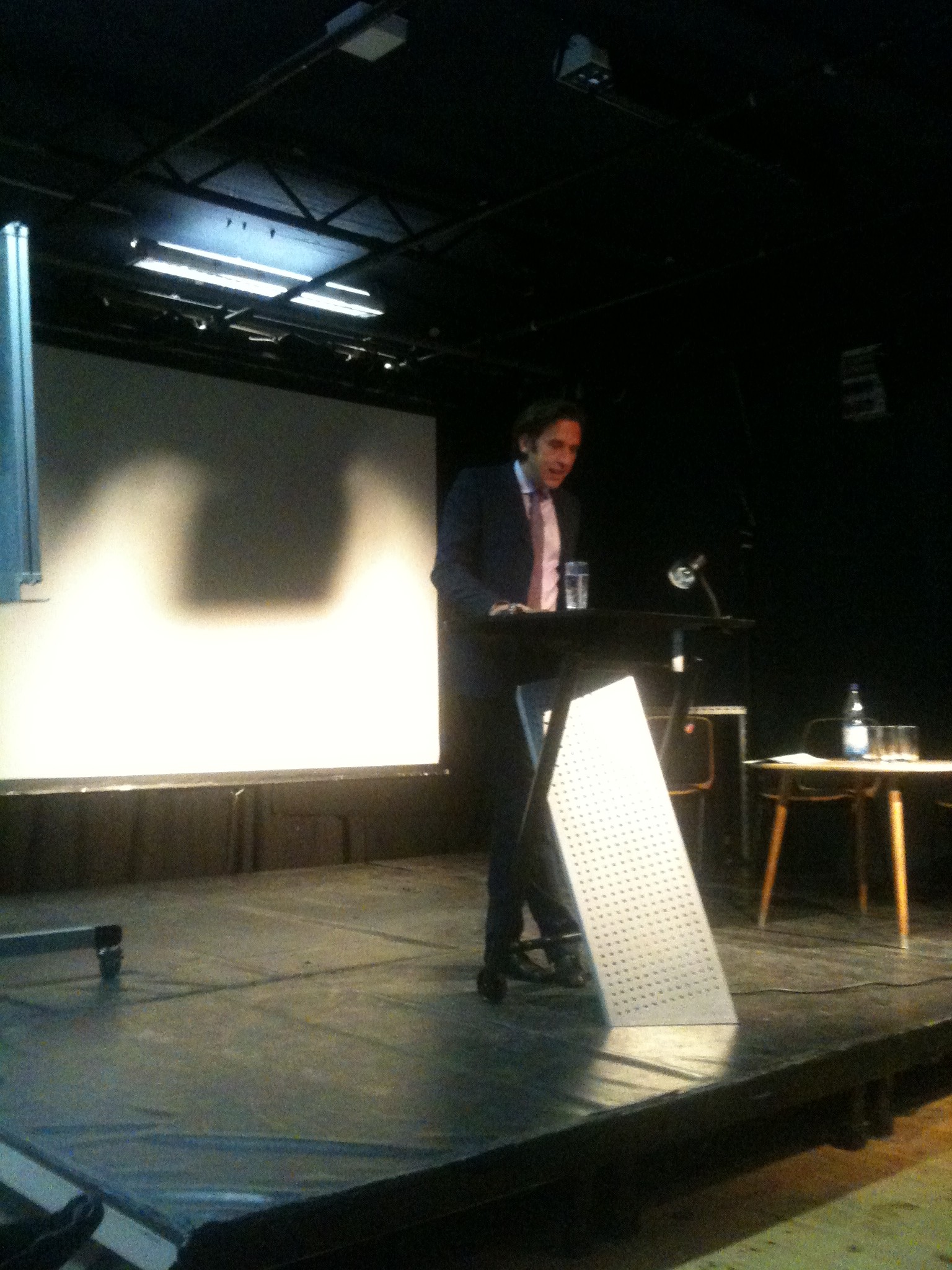
Claus Pias
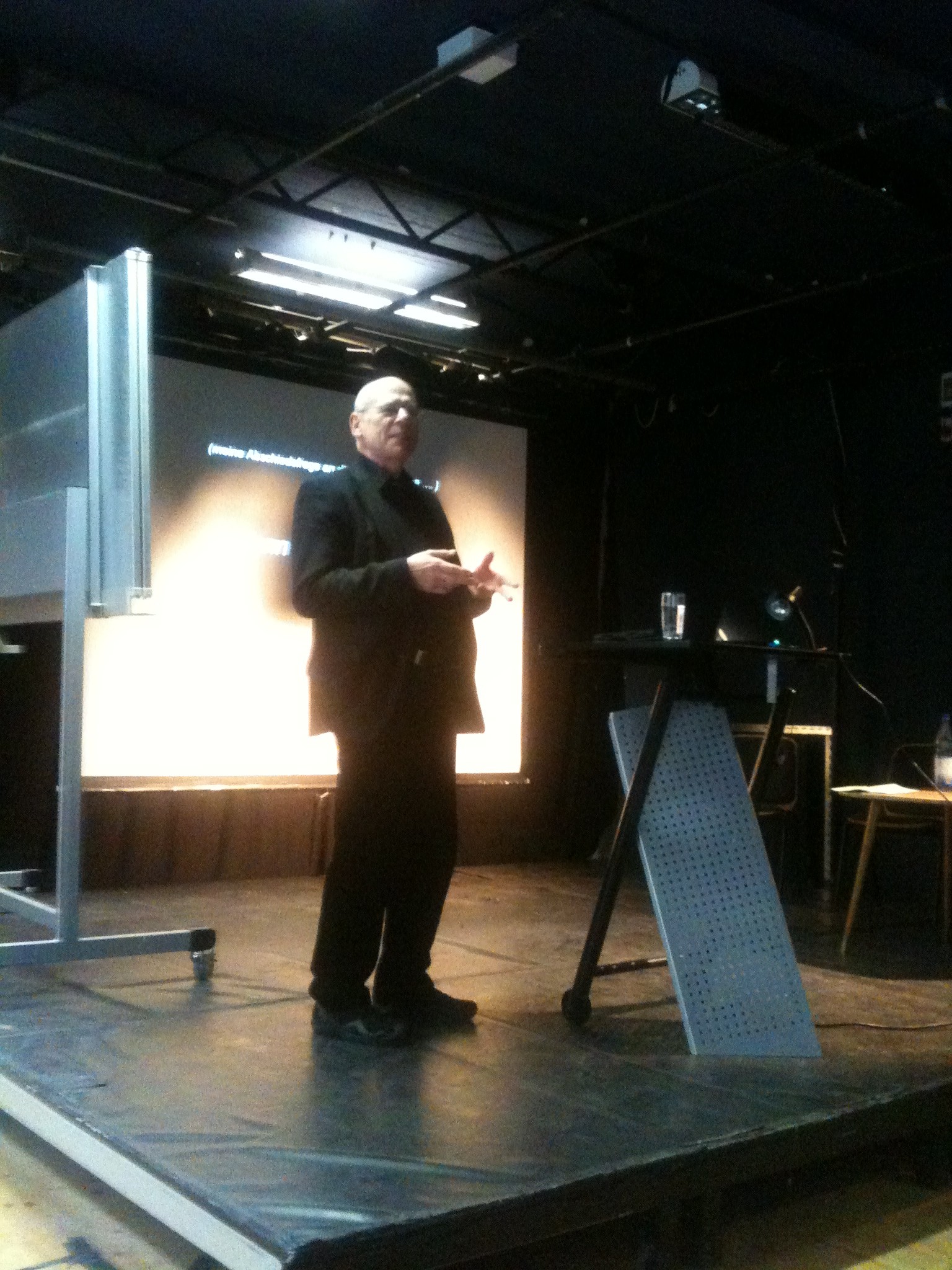
Wolfgang Hagen

Friedrich Kittler and the red wine.
Viral Capitalism – redux
Capitalism is sticky – it is able to attach to such a variety of objects, things, practices, and new fields that it almost seems to be productive in itself. Reading some interesting texts recently, I thought to pick up the concept of “viral capitalism” that I discussed in an earlier piece in 2005 and in Digital Contagions as an attempt to understand how it worked in relation to security politics of software in digital culture. Hence, it played the dual role of referring to virus cultures and anti-virus discourse, as well as pointing to a wider logic outside software of capitalism as that sticky, viral-like mode of spreading – not however just objects that are contagious, but environments, or milieus in which infection becomes possible. In such affective environments, capitalism as a sticky machine is able to operate. As part of the logic of security, then, it relates to how in milieus of (in)security , you are able to modulate affects, actions, practices and discourses so that you can get value even from risks, accidents and insecurity.
As such, one could say that an idea of viral capitalism relates to;
– the attraction power to which capitalism bases so much of its marketing power; this is the power of the affect to draw us in, to create worlds in which we feel natural to live in (capitalist worlds as leibnizian, as analyzed by Lazzarato). This is the aesthetic power of affect/attraction.
– Pass-on-power where social relations are in their already mimetic (Tarde) and infectious nature as if ready for appropriation into for instance marketing; (stay tuned for something we have written together with Tony Sampson – see his piece on Contagion Theory).
– The power of capitalism to turn even adversary practices as part of itself, directly or indirectly.
As a figure of network politics, viral capitalism functions in the aesthetico-technical regime.
An excerpt from Digital Contagions:
In a way, it seems as if capitalism invents such accidents and risks to keep itself busy. This idea that “if it’s not broken, break it” provides, then, an interesting way to approach the functioning of so-called information capitalism. Dangers and risks produce excellent needs and products in the consumer market, which aims to provide tools for controlling the uncertainties and anxieties of everyday life. The previous themes can be synthesized under the notion of viral capitalism, which stems from an idea of capitalism as capable of continuous modulation and heterogenesis. […]
The power of capitalism resides in its capability to appropriate the outside as a part of itself. In a sense, capitalism incorporates the ability to subsume heterogenesis as part of its production machinery, and heterogeneity is turned as part of the capital itself. In its functioning, capitalism is a continuing abstract machine of the new, inventing itself all the time, refusing to tie itself to any transcendent point (even though the actual workings of capital do constantly stop at some intervals of profit-oriented points, such as companies, corporations, and monopolies).
Of course, similar trends occurred in the cultural history of diseases long before viruses. As Nancy Tomes notes in her history of germs in America, the fear of microbes was, from the 1880s onward, turned into a lucrative business, with special goods and services designed for hygiene. This meant, for example, “safeguards against the dangers of sewer gas and polluted water, such as special toilet attachments and household water filters”, and on to antiseptic floor coverings and wall paint as well as sanitary dish drainers and fly traps. Hence, commodity interests were very active long before the media ecology of capitalist network culture.
Massumi argues that in information age capitalism, it is the circulation of things that counts, replacing their mere production as the key energetic principle of surplus value. This amounts to a change also in the commodity’s status where it becomes a self-organizing and living entity—a form of self-reproductive object. “The commodity has become a form of capital with its own motor of exchange (fashion, style, ‘self-improvement’) and cycle of realization (image accumulation/ image shedding (…)). Its value is now defined more by the desire it arouses than by the amount of labor that goes into it.”The commodity works as a virus— and the virus as part of the commodity circuit.
[…]
Luciana Parisi has made important remarks concerning the basis of information capitalism and the problems with Hardt and Negri. According to Parisi, the Empire becomes too easily a transcendent apparatus of power opposed to the creative virtualities of the multitude, which leads to a dualism of death and life, organic and inorganic. Instead, she proposes an endosymbiotic conception of capitalism, where it “exposes a machinic composition of molecular bodies involving continual and differential degrees of variation between bodies that capture and bodies that are captured.” Hence, she proposes an ongoing nonlinear symbiosis instead of a dualism. Capitalism, despite functioning as an apparatus of capture, does not proceed in a rigid manner of linear capture but proliferates differences in its wake. As Massumi writes, the rationality of neoliberalism works through a type of pragmatics, not perhaps so much through grounding principles or normative laws. Its cultivation of the metastable systems of markets and affects resides in its focus not on truth but on how the future (the unknown) can be managed on the basis of the data of the past (statistics). What matters is how to keep things running.
Object-Oriented-Madness
With tongue in cheek, I call it object-oriented-madness. Collections of lists, notes, polaroids: of objects, newspaper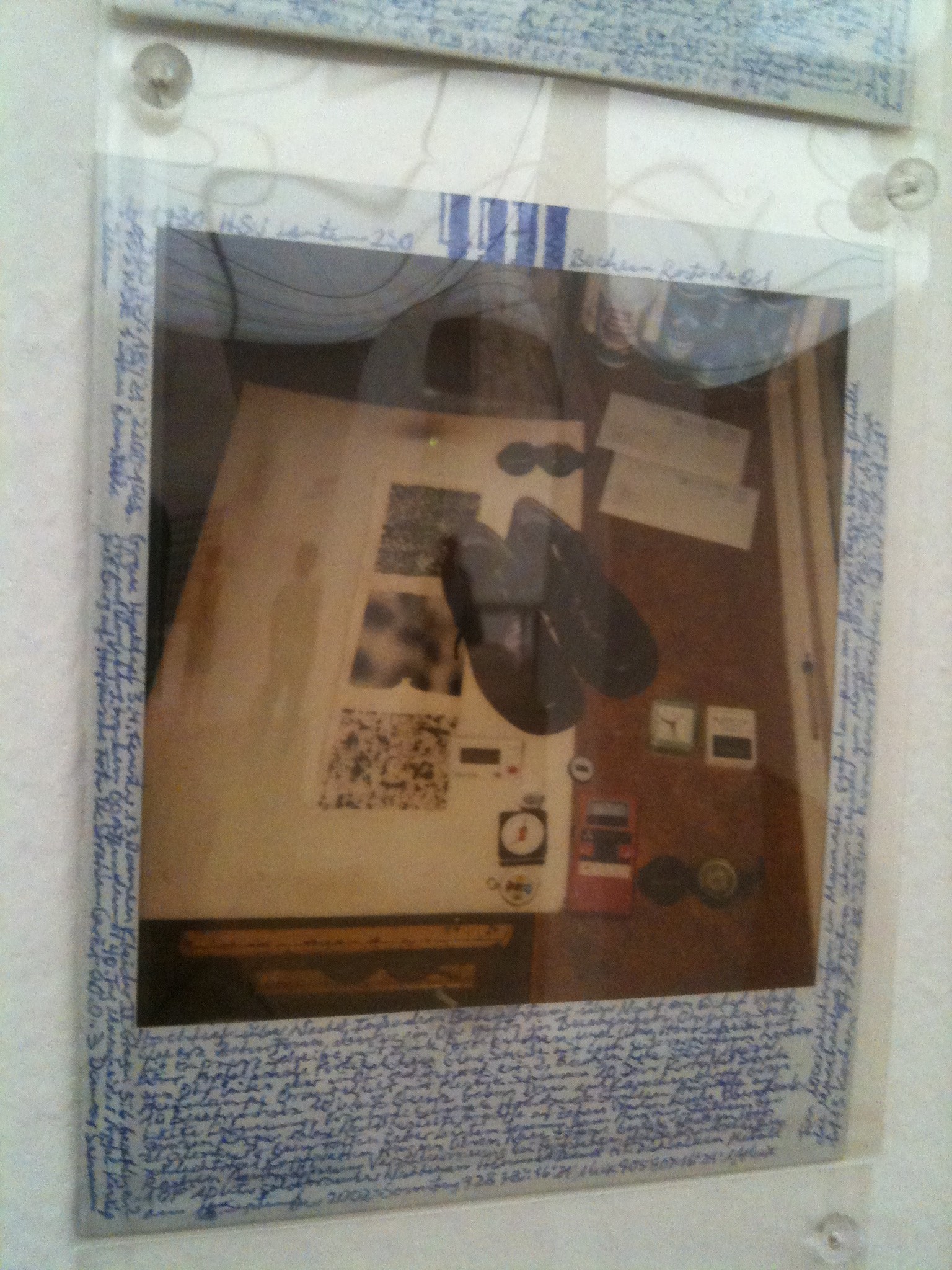 s, series after series, accompanied with measuring devices of various sorts (time measurement, geiger counter, and so forth). Even empty places, room corners, merit wide explanations and commentaries.
Horst Ademeit’s Secret Universe is like a diary of madness, illustrating some of the classical symptoms found often in medical case studies – and of continous interest to media theorists: they are not only personal/social symptoms, but socio-mediatic symptoms, as with Dr Schreber, or for instance Victor Tausk’s study of “influencing machine” concerning delusional schizophrenia – as well as broadcasting media (see Jeffrey Sconce’s article in Media Archaeology).
On the Hamburger Bahnhof-website the project is described as follows:
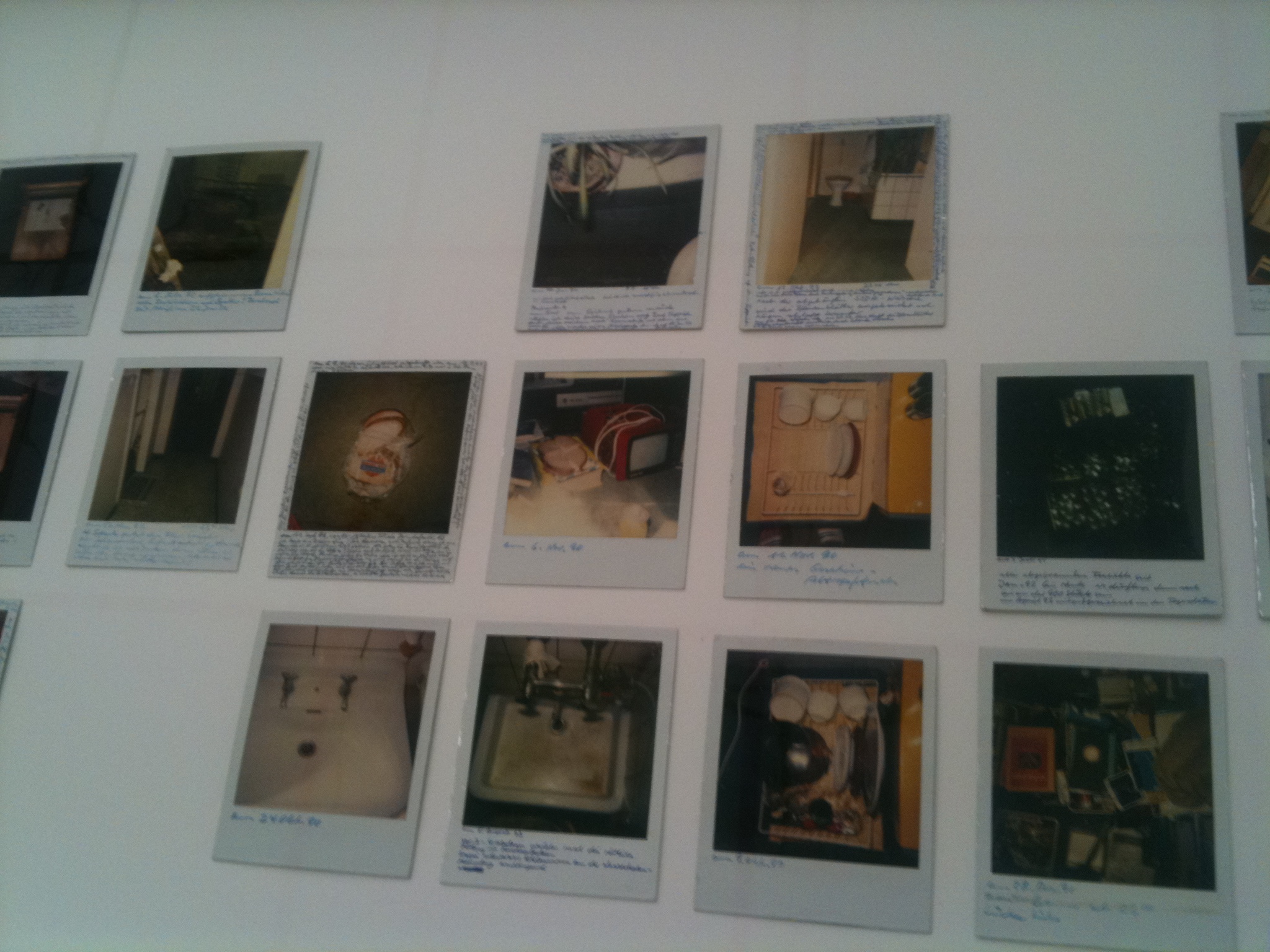
“This artist has devoted more than 20 years of his life to the photographic documentation of what he called “cold rays” and other invisible radiation that he thought harmed him and his environment. In the complex reference systems developed by Ademeit, certain motifs play a constant role: electricity meters, peepholes, building sites, electric cables, collections of bulky trash or bikes. Ademit began to cast the flood of images he produced in a concrete form in October 1990: he arranged measuring instruments and a compass on a newspaper and photographed them with a Polaroid camera. Over the course of 14 years, he made 6006 numbered Polaroids.”
Watching the hundreds, perhaps thousands of polaroids, meticulously commented one thinks of archival lists, notes, and notation systems themselves as tightly coupled with measurement systems. It’s curious how so many of the pictures were focused on electricity systems, part of wider electricity networks of course. But also indeed trash, miscellaneous objects in a manner that reminded me of some of the object-oriented ontology and vibrant matter theorists interest in hoarding and the life of objects. Jane Bennett talks of hoarding and “thing-power”, Paul Caplan has aptly talked of similar themes in relation to data and object-oriented philosophy approaches. What I want to point towards more widely is how the metaphysical idea of agency

Series
of things, and matter is inherent so well in mental disorders, which themselves can be seen as wider mediatic phenomena (well, also part of capitalist consumer society). As such, there is an inherent link between this technical media-capitalist context, and object-oriented approaches, if understood more widely. This brings specificity to the context in which the wider interest in thingsirreducible to discourses and human practices emerges. It is parallel to the observational power of the paranoid schizophrenic, who believes in thing-power — or that things have agency, connected to wider networks. Such paranoia is an observation of power, and of things empowered. Furthermore, watching the series of meticulous organisation (labeled, serialized also by numbering) of for instance newspapers to show the repetitious elements in layout etc. one cannot but think of the digital humanities projects concerning serialisation…could we find a geneaology even for that in the madness of painstaking serialisation?
Toilet Humour, or the History of Shit
Thanks to Robert Jackson, I was reminded of the existence of Dominique Laporte’s forgotten classic History of Shit – something I think I glanced at in the early 2000s when writing Digital Contagions. I never really dug into Laporte’s excavations of excrements, but was now reminded how wonderful and funny book it is. While offering a compelling (not without its problems in its strong reliance on psychoanalytic conceptual arsenal) multiple history of language/shit/public space/private individual as the modern ecology of subjectification, it talks as much about things that smell as it does about the various exercises to remove that inconvenient materiality. Stories of shit are about money, the subject, space, cleansing, materiality, toilets, makeup, privacy, urban design as well as, well, the thing itself.
See here for Jackson’s blog post about the book, and below a proof of its funny, quirky style and examples – as this letter from Madame la duchesse d´Orléans (1694) about the privileges and pleasures of the body – and its techniques, facilities.

subjectification - toilet training
“Fontainbleau, October 9, 1694
To the Electress of Hanover
You are indeed fortunate to shit whenever you may please and to do so to your heart’s content! … We are not so lucky here. I have to h old on to my turd until evening; the houses next to the forest are not equipped with facilities. I have the misfortune of inhabiting one and consequently the displeasure of having to shit outside, which gravely perturbs me because I like to shit at my ease with my ass fully bared. Item all manner of people can see us shitting; there are men who walk by; women, girls, boys, abbeys, Swiss Guards… As you can see, there is no pleasure without pain , and if we did not have to shit, I would be happy as a fish in water here at at Fontainbleau.”












 Machinology