A Pan-European Day of Anti-Austerity
We are all Greeks, but even more: it was pitched as the “1st Pan-European General Strike”. Yesterday, 14/11/12, around 40 unions taking part in anti-austerity protests across 23  European countries–that is at least something. So how do we make sure a day of anti-austerity turns into a week, a month, and years?
And see below, not that crazy demands, right? Not even absurd. Actually…quite modest.
Instead of austerity-driven cuts:
• Economic governance at the service of sustainable growth
and quality jobs,
• Economic and social justice through redistribution policies, taxation
and social protection,
• Employment guarantees for young people,
• An ambitious European industrial policy steered towards a green,
low-carbon economy and forward-looking sectors with employment
opportunities and growth,
• A more intense fight against social and wage dumping,
• Pooling of debt through Euro-bonds,
• Effective implementation of a financial transaction tax to tackle
speculation and enable investment policies,
• Harmonisation of the tax base with a minimum rate for companies
across Europe,
• A determined effort to fight tax evasion and fraud,
• Respect for collective bargaining and social dialogue,
• Respect for fundamental social and trade union rights.
– as proposed by the European Trades Union Convention
Renew — a CFP: Media Art Histories 2013
Media Art Histories-events are warmly recommended — so heads up for Riga 2013. The themes revolve around obsolescence, media archaeology, environment as well as archives. I am glad also to sit on the Advisory Board of the event!
Call for Abstracts:
Media Art Histories 2013: RENEW
The 5th International Conference on the Histories of Media Art, Science and Technology
Riga, October 8 – 11, 2013
The 5th International Conference on the Histories of Media Art, Science and Technology, Renew, will be hosted by RIXC and held in Riga, Latvia, October 8 – 11, 2013, coinciding with the international festival for new media culture Art+Communication. It will host three days of keynotes, panels and poster sessions on the histories of networked digital, electronic and technological media arts.
Besides general topics of the call, the theme of Renew, Media Art History 2013 addresses current tendencies in sustainability quests from various perspectives. As media art is based on increasingly out-dating technology and it is dependent on energy (electricity) the conference will discuss sustainable approaches towards the issues of producing, preserving and representing media artworks – how to ‘renew’ them through both – tools and histories. By focusing on networked media arts, the Renew conference will cover a broad range of topics to include early communication art (mail, fax, radio, satellite, etc.), net.art and net.radio, open source and network culture, locative media and wireless communities, hybrid networks and electromagnetic art, and last but not least – artistic investigations in sustainability, and future visions of art within the convergence of information and energy technologies.
Proposed topics:
* Histories of networked art and media technologies
* Archiving, preserving and representing new media art
* Media archaeology
* Paradigm shift – from new media to post-media conditions in art
* Writing histories of media art across Eastern Europe and the Baltics
* Revising the geospatial aspects – for writing comparative media art histories
* Resilient networks and emerging ‘techno-ecological’ art practices
* Multifarious potential of expression in media art – ‘new imagery’ of our times
* * *
DEADLINE for abstract proposals: January 25, 2013.
Notification of acceptance will be announced in March 25, 2013.
Individual proposals should consist of a 250-word abstract with title.
Proposals and inquiries regarding submissions should be made on www.mediaarthistory.org web-site.
* * *
Selected papers from the conference will be published in Acoustic Space and other venues. Founded in 1998 by E-Lab as artistic journal for sound art, networked audio experiments and new media culture, since 2007 Acoustic Space comes out as peer-reviewed journal for transdisciplinary research on art, science, technology and society, published by RIXC & Art Research Lab of Liepaja University.
* * *
The conference will be complemented by a variety of affiliated events, including the Art+Communication festival, with a thematically related media art exhibition, experimental film and video screening programme, live performances, concerts and workshops.
* * *
MAH 2013 Renew Conference Chair: Rasa SMITE and Raitis SMITS
Honorary Board: Jasia REICHARDT, Itsuo SAKANE, Peter WEIBEL, Douglas DAVIS, Robert ADRIAN
Renew Conference Advisory Board: Erik KLUITENBERG, Armin MEDOSCH, Inke ARNS, Andrey SMIRNOV, Jussi PARIKKA, Edwin van der HEIDE, Mark TRIBE, Gediminas URBONAS, Marko PELJHAN, Nishant SHAH, Edward SHANKEN, Darko FRITZ, Tatiana BAZZICHELLI, Frieder NAKE
White Stripes to Zombie Media – A Theme Tune
Jack White might not agree but White Stripes’ “Rag & Bone” goes at the top of my list for the theme tune for zombie media and media archaeology. Listen to it.
If you don’t want it, we’ll take it; if you don’t want to give it to us, we keep walking by.
Keep going, we’re not tired.
Got plenty of places to go, lots of homes we ain’t been to yet.
West side, southwest side, middle-east, rich house, dog house, outhouse, old folks house, house for unwed mothers, halfway homes, catacombs, twilight zones.
Looking for techniques, turntables to gramophones.
So take a last lick of your ice cream cone.
And lock up what you still want to own.
But please be kind.
And don’t rewind.
All of your pretty, your pretty little rags and bones.
All that obsolete stuff and junk, piled up, ready to be used, reused, modified and reappropriated – your rags and bones that fill the attic, the junkyard, the garage.
Of course, this applies to Jack White/White Stripes more generally too. He might not acknowledge that also the pre-digital is technological but still, this is where it actually gets interesting. For instance recording in non-digital studios (Elephant was recorded in London, at Toerag Studios):
It’s all tech, and scholars of music technologies and sound recording could tell much more about that. For Kittler, of course, it was about the reuse of war technologies in the studio, from Stockhausen’s late 1950s use of “the pulse generator, indicating amplifier, band-pass filter, as
well as the sine and square wave oscillators “, all remnants “ discarded U.S. Army equipment” (1999: 97) to Abbey Road . Microphones and tape technologies, all points to the primacy of the studio as this set, place of experimental modes of time axis manipulation and hence reality manipulation. Continuing with Kittler: “Berliner’s primitive recording technology turns into a Magical Mystery Tour. In 195 4 , Abbey Road Studios, which not coincidentally produced the Beatles’ sound, first used stereo audiotapes; by 1970 eight-track machines had become the standard; today discos utilize 3 2 or 64 tracks, each of which can be manipulated on its own and in unison.226 “Welcome to the machine, ” Pink Floyd sang, by which they meant, “tape for its own ends-a form of collage using sound .” In the Funkspiele of the Abwehr, Morse hands could be corrected; in today’s studios, stars do not even have to be able to sing anymore. When the voices of Waters and Gilmour were unable to hit the high notes in “Welcome to the Machine,” they simply resorted to time axis manipulation: they dropped the tape down half a semitone while recording and then dropped the line in on the track.” (109)
Similarly, it’s the operative technics that allows Jack White to do his rag & bone sort of technicity, completely technological too, and why not even a bit of zombie mediaesque in some of its valorisation of the media archaeological moment. Obviously, part of the narrative of rock is the insistance on the authencity which itself is consolidated through technical media.
And that is the trick. In the perceptive note by Ryan Bishop and John Phillips, in their book on avantgarde aesthetics and military/modern technologies they write of this constitutive role of media as environments for such a narrative that keeps on recurring — and is itself recursive in relation to the technological platform sustainining it: ” […] recording technology – like military surveillance technology – is designed to reduce the evidence of the technology itself, bringing the performance into your living room or bar, replacing “live” music, perhaps to the detriment of live performers.” (2011: 89).
Archival Infusions. An Interview with Robin Boast
Here another earlier recorded interview I did, this time with Dr Robin Boast. Our chat was inspiring for me, as usual; we talked archives, metadata, cultural heritage institutions and digital culture, and I always find Boast’s insights so provocative, so fresh. Boast is really someone who can talk of archival fevers and the history of the discipline; archive as a profession and an institution. He offers wonderful archival, museum science and anthropological  insights, infusions, into digital culture.
You can find the interview Mp3 here. The timing of re-uploading of the interview, from January 2011, is good; Boast has just been appointed Professor of Cultural Information Sciences at the University of Amsterdam in Netherlands, leaving behind UK and Cambridge. Great catch for Amsterdam!
Just to remind: all of these interviews I have been posting were made originally in the context of the Creative Technology Review podcasts, that I did with Julio D’Escrivan.
Don’t call him a media philosopher!
It was one year ago that Friedrich A. Kittler died. The German newspapers reacted, and slowly, The Guardian too, with a couple of writings and a podcast. I think that was it, for the English-speaking mainstream press. Besides some short notes on my blog, I wrote this short piece for The Guardian.
Academic discussions concerning his work have increased even more: such also include fantastic pieces like the memoir by Geoffrey Winthrop-Young of the Kittler-before-Kittler (i.e. the early 1980s one) ‘”Well What Socks is Pynchon Wearing Today?” A Freiburg Scrapbook in Memory of Friedrich Kittler’ in Cultural Politics Volume 8, Issue 3, and a forthcoming ZKM conference Of Gods and Scripts around the Mediterranean.
Of last year’s obituaries, some are circulating again online. Here is for instance FAZ: Jede Liebe war eine auf den ersten Blick.
Indeed, Kittler got the human (well, actually “spirit”, “the mind”, Geist – Geisteswissenschaften) out of humanities, and inserted the machine. Suddenly, inside the human(ities) we found all kinds of hardware. Typewriters, gramophones, circuit boards, computer chips, probably even a bit of internet cable in there somewhere.
However, don’t inscribe “media philosopher” on his grave stone.
And no, he did not call himself a media archaeologist either.

An Interview with Martin Howse
This is another interview, and audio recording now available, that I did in Berlin in 2011. It is my chat with Martin Howse, of microresearch, and the project(s) together with Jonathan Kemp and Ryan Jordan: decrystallisation, recrystallisation and the later Crystal Worlds in Berlin and London. We talk of what the crystal project means, ideas related to art methods, and ending up with evil media.
Related readings of The Crystal World exhibition: Howse and Kemp in Mute Magazine, and Matthew Fuller in the same magazine: “The Garden of Earthly Delights.”
Apologies for a bit lousy quality of the sound in my recording.
An Interview with Paul DeMarinis
I interviewed Paul DeMarinis in July 2011 in Berlin about his media archaeological art practices and methodology.
It was originally in the context of the Creative Technologies Review podcasts we did with Julio D’Escrivan, but the archives of those podcasts are not available so I wanted to share this interview (audio, mp3) for those interested.
Media Archaeology Lab, Colorado/Boulder
I am honoured to join the Advisory Board of the Media Archaeology Lab (University of Colorado in Boulder). Lori Emerson, the director, has b een working hard on this project that I have been following for a while now. It brings its own pedagogical and research mission as part of the discourse of media labs. Go back, slow down, but in order to do something exciting, it seems to be shouting to the digital calculating power boasting jazzy institutions which are a university senior management’s wet dream. Indeed, it is pitched as “is a place for cross-disciplinary experimental research and teaching using the tools, the software and platforms, from the past.”
As a parallel, I want to point to the Media Archaeological Fundus in Berlin, at the Institute of Media Studies, as one significant, already existing example. With a slightly different pitch, it also uses “media archaeology” as the nodal term through which to articulate its research and pedagogical mission. For it’s director, Wolfgang Ernst, this ties to the idea of “epistemic toys” — toys however only in the German meaning of “Spielzeug”, with a nod towards Heideggerian Zeug. What is significant for the objects in the Berlin Fundus is their epistemological value — media objects as epistemological objects that open up specific knowledges that are irreducible to their cultural techniques, as the introductory text to the Fundus states.
As part of the Colorado/Boulder Media Archaeology Lab, their motto “the past must be lived so that the present can be seen” actually corresponds to some of the ideas about processuality of the Berlin Fundus. I argue that one has to take this motto literally. The past (media technologies) must be experienced in operation, in process, so as to understand their epistemological value, so to speak. That way, to refer back to Ernst, they are able to smuggle a bit of the past as living present — an undercutting theme in media archaeology more widely, as Vivian Sobchak argued in the collection Media Archaeology. This is why we need these kinds of labs, as a form of critical education – and engineering – of past media technologies to understand the current electronic culture.
As part of MAL advisory board, I am in great company; other advisory board members include Matthew Kirschenbaum, Lisa Gitelman and Garnet Hertz, among other great folks. Wonderful initiative!
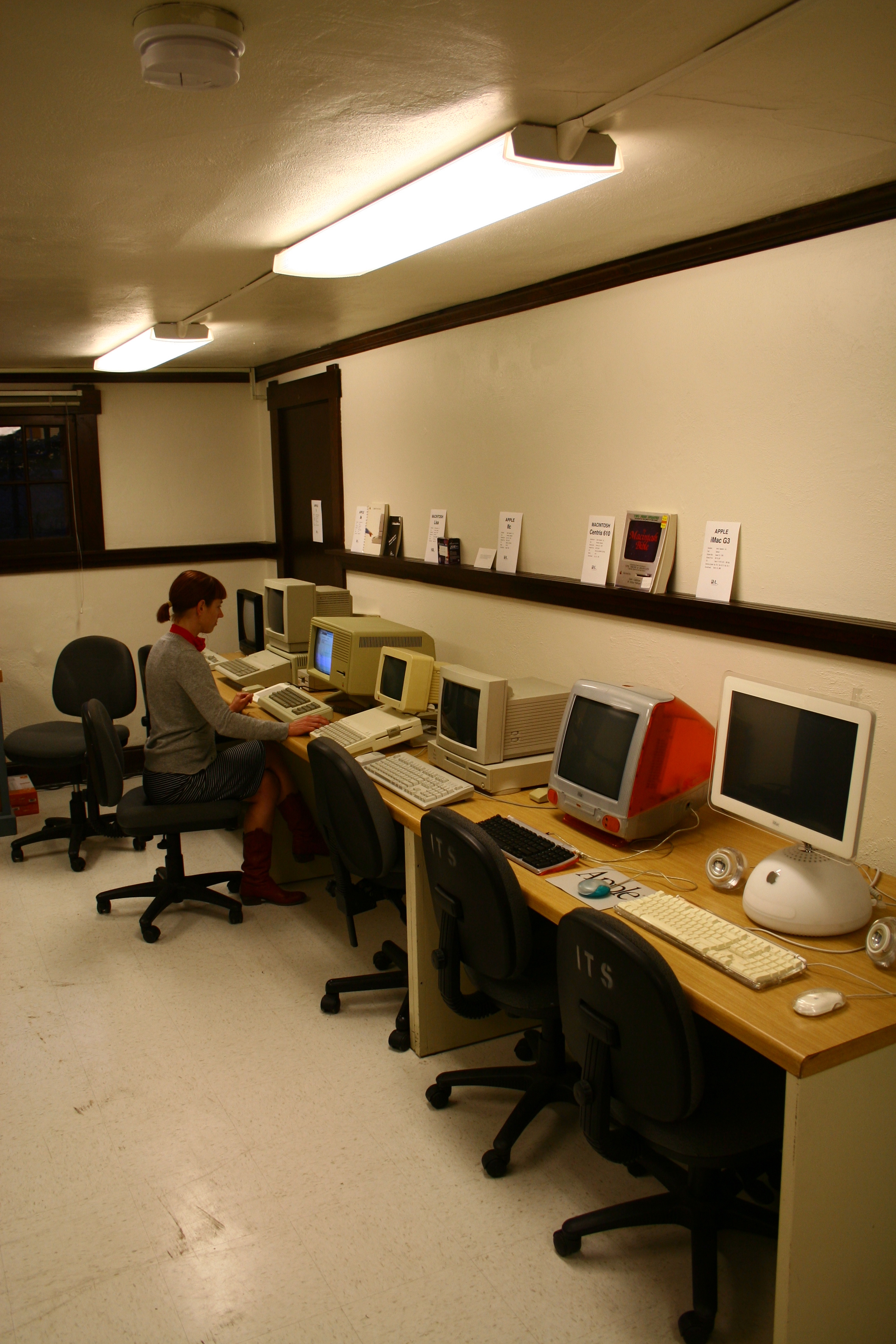
(Images and logo from the MAL lab and their website)
A Call for An Alternative Deep Time of the Media
I am here recapping some ideas from an earlier post, but I wanted to flag this as a separate theme…
I want to pick up on Siegfried Zielinski’s notion of deep time of the media — not straightforwardly media archaeological, but an anarchaeological call for methodology of deep time research into technical means of hearing and seeing. In Zielinski’s vision, which poetically borrows from Stephen Jay Gould’s paleontological epistemology at least in its vision, the superficiality of media cultural temporality is exposed with antecedents, hidden ideas, false but inspiring paths of earlier experimenters from Empedocles to Athanius Kircher, Johann Wilhelm Ritter to Cesare Lombroso.
Zielinski’s excavations are not content to stay within the regime of media archaeology, but want to uncover a non-linear layering of variations. Indeed, in a manner that seems to be borrowing from a Deleuze-Guattarian ontology of nomadism and the primacy of variation (I don’t however think that Z makes the link to DG explicit), Zielinski’s methodology is in this sense a refusal of any master plans of media development and a plea against both the drive towards psychopathia medialis (the standardization and uniformity as well as illusions of teleology). Instead, the paleontological conceptualisation of a media history of variations finds surprising case studies of aberrants paths for hearing and seeing, of optics and acoustics, of technical means of guiding, misguiding, educating and mocking the senses.
And yet, as an alternative deep time, I suggest that instead of male heroes, we approach a more geologically tuned deep time – deep in various senses, down to mineral excavation, and picking up some themes of media ecological sort. I want to speculate with a more geologically oriented notion of depth of media that is interested in truly deep times – of thousands, millions, billions of years and in depth of the earth; A media excavation into the mineral and raw material basis of technological development, through which to present some media historical arguments as to how one might adopt a material perspective in terms of ecological temporality.
For instance for the European Union, the future of information technology has to be planned starting from a material level up: The EU does not hold much in terms of critical raw material resources when it comes to advanced technology that are identified crucial for a longer term socio-economic change. Obviously, such issues are always voiced with a concern for the geopolitical-economic consequences. In short, this refers to the crucial status of China, Russia, Brazil, Congo and for instance South-Africa as producers of raw materials, and an alternative material future of technological culture. This connects to a realisation: the materiality of information technology starts from the soil, and underground – 500 meters, and preferably (for the mining companies) lower as the earth’s crust is dozens of kilometres deep.
Cobalt —- Lithium-ion batteries, synthetic fuels
Gallium —- Thin layer photovoltaics, IC, WLED
Indium —– Displays, thin layer photovoltaics
Tantalum —- Micro capacitors, medical technology
Antimony —– ATO, micro capacitors
Germanium —– Fibre optic cable, IR optical technologies
Niobium —– Micro capacitors, ferroalloys
Neodymium —- Permanent magnets, laser technology[1]
From animals to nature as a resource, a material ecology for media is an increasingly important topic. This is the double bind that relates media technologies to ecological issues; on the one hand, acting as raw material for the actual hardware, from cables to cell phones; on the other hand, as an important epistemological framework whether in relation to mapping of climate change or in terms of further resources for exploitation, as in the recent proposal not just for Internet of Things – but Internet of Underwater Things.
Perhaps an alternative sort of a deep time of the media is needed – one that does not excavate deep times of human inventions, successful or just imagined, but deep times of animal and geological sort, and the cultural techniques that are affiliated with such non-human regimes? This could be a further advance to consolidate the work of media ecology and zootechnics (cf. Sebastian Vehlken’s recent work in this area, as well as Insect Media).
[1] European Union Critical Raw Materials Analysis, By the European Commission Raw Materials Supply Group, July 30, 2010. Executive Summary by Swiss Metal Assets, October 1, 2011, under www.swissmetalassets.com (24.7.2012).
Zombie Media in Leonardo
The circuit bended and definitely (re)modified fruits of our collaboration with Garnet Hertz are out. True, “Zombie Media” has been circulating as an unborn living dead text for a longer while, ever since it was part of the Transmediale 2010 Theory Award competition — but now it is finally officially out in Leonardo (vol. 45, no 5)!
Working with someone like Garnet is a pure joy, and demonstrates why collaboration is good for you: you learn a lot. A lot lot.
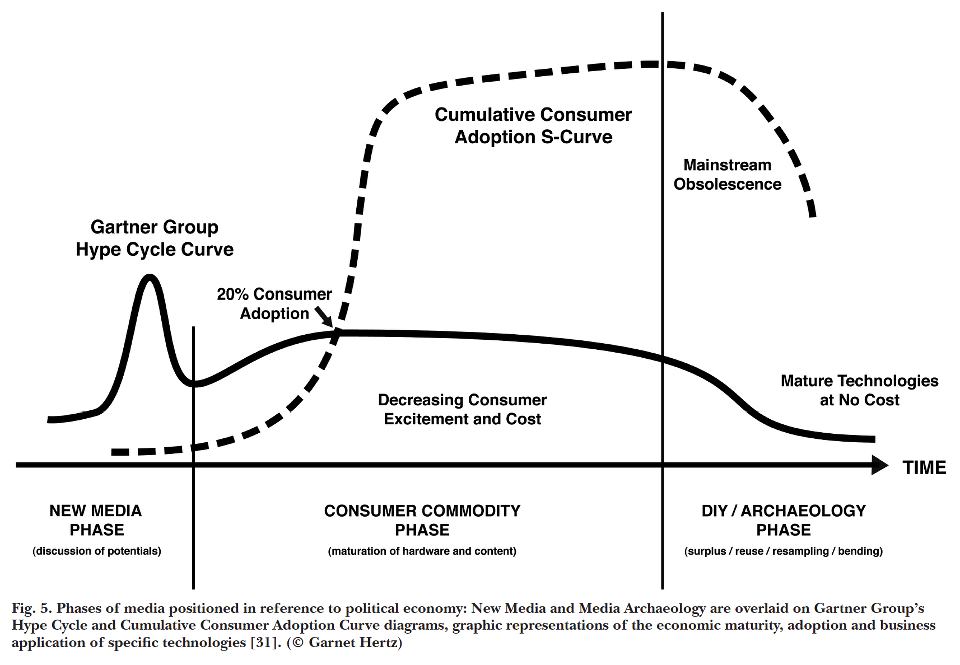
As a teaser to the longer “Zombie Media: Circuit Bending Media Archaeology into an Art Method”-article, please find below the short “manifesto” on “Five Principles of Zombie Media” we co-wrote for the Defunct/Refunct-catalogue (PDF).
———-
Zombie media addresses the living deads of media culture. As such, it is clearly related
to the earlier calls to investigate “dead media” by Bruce Sterling and others: to map
the forgotten, out-of-use, obsolete and declared dysfunctional technologies in order
to understand better the nature of media cultural development. And yet, we want to
point to a further issue when it comes to abandoned media: the amount of discarded
electronic media is not only the excavation ground for quirky media archaeological
interests, but one of the biggest threats for ecology in terms of the various toxins they
are leaking back to nature. A discarded piece of media technology is never just discarded
but part of a wider pattern of circulation that ties the obsolete to recycling centers,
dismantling centres in Asia, markets in Nigeria, and so forth – a whole global political
ecology of different sorts where one of the biggest questions is the material toxicity of
our electronic media. Media kills nature as they remain as living deads.
Hence, we believe that media archaeology – the media theoretical stance interested
in forgotten paths and quirky ideas of past media cultures – needs to become more
political, and articulate its relation to design practices more clearly. We are not the only
ones that have made that call recently – for instance Timothy Druckrey writes:
“The mere rediscovery of the forgotten, the establishment of oddball paleontologies, of
idiosyncratic genealogies, uncertain lineages, the excavation of antique technologies or
images, the account of erratic technical developments, are, in themselves, insufficient to
the building of a coherent discursive methodology.” [2]
We would want to add that in addition to developing discursive methodologies, we
need to develop methodologies that are theoretically rich as well as practice-oriented –
where ontologies of technical media meet up with innovative ideas concerning design
in an ecological context.
As such, the other part of the zombie media call is the work of reappropriation
through circuit bending and hardware hacking methodologies – to extend the media
archaeological as well as ecosophic interest into design issues. By actively repurposing
things considered dead – things you find from your attic, the second hand market, or
amongst waste – the zombiefication of media is to address the planned obsolescence of
media technologies which is part of their material nature. In reference to contemporary
consumer products, planned obsolescence takes many forms. It is not only an ideology,
or a discourse, but more accurately takes place on a micropolitical level of design:
difficult to replace batteries in personal MP3 audio players, proprietary cables and
chargers that are only manufactured for a short period of time, discontinued customer
support, or plastic enclosures impossible to open without breaking them. Whether you
can open up things – the famous black boxes of media culture characterized by iPhones
and iPads – is one of the biggest political and ecological questions facing our media
theory and practices too.
As a manifesto, five points of zombie media stand out:
1/ We oppose the idea of dead media. Although death of media may be useful as a tactic to
oppose dialog that only focuses on the newness of media, we believe that media never
dies. Media may disappear in a popular sense, but it never dies: it decays, rots, reforms,
remixes, and gets historicized, reinterpreted and collected. It either stays as a residue
in the soil and in the air as concrete dead media, or is reappropriated through artistic,
tinkering methodologies.
2/ We oppose planned obsolescence. As one corner stone in the mental ecology of
circulation of desires, planned obsolescence maintains ecologically unsupportable
death drive that is destroying our milieus of living.
3/ We propose a depunctualization of media and the opening, understanding and hacking
of concealed or blackboxed systems: whether as consumer products or historical
archives.
4/ We propose media archaeology as an artistic methodology that follows in the traditions
of appropriation, collage and remixing of materials and archives. Media archaeology
has been successful in excavating histories of dead media, forgotten ideas, sidekicks and
minor narratives, but now its time to develop it from a textual method into a material
methodology that takes into account the political economy of contemporary media
culture.
5/ We propose that reuse is an important dynamic of contemporary culture, especially
within the context of electronic waste. “If it snaps shut, it shall snap open.” We agree in
that open and remix culture should be extended to physical artifacts.






 Machinology