Architecture’s Underbelly
One of the low points of architecture in 2013 was architect Zaha Hadid’s football stadium in Qatar. Designed for the forthcoming games of 2022, the main part of the discussion has been about whether it resembles a vagina or not.

Besides reducing architectural discourse to a pretend shock about female genitalia, the case is emblematic of how design is detached from the actual world conditions. Instead of engaging in any way with the reports about abusive working conditions in the construction sites of such stadiums for Qatar 2022, we are left debating the building’s pinky Freudian connotations. Despite the pseudo-feminist debate it raised, a rather sad moment for design. It actually just flags detachment of both architectural popular discourse and architects such as Hadid from a connection with things that might have some material meaning or a meaningful impact for those whose lives this has a direct lived relation.
The underbelly of star designers are: “long working hours, hazardous working conditions, the workers being unpaid for months, had their passports confiscated, forced to live in overcrowded labour camps, denied the right to form unions, and without access to free drinking water in extreme heat”.
But the creative industries backed discourse of stars and creativity demands this underbelly of grey abusive low-paid and globally displaced hard work that is sustaining the fluffy public discourse about design.
Cultural Techniques-special issue
Our book-length special issue on Cultural Techniques (Kulturtechniken) is out. Co-edited by Geoffrey Winthrop-Young, Ilinca Iurascu and myself, the special edition in Theory, Culture & Society is a significant introduction to the term that stems from German academic discussions in cultural and media studies. One could say it offers a significant variation on themes familiar from postwar German humanities’ focus on media, technologies and epistemo-ontological questions of culture in a post-representational and post-textual mode.
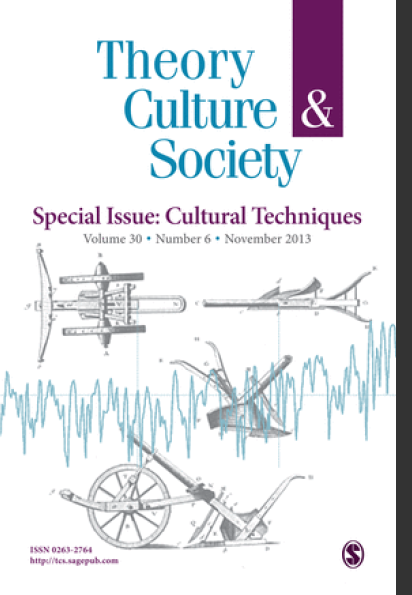
By way of some significant translations as well as new articles the issue pitches a way to understand cultural reality through its techniques. The usual definition is from Thomas Macho:
“Cultural techniques – such as writing, reading, painting, counting,
making music – are always older than the concepts that are generated
from them. People wrote long before they conceptualized writing
or alphabets; millennia passed before pictures and statues gave
rise to the concept of the image; and until today, people sing or
make music without knowing anything about tones or musical notation
systems. Counting, too, is older than the notion of numbers. To
be sure, most cultures counted or performed certain mathematical
operations; but they did not necessarily derive from this a concept
of number.” (Macho, 2003: 179)
But as the issue demonstrates, there is more in this mix. The multiplicity of positions and inplications is well articulated in Winthrop-Young’s Introduction to the issue. He articulates how not only in Macho, but in different ways in Cornelia Vismann’s and Bernhard Siegert’s work the constitutive role of cultural techniques functions. In fact, could say that this is the German media theory version of the hominization-thesis: how we become humans; how agency is constituted by cultural techniques which allow us to occupy subject positions. Space, enclosures and passages between them is one way to understand the idea:
“Thus the difference between human beings and animals is one that
could not be thought without the mediation of a cultural technique.
In this not only tools and weapons . . . play an essential role; so, too,
does the invention of the door, whose first form was presumably the
gate [Gatter] . . . The door appears much more as a medium of coevolutionary
domestication of animals and human beings.” (Siegert, 2012: 8)
Key here is the way in which cultural techniques process distinctions with material and aesthetic means. In Winthrop-Young’s lucid words, “Procedural chains and connecting techniques give rise to notions and objects that are then endowed with essentialized identities.Underneath our ontological distinctions (if not even our own evolution) are constitutive, media-dependent ontic operations that need to be teased out by means of techno-material deconstruction.” The implications for a range of recent years of theory-debates are intriguing; it refers to the fact how we need to address practices of theory and techniques of theory as part of the work of concepts and philosophy of contemporary culture. Besides it also shows some early ideas that resonate with a post-textual approach to cultural analysis (for instance in Sybille Krämer and Horst Bredekamp’s article).
I was asked to produce a short video abstract of my own contribution. In addition, find below the table of contents.
Special Issue: Cultural Techniques
Edited by Geoffrey Winthrop-Young, Ilinca Iurascu and
Jussi Parikka
Articles
Cultural Techniques: Preliminary Remarks by Geoffrey Winthrop-Young
Culture, Technology, Cultural Techniques – Moving Beyond Text by Sybille Krämer and Horst Bredekamp
Second-Order Animals: Cultural Techniques of Identity and Identification by Thomas Macho
Cultural Techniques: Or the End of the Intellectual Postwar Era in German Media Theory by Bernhard Siegert
After Kittler: On the Cultural Techniques of Recent German Media Theory by Bernard Dionysius Geoghegan
Cultural Techniques and Sovereignty by Cornelia Vismann
The Power of Small Gestures: On the Cultural Technique of Service by Markus Krajewski
Zootechnologies: Swarming as a Cultural Technique by Sebastian Vehlken
From Media History to Zeitkritik by Wolfgang Ernst
Afterword: Cultural Techniques and Media Studies by Jussi Parikka
Review Article
Files, Lists, and the Material History of the Law by Liam Cole Young
The Anthropobscene: The Elemental Media Condition
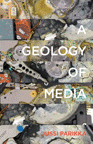
Winchester School of Art are one of the partners of the transmediale-festival, which takes place again in January/February 2014 in Berlin. This short text below is a sort of a trailer to our bit for the event: the text is co-written by myself and Ryan Bishop and the the contribution to tm14 is likewise co-curated by us. The text gives an indication of some of the themes we will discuss during the festival and conference week, and it draws on some of our work on these topics: Ryan’s writing on the four elements and contemporary aesthetics, and my work-in-progress book project on “geology of media” and what I pitch as the anthropobscene – a new geological era catalysed by the corporate capitalist measures of depletion and exploitation.
Ryan Bishop and Jussi Parikka:
The Elemental Media Condition
Ever since such early geologists as James Hutton and Charles Lyell voiced a distance from biblical time, the Earth has had a proper history. The natural historical durations of the Earth have, despite academic disciplinary divisions, always intertwined with human history. In the current moment, the complex interactions of the two seem more prescient than ever. To follow in the footsteps of Dipash Chakrabarty, the horizon of the anthropocene forces historians to think of durations of nature as entangled with social history, and the historiographical functions of temporality need to be considered alongside such vectors that acknowledge the work of capitalism as a specific epoch. In this sense, we would like to refer not only to the anthropocene as the debated new geological era in scientific classification, but also what can be called the anthropobscene. This portmanteau word combines anthropocene with obscene, thus highlighting the vicious exploitative actions of corporations, governments and other agencies operating on different levels: from human individuals to multigovernmental organisations and transnational corporations. In much the same manner that Jean Baudrillard reconfigured the subject-object relationship placed within a scene as a network-screen relationship in the obscene, the anthropobscene reconstitutes the relationship between human scales of intervention into those of the geological. Thus, amongst other things, it refers to the obscenity of heavy pollution of the earth and the air, bringing back discussions of the four elements as found in the Pre-Socratic thinker Empedocles, whose writings strike both ancient and contemporary chords. Cultural theorists, such as Gary Genosko, have voiced an urgency for a renewed consideration of the elements.
For Empedocles, humans, nature and the universe contain the same elements. Flesh and blood are composed of approximately equal parts of earth, fire, water, and aether: the four elements that constitute the universe. The entire material world for Empedocles comes from the mixture and amounts of these four elements, the mixing of which he likens to paints on an artist’s palette with their different effects due to combinatory portions. This insight of multiple and diverse substances generated through combinations and proportionality becomes a cornerstone of modern science and chemistry. The harmony of Love and the discord of Strife result from the proportionality of the elements with each constantly changing and warring with the others. The Empedoclean elements of this cosmogony and in nature constitute both media and content. They make, transform and destroy at the same time.
Empedocles’ writings use physics to derive an understanding of ethico-political, even moral, laws. In the teaching of Empedocles the problem of substances as they present themselves to us takes a specific form: how do the Many come from One and One from Many? The primary and ultimately determinate forces behind the various manipulations, combinations and transformations of the elements in Empedocles are in the standard translations Love and Strife, which move in cycles of harmony and disharmony that reign over all of nature, including humans, fish, beasts and birds. But the elements are not simply passive recipients of the forces of Love and Strife. They can and do themselves act as causal agents, influencing the waxing or waning of Love or Strife.
Contemporary media culture can be opened up through such a consideration of elements. Indeed, as the philosopher Erich Hörl has argued, the technological is one crucial condition for the discourse – and practical existence – of this hypothetical anthroposcene – and anthropobscene, we might add. For artists such as Robert Smithson in truly Empedoclean fashion, the tectonic realms of the Earth and the mind are interconnected. Smithson’s account amounts to a critique of the McLuhan-focussed idea of technology as extensions of Man. Instead, for Smithson, writing in 1968 in Artforum, it is elemental. One is here tempted to think it is elemental in the sense of the Pre-Socratic four elements, as well as elemental in the sense that those elements are more crucial than ever for a consideration of the biopolitical condition. Such aspects range from the materiality of data mining to environmental exploitation.
Preempting Dissent in Istanbul
We (as in Winchester School of Art) are supporting a screening of Preempting Dissent in Istanbul, at SALT (November 28, at 20.00). This is the first screening in Turkey.
The new documentary is based on the book of same name by Greg Elmer and Andy Opel. The documentary is best described as “a culmination of a collaborative process of soliciting, collecting and editing together video, still images, and creative commons music files from people around the world. Preempting Dissent interrogates the expansion of the so-called ‘Miami-Model’ of protest policing, a set of strategies developed in the wake of 9/11 to preempt forms of mass protest at major events in the US and worldwide.”
The screening is one of the activities that Winchester School of Art is supporting and organizing in Istanbul currently.
Following the screening in the Walk-in Cinema there will be a Q&A with Greg Elmer and myself. The Q&A will be held in English.
More info on the Facebook page of the event.
A teaser trailer of the documentary.
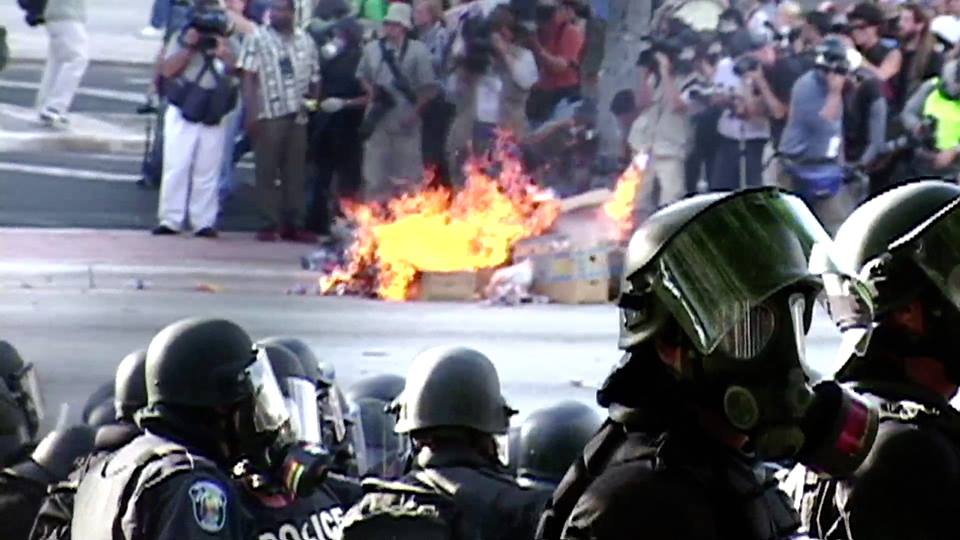
A still from Preempting Dissent (2013).
Technicities
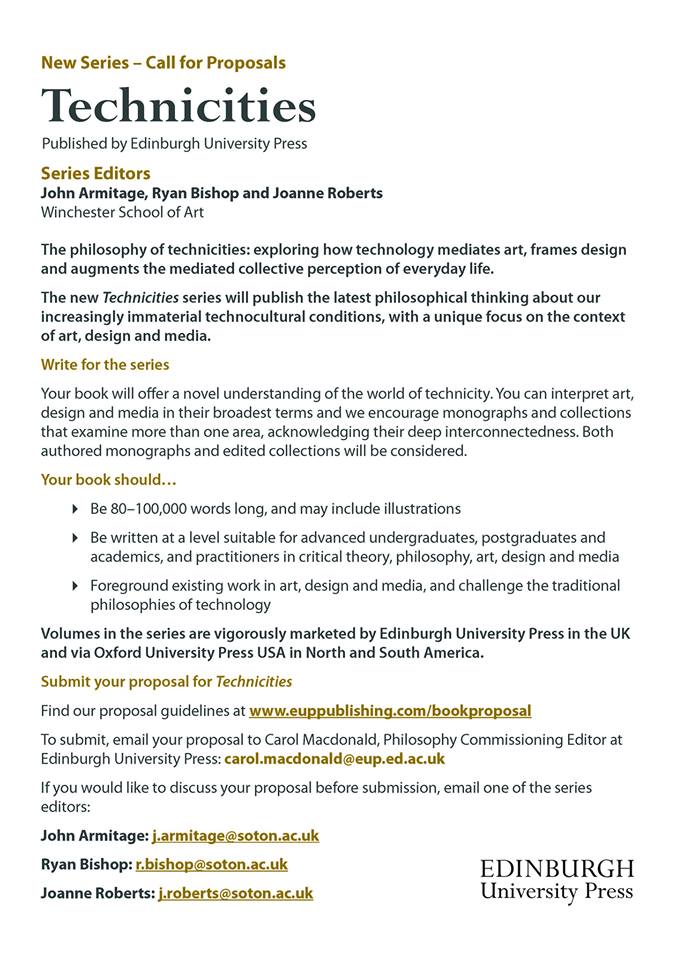
Technicities is a new book series, edited at the Winchester School of Art by my wonderful colleagues John Armitage, Ryan Bishop and Joanne Phillips. The series is published by Edinburgh University Press, and is promising to “publish the latest philosophical thinking about our increasingly immaterial technocultural conditions, with a unique focus on the context of art, design and media.” Armitage and Bishop are two of the co-editors of Cultural Politics-journal, which should give some idea what sort of books they are looking for.
On Dignity and Consultancy Services: Pekka Himanen
The final report (to be turned into a book) by the Finnish consultant Pekka Himanen is out. His intermediary report made the headlines already, accused of substandard quality. The project was born in the midst of what were identified as rather dodgy funding practices, commissioned without proper academic evaluation by the Finnish government/the prime minister Katainen.
Now the first news items and reactions (and here) to the final report of the project are out. Suffice to say, the reactions are rather appalled and questioning the quality control mechanisms of the research. As one professor implied, the project report does not really qualify to use the term “research”, which should be about production of new knowledge. Both terms, “new” and “knowledge” were doubted in the case of Himanen’s booklet.
As before, Himanen is a fierce proponent of a discursive turn towards “dignity“. I want to characterize Himanen as a promoter of post-welfare state mode of governmentality. Instead of support for direct and concrete measures towards education and other mechanisms of the welfare state for ensuring safety and sustainability of life, Himanen is geared towards a new society based on discourses (values?) of “dignity” and for instance “trust”. He also talks of “succeeding together” as an anchor point. The post-welfare state of “dignity” is a governance through the abstract power of terms, where the quasi-philosophical consultancy discourse is embedded in a more radical set of political economic reforms undermining any basis for what defined for instance the Finnish model of education, healthcare, and innovation emerging from baseline safety.
Some of the reactions by prestigious Finnish professors talk of the report in no appreciating terms. After reading it, they evaluate that none of the texts would pass a normal peer-review process of a journal. Any new research is not really present but based on the earlier work of the participants. One professor is rather direct in his judgement: the report leaves the reader with a feeling of pity and commisserating shame for Himanen and the project. Oxford University Press is going to publish the English version in 2014.
(Disclosure: I have not yet read the final report myself. I am only commenting on the discussion around it today, and the earlier research/statements by Himanen).
Kurenniemi – A Man From the Future
Erkki Kurenniemi is a curious case in media art history. He is the “Finnish hybrid of Stockhausen, Buckmister Fuller and Steve Jobs” who offers an alternative insight to past decades of interactions between art, science and technology.
He was featured at Documenta 13, part of a great exhibition at Kunsthall Aarhus, and now Kiasma (Helsinki) is running an exhibition focusing on his technological art practice.
With Joasia Krysa, we are preparing an edited collection for MIT Press on Kurenniemi’s work.
However, today is published a nice little collection of writings (in English) on Kurenniemi’s character and work: Erkki Kurenniemi – A Man From the Future! Do read and dip into an alternative insight to post World War II artistic cultures of science and engineering.
Kurenniemi: Electronics in the World of Tomorrow (1964)
New Publications
Amodern–journal has a massive special issue on Network Archaeology out now. I was also interviewed for the collection that followed up on the Miami University last year’s conference of the same theme.
Other new publications include a piece from last year. The first version of this paper on dust (Dust and Exhaustion: The Labor of Media Materialism) was given as a keynote for the Canadian Communication Association annual conference in 2012 at Wilfrid Laurier University. Some smaller variations came out in Depletion Design as well as in Artnodes-magazine. This is however a rather long stand-alone piece which narrates through “dust” themes of non-human materialism, digital culture, work and exhaustion: it picks up on themes of exhaustion and nanoparticles, as much as the metal and mining aspects which contribute to the scale in which we can expand our ideas concerning materiality of media culture. Below the first beats of the text.

“Each particle of dust carries with it a unique vision of matter, movement, collectivity, interaction, affect, differentiation, composition and infinite darkness” — Reza Negarestani, Cyclonopedia
I. Dust — The Non-Thing
There is something poetic about dust. It is the stuff of fairy tales, stories of deserted places; of attics and dunes, of places from so long ago they seem to have never existed. Dusty books — the time of the archive that layers slowly on shelves and manuscripts. Marcel Duchamp’s 1920s Large Glass was a compilation of dust. In a way, he allowed dust to do the work: a temporal, slow compiling by the non-human particles as a work of art installed at the museum, “a purposeful inactivity.” [1] Dust can transform, even if it can itself easily escape any grip. It is amorphous, even metamorphic, in the manner Steven Connor describes. [2] There is also a lot of it. It can be done and dusted, removed from sight and forgotten — in need of no further attention. Nanoparticles are everywhere and form societies unseen and unheard of, yet they conglomerate on a scale unimaginable to human beings. We are a minority. They have their say on human things, and cover what we leave behind intentionally or by accident — obsolescent technologies, wrecks, monuments — which remind us not only of these things themselves but of the gradual sedimentation of dust. Dust marks the temporality of matter, a processual materiality of piling up, sedimenting, and — through its own million-year process — transformations of solids to ephemeral and back. It swarms and overwhelms, exhausts and clouds. “Breathe as deeply as you will, dust will never be depleted.” [3]
There is something poetic and sometimes even romantic about lack of breath. Lung diseases are after all a sign of the delicate soul, and have a long cultural history. Tuberculosis features in a vast range of examples from a Puccini opera to Thomas Mann’s The Magic Mountain (1924). The pale tuberculotic body feeds towards the mythical airiness of lungs, blocked by the disease. It is as if tuberculosis releases the body from matter: “TB is disintegration, febrilization, dematerialization; it is a disease of liquids — the body turning to phlegm and mucus and sputum and, finally, blood — and of air, of the need for better air.” [4] But the lung-diseased body is easily exhausted, lacking in air, gasping for it. It is a tired body, and tiredness is one key trajectory we should be following as well: a laboring body.
This is a text about dust as well as exhaustion: about non-human particles as well as labor. It takes small things like dust as one vector for its argument, and as a vehicle in the manner of which we sometimes think through objects. Dust is, however, not quite an object, not in the intuitive sense that objects are supposed to be easily graspable. It does not fit the hand, even if it covers vast terrains. It is more environmental and better characterized as a milieu. Well, almost a milieu: we rarely count it among things that matter, but what if we did? What if we followed dust as a trajectory for theory — theory that is concerned with materiality and media? What if dust is one way to do “dirt research”: a mode of inquiry that crosses institutions and disciplines, and forces us to think of questions of design as enveloped in a complex ecology of economy, environment, work, and skill. Dirt brings noise, as Ned Rossiter reminds us, and dirt research can be understood “as a transversal mode of knowledge production [that] necessarily encounters conflict of various kinds: geocultural, social, political and epistemological.”[5]
A Pioneer of Finnish Media Studies
Aivokuvia sounds much groovier in Finnish than in English; the translation to the word would be “Images of the Brain”. But it also resonates with the idea of “brain scans”, making the term more interesting in English too; a nod to Deleuze’s film theory, but also to the fascination with the materiality of the corporeal brain, interconnected with possibilities of perception and sensation, but also with the cultural-technological framing of it.
Professor Jukka Sihvonen, whose 60th birthday is celebrated by a seminar as well as the launch of his new book Aivokuvia, has always been someone who in his writing incorporated a fantastic sense of the potentials in Finnish language and how to bend it as an active medium itself for the writing of media and film theory. Sihvonen is a major figure on the Finnish scene as well as for my personal development: he was the one who introduced so many of us at the University of Turku, 1990s and onwards, to the theoretical figures of Paul Virilio, Gilles Deleuze, Friedrich Kittler and others. Besides proper names and theorists, he inspired us to engage in a certain mode of thinking: rigorous, but creative; refusing the most obvious questions and answers; a style of thinking in the Deleuze-Guattarian sense of the word. After his Deleuze-course, we spent several extremely long houred sessions with Teemu Taira and Pasi Valiaho excavating A Thousand Plateus in our reading group. Sihvonen spoke about Virilio and video games; he suggested to read Kittler, and made us ponder what this odd German theorist was trying to say in his Kittler-deutsch. Some of us went on to participate in Kittler’s seminars, some in Wolfgang Ernst’s, both at the same address of Sophienstrasse 22. I myself owe so many of my research ideas to his inspiration – insects, for instance. Sihvonen’s interest in Cronenberg was probably initially behind that route.
A bit in tongue in cheek (yes, do not take such branding exercises ever seriously)I have also called him one of the master minds behind a “Turku School of Media Studies“.
The new book Aivokuvia is exemplary of his interests over the years. It is more of a film theoretical book: Aivokuvia ties together the films of Tarkovsky, Bigelow and Cronenberg with the philosophical engines of Deleuze and others. Besides this new book, it is still Konelihan varina [The trembling of the machinic flesh] which is my favourite book of his, and which really as a student inspired me to dive in to theories of media and technology enmeshed in a cultural historical context.

University of Turku is organising the celebration seminar Video: media, taide, teknologia [Video: media, art, technology] as well as the launch of Aivokuvia, published by Eetos-association. I wish I could be there to celebrate. Warm congrats to Jukka. Looking forward already to the next book of his.
Fibreculture Books
Keep an eye on this one: open, online and with the branded mark of a great journal, the Fibreculture book series with Open Humanities Press.
“After over a decade of transition, digital and networked media’s disruption of so-called ‘heritage’ media is now the status quo. Even if change is ongoing, and even if media institutions and disciplines are still playing catch up, digital and networked media are now very much the established media. They have massively expanded the range of niches they can inhabit. They have colonised many practices in everyday and professional life. They have transformed politics and activism, science and research, art and design. They have questioned forms of rationality and standard modulations of affect. Yet if we now live in an atmosphere infused by media technologies and communicational events, this atmosphere is both intimate and alien. Like the weather under climate change, the common world is one in which nothing seems quite as it was. Clear communications and fluid networks—like clear skies and warm temperatures—feel as preternatural as they are comforting. They still hold the promise of a new world, but sometimes this new world looks as much like a complex form of neofeudalism as a celebration of a new communality. In such a situation the question of what ‘media’ or ‘communications’ are has become strange to us. It demands new ways of thinking about fundamental conceptions and ecologies of practice. This calls for something that traditional media disciplines, even ‘new media’ disciplines, cannot always provide. The Fibreculture book series explores this contemporary state of things and asks what comes next.”








 Machinology