A Mini-Interview: Mercedes Bunz explains meson press
meson press’ first book, Rethinking Gamification (PDF), was just released in Lüneburg. Part of the Hybrid Publishing Lab at the Leuphana University, the press focuses on digital culture and network media with the aim to “challenge contemporary theories and advance key debates in the humanities today.” I was interested in inviting one of the representatives of the press, Mercedes Bunz, to share in the style of some earlier mini-interviews I have conducted what she sees as the stakes in coming up with a multiple-format publishing house that focuses on theory.
Most of scholars are increasingly frustrated with the dinosauric habits of big academic publishers, but how to establish alternatives in the academic world that is challenged both by the necessity of new formats and by the only slowly changing recognition systems of the academic world?
The burning questions in publishing seem to be about the changing media ecology of academia of which publishing is one part – and inherently connected to institutional settings and subject-positions.
In other words, the question posed to Bunz: 
“What and why is meson press as a theory publishing project and does it connect with the wider question of the “post-digital scholar?”
Mercedes Bunz: “You are right: publishing itself gets profoundly questioned by digital media, it isn’t just that digital media is an exciting field for theory because it never stands still.
The interesting thing: while we all know that within publishing there is “disruption”, oddly enough this doesn’t necessarily mean that there will be change. It might be true that technology offers alternative ways of publishing. However, reputation management and academic recognition systems stand in the way and ensure that nothing changes. Thus, the situation we find ourselves in is slightly mad: technically there are many ways to publish and share intelligent thoughts by now. However, young academics can’t use those alternatives because then their book a) can’t find its way into academic libraries which means b) they don’t get cited, or c) the book isn’t recognized for their CV. For all of that it still needs an approved publisher. Our technical super-connected, post-digital world is left helpless.
Of course, one can’t accept this.
meson press works its way through this situation. Naturally as academics who are also media scholars, we are quite interested in exploring the question: What chances are there in digital book production for theory debates? Our answer so far is the following: We publish open access, and this makes books easily findable and pushes citation. Also we foster the findability of our books regarding search engines and catalogues, and take marketing quite serious. However, the most important difference in my opinion is the conceptual understanding of what this is: a book.
Similar to Mattering Press, or Christopher Kelty’s scholarly magazine Limn http://limn.it/ our publishing project is an academic cooperative: from academics for academics. This means in our view, a book becomes a place to meet and debate, similar to a lecture, a workshop, or a seminar. Editing a book was always a starting point for a discussion, copy-editing was always a way to connect or disagree. It is this tendency which now needs to be further amplified. In other words, we take quality assessment very serious and try to turn it into a concept: A book isn’t just a product that starts a dialogue between author and reader. It is accompanied by lots of other academic conversations – peer review, co-authors, copy editors – and these conversations deserve to be taken more serious. In a post-digital world one needs to understand that a book is a process that gives good reason to meet in person. Formats like book sprints have lead the way. Wendy Chun has also inspired us to create a writing group in which we constructively discuss a non-completed essay or chapter.
So I suppose this is how meson press connects to our situation as post-digital scholars. As a publishing house which is also a publishing project, we focus on the book as a form of communication, and this communication is an important part of its production. This is a way to optimize its task: to intervene, and challenge (which is not an easy task in our neoliberal societies). But we like the humanities, and we like them alive and kicking.
If I may give you a little overview of our upcoming publishing projects: After”Rethinking Gamification” we will publish two forgotten classics: The first will be by the Greek-French philosopher Kostas Axelos “On Marx and Heidegger”, which is edited with great care and expertise by Stuart Elden. We are very interested in Axelos’ take on technology and alienation. The second will be by Antonia Caronia “The Cyborg”.
Also we are very proud that Yuk Hui and Erich Hörl have started editing the series “After Simondon” with us, and we are preparing two edited collections “Diffracting Kittler: German Media Theory and Beyond” and “Critical Keywords for the Digital Humanities”.
Sorry, but may I end this little interview with an appeal? If anyone has an idea for a thrilling book proposal in the context of digital culture and media studies, please send us a short trenchant abstract and chapter overview to: mesonpress@hybridpublishing.org.”
Pour une archéologie des virus – an interview
Here’s an interview with me by Camille Paloque-Bergès published in French in Tracés (N° 21, 2011/2). It’s on the archaeology of (digital) viruses in contexts of security, biopolitics and media theory. It’s not exactly recent but I don’t think I have posted or even seen it online before.
Smog: Cloud and Molecular Aesthetics
The text below an abstract, something I promised to present at the forthcoming Istanbul-conference on Cloud And Molecular Aesthetics. It riffs on my earlier post on smog as part of environmental art history, an ecological art history/aesthetic set of terms.
Media Moleculars of Smog Culture: An Alternative Aesthetic
Speaking of molecules, photochemical smog that covers so much of our surroundings especially in dense urban areas consists of Nitrogen Oxide (NO), Nitrogen Dioxide (NO2), Ozone (O3) and Volatile organic compounds (RH). This is the elemental media condition across aesthetics of contemporary landscapes of industrial and post-industrial life. An urban screen, hovering above cinematic places of Los Angeles, etc. The sunlight reacts with the pollutants, resulting in a weird set of visual media: photochemical smog.
A matter of concern for inhabitants and of course biochemists, it however is also an issue we can address in our context of aesthetics, imaging and visual culture. This talk proposes to address smog – and more widely environmental issues from pollution to issues of geophysics – as relevant parts of our visual culture, proposing another sort of an angle to the “molecular”. Indeed, the constituent definition of molecular that one inherits from Deleuze and Guattari sits in relation to the ontology of perception. This molecular becomes more than a chemical description and a way to address the dynamic constitution of the (molar) individual. As Tom Conley explains, this is a sort of a “chemical animism” speaking of the elemental molecular conditions that constitute systems of “complex interactions”.
The molecular is an ontological angle that for Deleuze presents a world of “tiny perceptions” which are not only small in size but qualitatively present a different view to the whole. Hence emerges the whole agenda of micropolitics of perception and what could be called a chemistry of individuation. However, in the context of this talk, I won’t go into a detailed discussion focusing on Deleuze so much as hint towards speculative ideas of a media history of smog, environmental pollution and the technologies of tele-sensing /smog sensors as constituting a different sort of a visual culture of “new media” of mixed temporalities: the ancient rays of sun, the modern fumes of the city, and the emerging technologies of tele-sensing. I argue that such topics bring an additional angle to the already important extension of aesthetics in the realms of biotechnologies, the molecular vision, and the new diffentiating scales at which perception is constituted. Perhaps it’s the smog screens, reacting with sun light, that execute the truly ancient new media environment of post WWII culture as a sort of a non-human staging of the environmental catastrophy as well as an art historical period outside the usual categorisations.
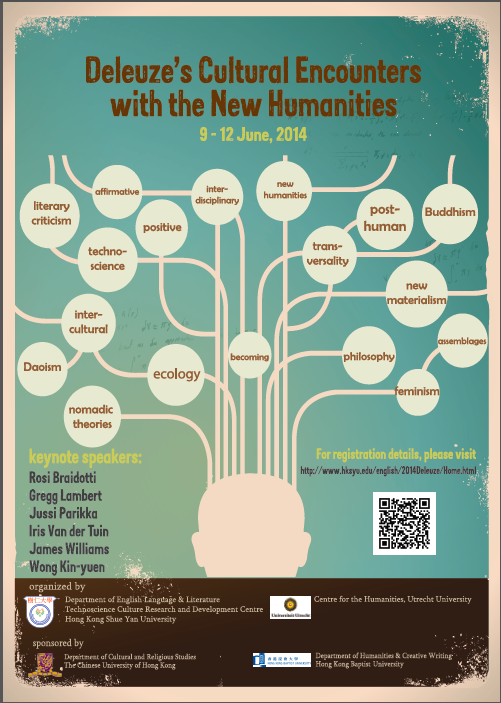
Deleuze and the New Humanities in Hong Kong
I will be speaking in Hong Kong in June and addressing Deleuze and digital culture. However, my argument is that instead of the usual suspect of starting with the Control Societies-text, Deleuze affords an understanding of the materialities of technological and scientific culture in many other ways too. As part of the geophysical materiality, we can talk about desire’s investment as an infrastructural issue of power – not ideology, just desire but that is infrastructurally effective.
A Fellowship at MECS
I am pretty happy about spending some time in Germany over the summer– and not just any trip, but as Senior Fellow at the Leuphana University Media Cultures of Computer Simulation-centre (MECS). MECS is one of the exciting developments at Leuphana (in Lüneburg) and in Germany, collecting some of the most interesting media theorists, analysts and historians. Led by Claus Pias and Martin Warnke, MECS’s project description tells the story of mutually informing investigations of media culture and science. Indeed, MECS presents itself as part of analysis of changes in scientific methods but also rather fundamental questions as to the nature of scientific knowledge itself. Furthermore, digital media becomes an agent in this transformation. “Digital media develops a medial obstinacy; it generates and at the same time processes problems which in the past were often inaccessible, either by analysis or experimentation.”
MECS’s annual themes for the coming years are found here – for this year, the focus is on Wissen referring to knowledge and the media epistemology of computer simulations, followed next year by Rechnen: to calculate/calculation.
In this context my own project focuses on the double bind of the media epistemological (e.g. sensors) and the environmental questions (such as smog) in a theoretical context of media materialism. I have been interested in how to expand media materialism to a wider set of material questions that include media ecology and the environmental too, partly in the context of Geology of Media. I also need to write a couple of commissioned articles on Friedrich Kittler during the summer. In addition, with Paul Feigelfeld we will edit a short e-issue focusing on Kittler for Theory, Culture & Society.
Designing Techno-Political Realities and Imaginaries
We at the Winchester School of Art (#WSA) are hosting this lovely little event – with quite the trio: Benjamin Bratton, Jordan Crandall and Ed Keller are coming to Winchester for meetings and agreed to give a joint panel on Design, Biopolitics and Contemporary Technological Realities – and imaginaries we might want to add.
More info here, and below their titles for the short interventions in the panel:
Benjamin H. Bratton: “On Platform-Based on Robotics”
Jordan Crandall: “The Materiality of Drones”
Ed Keller: “Shadow Ecologies, An Alternate Biopolitical History”
Recursions: a new book series in media & cultural theory
 We are proud to announce the launch of a new book series titled Recursions: Theories of Media, Materiality and Cultural Techniques. Placed with Amsterdam University Press, a publisher known for its strong track-record in film and media studies, the series will publish fresh, exciting and important books in media theory. This includes both translations and other volumes that address the core themes outlined below. I am very excited about this project and working with my co-editors Anna Tuschling and Geoffrey Winthrop-Young. We have already some significant projects lined up for 2015 and more forthcoming that we will announce in the coming weeks and months. We are supported by a very strong international advisory board. Get in touch if you want to learn more but first read below for more information!
New Series Announcement
The new book series Recursions: Theories of Media, Materiality, and Cultural Techniques provides a platform for cutting- edge research in the field of media culture studies with a particular focus on the cultural impact of media technology and the materialities of communication. The series aims to be an internationally significant and exciting opening into emerging ideas in media theory ranging from media materialism and hardware-oriented studies to ecology, the post-human, the study of cultural techniques, and recent contributions to media archaeology.
The series revolves around key themes:
- The material underpinning of media theory
- New advances in media archaeology and media philosophy
- Studies in cultural techniques
These themes resonate with some of the most interesting debates in international media studies, where non-representational thought, the technicity of knowledge formations and new materialities expressed through biological and technological developments are changing the vocabularies of cultural theory. The series is also interested in the mediatic conditions of such theoretical ideas and developing them as media theory.
Forthcoming 2015
- Sybille Krämer – Medium, Messenger, Transmission: An Approach to Media Philosophy.
- Claus Pias – Computer Game Worlds.
Editorial Board
- Jussi Parikka (University of Southampton)
- Anna Tuschling (Ruhr-Universität Bochum)
- Geoffrey Winthrop-Young (University of British Columbia)
Advisory Board:
- Wendy Hui Kyong Chun (Brown University, US)
- Geert Lovink (Hogeschool van Amsterdam, The Netherlands)
- John Durham Peters (University of Iowa, US)
- Thomas Y. Levin (Princeton University, US)
- Marie-Luise Angerer (University of Arts Cologne, Germany)
- Eva Horn (University of Vienna, Austria)
- Markus Krajewski (University of Basel, Switzerland)
- Erick Felinto (State University of Rio de Janeiro, Brazil)
- Adalberto Müller (Federal University of Niterói, UFF, Rio de Janeiro)
- Eivind Røssaak (National Library of Norway)
- Steven Connor (Cambridge University, UK)
- Peter Krapp (UC Irvine, US)
- Antje Pfannkuchen (Dickinson College, PA, US)
- John Armitage (Winchester School of Art, UK)
- Till Heilmann (University of Siegen, Germany)
- Isabell Otto (University of Konstanz, Germany)
- Astrid Deuber-Mankowsky (University of Bochum, Germany)
- Sean Cubitt (Goldsmiths College, London, UK)
- Claus Pias (Leuphana University, Germany)
- Stefan Rieger (University of Bochum, Germany)
- Andrew Murphie (University of New South Wales, Sydney, Australia)
- Axel Fliethmann (Monash University, Melbourne, Australia)
- Yuji Nawata (Chuo University, Tokyo, Japan)

Authors’ information
Proposals welcomed
Proposals for monographs or edited volumes should kindly follow the standard AUP Proposal Form (http://en.aup.nl/en/service/authors) and should also include the envisaged table of contents, an overview of the volume and abstracts of the proposed chapters or articles.
Further information
If you are interested in publishing a book with us please contact Jeroen Sondervan, Senior Commissioning Editor for Film & Media Studies at j.sondervan@aup.nl or one of the series editors.
More information about Amsterdam University Press.
Insect Media: Introduction
I’ve uploaded the Introduction-chapter of Insect Media online on Academia.edu! More info on the book, as before, on University of Minnesota Press website. If you want a quick glimpse into the arguments of the book, some reviews online include Jacob Gaboury’s in Rhizome and Jennifer Gabrys’ in Mute.
A short blog post on “What is Insect Media?” gives a condensed glimpse into some of the themes. For a more popular take, see what Wired wrote about the book.

The Warhol Forensics
The news about the (re)discovered Andy Warhol-images, excavated by digital forensics means, has been making rounds in news and social media. In short, a team of experts – including Cory Arcangel – discovered Warhol’s Amiga-paintings from 1985 floppy discs. As described in the news story: ”
“Warhol’s Amiga experiments were the products of a commission by Commodore International to demonstrate the graphic arts capabilities of the Amiga 1000 personal computer. Created by Warhol on prototype Amiga hardware in his unmistakable visual style, the recovered images reveal an early exploration of the visual potential of software imaging tools, and show new ways in which the preeminent American artist of the 20th century was years ahead of his time.” The images are related to the famous Debbie Harry-image Warhol painted on Amiga.
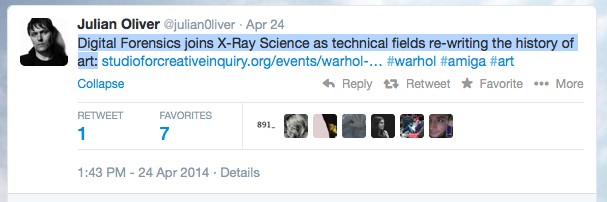
The case is an interesting variation on themes of media art history as well as digital forensics. As Julian Oliver coined it in a tweet:
The media archaeological enters with a realisation of the importance of such methods for the cultural heritage of born-digital content, but there’s more. The non-narrative focus of such methodologies is a different way of accessing what could be thought of as media archaeology of software culture and graphics. The technological tools carry an epistemological, even ontological weight: we see things differently; we are able to access a world previously unseen, also in historical contexts.
But there is a pull towards traditional historical discourses. The project demonstrates a technical understanding of cultural heritage and contemporary software culture but rhetorically frames it as just another part of the art historical/archaeological mythology of rediscovering long lost masterpieces of a Genius. This side still needs some updating so that the technical episteme of the excavation, detailed here [PDF] can become fully realised. Techniques of reverse engineering as well as insights into image formats as ways to understand the technical image need to be matched up with discourse that is able to demonstrate something more than traditional art history by new means. It needs to be able to show what is already at stake in these methods: a historical mapping of the anonymous forces of history, to use words from S. Giedion.
Scholars such as Matt Kirschenbaum have already demonstrated the significant stakes of digital forensics as part of a radical mindset to historical scholarship, heritage and media theory and we need to be able to build on such work that is theoretically rich.
Medya Jeolojisi
“Medya Jeolojisi“, a Turkish translation of my “Geology of Media”-piece is now available on Birikim online. A big thanks to translators Ezgi Akdağ & Aycan Katıtaş! The short text offers an alternative account of media materiality, and it was originally published in The Atlantic. (Also a Swedish translation is expected).
The short piece is a good teaser trailer to the forthcoming book(s): The Anthrobscene (forthcoming 2014) and Geology of Media (expected Spring 2015).








 Machinology