Archive
The lab as a symptom
I am giving a talk on Laboratory Fever in Amsterdam later in May and I am currently drafting some notes for that. This talk is part of the larger research and book project with my colleagues Lori Emerson and Darren Wershler, and most of our research process is documented on the What is a Media Lab-website. Below however a short excerpt from the forthcoming Amsterdam talk, and relating to a passage about (culture/humanities) labs as places of making, and the lab as a symptom.
___
In her historical contextualisation of the laboratory (“The Laboratory Challenge”), Ursula Klein puts it in rather clear terms: the laboratory was not merely a place of pure science and before the institutionalisation of the site since the 19th century as part of the scientific set up, it had many artisanal connotations as well. The lab was anyway part and parcel of a set-up of making and things, where knowledge was produced in material settings. Indeed, her interest is articulated relating to this “laboratory tradition that meshed studies of nature with technological innovation.” Now, I wonder, how much could we gain and how far could we venture with the poached idea if we did a sort of a minor tweak and see how it sounds when considering the rhetorical promise as well as conditions how we think of labs in the humanities interested in culture and making?
“The laboratory tradition that meshes studies of culture with technological innovation”. A simple and elegant hack, and an update of the scientific lab to a more humanities one? Acknowledging both the relation to “critical making” and also the nexus of culture and technology? Would this solve some of our problems and establish a seeming relation to the scientific labs as labor and elaboration of nature?
But too easy quips aside, there is something in the ways in which the lab as a site of technological making and artefactuality, in some ways, can be seen relating to the arguments by historians of science. Indeed, have we arrived at a situation where we return to the pre-scientific contexts of experimentation and wonder, where also romantic poetry is pitched as such a mode of experimentation, as Novalis once had it, and cultural realities can also found their sites of tests and experiments? Is the lab the neo-romantic but also the pre-scientific lab – a place of making and apparatuses, a place happy to borrow from the scientific aura of the science lab but not merely as an imitation of that model, but a sort of a institutional move that fits in with the issues of basic funding for departments too? Some might critique it as exactly a nostalgic move: at a time when most technocultural processes seem to be escaping the horizon of phenomenological perception and the tool-making human’s hand, we establish sites of such nostalgic proximity to individual technologies that are merely at most interfaces to the massive planetary level technological infrastructures. And yet, establishing concrete sites might be one way of interfacing not only with technologies but educational possibilities of intervention with that technological reality.
Because of the magnitude of questions “the lab” triggers, the number of separate and distinct labs there exists, and that every lab could produce their own particular answer, I would suggest that it is more fruitful to consider the lab not so much as a solution but as a symptom itself; just like Thomas Elsaesser (2016) recently asked about the discipline of media archaeology the question: instead of what is, we should ask why now? And we can extend the same logic of questioning to labs: not just what is a lab but why now? What is it about the lab not merely as an internal place of new methods or new forms of creative or academic activity but as a fold between such techniques and external political and economic conditions of current institutions that makes it a symptom? What are the sort things that temporalise this spatial setting as a question of the now – a question that defines it as a contemporary setting for particular experiments in not only academia or creative industries, but in “political anthropology of new institutional forms” to use Brett Neilson and Ned Rossiter’s ideas.
Shannon Mattern at WSA
We are happy to host Shannon Mattern at the Winchester School of Art. She is giving a talk on Infrastructural Tourism on May 3rd, at 12 – details below! The talk is organised by our Centre for Global Futures and the emerging new research group AMT – Archaeologies of Media & Technology, about which more information later.

Here’s the information about the talk:
Abstract: Infrastructural Tourism
We seem to have come to a sudden recognition that the Internet is a place made of countless material things – cables and data centers and rare earth minerals. We’ve witnessed a dawning realization that our Amazonian consumptive appetites are dependent on similarly heavy logistical systems and exploitative labor practices. We’ve surrendered to the reality of the Anthropocene and its precarious infrastructural, environmental, political, and ethical futures. This emergent infrastructural intelligence has spawned an explosion of infrastructural “literacy” and engagement projects that seek to “make visible the invisible,” to call out the unrecognized, to bore into the “black-boxed.” Grand Tours of nuclear infrastructures and key sites in telecom history have inspired many a recent Bildungsroman, in myriad mediated forms. Apps and data visualizations, sound walks and speculative design workshops, DIY manuals and field guides, urban dashboards and participatory mappings, hackathons and infrastructural tourism – strategies employed by artists and activists and even some city governments and federal agencies – all seek to “raise awareness” among a broader public about infrastructure’s existence and its politics. They aim, further, to motivate non-specialist communities to contribute to infrastructure’s maintenance and improvement, to inspire citizen-consumers to advocate for more accessible and justly distributed resources, and perhaps even to “engineer” their own DIY networks. In this talk I’ll explore various pedagogical strategies, representational techniques, and modeling methods that have been employed to promote “infrastructural intelligence” — and consider what epistemologies, ontologies, ethics, affects, and politics are embedded in those approaches.
Bio
Shannon Mattern is an Associate Professor of Media Studies at The New School. Her writing and teaching focus on archives, libraries, and other media spaces; media infrastructures; spatial epistemologies; and mediated sensation and exhibition. She is author of _The New Downtown Library: Designing with Communities_ and _Deep Mapping the Media City_ (both published by University of Minnesota Press), and she writes a regular column about urban data and mediated infrastructures for _Places_, a journal focusing on architecture, urbanism, and landscape. She has also contributed to various public design and interactive projects and exhibitions. This spring she is a senior fellow at the Internationales Kolleg für Kulturtechnikforschung und Medienphilosophie at the Bauhaus-Universität Weimar. You can find her at wordsinspace.net.
Media Theory in Transit – a symposium at the Winchester School of Art

Media Theory in Transit: A one-day symposium at the Winchester School of Art, University of Southampton,
November 24, 2015.
organised by Jussi Parikka and Yigit Soncul
Media theory is in transit: the concepts travel across space and time, claiming new meanings for new uses along the way. We are not dealing with a static body of knowledge, but a dynamic, situated process of articulating knowledge and perceiving reality. Media theory crosses both geographical and disciplinary boundaries. It trespasses the border between Humanities and Sciences, and is able to carve out new sites of knowledge. It moves across conceptual lineages from human to non-human, and supposedly distinct senses such as sight, hearing and smell. Media theory is not merely a reflection on the world but an active involvement that participates in creating the objects of interest.
This event investigates such conceptual, geographical and sensorial passages of media theory. The talks address contemporary media theory and issues that are now identified as urgent for academic and artistic practices. The speakers represent different fields of arts and humanities as well as media theory, and engage with the question: how does theory move, and itself occupy new areas of interest, across academic fields and across geographies, in which theory itself is set to be in movement.
The event is supported by the Santander-fund, via University of Southampton and the Faculty Postgraduate Research Funds.
Media Theory in Transit is open and free to attend but please register via Eventbrite!
Schedule
The PhD Study Room (East Building)
10.30 Introduction by Yigit Soncul and Jussi Parikka
10.40 Erick Felinto (State University of Rio de Janeiro, UERJ): “Vilém Flusser’s ‘Philosophical Fiction’: Science, Creativity and the Encounter with Radical Otherness”
11.30 Joanna Zylinska (Goldsmiths, London): “The liberation of the I/eye: nonhuman vision”
12.20 lunch break
14.00 Shintaro Miyazaki: (Critical Media Lab, Basel): “Models As Agents – Designing Epistemic Diffraction By Spinning-Off Media Theory”
14.50 Seth Giddings (WSA): “Distributed imagination: small steps to an ethology of mind and media”
15.20 Jussi Parikka (WSA): “Labs as Sites of Theory/Practice”
15.50 short summary discussion
16.10-16.30 Jane Birkin (WSA) “The Viewing of Las Meninas” (performance)
Terms of Media 2: Actions
Part two of the Leuphana University and Brown University collaboration “Terms of Media” is taking place in October in Providence, US. I am extremely glad to be part of it, talking in the section “Remain”. If all goes as planned, the talk will move from the “remains” or “remainder” in the sense of the archival and the epistemological to emphasize issues of remains of media technologies in actioned situations. Remains are not merely of the archival, but part of a design brief with a hands-on relation to epistemology; labs, studios that address the remain as in the context of media archaeology but also design, sometimes implicitly, sometimes explicitly. The remainder becomes further detached from a nostalgic object to an issue that relates to contemporary ecologies of architecture, extended urbanism, supply chains and the “alternative worlds, alien landscapes, industrial ecologies and precarious wilderness” (Unknown Fields). I also will try to conclude with a mention of the methodological and thematic dilemma of infrastructural remains with a hat tips to Shannon Mattern and Unknown Fields (Liam Young & Kate Davies).
Below more info about the conference!

TERMS OF MEDIA 2: Actions
Brown University
October 8-10, 2015
with Marcell Mars, Rick Prelinger, Lisa Parks, Claus Pias, Timon Beyes, Reinhold Martin, Jussi Parikka, Rebecca Schneider, Goetz Bachmann, Lisa Nakamura, Gertrud Koch, Bernard Stiegler, Finn Brunton, Mercedes Bunz, Wolfgang Hagen, Eyal Weizman, Kara Keeling, Luciana Parisi
Please forward any questions to termsofmedia@brown.edu
RSVP HERE: https://goo.gl/csrNhR
An international conference to analyze and reshape the terms—limits, conditions, periods, relations, phrases—of media.
“Media determine our situation,” Friedrich Kittler infamously wrote in his introduction to Gramophone, Film, Typewriter. Although this dictum is certainly extreme – and media archaeology has been critiqued for being overly dramatic and focused on technological developments – it propels us to keep thinking about media as setting the terms for which we live, socialize, communicate, organize, do scholarship etc. After all, as Kittler continued in his opening statement almost 30 years ago, our situation, “in spite or because” of media, “deserves a description.” What, then, are the terms of media? And, what is the relationship between these terms and determination?
This conference will serve as the concluding half of a two-part project, following an earlier conference at Leuphana University in Lüneburg, Germany, and will be followed by a series of publications based on each which will seek to repose and update these fundamental questions of media theory: Does our situation indicate a new term, understood as temporal shifts of mediatic conditioning, which deserves a re-description? How and on what terms are media changing, reflecting changes in media itself? What are the terms of conditions that we negotiate as subjects of media? How do the terms of media theory relate to such conditions? What are the terms of conditions of media theory itself?
Thursday Keynotes to be held in the Martinos Auditorium, Granoff Center:
154 Angell Street
Providence, Rhode Island 02906 USA
Remaining talks to be held at Pembroke Hall:
172 Meeting Street
Providence, Rhode Island 02906 USA
Schedule is as follows:
Thursday, October 8, 2015
Conference Introduction, 7 p.m.
• Wendy Hui Kyong Chun, Professor and Chair, Department of Modern Culture and Media, Brown University
Keynote Address, 7:15 p.m.
• Marcell Mars, Public Library Project
• Rick Prelinger, Professor of Film and Digital Media and Board Member of the Internet Archive, University of California, Santa Cruz
Opening Reception, 9 p.m.
Friday, October 9, 2015
Session 1: Structure, 10 a.m. – 11:30 a.m.
• Lisa Parks, Professor of Film and Media, University of California, Santa Barbara
• Claus Pias, Professor for Media Theory and Media History, Institute of Culture and
Aesthetics of Digital Media, Leuphana
Session 2: Organize, 11:45 a.m. -1:15 p.m.
• Timon Beyes, Professor of Design, Innovation and Aesthetics, Copenhagen Business
School
• Reinhold Martin, Professor of Architecture, Planning and Preservation, Columbia
University in the City of New York
Lunch, 1:15 p.m. -2:30 p.m.
• Presenters and invited guests
Session 3: Remain, 2:30 p.m.-4:00 p.m.
• Jussi Parikka, Professor in Media & Design, University of Southampton
• Rebecca Schneider, Professor, Theatre Arts and Performance Studies, Brown University
Session 4: Work, 4:15 p.m.-5:45 p.m.
• Goetz Bachmann, Professor for Digital Cultures, Institute of Culture and Aesthetics of
Digital Media, Leuphana
• Lisa Nakamura, Professor, Departments of American Cultures and Screen Arts and
Cultures, University of Michigan
Conference Dinner, 7 p.m.
• Presenters and invited guests
Saturday, October 10, 2015
Session 1: Animate, 10 a.m. – 11:30 a.m.
• Gertrud Koch, Visiting Professor, Department of Modern Culture and Media, Brown University
• Bernard Stiegler, Head, Institut de recherche et d’innovation, Centre Georges Pompidou
Session 2: Communicate, 11:45 a.m. -1:15 p.m.
• Finn Brunton, Assistant Professor, Department of Media, Culture and Communication,
New York University
• Mercedes Bunz, Senior Lecturer, Communication and Media Research
Institute, University of Westminster
Lunch, 1:15 p.m. -2:30 p.m.
• Presenters and invited guests
Session 3: Forecast, 2:30 p.m.-4:00 p.m.
• Wolfgang Hagen, Professor, Institute of the Culture and Aesthetics of Digital Media,
Leuphana University
• Eyal Weizman, Professor of Spatial & Visual Cultures, Goldsmiths, University London
Session 4: Mediate, 4:15 p.m.-5:45 p.m.
• Kara Keeling, Associate Professor of Critical Studies and American Studies and Ethnicity, University of Southern California
• Luciana Parisi, Reader, Centre for Cultural Studies, Goldsmiths, University of London
Negotiating Affect in Media/Cultural Studies
I came across this earlier review essay ” Negotiating Affect in Media/Cultural Studies” (PDF) of Jodi Dean’s, Steven Shaviro’s and my own book (Insect Media) which might interest some people out there.
It was published in WSQ: Women Studies Quarterly 40 (1&2, Spring/Summer 2012).
Geology of Media reviews and more
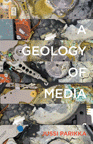
The first reviews of A Geology of Media are out! Some links here if you are interested in the first reception of the book:
Sean Cubitt reviews it in Theory, Culture & Society;
J.R.Carpenter wrote the review Massive Media for Furtherfield.
ArtReview did a short review in their May 2015 issue:

In addition, Kunstkritikk published an interview with me on the themes and topics of the book!
The Kittler e-special is out
 Theory, Culture & Society asked me and Paul Feigelfeld to edit an e-special issue on the work of the German media theorist Friedrich Kittler. We are happy to announce that the issue has now been published and it is the first in a series of e-specials the journal is commissioning. Our issue includes a selection of Kittler’s own articles and texts by other scholars about his work. The articles are open access for a selected period. The issue includes also a new Kittler-translation “Authorship and Love” which is introduced by professor Geoffrey Winthrop-Young.
We also wrote the introduction to the issue: Kittler’s Media Exorcism (PDF).
Recently also this book Media After Kittler got published, and there is a French translation of Kittler’s software writings forthcoming later this year.
The Media Philosophy of Messengers and Transmission
 Sybille Krämer’s Medium, Messenger, Transmission: An Approach to Media Philosophy is the first book in our new book series Recursions (Amsterdam University Press). The influential book that represents one significant strand of so-called German media theory is translated by Anthony Enns and is now available!
Enns has also written a very good introduction to the book that offers a context in which to understand Krämer’s impact in the field of media theory and media philosophy. Her work has over the years addressed philosophy of technology, cultural techniques and processes of formalisation in mathematics, as well as themes relating to artificial intelligence, language and rationalism. Krämer is interested in how a focus on the technical apparatuses is not sufficient for us to understand the wider field in which media works – she is interested in mediality. Krämer’s take on media philosophy introduces different models for such medial operations of transmission and messaging.
As Enns outlines in his translator’s introduction, Krämer’s position suggests that:
“(1) A philosophy of mediality can only begin by recognizing that there is an unbridgeable distance between the sender and the receiver ‒ a distance that can never be overcome.
(2) The medium occupies the intervening space between the sender and the receiver, and it is able to facilitate their connection while still maintaining the distance that separates them.
(3) All forms of communication are reducible to acts of (non-reciprocal) transmission between the sender and the receiver, as unification and dialogue remain impossible.
(4) Transmission is an embodied, material process, yet it is frequently understood as disembodied, as the medium is supposed to be invisible through its (noise-free) usage.” (Enns 2015, p.13).
Enns outlines how Krämer’s phlosophical position refuses technological determinism but is constantly interested in how the non-human participates in communication even if we often mistake and reduce agency to the humans participating in the event. Hence it is a take different from Friedrich Kittler’s but also differs from the hermeneutical accounts to understand mediality. Enns continues how “[a]ccording to Krämer, all of these various forms of transmission ‒ angels,
viruses, money, translators, psychoanalysts, witnesses, and maps ‒ can be seen as media in the sense that they simultaneously bridge and maintain differences between heterogeneous worlds. The messenger model thus depends on the basic insight that a community of different individuals is founded on the distance that separates them, which precludes the possibility of unification or intersubjectivity, and all attempts at communication are actually acts of transmission, as communication is fundamentally unidirectional, asymmetrical, and non-reciprocal.” (Enns 2015, p. 16).
As series editors, we hope that the book will have the wide impact it deserves, being such an important take on fundamental issues that speak to media and communication scholars but also to the wider philosophical and cultural discourse concerning what mediation means.
You can find the introduction to the Recursions book series online (Academia.edu) and copied below.
Please consider asking your library to order a copy of Krämer’s exciting study!
For review copies, you can contact AUP or one of us series editors.
***
Recursions: Editors’ Introduction by Jussi Parikka, Anna Tuschling and Geoffrey Winthrop-Young
Recursions: Theories of Media, Materiality and Cultural Techniques is a book series about media theory. But instead of dealing with theory in its most classical sense of theoria as something separate from practice that looks at objects and phenomena from a distance, we want to promote a more situated understanding of theory. Theory, too, is a practice and it has an address: it unfolds in specific situations, historical contexts and geographical places.
As this book series demonstrates, theory can emerge from historical sources and speculations still closely attached to material details. We therefore speak of the recursive nature of theory: It is composed of concepts that cut across the social and aesthetic reality of technological culture, and that are picked up and reprocessed by other means, including the many media techniques featured in this book series. The recursive loops of theory and practice fold and define each other. The genealogies of media theory, in turn, unfold in recursive variations that open up new questions, agendas, methodologies, which transform many of the humanities topics into media theory.
The Recursions series revolves around the material and hardware understanding of media as well as media archaeology – a body of work that addresses the contingent historical trajectories of modern media technologies as well their technological condition. But we are also interested in addressing the wider field of cultural techniques. The notion of cultural
techniques serves to conceptualize how human and nonhuman agencies interact in historical settings as well as to expand the notion of media to include the many techniques and technologies of knowledge and aesthetics. This expansive – and yet theoretically rigorous – sense of understanding media is also of great use when considering the relations to biology and other sciences that deal with life and the living; another field where media studies has been able to operate in ways that fruitfully overlap with social studies of science and technology (STS).
Overall, the themes emerging from the Recursions book series resonate with some of the most interesting debates in international media studies, including issues of non-representational thought, the technicity of knowledge formations, and the dimensions of materialities expressed through biological and technological developments that are changing the vocabularies of cultural theory. We are interested in the mediatic conditions of such theoretical ideas and developing them as new forms of media theory. Over the last twenty years, and following in the footsteps of such media theorists as Marshall McLuhan, Friedrich Kittler, Vilem Flusser and others, a series of scholars working in Germany, the United States, Canada and other countries have turned assumptions concerning communication on their head by shifting the focus of research from communication to media. The strong – and at times polemical – focus on technological aspects (frequently referred to as the ‘materialities of communication’) has since given way to a more nuanced approach evident in appellations such as ‘media archaeology’ and ‘media ecology’. These scholars have produced an important series of works on such diverse topics as computer games, media of education and individuation, the epistemology of filing cabinets, or the media theories underlying the nascent discipline of anthropology at the end of the nineteenth century, thereby opening up an entirely new field of research which reframes our understanding of media culture and the relationship be tween media, culture, politics, and society.
In other words, these approaches are distinguished by the emphasis on the materiality of media practices as well as the long historical perspectives they offer. A major part of the influences of recent years of media theory, including fields such as software and platform studies, digital forensics and media ecology, has been a conjunction of German media theory with other European and trans-Atlantic influences. The brand name of ‘German media theory’ commonly associated with, though not restricted to, the work of Friedrich Kittler – is a helpful label when trying to attempt to identify a lot of the theoretical themes the book series addresses. However, we want to argue for a more international take that takes into account the hyphenated nature of such influences and to continue those in refreshing ways that do not just reproduce existing theory formations. We also want to challenge them, which, once again, refers to the core meaning of recursions: variation with a difference.
UNSW Distinguished Scholar Visit
I am pretty chuffed about this visit: I received one of the University of New South Wales (Sydney) Distinguished Visiting Scholar awards and will be giving some talks and a workshop, as well as meeting loads of people during my time in the Southern hemisphere.
It’s not a big surprise that my talks and workshop will focus on media theory, materiality and history. In the workshop, or “master class”, we will be reading key texts of German media theory, especially focusing on the concept of cultural techniques.
One of the talks (on March 17) will be on the geophysical materialities of media in art and technology, “a story less about extensions of Man than extensions of the planetary.” It’s a preview of the forthcoming book A Geology of Media.
In addition, another talk (March 16) is an early attempt on what might become a research/book project together with Lori Emerson and Darren Wershler on humanities labs/media archaeology labs. Below is the abstract for that. Thanks to Tom Apperley at UNSW for coordinating and facilitating the visit. For any queries related to the talks, contact Tom.
A Laboratory Practice? Media Archaeology Labs and Humanities Knowledge as Creation and Hacking
This talk will address media archaeology but from the angle that considers it as a spatialised, institutionalized practice. By addressing existing and emerging media archaeology labs such as in Berlin, Boulder (Colorado) and other places, it aims to offer ideas how to contextualize the idea of “labs” in contemporary humanities. Media archaeology labs are often pitched as a way to think cultural heritage and contemporary technology outside the more established institutional practices of archives and museums. Instead, the labs seem to have become sites of “hacking”, opening up technologies and pedagogical ways of appropriating past technologies as epistemological ways of understanding modern technological culture. Besides offering examples and introduction to some key ideas and practices, the talk aims to expand to artistic practices and other cross-disciplinary ways of humanities knowledge-creation.
Digital Thought Deserter: An Interview in e-flux
In the new e-flux issue #62 you will also find an interview Paul Feigelfeld conducted with me: “Media Archaeology Out of Nature“. It focuses primarily on the themes of media theory, ecology and interfaces also with the work we do with the emerging Consortium (with WSA, University of California San Diego and Parsons School of Design, New School); synthetic intelligence, the planetary media condition, remote sensing, etc.
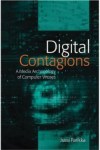
With a focus on the “media ecology”-trilogy of Digital Contagions, Insect Media, and the forthcoming A Geology of Media, the interview maps topics related to the ecopolitics of technological culture. A warm thanks to Paul for the interview and supporting my aspirations to be a digital thought deserter.
“Media theory would become boring if it were merely about the digital or other preset determinations. There are too many “digital thought leaders” already. We need digital thought deserters, to poach an idea from Blixa Bargeld. In an interview, the Einstürzende Neubauten frontman voiced his preference for a different military term than “avant-garde” for his artistic activity: that of the deserter. He identifies not with the leader but rather with the partisan, “somebody in the woods who does something else and storms on the army at the moment they did not expect it.”7 Evacuate yourself from the obvious, by conceptual or historical means. Refuse prefabricated discussions, determinations into analogue or digital. Leave for the woods.
But don’t mistake that for a Luddite gesture. Instead, I remember the interview you did with Erich Hörl, where he called for a “neo-cybernetic underground”—one that “does not let itself be dictated by the meaning of the ecologic and of technology, neither by governments, nor by industries.”8 It’s a political call as much as an environmental-ecological one—a call that refers back to multiple (Guattarian) ecologies: not just the environment but the political, social, economic, psychic, social, and, indeed, media ecologies.”
Besides that longer e-flux text, two other short texts appeared the same day: a general audience text on media and the Anthropocene in Conversation and also a mini-interview conducted by the Finnish Institute in London as part of their Made By-series.








 Machinology