Archive
An Interview in Figure/Ground
I was recently interviewed for Figure/Ground Communication. So I talk of things here. Some even personal ones, like why ending up in this career path (don’t really know, to be honest).
The Turku School of Media Theory?
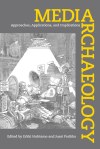
Under the term of “a New Media Archaeology”, the inaugural issue of NECsus – European Journal of Media Studies has a review of Insect Media, Media Archaeology as well as Pasi Väliaho’s Mapping the Moving Image. Picking up on these three books out of four is not out of selfishness or wanting to dismiss the fourth book (Cinema beyond film: Media epistemology in the modern era ) touched upon in the review/report but to point to a funny detail or a coincidence. In the same review, all of us from me to Erkki Huhtamo (co-editor of Media Archaeology) to Väliaho studied at the University of Turku, even if Huhtamo already in the 1980s, and by the time me and Pasi came to the university, Huhtamo was on his gradual way to media archaeological fame.
Hence, the title of this posting, “The Turku School of Media Theory”, is very much tongue in cheek and not to be taken completely seriously, although one has to say there was a minor buzz back then. I briefly asked Huhtamo about his 1980s Turku-times and influences; for him, early 1980s literature studies lectures by Hannu Riikonen were the ones to introduce Ernst Robert Curtius. This also meant picking up the notion of “topos”, so important for Huhtamo, and gradually by late 1980s, starting to think media culture too through it. Indeed, like mine also Huhtamo’s roots are in cultural history. Huhtamo was for instance in the 1980s using the idea of recurring topoi to investigate late 16th century Italian travel narratives.
Huhtamo had in the late 1980s picked up on various media theoretical strands for instance through the cultural semiotics of Eco as well as Barthes. Siegfried Zielinski visited Turku back then (probably early 1990s?) and Zielinski’s Audiovisionen was one of the books that was read in Turku by Huhtamo and for instance Jukka Sihvonen — currently professor of Media Studies. Sihvonen was the one who acted as the catalyzer for my and Väliaho’s (among other folks’) inaugural interest in such media theoretical oddities as Kittler and German media theory in general. In addition, Sihvonen’s seminar on Deleuze in the late 1990s was really one of the key elements which kick-started a lot of the interest in material media theory. (I will leave it to someone else to provide fullfledged and accurate histories of Finnish and Turku academia of the 1990s). One needs such minor exits, escape routes, and suddenly academic classes can shift into exciting eye-openers and turning points.
Similarly one could say that a lot of the stuff happening in Turku in media theory – not only in Film and TV studies (later Media Studies) but also Cultural History – was despite the seemingly internationally peripheral location great quality (lots of other things were happening then and still, including Women’s Studies, which for instance has produced lots of very interesting feminist art theory). Oh and it has not disappeared anywhere – Media Studies is doing excellent, Art Studies has taken a new materialist turn in Turku, and in addition, for years the University has had its own folks in Digital Culture (where I am affiliated Faculty member as an Adjunct Professor, Docent) too!
The Anne Friedberg book award for Insect Media!
 Could not be any more excited to finally be able to publicize this:
Insect Media has won the Society for Cinema and Media Studies Anne Friedberg book award 2012 — awarded annually for Innovative Scholarship! Winning a book prize feels fantastic, but of the possible prizes, exactly the one that carries her name; remembering the inspiration her Window Shopping gave during my studies in the 1990s, and then later, The Virtual Window — all of her work pointing to the way we should be expanding media studies into new fields and investigations!
This sounds like an invented story but it is true: when I received the email about the happy news, I was indexing my forthcoming What is Media Archaeology?-book and only a couple of hours earlier had added the entry “Friedberg, Anne”…
The panel said this of my Insect Media:
“Combining philosophy, theory, history and archival research, Parikka presents, ‘forms of swarm culture in terms of new architectures to offer insights into networked media and the media environments we live in.’The book’s style and writing is energetic, cohesive and enlightening. Moving between early underwater films to cyber theory (biodigitality), the book is full of erudite reflections on Spinoza, algorithms, ticks, Umwelt, and contemporary culture.”
A huge thanks to all!
More about the Anne Friedberg Innovative Scholarship Award:
“The Anne Friedberg Innovative Scholarship Award recognizes the best new scholarly work that exemplifies rigorous, interdisciplinary and theoretical inquiry into issues of vision and visuality. Funded by a generous gift from her estate, the Anne Friedberg Award recognizes innovative work that expands the discipline of film and media studies, emphasizing its relationship to other visual fields, including architecture, art history, and digital media. Believing that “how the world is framed may be as important as what is contained within that frame,” Friedberg was known for her intellectually agile examination of the increasingly visual nature of contemporary culture and its representation on a gamut of screens: at movie theaters, on televisions and computers, on iPhones, BlackBerrys and other hand-held devices. The author of two books on these subjects, Window Shopping: Cinema and the Postmodern (1994) and The Virtual Window: From Alberti to Microsoft (2006), Anne Friedberg was President-Elect of the Society for Cinema and Media Studies before her untimely death in 2009.”
Launch of Winchester Centre for Global Futures in Art Design & Media
This is our new centre (where I am a Senior Fellow). All welcome!
Launch of Winchester Centre for Global Futures in Art Design & Media
Wednesday 1 February 2012, 5:00 p.m. to 8:00 p.m.
Lecture Theatre A (above the WSA Gallery; Westside Building)
University of Southampton
Park Avenue, Winchester, Hampshire, SO23 8DL
WSA is very proud and excited to announce the launch of its new research centre: the Winchester Centre for Global Futures in Art Design & Media.
To mark this occasion, the Centre will be hosting an evening of talks on Wednesday, 1st February 2012, 5:00pm to 8:00pm. Speakers will include Winchester Centre’s newly appointed Professor, Turner Prize nominated artist Jake Chapman, artist and Head of School Bashir Makhoul, and art historian Jonathan Harris, Director of Research at WSA.
Newcastle University’s Professor of Cities and Society, Stephen Graham will also speak on the topic of ‘Cities Under Siege: The New Military Urbanism,’ which explores the import of visual technologies and practices in the complex intersection of urbanism, militarisation and artistic practice. Professor Graham will be introduced by Winchester Centre Co-Director Ryan Bishop, who will explore the links between Graham’s theoretical work and Makhoul’s upcoming solo exhibition at the Yang Gallery in Beijing this spring.
A drinks reception will follow the talks in the WSA Gallery.
Winchester Centre embodies the ethos of research-led practices in Art, Design and Media at Winchester School of Art. The Centre highlights historical, contemporary and future roles for art, design and media within globalization. Its members build sustained collaborations with international partners in public service, the creative industries and civil society. Critically concerned with art and design practices of making, thinking and representation, the Centre actively engages in education and enterprise, exploring the contribution of media, materials and technologies to the improvement of human societies globally.
Led by recently appointed professors Ryan Bishop, Sean Cubitt, Jonathan Harris and Bashir Makhoul, Winchester Centre will make a decisive contribution to the work of WSA and the University at large, as well as to the larger communities of Winchester, Southampton and Southeast England.
More information about the Winchester Centre’s activities, research interests and events can be found at http://www.soton.ac.uk/wrc
Admission is free and all are welcome.
Ooops
Based on this year´s blog statistics, a guaranteed way to drive up traffic is to either to write about Friedrich Kittler (after he is dead) or about Object Oriented Philosophy. The latter of these two, my previous posting gathered an awful lot of commentaries, including for me really useful feedback, so thanks to all for contributing. But it also reminded me that mentioning OOO/OOP is the guaranteed way to raise big emotions — reminding me why I never wanted to dip into those conversations. That does not mean that there is awful lot of good ideas there, but I just don´t want to get drawn into such heated discussions.
Here is Graham Harman´s mention of the discussion, also calling for more “productive debate”. I was not able to leave a comment on his blog and continue that debate so wanted just to briefly flag a couple of points here.
Firstly, for me, my blog post was not meant to poke at anyone just to irritate. I was merely interested, after reading and following debates, in some of the core questions from my perspective. I did not realize they were unproductive, and feel slightly paranoid now how my texts can be suddenly turned as part of some bigger academic catfight to which I have no desire to be part of.
Secondly, I am not interested in general debates “object” vs. “process”. Neither answers what I am after, and that is to map the specificities of technical media culture. Hence, I cannot decide beforehand whether I am dealing with object, process or something else. I am too much of a cultural historian, or a media archaeologist even, and interested in mapping/using the heterogeneous sources through which to understand technical media culture, from its technico-scientific roots to various imaginaries; political economy to political ecology; the ethico-aesthetico to aesthetico-technical. But that’s me. Others can and are (take for instance Bryant, Bogost or Paul Caplan) are doing really interesting things with OOP and media, even if I might differ on various points. I am interested in materiality, and also politics of matter(ing) – Braidotti, Grosz, Barad, Parisi, Terranova, post-fordist political theory – where questions about the real or new materialism are mobilized in so many differing, often also conflicting ways. But that’s another story.
Thirdly, in relation to Harman´s post — of course I would be saying critical things about OOP; saying critical things is just taking an interest in something. I think that is better than not saying anything critical. I have not wanted to say anything too publicly because I have felt and always added that I am not qualified to do that, and that I will leave OOP-discussions to others. So be it from now on as well, as the some of the repercussions and comments are getting too weird, already now. It’s not a very welcoming debate.
Fourthly, what I have probably said about Simondon is that he solves more problems for me than does OOP, and feels closer to the fields I am tackling with. For me, in a Kittlerian fashion, I want to articulate the double bind of philosophy and its relation to technical media — both historicized. I am a pragmatist in this way — perhaps sharing a bit of similar ground as Bogost mentioned in one of his comments to the post: interesting to see what we can do with different theories.
And btw. on top of my reading list, Bogost´s Alien Phenomenology, as soon a its out. And a couple of months after that, Braidotti´s The Posthuman. Oh the bliss of non-human world. And hats off to so many theorists of the non-human.
Towards Winchester
June 1st, I am starting a new job at Winchester School of Art (University of Southampton) as Reader in Media & Design. I am excited to be joining such a vibrant community of lecturers, researchers and ambitious plans for the future. I am part of an initiative to build an extensive research concentration on Global Media and Art – where the interchanges between art, technology and science are a key part of the agenda. It was not easy to leave behind Anglia Ruskin, ECFM, ArcDigital and CoDE – but they will continue to prosper with the help of their body of wonderful researchers!
A requiem for the slaughtered words
I guess this is dead media (archaeology).
I am doing farewells, and ritual slaughters of pieces of text that I need to cut from my new Media Archaeology and Digital Culture-manuscript (book forthcoming 2012 from Polity Press). I ended up realizing I am 15,000 words over the word limit so I need to become ruthless. This means picking up the academic chainsaw, the butcher’s knife, the well-sharpened axe that I keep under my bed anyway, and putting on my best Jack Nicholson (in The Shining) impression before the slaughter begins. Some of the remains (consider them sliced out organs, even if minor ones, of the text) are buried at Cartographies of Media Archaeology as part of the “Kill the Darling”-series (and part 1 here).
Platform Politics-conference: Opening Words
 We organized a very successful Platform Politics-conference in Cambridge, May 11-13, where our speakers included such exciting scholars and writers as Michel Bauwens, Michael Goddard, Tiziana Terranova, Nick Couldry, Nick Dyer-Witheford, Felix Stalder, and Tim Jordan.
These are my short opening words to the event:
Platform Politics takes place as part of the Arts and Humanities Research Council founded networking project on Network Politics. We pitched it to the AHRC with the suggestion that it takes one to know one: to understand emerging forms of social action and politics on networks and in network society, one has to develop networks, to crowdsource ideas from leading scholars, activists, artists; to map and to bring through various channels such partipants together in order to identity themes and directions which need more focus. Hence, we have arrived at the third and final event of the project – now on Platform Politics, following the first event in Cambridge on Methodologies of Network Politics research, and last year in Toronto at the Infoscape research lab with help from Greg Elmer, Ganaele Langlois and Alessandra Renzi we discussed object oriented and affect approaches to network politics.
We wanted to keep the notion of platform quite broad in order to solicit a more open range of papers. Hence, from software platforms such as Twitter and Facebook to robotics, from theoretical insights that draw from post-Fordist theories of politics and labour to object oriented philosophy, and much more, we have a privileged position to think through the platform (often seen as technological, as in platform studies) as a platform for our investigations (hence, also as a conceptual affordance). This does not mean to say that platform studies as represented in the Bogost and Montfort led series is techno-determinist, and solely focuses on such – quite the contrary, it tries to find a specific relation between technology and aesthetics. Yet, it is good to emphasize the mobilization of the concept as part of various transitions, and translations: platforms in technological (and again there various levels from apps to clouds, online platforms to technological hardware structures), conceptual, economic and of course political sense (expect at least a couple of references to Lenin in this conference).
So if Bogost and Montfort make sense of platform studies through this kind of layering:

Bogost and Montfort: Platform Studies
I would add that the notion of platform politics is able to articulate various levels together, and bring smoothness and movement to the interaction of the layers. In other words, in addition to the specific level of “platforms” we can think of the platform itself as distributed on a variety of layers as assemblages (in the manner Manuel Delanda uses the term?). A good example of this – something we were unable to pursue because of the problem of finding the slot for it! – was the idea of organizing a circuit bending/hardware hacking workshop (with Seb Franklin). The idea was to follow Garnet Hertz’s lead, and the way he has organized such workshops both to kids as well as to media theorists — and to use hands-on tinkering, opening up technology such as battery-operated toys, as a way to think through hardware platforms, how design solutions incorporate politics, how they afford conceptual approaches, and act as one node across a variety of other platforms. (An example of such is articulated in the forthcoming “Zombie Media: Circuit Bending Media Archaeology into an Art Method”-text, by myself and Hertz, in Leonardo-journal where we tie the question of such design politics of hardware to media archaeology, art methods and the political economy of network culture).
Platforms reveal to be ontogenetic – i.e. creative forms of interaction, not just stable backgrounds for a continuation of the social. They organize social action in a double bind where social action organizes them. Platforms rearticulate the social. For instance software platforms constitute a catalyzer for specific social forms, and as such incorporate in themselves a multitude of social, political, economic forces. It is a question of production – and of what kinds of social relations are being produced, a good example being the Telecommunist project and the Thimbl open source distributed microblogging service that incorporates a different sociability than proprietorial web 2.0 business and software models. And yet, this sociability is grounded on the level of the potentials of networks, the P2P instead of Web 2.0, distributed instead of the centralized client-server-model.
At the beginning of the project, we started with the question of “”what is network politics?”” and requested initial position papers from some key writers in the field – today of those we have Tiziana Terranova and Greg Elmer attending. Other theorists included Alex Galloway, Eugene Thacker, Katrien Jacobs and Geert Lovink.
The idea was to organize this as a form of request for comments – the RFC format, familiar from internet design culture, of questioning, lining up comments and positions, which however did not pan out as extensively as we wanted (this has to do with other organizationally interesting themes concerning spam management in participatory platforms, and so forth). However, what we got from the position papers were some initial leads. Furthermore, we started with some assumptions where to start tracking network politics:
– politics of new network clusters, services, platforms – Twitter, Facebook, as well as mapping alternative forms of software-based ways of organizing traditional political parties as well as new formations, NGOs, and temporally very different groupings/phenomena – whether the suddenly emerging and as suddenly disappearing “like” protests for instance on Facebook, or the more long-term effects of Wikileaks– leak not only in the meaning of leaking secret information, but leaking across media platforms, and reaching a long term sustainability through “old” media trying to come grips with such online activities.
– biopolitics of network culture, or in other words, the various practices which form internet cultures – hence a step outside of the technological focus, to look at what practices define network politics, and as such the links between work and free time, of play and labour, the circulation of affects, sociability, and so forth. Cognitive capitalism but as much affective capitalism. Yesterday (referring to the pre-conference event with Michel Bauwens and Michael Goddard) we got a bit into talking about investments of affect, desire and such topics.
– we were interested too in the metaquestion: what form would investigating network politics have to take? Outside the normal practice of humanities, writing and meeting up in conferences, what are the specific pedagogic and research tools/platforms that are actively changing the politics of education and research inside/outside academia. What are the research/creation platforms that are able to articulate this, so that we are not only stuck with “master’s tools”?
– And in a way, as a more unspecified but as important was the question of politics of the imperceptible: what kinds of forms of politics there are out there that are not even recognized as politics? From artistic practices to the grey work of engineers, new arenas of expertise, skill and again, social action contribute to the way in which politics is fleeing from traditional institutions.
The project has been able to map various positions to such questions, and raise new ones – which has been the purpose of this all: to produce more leads for further work. The same thing applies to this conference, and we are hoping to come out with excellent contributions, that do not fall within such original ideas. During the project’s unfolding, “network politics” became a wider popular media phenomenon too, where old media started to focus on what is was able to brand as “twitter-revolutions, or facebook-revolutions” – and yet this only emphasized the need to complexify the notions, and the histories of such events and platforms, as has been done on various email lists, and various other debate forums already. I am sure we can continue on that, and produce some really exciting discussions – and as always in our events, we really hope that a lot of the emphasis is on discussions in the sessions, as well as outside them.
Unnatural (Media) Ecologies
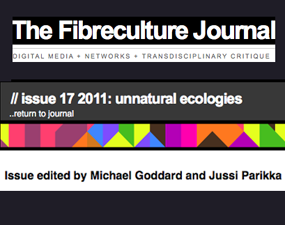 After a long wait, it’s out like nature itself! The Fibreculture-journal Media Ecology-special issue, titled “Unnatural Ecologies”, and edited by me and Michael Goddard.
The idea for a journal issue was picked up and continued from a panel organized for the MeCCSA conference in Bradford (2009) where I spoke with Matt Fuller and Michael Goddard on the media ecological approach in media and cultural studies. With Michael, we picked up on the idea of rethinking media ecology “after Matt Fuller’s work”, i.e. how we can transport the concept and practices into new directions that differ from those of the more classical media ecology work by (post-)McLuhan scholars. Hence, we ended up thinking more about Guattari’s three ecologies, Simondon, political and art practices, as well as nature itself as media. One of the leading ideas that Michael emphasized was how to think media ecology as a practice itself – how to understand it as a set of theories in practice.
Hope you enjoy the issue!
(My own text addresses “ecomedia”, nature as a communication framework [Harwood-Wright-Yokokoji and Mediashed art project] and extending that towards imaginary media as a reimagining how far back in time and as practices we can extend “media”.)
Arts Future Book – Book Futures of Arts
I don’t think I have blogged this, so a heads up: a very interesting new series from Gylphi, Arts Future Book. If you have great projects that could fit in, get in touch (either via me, I am on the editorial board, or directly with the general editor Charlotte Frost):

Edited by Charlotte Frost, Arts Future Book is an academic book series aiming to publish texts on art and visual culture in both print and digital formats. The series seeks to foster new scholarship in the arts, and publish unique works that rethink contemporary visual culture and establish new systems for considering art. It will highlight aspects of the impact of digital technologies on contemporary culture and indicate the ways in which technology informs our knowledge of the arts. The series will exploit recent technological advances in publishing to better disseminate such bodies of arts knowledge and develop wider readership and new reader experiences. Its premise is the notion that ideas are formed in dialogue with the media that represent them and that authors can actively forge the future of disciplines by recreating their core media. Therefore, this series sets out to chart new territory in disciplines dealing with the criticism, theorization and historicization of the arts. Each book published within the series will respect established academic standards, while redefining what an academic text might be and how it might be used.







 Machinology