Archive
Operational Images project funding
Some news: I am happy to announce that we have won a large grant for our proposal “Operational Images and Visual Culture” with colleagues at FAMU, photography department, part of the Academy of Performing Arts, Prague. Funded by the Czech Science Academy, our research team will engage with contemporary visual culture, photographic theory and the notion of operational images that stems from Harun Farocki’s work. The project is not solely focused on Farocki but the concept of the operational – sometimes translated as operative – image becomes one of the guiding lines of inquiry that facilitates useful, interesting and alternative ways to understand media archaeology of technical images (as patterns, as measurement, as instructions etc.) and contemporary practices of photography. Automated, instructive, algorithmic, measuring and non-representational images are here part of our focus that stems from some of the discussions of past year’s of media, film and visual theory.
FAMU has a great reputation, not least as a renowned film school and I have had the pleasure of collaborating especially with Dr. Tomáš Dvořák over the past year on other projects already. Stay tuned for updates from our Operational Images project and please get in touch if you have any questions!
The Project’s FAMU website for further info.
Earth/Sky exhibition opening talk
With Ryan Bishop we wrote the following short oral presentation as part of the opening panel of the Earth/Sky exhibition that is on at the Calit2 gallery at UC San Diego! Please visit the show if you are in the region and for those interested, below the short opening introduction.

Ryan Bishop and Jussi Parikka
March 7, 2019, UC San Diego
Earth/Sky exhibition – introductory remarks
Where the vertical X line meets the horizontal Y line in the X/Y axis is called the origin. Although we are not going to pursue myths of origins in this panel, that intersection is certainly the origin of inspiration for our exhibition and the works that comprise it.
What is the relationship between the X/Y axis and the horizon? Where is the horizon in the X/Y axis and how is it constructed, reconstituted, erased, or negated by the visualizing technologies these artists deploy, explore, exploit and query? The question of the horizon in relation to technology emerged in its contemporary guise in the aftermath of WWII and remains with us, cast by Martin Heidegger as “the age of the world picture “. The telecommunications technologies developed to provide constant real-time surveillance of the earth necessary to conduct the Cold War and enforce the Truman Doctrine simultaneously converted the earth into a globe (a bounded sphere visible at all times) as well as into a flattened world without horizon (due to the use of “over the horizon” visualizing technologies and complete surveillance of the entire planet all at the same time).
It found visual form in two works produced about the same time as Heidegger was writing: Buckminster Fuller’s Dymaxion Air-Ocean World Map, and Jasper Johns’ large-scale painting for the Montreal Expo ’67 inspired by Fuller’s map (and installed in Fuller’s massive geodesic dome erected there for the expo). The multi-pieced and multi-shaped canvas painting measures more than 30 feel long and over 15 feet high. As with Fuller’s cartographic vision, the icosahedron Dymaxion map created by Johns could be disassembled or assembled at will. Fuller’s map could be folded together to create a sphere or unfolded, origami-like, to be a flat two-dimensional object. Co-created with Shoji Sadao, Fuller’s map provided the model for the interactive, data-driven version used in his real-time teletechnological teaching tool called the World Game. Fuller and Sadao’s map moved easily, then, between 3-D and 2-D representations of the earth’s continents. These were represented in size based on population distribution and resource usage instead of the standard cartographic nod to physical coverage. While Fuller’s optimistic vision of the map’s pedagogical elements was at odds with Johns’ more pessimistic view of the geopolitical agonism that marked the moment, the map mimetically reproduces fully “the age of the world picture”. The globe as stage for Fuller-inflected neighbourliness also became a site of contiguous land masses locked in Johns-depicted animus: 3-D holistic vision coupled with 2-D Cold War strategically-generated economic inequities.
The cultural politics of Heidegger’s interpretation of modernity’s generated metaphysics can be charted in the capacity for representation to equate with both experience and the real, for the map to create the territory and the technological means for cartographic representation to become the tools for human crafting of the earth as globe, as flat observable plane or, as Fuller termed it, Spaceship. The visualizing teletechnologies on display in the Dymaxion Map, as well as the works in our exhibition here, are just such tools, for they chart a trajectory in which the world travelled from being construed as plane to orb to globe to flat, surveilled entity again. Our capacity to see and render the planet whole erased the horizon of the world and made it capable of being held in our collective teletechnological grasp. This is the “negative horizon” theorized by Paul Virilio: the conversion of the surface of the earth to pure surface, pure plane, to salt flat deserts and “mineral cemeteries” (141), a screen for projections and visions, a platform for unfettered terrestrial and aerial acceleration and optical realization. The age of the world picture is evoked in these maps made by Fuller and Johns, and it is so in the means by which we have enframed, delineated and curtailed potential futures, realized or not.
This leads us to our works on display in the exhibition (as well as the one screened as part of this opening panel, Susan Schuppli’s vertical cinema piece Atmospheric Feedback Loops). Schuppli’s audiovisual installation “Nature Represents Itself” presents the Deepwater Horizon oil spill in its legal and aesthetic form to propose the ecological site as a material witness capable of representing its own damaged condition. This auto representation of environmental disaster posits a new medium unique to the components of the disaster; in many ways, it is a visual analogue to Reza Negarestani’s philosophical fiction writing that fabulated the non-human revenging force of petroleum in Cyclonopedia. Furthermore, it taps into the multiple camera angles of the Anthropocene: the live feed of the underwater oil leak, the aerial view of the region as a massive size oil painting (as Ubermorgen, art group, coined it), the cultural politics of TV footage, the scientific imagining, and so forth.
Concerns about the horizon are omnipresent in the name of the documented disaster: the Deepwater Horizon oil spill, with its connotations of X and Y in itself as well as the dimension of depth as the passage to the underwater realms that link from Jules Verne’s fictional Captain Nemo’s megalomanic world tour to the as megalomanically disastrous seascapes of drilling and deep sea mining. While the melting arctic ice that will flood vast coastal areas and towns presents its own new northern passages as well as oil and mineral opportunities, we are left with the archive of disasters that already took place across the petrocultural century. Deepwater is one where the various axes are again brought together both as its spatial coordinates and as part of visual culture of disasters.
The Gulf of Mexico was made an unintentional canvas of human intervention and failure, as seen in the many images of the disaster taken by NASA’s pertinently named Terra satellite. The visual register on screen in Schuppli’s work is that of the accident, which is a recurring feature of that axis where visual culture and technological infrastructure and political decision-making meet. As Paul Virilio reminded us, the invention of any technology is also the invention of its failure, of its accidents. The technology in its operation and its failure provide equally fodder for planning, speculation and aesthetic production. This also applies to the speculative side in more ways than one: not merely inventing technologies, but inventing their accidents around which technological systems can be laid out as large scale systems. Virilio in fact posited that the history of technology could better be queried and understood through a Museum of Disasters than our usual technolophillic celebratory institutions. If such a site were to be built, Schuppli’s work could take a proud place there as one example of the long term legacy of petroculture as itself an invention of an accident around which modern culture takes place, from transport to industry, from lifestyle to the variety of materials that sustain our sense of the everyday.
Another kind of an accident lurks in Herregraven’s “Sprawling Swamps,” a series of fictional infrastructures dispersed within the cracks of the contemporary financial geography that operate on a technological, legal and social level. Herregraven’s focus is on the littorals, the ambiguous shifting zones where sea and land interact, the port and the portal interface. These ambiguous and ambivalent spaces, gaps between economic and environmental certitudes, speak to Paul Gilroy’s arguments for a “critique at sea level”. Picking up from Gilroy, Francoise Verges asks: how do we develop cultural theory that starts from water, the sea, the oceans – from the middle passage, but then also the northern passages, the various forms of colonial and other kinds of disasters, including contemporary ones that take place across liquid and swampy landscapes? What is sea level in the current moment and in this moment of warming currents? Increasingly land can become water, arable land can become desert, etc. in the weird mixes of the classical four elements; as Gary Genosko puts it, these four elements are not however anymore the stable sort of earth-water-fire- air. A longer quote from Genosko (in the Posthuman Glossary) gives a clear picture of the new synthetics of elements:
The new fundamental elements… EARTH : dust; WATER : blood; AIR : lethal fogs; FIRE :flammables. Wrapped around these elements is the planetary phylum, a great tellurian cable bunch with its own products: EARTH : electronics; WATER : liquidities like water bottled in plastic, which throws forward diagrammatic intensities in the explosion of plastic debris; AIR : gases (green house); and FIRE : smouldering car tyres, slashed rainforests and seasonal wild fires in the great northern forests. However, as we have seen, the new elements combine both in existing directly – blood mixed with dust in the extraction of conflict minerals and oil fields, or methane, a flammable unnaturally mingled with the water supply, and which contributes to the green house gas effect – and by means of especially communicative matters, like microscopic fragments of plastics that perfuse the oceans and get into the food chain, and constitute fine dusts that affect respiration, settling among the fogs, gases and lethal clouds.
The Ovid-like metamorphoses of nature, of bodies changed, operates in pre-socratic thought in relation to the elements with the universe composed of these elements battling or playfully transforming into one another, as Empedocles theorized. But from Empedocles, we should move further to the chemical period of the past 200 years of chemistry and its multiple forms of interaction and escalation of planetary deposits. What we are witnessing now is a rapid reshaping of the elements of the planet, some by design but most not, some by human actors and some by technological systems working autonomously or in tandem with others in unintended ways. The dynamic nature of matter, and of nature, finds form in precarious legal, financial and governmental infrastructures poised along the liminal littorals. Nonetheless urban human forms as a guiding set of imaginaries are seemingly impervious to the vicissitudes of unstable ecologies, in spite of high winds, hurricanes, typhoons, floods and drought.
Visualizations of the XY axis rarely show the air or the sky. The seeming transparency of atmospheres is however a source for another sort of “light media” and “sky media” that is often crystallised in technological figures such as drones or satellite infrastructures or then in the toxic legacies such as smog. It also includes the longer legacy of the aerial perspective – sightlines lifted from the ground.
We most often see the earth as surface (with the X line being the literal line of sight). The horizon is usually implied, what we know lies beyond the frame. Heba Amin’s lyrical and witty projection piece, “As Birds Flying,” allows views of the sky, the earth, the horizon, savannahs and wetlands, settlements and aviary migrations, which in turn allude to human migrations on the rise throughout the world. Her use of found footage and non-human surveillance techniques, in this case mistakenly believed to be strapped to a migrating stork, reveals horizons of visualization, tracking and the continual geopolitical struggle for contested terrain. This view is not stable but one in movement; a survey of landscapes and velocity, of movement and tracking, of cinematic visions projected onto daily existence.
It is worth noting in closing that the aerial views on view in the show now are visible by humans but the majority of the images of the earth’s surface being produced today are by machines for machines: they are not representational but informational and automated; this is what Harun Farocki coined as the world of operational, or operative, images, which also includes an increasing amount of environmental imaging. These are also a dominant strand of the Earth/Sky and X/Y axis visualizations of the present that expands from aerial views to soil analysis, and to interplanetary visual cultures as with the recent Mars Rover images too. These images as measurements are used for their data despite the at times glamorous views we get a glimpse of. That which isn’t visible can be translated into data visualizations that help feed a vast machine of charting, control and most importantly prediction.
In so doing the X-Y axis extends to include the Z axis, and enters into predictive temporalities: planning, investment, policing, and so forth. The role of AI techniques of prediction in the futures markets results in manipulation and prediction that links governmental sovereignty to data visualization technologies and their capacity to shape and generate financial systems and markets. The particular surfaces that are catered as massive datasets are the past archive for the hypothetical future-nows that open up a new horizon. Questions surrounding the large-scale production of premediated near-future predictive strategies linking geomedia to algotrading speeds up the earth as the manipulation of its materials for control and gain set the data-gathering agenda in spite of the many admirable and altruistic projects that may complement it. In this way, the images and the predictive data scraped from them replicates bureaucratic tools of domination past. Sean Cubitt writes: “That trinity of fundamentally bureaucratic media—databases (filing cabinets), spreadsheets (ledgers) and GIS (maps)—still operates, not least at the level of companies and institutions, where it continues to provide the backbone of a residual early-modern biopolitics.” These instances of administration , Cubitt continues, “were the dominant media of the early 21st century, because they were the media of domination.” The techniques and technologies have changed but the larger cultural technics and their ontological rationale have not.
The origin of the X/Y axis remains literally and figuratively in place, if not accelerated and exacerbated by our visualizing technologies.
Post-Anthropocene Fashion
“…fashion cycles now follow the rate of Moore’s Law … ” — Liam Young on the Hyperface project (Hyphen Lab + Adam Harvey). This article features in the Machine Landscapes publication; I am thinking about this in the context of our Archaeologies of Fashion Film project which while being mostly focused on early cinema, has an angle to questions of post-cinema of fashion too. Hence, one cannot avoid how the question of movement of images has shifted to include aspects of data and not merely how the image is something we watch, but something that watches back, reverses the assumed order of address; hence, also, textiles as digital surfaces feature into this lineage as part of an alternative “archaeology” of cinema as part of apparatuses of surveillance and military, of targeting and camouflage.


The Hyperface scarf
Library’s Other Intelligences videos
Our show Library’s Other Intelligences is on at Oodi in Helsinki until March 10th and we have now our videos of the three featured pieces! Please find links below:
Jenna Sutela: nimiia ïzinibimi
Jenna Sutela’s nimiia ïzinibimi is a unique book based on an invented new language representing those who lack first-hand access to, or the ability to produce, “natural” language.
Samir Bhowmik & 00100 ENSEMBLE: Memory Machines
Samir Bhowmik’s and 00100 ENSEMBLE’s Memory Machines is a performative art project that explores the infrastructure of the Central Library Oodi
Tuomas A. Laitinen: Swarm Chorus
Tuomas A. Laitinen presents Swarm Chorus. He composed a performative installation and a sound piece with generative tools that are interpreting the construction of medieval musical canons. The work as a whole is likened to an ecosystem of circulating substances, with its words, inspired by ecological science fiction, functioning as fictional recipe poems describing and decoding an alchemistic combination of matter and meaning.
In addition, the Code, Craft, and Catalogues: Arts in the Libraries-seminar will take place in New York on March 9th. It is also part of the Mobius fellowship program.

Earth/Sky exhibition in San Diego
I am happy to announce that our exhibition Earth/Sky opens in San Diego, at Calit2 gallery in March! Curated by me and Ryan Bishop, the exhibition features works by Heba Y. Amin, Femke Herregraven and Susan Schuppli. Please find below a longer curatorial note and a schedule of the opening seminar we are organising in conjunction of the launch party (March 7th).
EARTH/SKY is an exhibition of environmentally-informed artistic engagements with the intersection of vertical and horizontal planes. The art works explore the myriad ways in which the juxtaposition of earth and sky metonymically evokes a range of X/Y axes that allows for material and immaterial interactions between horizontal and vertical planes. The ground of the earth is also the ground that delineates when air becomes sky. The cinematic image and the calculated image are a further part of defining how the vertical and horizontal, the earth and the sky link up as realities that can be measured. The images that are presented in these works are also in such a way technical forms of measurement – from climate science to the political control of territories. From climate change to contemporary finance and migration, the pieces set environmental questions and environmental perspectives into a dialogue with contemporary global politics that always, however, is situated across particular regions and sites: from aerial views of oil slick simulations to bird flock and drones in desert landscapes of Egypt and on the fictional landscapes of swamps and shorelines, images conjure territories and territories are conjured up landscapes on the X/Y axis.
Three artists included in the exhibition are Susan Schuppli (London, UK), Femke Herregraven, an artist based in the Netherlands, and Heba Y. Amin, a Berlin-based Egyptian artist. Schuppli’s installation “Nature Represents Itself” is an oil film simulation and hydrocarbon composition that documents both the initial surface slick as well as subsurface plumes resulting from the 2010 Deepwater Horizon oil spill in the Gulf of Mexico. Produced in 2018, this simulation is exhibited in conjunction with audio detailing the lawsuit led on behalf of the rights of nature against BP. While satellite transmissions, the underwater video feed, and even Public Lab’s activist mapping project all combined to document the aftermath of the disaster, the slick was already operationalizing an independent mode of media itself. Oil spills are literally slick images that find their cinematic origins in petroleum production. Schuppli presents the oil spill in its legal and aesthetic form to propose the ecological site as a material witness fully capable of representing its own damaged condition.
Herregraven’s “Sprawling Swamps,” was shown at transmediale 2018. An ongoing multimedia project begun in 2016, “Sprawling Swamps” is a series of fictional infrastructures dispersed within the cracks of the contemporary financial geography that operate on a technological, legal and social level. The infrastructures are located in specific locations from swamps to shorelines but also engage with the immaterial economies of value. The piece attempts to engage with infrastructure as it relates to the turbulent dynamics of nature – itself a crucial part of the current discussions about landscape that is determined across technological and ecological questions.
The third piece in the show, Amin’s “As Birds Flying”, provides a view of the sky in flight and as flight, but in so doing comments on politics, surveillance, paranoia and environmental manipulation. A self-conscious mediation on the aerial view and its erasure of the geometry of perspective inherited from the Renaissance, Amin’s work explore the political absurdity generated by an obsession with the televisual mastery of the air and ground. Taking an incident from 2013, in which a stork fitted with an electronic device for migratory research was mistaken for a non-human source of surveillance and thus taken into custody by Egyptian officials, Amin’s cinematic response then becomes a meditation on migration of birds in parallel to human migration and the control of also rural territories. “The short, allegorical film is constructed out of found drone footage of aerial views of savannas and wetlands, including settlements in Galilea – sweeping views that seem to be taken by the ‘spy’ stork in the above story. ‘Seeing the country from the top is better than seeing it from below’, the soundtrack says, with footage of a bird soaring in the air. Funny, absurd and disconcerting, the video’s suspenseful cinematic soundtrack contains the reconstructed audio sequences of dialogue from Adel Imam’s lm Birds of Darkness.”
Each of these three works explore how the intersection of earth and sky is imagined, realized, subverted, represented and manufactured within complex ecologies of time, finance, science, technology, aesthetics and power. The ineluctably inextricable dimensions of ecological and environmental influence of sky on earth and earth on sky become the foundations for aesthetic, scientific, technological and political examination provided by these three artworks.
The exhibition is accompanied by an artistic-academic panel that addresses the topic of earth and sky as examined by considerations of the earth’s surface and its vertical, media technological determinations.
We are also screening Susan Schuppli’s vertical cinema piece Atmospheric Feedback Loops as part of the opening event.
Earth/Sky
Thursday, March 7, 2019
Time: 5:00pm-7:30pm
5:00 Calit2 Auditorium; Atmospheric Feedback Loops Screening
5:30 Panel Discussion with Ryan Bishop, Jussi Parikka, Susan Schuppli, and Femke Herregraven, Moderated by Jordan Crandall
6:30 Reception and gallery open
The show will run March 7-June 7, 2019, with gallery hours 12pm-5pm Monday-Friday.
The events are free and open to the public
http://gallery.calit2.net
http://qi.ucsd.edu/events/event.php?id=2974
For the opening, RSVP requested to galleryinfo@calit2.net
Library’s Other Intelligences opens
I am happy to share that our joint project with Shannon Mattern, Library’s Other Intelligences, opens in the new Oodi library in Helsinki in January!
Digital cultures of alternative intelligence, library architectures as a stage for performance and imaginary languages, and memory machines tours that take you through the library as a living organism of infrastructure are some of the themes the works by Jenna Sutela, Samir Bhowmik and Tuomas A. Laitinen address!
The opening takes place on January 11th including a small symposium on January 12th. There is also a press tour on Wednesday 9th of January – please be in touch if you want to attend.
Warm welcome to all! A brief blurb below including a link to the Memory Machines tours.
Memory Machines tours: January 11, 12 &13 at 18:30. Sign up here.
The Library’s Other Intelligences, an art project organized by the MOBIUS Fellowship Program of the Finnish Cultural Institute in New York in collaboration with the Helsinki Public Library, will open at the new Central Library Oodi in January 2019. The project features newly commissioned artworks, original research and a series of events, including an opening celebration on Friday, January 11, and a symposium on Saturday, January 12.
MOBIUS fellows Jussi Parikka (University of Southampton, Winchester School of Art, UK) and Shannon Mattern (The New School, US) have commissioned Finnish artists Samir Bhowmik, Tuomas A. Laitinen, and Jenna Sutela to create works that examine the new intelligences represented in our evolving knowledge institutions. These artworks reveal the alien logics of neural nets, give voice to machinic and speculative languages, and make visible the material infrastructures that allow intelligence to circulate. The exhibition’s featured artists are known for work that engages with AI, biological intelligence, digital culture, and the infrastructures of modern societies.
Visitors to the library will be invited to engage with the works – and with the new building – by attending live performances, embarking on expeditions, and reimagining how we will read, listen, and learn in a new techno-cultural future. The opening celebration will take place at Oodi on Friday, January 11, from 7 to 10pm; and the curators and artists will host a symposium about the exhibition on Saturday, January 12, from 2 to 4pm.

Image: Jenna Sutela: nimiia ïzinibimi, 2019
On Air, Inhale
I had the pleasure of contributing to Tomas Saraceno’s new show On Air at Palais de Tokyo with a short text for the publication as well as with a talk as part of the seminar on December 14th, which was organized by Filipa Ramos. The show itself moves from spiders and webs to air and balloons, from entanglements of the Anthropocene to the light materials of the Aerocene combining speculative design, investigation of materials and beautiful installation structures.
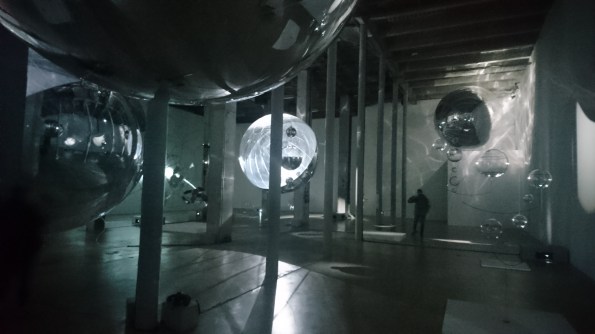
My short text for the catalogue was titled “Inhale”:
Inhale and you engage with history, not metaphorically, nor poetically but literally. Inhale the air of a city and you inhale its industrial legacy, its current transport system, its chemistry built at the back of technological progress. There’s more in the air and the sky than meets the eye. On the level of eyes, nostrils and skin, the city and its surroundings, it becomes a touch. It is inhaled, enters the body as haptic environment. It is the haptic environment in which one sees and encounters the surroundings as a large scale Air-Conditioning Show. It is history carried forward as chemistry. It is technology breathed in as minuscule particles. The air is the environment we have to somehow learn to address as one way to invent a breathable future.


De insectos, máquinas y posverdades
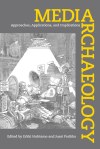
The new issue of the Luthor journal (published by colleagues in Argentine) is out and with a focus on media archaeology. The issue also includes an interview with me (“De insectos, máquinas y posverdades“) for those interested. We discuss media archaeology and transdisciplinarity, materiality, questions of geography as well as some brief points about literature in relation to the field. I also mention some current and emerging projects, from fashion film to operational images.
Edit: now the original English version of the interview (not copyedited) is also available (PDF): download here.
Sacred Channels
Editing our Recursions book series is fun – both for the sake of getting to work with Anna Tuschling and Geoffrey Winthrop-Young and because we are able to help in getting great books in media theory into the world.
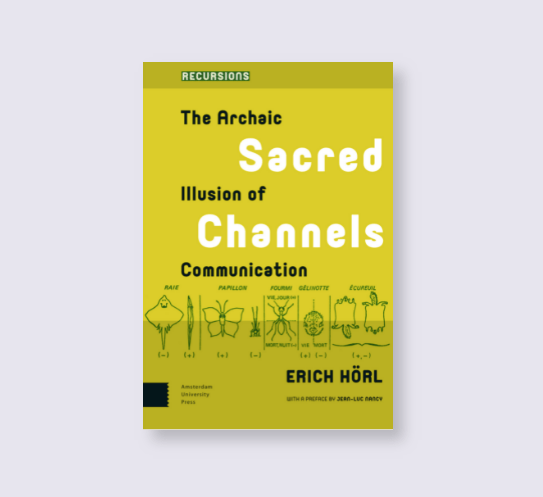
The most recent one is the just published translation of Erich Hörl’s Sacred Channels: The Archaic Illusion of Communication. I believe the endorsement by Michael Wutz is a perfect summary of the book’s significance:
“Erich Hörl’s Sacred Channels is as original and innovative as they come. The book articulates an archaeology of modern notions of the sacred and the primitive and draws upon a wide-ranging theoretical framework that includes philosophy (phenomenology, Heidegger, and deconstruction), anthropology, media theory, and breakthrough developments in modern science. The substantial preface by Jean-Luc Nancy, and the excellent translation by Nils. F. Schott, make Sacred Channels(by now a classic in the German-speaking world) a groundbreaking book finally available to an English-speaking audience.” – Michael Wutz, Weber State University
The website includes also a free preview PDF of Nancy’s preface and the table of contents (link opens as PDF).
A Lab of Labs
AMT was again part of the Istanbul Design Biennial, this time together with Bilkent University (Ankara) hosting a workshop and a panel. We responded to the main theme of School of Schools with our own emphasis: a lab of labs. In other words, working with the Bilkent Media Archaeology Lab (led by Andreas Treske) we organised a two day event that performed a lab in as a method to investigate it as a assemblage of methods, techniques, affordances of the lab in an urban environment and in the context of Istanbul, a city with a long heritage of crafts, workshops, and design irreducible to a sanitized design thinking discourse.
Benefiting from the experience of Ege Berensel and Başak Altın we engaged in workshopping that included 8 mm found footage (home films) and motherboards (as a source of circuit bending and tinkering). While Ebruk Kurbak joined us to talk about her work in textiles, computing and material methodologies in speculative design, and Tuğçe Karatas shared her views as an independent curator, our special surprise guest was the local TV repair shop expert who gave us a two hour crash course into his work and electronics! The lab includes many kinds of expertise.
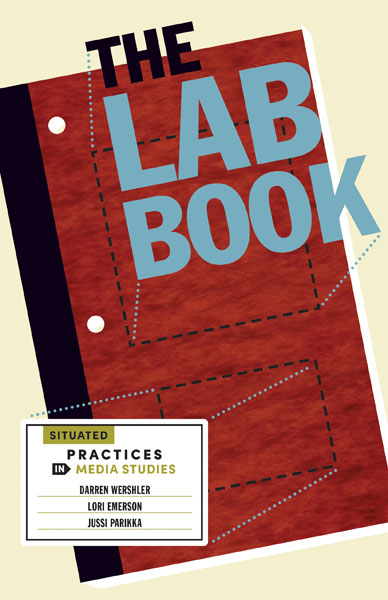
The workshop was also part of the research for #TheLabBook – online at What is a Media Lab?.
 Andreas Treske’s opening words, together with Björk’s poetic exploration of the television.
 Başak Altın and Ege Berensel, artists from Ankara, were part of the work. Here Basak narrating a short visual history of motherboards.
 An unpicking of a video projector into its material-epistemic components, measurable as objects of interest, unfolding multiple levels of media archaeology. #OfficeTruisms
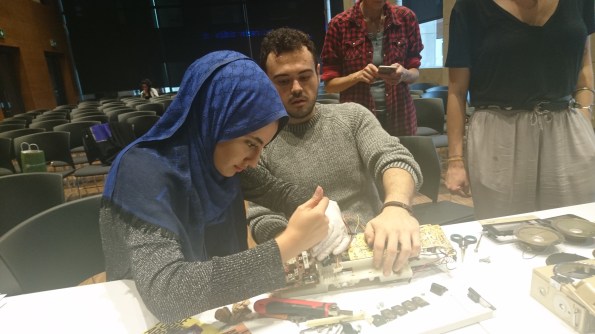
Labs as hands-on practice.
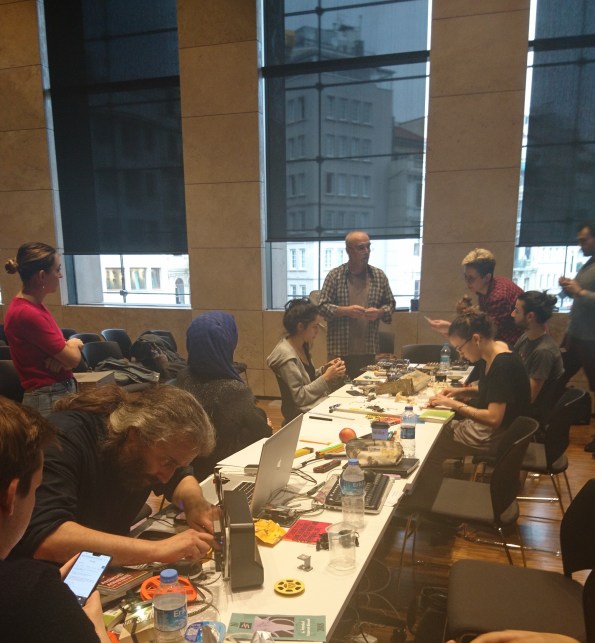
A short introduction to electronics – from the perspective of repairing televisions and other appliances.






 Machinology