>Affect – start of the RIB and ArcDigital theme year
>What are affects good for? I am not referring to the stuff going through your body and your mind, but the concept. ArcDigital and RIBs (Representation, Identity and the Body) theme year on Affect was kicked off yesterday with discussions based on Nigel Thrift’s and Eric Shouse’s texts. Good points followed, so many I cannot summarize them here. But for me, its the possibility of tapping to various weird materialities that “affect” affords us. This ranges from the 0.5 second delay between event and consciousness Wundt talked about, the odd reactions that Reagan talking can have, the relationality of bodies in movement, as well as for example the software objects defined by their relations — i.e. also non-human affects being possible. Affects are the element of transformation, and transmission — of bodies relating and being in their relatedness. As Joss Hands pointed out, the danger of the concept is becoming too wide, too vague. Hence, there is no one big theory of affect, just good uses in contexts where we need to think beyond signification, representation and the human.
Affects are more — they are the primary surplus due to their by definition relational nature. This is where the connection to sensations might become clearer. To quote Massumi: “Sensation is the registering of the multiplicity of potential connections in the singularity of a connection actually under way. It is the direct experience of a more to the less of every perception.” (In Parables for the Virtual, p.92). What is the relation between sensation and affect? Definitely, in the Deleuzian inspired schemes, its not always clear. If affects include/are transitions, sensations travel as well. Consider Deleuze writing on Bacon: “Bacon constantly says that sensation is what passes from one ‘order’ to another, from one ‘level’ to another, from one ‘area’ to another. This is why sensation is the master of deformations, the agent of bodily deformations.”
Affects are less. They escape the conscious perception, flee and yet effect, impose on social interaction. Its the mentioned lost time, perhaps — in terms of capturing the possibility of tapping into the preconscious. We smile before the joke gets funny, we react before the person even starts to make sense, we feel it already before the actual meeting has started. Of course, so closely connected to feelings — they loop together, as Milla reminds us. It does not stay unnoticed by the intensive body that we engage continously with agendas, structures, classifications and so on of emotions. Affects produce emotions that are shared, but they feedback through various political and social acts of naming etc?
Are they tonalities? Yes, to an extent that tonalities are shared, or connect things/people/entities in time-spaces. Its the in between of perceiver and what is perceived. To again quote Massumi: “The properties of the perceived thing are properties of the action, more than of the thing itself. This does not mean that the properties are subjective or in the perceiver. On the contrary, they are tokens of the perceiver’s and the perceived’s concrete inclusion in each other’s world.” (again from Parables of the Virtual, p.90).
Vocabularies for weird materialities? This ranges from bodies in movements, of micromovements on the skin, such concrete inclusions of bodies sharing something and becoming together, of non-human objects/processes defining each other, of feeling the intensity of fastness, slowness, closeness, distance. Its what psychophysiology was keen on mapping in the 19th century in connection with the birth of modern media culture (as always, Jonathan Crary’s Suspensions of Perception is the book to read), and what biotechnologies, brain and cognitive sciences and even quantum physics inspect. It is also the regime of things such as somatosenses — proprioception, kinesthesia, the visceral…(Eleni Ikoniadou who is just finishing her PhD from UEL on rhythmic ontologies is working in this field).
In the midst of a panorama of approaches, what seems to become increasingly crucial is that we need new cartographies of affect — ones that don’t rely only on psychoanalysis etc., but inspect art/science/technology/philosophy as the source of innovation/invention.
To conclude, a good example of such interchanges: Christa Sommerer and Laurent Mignonneau’s Nano-Scape system from 2001.
>First ArcDigital talk of the Semester: Dr Joyce Shintani
>A big thanks to Dr Joyce Shintani for kicking off ArcDigital talks for this semester! We started these lectures last academic year in order to excavate the interzone between theory and practice of/in digital culture, the trandisciplinary zones often left untouched by the established disciplines of academia. Last year we had a range of excellent speakers from Espen Aarseth to Steven Shaviro and Gary Genosko (and a number of others!), and this year we continue from Shintani to Greg Elmer, Wolfgang Ernst, Richard Grusin…and so on.
Shintani’s talk focused on music and sound in recent media art — and she presented an overview of s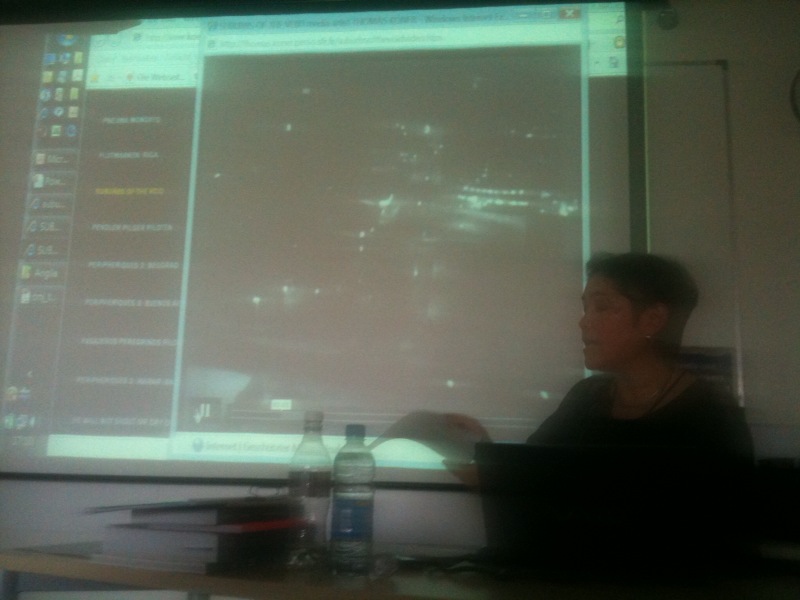 ome of the themes in recent exhibitions such as Art Basel, Ars Electronica and Sonar (Barcelona). By focusing on the element of music, Shintani was touching on such regimes of sensibility too often left untouched by the visual emphasis of media art/theory — an idea that resonates strongly with such claims for a “sonic turn” in cultural theory. Turn or not, such a multimodal perspective is much needed to understand multimedia as something more than just multiple media put together. Indeed, its not only sound and something else, but a focus on sound that deterritorialises our perspective on works of art from visual screen based to installations. Its not only about music per se, in that sense, but about sound as an attraction point for the user and for the analyst. Shintani pointed to some implications:
– music has been built upon the centrality of the word (as already Adorno argued); hence a much more multimodal approach is needed — media is not only literature based, but interfaces of direct bodily sensations, musical expectations etc. demand a different focus
– This has implications in terms of institutions from teaching to performance
– a post object-subject approach demands a much more refined idea of embodiment and interaction than has been catered in the word-biased approaches.
All this is clear and stems from what she identified as current “trends” — not in terms of fashionability but the singularity of some of the works she is interested in;
– Increasing minituarization
– Enabling ease of access to sound/music — i.e. a certain DIY approach
– cooperation and collaboration in the process of art making
– “sophistication” of interactivity in connection with easing of access
– a strong focus on mixed media — “Continuation of breaking down of barriers, mixing of media that stems from Adorno’s “Verfransung” — a wandering crossover, aberrant paths of and in media production).
In this context, Shintani is working on her new project: “Embodiment and “the Other”. A multidisciplinary Comparison of Changing Aspects of the Subject in Musical Multimedia Works.
Reality Checkpoint
Cambridge is the academic Disneyland. It is screaming for its Ballard to write Super-Cambridge that maps the perverse libidinal economies (connected to the monetary economies) which circulate here.
One of the fascinating points, or lines in Cambridge is the so called reality checkpoint.

It has got a long history, partly documented already on Wikipedia as well but it captures so well on an affective level as well the fine divisions found in Cambridge. After crossing Parker’s Piece, heading towards the centre, you are warned of the approaching bubble disconnected from the real world (again: Academic Disneyland). Quite often the original 1970s context for reality checkpoint pointed towards the difference between Cambridge undergrads and the “normal people” of Cambridge, but as apt is the fact that it apparently was first scratched on the lamp post by CCAT — now Anglia Ruskin — student(s).
And I always add that the other university might have their Nobel Prize winners etc. ARU heritage comes with Pink Floyd members (David Gilmour and Syd Barrett studied at our predecessor).
Oh, would that be the day if we had a “David Gilmour chair in sonic media”, or a “Syd Barrett chair in experimental media studies.”
>Tabula Rasa of Neoliberalism
>Meditations after watching Doll House (and in the midst of the emerging genre of avatar/surrogate-films such as The Gamer, Surrogate, etc.):
Memories are valuable to any corporate/neoliberalist logic as pathways to subjectification. Subjectification works through capturing memory, and the Lockean idea of tabula rasa as the ground for subjectivity-through-experience is more of a pragmatic than ontological assumption. Contemporary capitalism works through creations of worlds, argues Maurizio Lazzarato, and Doll House exemplifies in this sense not (only) a world of high tech virtual realities, but the functioning of Leibnizian neoliberalism. It’s about the refrains that stick to your mind, and create habits that pave the way for consumerist etc. behavior. Mind and body are hence synced. The other link to neoliberalism comes through Naomi Klein’s Shock Doctrine: through shock that reduces to a childlike status the mind/society becomes open to reprogramming (thanks to Joss Hands for the reminder re. Klein.)
Lazzarato and his reading of Tarde is in many aspects an apt opening to such worlds as Doll House’s. Subjectivity as an automate would be the perfect tuning of behaviors for a certain goal — something clearly visible in the idea of being able to program people for specific tasks, and for such tasks only. (cf. Lazzarato’s Les Révolutions du capitalisme). But this is not the whole truth. Memories leak, also through the tabula rasa. This is what Doll House is about; how memories while being captured, still leak, and how memory is less a storage space that can be filled and emptied according to will than a dynamism that cannot be detached from the body. Hence, memory becomes a dynamic engine with different layers suddenly converging and diverging. In Bergsonian terms, its the duration of lived memories that persists despite the quantified “memory bytes programmable” that seem to ground the fantasy of drone people á la 21st century.
Memory is much more material and dirty than anything that could be wiped away. It sticks. (An obvious direction would be to write this through Freud’s memory machine metaphor, and talk about the dynamic materialism inherent in any process of imprinting/wiping.)
Where goes then the line between living and dead labour?
Agency is not one, nor is it even two as with doppelgangers, twins, or any other classic film doubling of minds/bodies. Its multiple, much more akin to a logic of infinite variation that characterizes digital technologies than an optical metaphor. But such avatars are not only projections stemming from the human, so to speak. They feed back. This seems to be something at the core of some of the media examples emerging now. There is a much more interesting feedback loop between bodies and avatars, minds and surrogates than only a projection of fantasmas. Bodies resonate with their spectral variations, and such spectral variations can return. (No return of the repressed through.)
>Embedded video in print media
>BBC Breakfast Show this morning reminded me of something I have been lazily following, i.e. some new ways of embedded video to print media. As shown in this Wired-article, this is a quite clumsy system where the digital screen was embedded inside the magazine making it quite thick and lacking from the usual portability of print media. It was not the ePaper dreams that actually might make video quite a functional part of magazines, etc.
As a tool for advertisers, the ability to embed short spots as video onto pages was discussed from the view point of attention management, contextualised in the overcrowding of perception space where the implicit question seemed to be where to find more space to cram adverts. I remember when interviewing the media artist Marita Liulia years ago her flagging her eagerness to participate in any project that would develop shelters from such attention catchers…
Interestingly, some of the people commentating the embedded video took it as a granted fact that we have a desire to actually want to see adverts; something that struck me at least as absurd. A woman commentating this from the viewpoint of print media pointed out how the Internet is filled with video adverts (really?) and everyone who wants to see them goes there. But are we not actually most of the time avoiding such videos that stick to the screen often more persistently than your average malware? This begs the question: how much would actually an audiovisual video that automatically starts playing when you turn the page irritate, disturb and eventually put off the magazine reader instead of being just the normal add-on that you can live with, like with still advert images? Attention management, folks, again; it cannot be on your face, but a more subtle way of negotiating catching the perception without making it the main feature. Sorry, but I feel this just does not work.
>Trust, Identity, Security seminar at Anglia Ruskin
>David Skinner pulled together with Claire Preston a very nice event at Anglia on Thursday on Trust, Identity and Security. Even if my particular area relating to software and security was not that much covered, the themes interlinked well with some stuff I have been thinking. In terms of such notions of social “glue” as trust, Marek Kohn kicked off with a very general take on the social basis of trust — although having said “social basis” I need to flag that I was left a bit cold with the too individualized/atomized image of trust that he painted. Too much of the presentation focused on trust outside its historical and institutional settings, using examples that implied it more as a psychological/rationalized/cognitive theme. I disagree with this quite strongly, and was hoping for a discussion more focused on the affective/non-cognitive politics and management of trust in terms of network culture.
In short, my point: a) trust is something guaranteed as a temporal relation in modernity by institutions, b) such institutions have been forced to change and their ability to guarantee the secured future has suffered during what different commentators would call late-capitalism, postmodernity, or for example network culture. This applies to social relations, production and legitimacy of knowledge, economic relations, and huge amount of other key factors. c) Instead of a cognitive relation, institutions have already historically worked on trust as a management of affective states, to put it a bit too broadly. What I mean is that trust works on automation most of the time — its not a cognitive relation of weighting wins and losses. Its an affective relation that involves the management of futurity as something present; a creation of a condition where future seems as if already present and controllable.
In the other session, presentions by for example David Skinner and Greg Elmer touched interestingly also the topic of futurity. David’s talk was on the UK police DNA Database, and very spot on in terms of control through information; not only a creation of “traces” through DNA collection etc., but also through active creation of profiled, targeted “problem groups” — which happens to be very racially loaded practice. The already existing amount of profiles on the database is very much geared towards collecting from the black communities and through “preemptive profiling”, very problematic self-realizing groupings are created. Preempting as a political tool is a good idea/concept that Greg Elmer has been developing (also together with Andy Opel in their book on the topic.) In his video talk, Greg talked about both the concept as one of management of futures, and also on the ongoing online collaboration to create a documentary on the topic. What is preemption? Its about shooting first, asking later — a practice enabled by a range of non-lethal weapons such as tasers; but also more discursively a mode of governing the present through reacting to “inevitable futures” (where risks are treated as if inevitable events, and hence in need of preemptive actions.) This is the logic of the Bush regime in a way, but not limited to a set of tools by the ex-US Government (and also having clear connections with e.g. Richard Grusin’s notion of premediation).
The day ended with Sean Cubitt’s different angle to the topic of databases and security. He gave a brilliant genealogy of management of colors and perception through the histories of the raster screen. The same mode of cutting and organizing perception into discreet units that governs the raster screen approach is apparent according to Cubitt also in the database mode of governing through creating units that are inter-exchangeable etc. In a way, I was after Skinner’s presentation thinking about how modes of racism and racial profile have moved from the visual regime of e.g. orientalism to the informatics of databases and hence non-visual media, but actually Cubitt made me rethink and realize the possible connections between visual and database media. The technicality inherent in modes of management of perception are already hinting towards the logic of computational databases, seems Cubitt to argue and I have to admit his points were quite convincing even if I am not usually the first person to argue for the centrality of the visual in media cultures (esp. technical).
Bifo/Guattari — philosophic plumber poets
Franco Bifo Berardi’s Félix Guattari – Thought, Friendship, and Visionary Cartography was a great by-the-pool-book, and it made me convinced of the fact that Guattari is at least as important to media studies as is Deleuze. Ironically however, Bifo’s points that seem closest to the core of media studies — his meditations on the Internet — are the least convincing, but his other remarks concerning what Guattari might call mixed semiotics, the refrain, the semiochemical, etc. are excellent in expanding media studies towards processes of subjectification. Bifo is polemic, aberrant and intriguing writer whose ideas often escape me yet I continue returning to them. I find this book on Guattari to be as much about Bifo, and hence it indeed shows how thinkers/writers act at best as catalysts; they take you to places where you would not have gone without them. Or as Bifo puts it: “rhizomatic thought is the cartography of landscapes yet to come…”.
Bifo is not afraid of spreading the concept of the viral in his book, which seems to apply to his methodology as well. Contagion, viral spread and such concepts act less as metaphors than to demonstrate how such semiotic regimes as language act as mixed semiotics, always non-reducible to signification but spreading through a variety of regimes. Bifo paints the picture of Guattari as a materialist thinker — a new materialist — who is interested in the interplay and transversal relations of signification and non-signification. So virality refers to the mechanospheric dimension of reality that bypasses divisions between biosphere, noosphere etc. to underline that reality consists of the relations of heterogeneous elements. His materiality is the materiality of the singular — not reducible to representations, contexts or other concepts borrowed from a more linguistic orientation of cultural analysis — but one where the materiality of the event in its singularity is approached as a situated experience. There is one nice phrase that I want to quote from Bifo: “We generally say the the meaning of a statement depends on the context, but we must add that the meaning of the context in turn depends on statements that intersect it.”
In terms of signs and language in its materiality, some of the implications reach towards software as well. I tried recently to write something about ethologies of software which tried to find some Deleuzian points of entry to code — but ones which would not see code and the digital only as a reduction of intensities. Bifo’s grasp of language in Guattari does this as well — the focus on signs as always constituted of affects. Bifo quotes Paolo Fabbri on Deleuze and signs: “Any sign is the effect of the action of a body on another body, and therefore affect; and this variation of effects on a body provokes a variation in power, in affective sensibility: increase of power (joy), decrease of power (sadness.” Now to transport this idea to software is the intriguing bit; and to see code not only as codification and regulated order, but as performance, temporality, and bodies of code in interaction. Furthermore, such a mode of analysis would see software as an assemblage – and part of other non-code related activities that sustain it (a media ecological approach.)
Materialism of language — and the multiplicity of semiotic regimes is one key point that Bifo/Guattari offer. Another related to this is the conceptualisation of capitalism as a semiotic operator, a point worth quoting in length..:” the pervasiveness of the capitalist model no longer depends solely on an effect of abstract overcoding that manifests itself especially in the moment of exchange, but also depends on the technologically mediated integration of different moments of manufacturing: planifying moments, techno-scientific moments, informational moments, material moments, and so forth.” In other words, capitalism act as such an operator that relays, channels, establishes and integrates processes of social production. This I find an important point in the sense that it does not negate capitalism to a dead vampire that only sucks on living energy, but as a mode of operationality. It does not mean a benevolence of capitalism, but it still points towards its energetic side.
Bifo is strong when he talks with Guattari on capitalism and its operations in the infoscape, also when he addresses the postmediatic affect and the psychic dimensions of capitalism. The idea of “schizoanalytic aesthetics” becomes a methodological guideline of sorts as well, where such an aesthetics is not focused on “beauty as an object of contemplation, but the way in which bodies perceive each other in the social field. In an era of displacement and migrations, of contaminations and integralisms, of nationalisms and aggression, an essential political problem is that of the semantics of social proximity, and thus of aesthetics.” Such a rethinking of aesthetics internal to politics and even ontogenesis of relationality is what ties the project to other thinkers recently much discussed; Jacques Ranciere of course, but even A.N.Whitehead in the mode that for example Steven Shaviro takes him as a fresh alternative to a Heideggerian inspired post-structuralism. Of course, Guattari/Bifo are not as consistently “philosophical” in the sense of elaborating all details of their onto-politics etc., but this does not lessen their importance. Bifo makes the wonderful remark in the interview that is attached to the book that Guattari often sounded like a plumber when he wrote about flows, tubes, cutting and tightening.
Bifo, on his part, talks how his book was perceived by his publisher Luca Sossella as a book of poetry.
Yet, as said, the shortcomings of the approach are evident in the passages on the Internet. Some approaches have indeed put too much emphasis on the rhizomatic nature of the Internet, and critics have as much failed to see the emergence of much more interesting Deleuze-Guattarian inspired Internet studies. Hence Bifo’s emphasis on the rhizomatic, distributed and hence revolutionary character of such networks fail to see the layered, also hierarchical protocols etc. that characterize the modern Internet.
>Hey Mr. Tory, why do you hate media studies so much?
>Oh Mr. Tory, why do you hate media studies so much? It’s amazing that you claim the education system of dumbing down, as if it was somehow connected to the popularity of what you claim to be “soft subjects”, as media studies. Of course, I am sure that English is not on that list — it does after all represent the finest in British culture, right? Languages in general are seen as “tough topics.” And what they teach there in English lit., or languages? — literature, books, practices of reading and interpreting — does not have anything to do with media? Well, Mr. Tory, if you would study media studies, you might see things differently. Literature too is a medium, it just happened to be the key medium for production, consumption, governance and distribution of information before the internet came along. Perhaps you should study media studies to get a bit of perspective.
Why do you Mr. Tory hate media studies so much? I wonder whether you would be yourself able to pass the courses? Do you know what media studies is about? No, its not what BBC suggested through its Media Studies test. It’s not about learning to what social class/audience category teachers belong (as suggested in the BBC test), or what font BBC website uses (another question in that test). I wonder how you might survive reading Adorno, tackling Marx, engaging with Hall, writing an essay about Guattari, or coping with the centrality of software for contemporary culture. Badly, based on the statements you give.
Why do you Mr. Tory hate media studies so much? Because it might actually produce critical knowledge that is not only aware of the centrality of maths and sciences for the contemporary media culture of “creative industries” (e.g. through software studies), but also because it is able to create such connections that reveal their relations with other fields, including economics, politics and like. Its for this reason, Mr. Tory, that actually I would claim the centrality of media studies to understand contemporary culture. It is in an ideal position to understand the links between arts, sciences and technology, with yet another source of inspiration coming from philosophy. Too much for you? I am sure it is — after all, it might make you question so many of your own defining beliefs. To freely quote the Finnish poet Pentti Saarikoski: the conservatives, the right wing, they don’t need philosophy — their world view is ready and sealed. To update it: the tories don’t need media studies, it might question too much and critically their world. Better damp it down, before it gets too far.










 Machinology