6 Theses Concerning the Digital Economy and Creative Industries
This short text was written for the publication our Publishing MA students are doing; Click of Time: Reflections on the Digital Age, aimed at a wider audience, also as marketing material for the great work the MA is doing! Hope our planned new MA Cultures of the Digital Economy can do the same (we hope its running in September 2011).
6 Theses Concerning the Digital Economy and Creative Industries
1. There are already too many theses concerning new media culture. Since its inception, new media, new technologies and the presumed new economies have been the object of wild fantasies, unrealistic aspirations and wet dreams. As much as with the utopian discourses concerning the industrial revolution, the post-industrial, digital revolution was seen at least since the 1990s as the big turn. The assumption: everything changes. We need new signposts, new coordinates and new ways of thinking. The project of humanities was to become the market branding team for the new technological and economic revolution. Still remember Nicholas Negroponte? Still remember the enthusiasm of Mondo 2000, early Wired and others? Still remember the drastic changes from atoms to worlds of bits that was supposed to be changing the way we think about the world?
2. There is not much new about new media. Not that I want to say that its all been there before, however, to paraphrase a Finnish social scientist Mika Pantzar, nothing is so worn out and old than the continuous talk of the new. Indeed; part of the boom since the 1990s, when everything was supposed to change, was the methodological and consistent forgetting of history. Hence, it is no wonder that in the midst of the 1990s boom such new fields as media archaeology that investigated the complex relations and borrowings from the old of new media culture emerged. Oh yes, the new has been before. The old was once new too.
3. There is not much new about new technologies. Much of the dream machines that are supposed to bring new value, new ideas, new connectivity are actually based on old ideas. The computer is not really that new media, but born in the after wake of WW II. The network society has been emerging since the 1960s; email and information capital since the 1970s. 1960s and 1970s research labs came up with the ideas of mobile content, ebooks, collaboration with online documents, a variety of graphical user interfaces and tele-work. The principle of the Web was mapped in the early 1990s; the assumption seems to be that we just need constant upgrading to keep up and keep the idea lucrative for the business discourse (Web 2.0, Web 3.0, Web 4.0…). What we are living in is less a culture of new technologies, but a culture of upgrading as the constant logic of futurity of capitalism.
4. There is nothing much new about the new, digital economy. This is what the 1990s dot.com bubble-become-crash was all about (not coming up with any real income streams and business models) and this is what the current hype about digital economy is about in different fashion. Not surprisingly, the most interesting perspectives on the ‘new’ economy are able to point about how it draws on some seemingly ancient forms of power and political economy. Michael Hardt and Antonio Negri, perhaps the most recognized critics of contemporary capitalism, talk about the return of the rent as a primary mode of extraction of value from the commons; writers such as Matteo Pasquinelli brand our age as one of digital neo-feudalism where the ownership of the infrastructure of communications remains tightly in the hands of few ‘landlords’ while facing ‘a multitude of cognitive workers forced to ‘creativity’.’ The digital economy seems to be a promise of a generalised mode of productive forces from the media to the universities combined with creative industries; however, supportive mechanisms for such fields are at the same time being drastically reduced as with the funding cuts to universities.
5. Creativity is no automatic bliss. Working overtime without compensation, having no other means of income generation besides your skills, brains, bodies and health, being forced into precarious jobs without a promise of a steady income – this characterises as much the contemporary digital economy as does the celebration of crowd-sourcing, collaborative work, participatory culture. Increasingly, the ideas of collaboration, openness and creativity are being harnessed as part of economic doctrines in a manner of parasitic adaptation. I have referred to this earlier as ‘viral capitalism’ – the power of adaptation, subsumption and viral attachments through which critical ideas are turned as part of accumulative value creation. What is often less talked about is labour – the work put into creativity, which is not only a sudden burst of inspiration but takes time, energy and such resources that are not directly monetary but still essential for value creation. The digital artisans are not automatically the new ‘happy class’, but ridden with new mental and physical symptoms of the digital economy; work fatigue, family problems due to overtime, stress-related new disease syndromes…
6. Much of the talk about digital economy is not really that much about the digital. Paradoxically, the systematic and even discriminatory identification of the digital with its technological and mathematical roots misses the point. The Digital Economy Bill and other initiatives by the Government are keen on building infrastructures and maintaining through such hard(ware) measures the competitiveness of the British economy vis-à-vis other networked countries. As part of this and the economic crisis of 2008-2009, the emphasis on sustaining STEM (mathematics, science, ICT and design technology) subjects has also grown; these are seen as the key fields for the future of the digital Britain, whereas the constant attacks against arts and humanities have targeted the wider groups of digital artisans and their expertise. There is no denying that the humanities of the future (oh well, today as well) need to be a new kind of mix between science, technology and critical, historical humanities epistemologies. Yet, the reliance on the primacy of STEM misses the rhizomes. Digital creativity does not grow only of laboratories of computers and such, but from rhizomatic, spreading, uncontained laboratories of experimentality, thinking and artistic methodologies. This is where the computer culture was born – from new alliances of the avant-garde arts and media labs and that is where the new ideas for exciting futures should come from. We need more Stockhausen, Stelarc and Eno – less Gates, Zuckerberg and Mandelsson.
>Mapping Maternity performance
>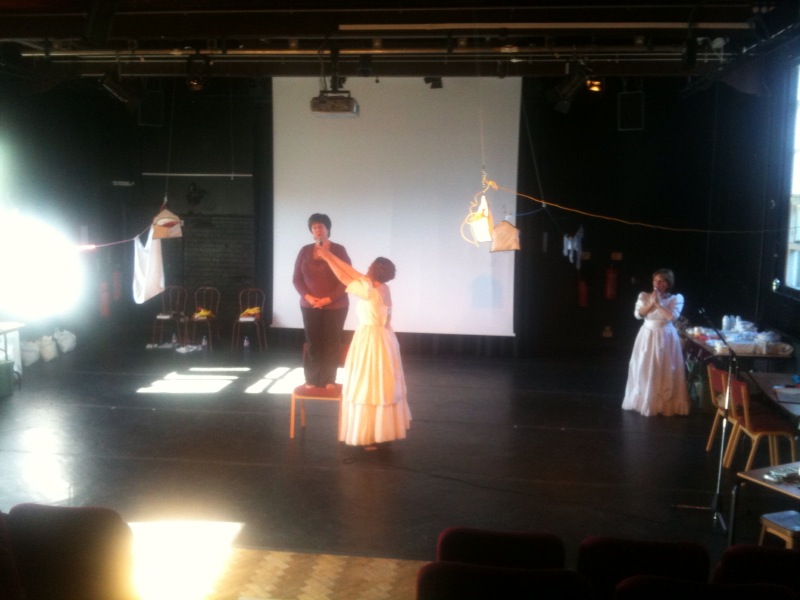
On a Sunday walk visited the Mapping Maternity durational performance (6 hours) for a short while. Here a short blurb, and a picture. Funny, interesting and intelligent, it made perfect sense as a performativity of the various assemblages, routines, codes and chaotic sequences of which the very regulated but still affective role of motherhood/maternity is formed of. It ranged from clinical contexts to affects of aurality, bodies, and spaces.
“Mapping Maternity
Three women, equipped with cakes, tea, microphones, prams, toys, nappies, talcum powder, birth plans, Nina Simone’s My Babe Just Cares For Me and endless lists of things to do, things to avoid, recipes to follow and questions to ask, embark on a 6-hour long journey of mapping. You are invited to follow their travels, observe their struggles, and listen to their confessions on this laborious day.
A 6-hour durational performance devised and performed by Kerstin Bueschges, Jan Farrar and Sandra Flores. The audience is free to come and go as they please. “
>Networkpolitics-poster
>Here is the poster for our forthcoming Network-politics event, full title: Thinking Network Politics: Methods, Epistemology, Process. Its the first in series for the AHRC funded project, followed up by next one in Toronto around end of October and the final one in Cambridge, next year.
This promises to be an exciting event, where most of the emphasis is on emerging discussions instead of “only” academic talks; the length of talks is reduced to give time to what follows from the position papers that touch media arts and artistic methods, activism, network ontology and methodology, media archaeology, clouds and love. A whole range of themes, indeed.
Registration here.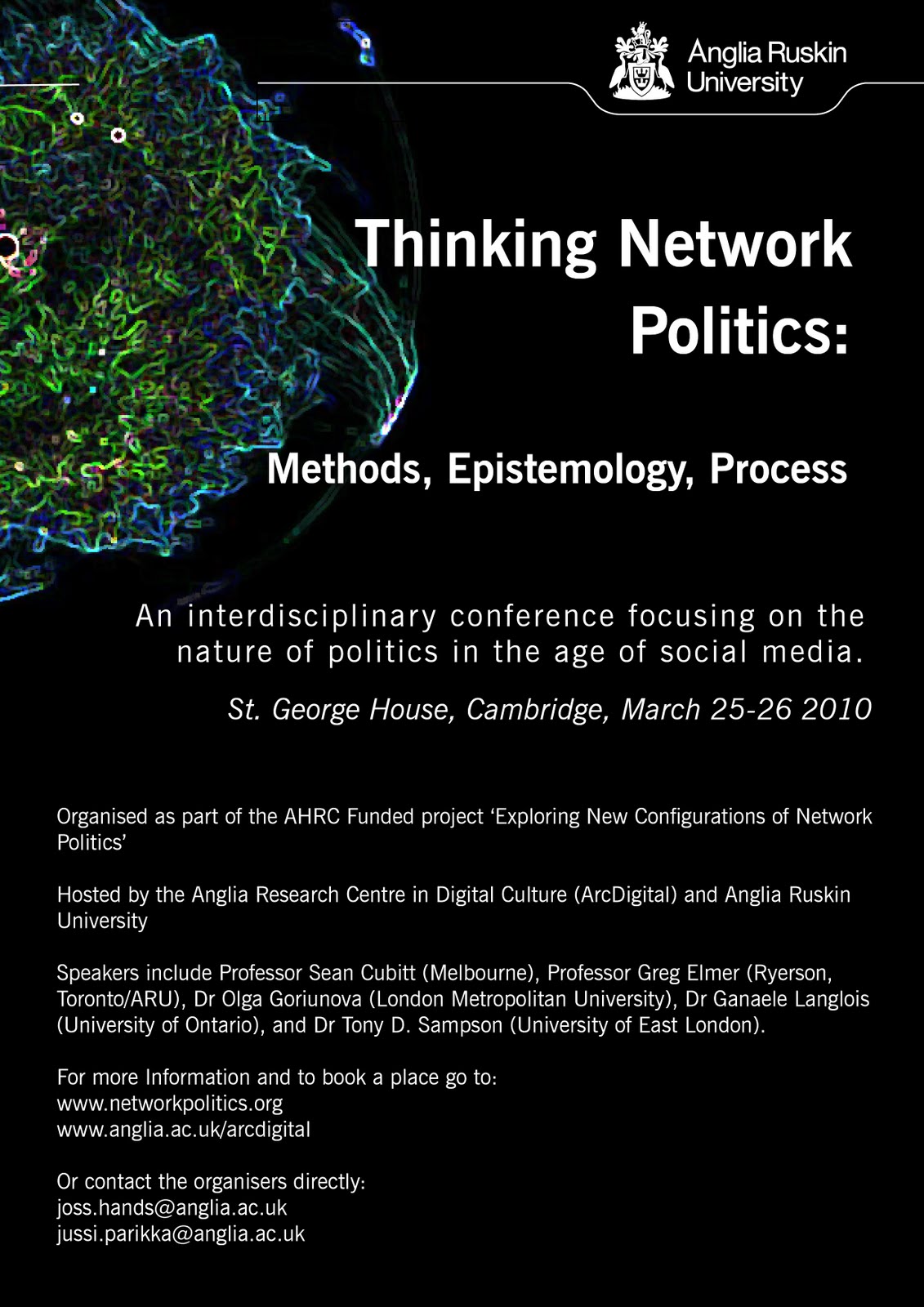
>Does Software have Affects, or, What Can a Digital Body of Code Do?
>I am going to attach here an abstract I submitted for a conference today — the Deleuze studies conference in Amsterdam. Its something I did for a book coming out soonish, on Deleuze and Contemporary Art:
Can software as a non-human constellation be said to have “affects”? The talk argues that as much as we need mapping of the various affects of organic bodies-in-relation in order to understand the modes of control, power and production in the age of networks, we need a mapping of the biopolitics of software and code too. If we adopt a Deleuze-Spinozian approach to software we can focus on the body of code as a collection of algorithms to bodies interacting and affecting each other. What defines a computational event? The affects it is capable of. In a parallel sense as the tick is defined through its affects and potentials for interaction, software is not only a stable body of code, but an affordance, an affect, a potentiality for entering into relations. This marks moving from the metaphoric 1990s cyberdiscourse that adopted Deleuzian terms like the rhizome into a different regime of critique that works through immanent critique on the level of software. This talk works through software art to demonstrate the potentials in thinking software not as abstract piece of information but as processes of individuation (Simondon) and interaction (Deleuze-Spinoza). A look at software practices and discourses around net art and related fields offers a way of approaching the language of software as a stuttering of a kind (Jaromil). Here dysfunctionalities turn into tactical machines that reveal the complex networks software are embedded in. Software spreads and connects into economics, politics and logics of control society as an immanent force of information understood in the Simondonian sense. The affects of software do not interact solely on the level of programming, but act in multiscalar ecologies of media which are harnessed in various hacktivist and artist discourses concerning the politics of the Internet and software.
Encountering (only as a website though) today the Sonicity-installation project I continued thinking about this. The project turns light, humidity and other environmental data such as people into input for algorithmic sonification through MAX MSP and further to visualisation.
What intrigues me in this is the process of transformation and transposition of various sensory regimes; translations from input into data and further to sound, image, etc. This somehow connects for me to considerations of affect (bodies in relationality, a variety of heterogeneous bodies) as well as the materiality of code data as well (especially becoming sonorous, visible, and hence touching human bodies directly too). “The changing data is what affects what you see and experience. Live XML feeds are ciming from the real time sensors.. The sensors monitor temperature, sounds, noise, light, vibration, humidity, and gps. The sensor network takes a constant stream of data which is published onto an online environment where each different interface makes representations of the XML.” (Sonicity-website).
Naturally, such transpositions could be connected to earlier avant-garde synaesthesia; people such as László Moholy-Nagy’s explorations into the interconnectedness of sound with visual regimes is exemplary here (see Doug Kahn’s Noise Water Meat, p. 92-93), especially when the point about synaesthesia not only as an aesthetic category but irreducibly laboratorial is made clear. Such synthetic processes that make us think about the interrelations of heterogeneous sensations and their sources work through the new technologies and sciences of sound and perception. Indeed, if code/sofware has affects — that is not anymore sillier question than “I wonder how your nose will sound” (Moholy-Nagy).
Oh its not all visual is it?

Jasia Reichardt gave a talk of media archaeological proportions; of machines and art where machines infiltrate not only the imagination of artists as objects, but the sexual desires of consumer societies, machines are as much imagined as they are real — they inhabit border zones of the modernist imagination. Whereas I enjoyed a lot her picture arsenal — for example the ones from Grandville’s L´Autre monde (1844) — the talk was not as consistent as I hoped. In addition, to the very good question of how would she reconsider her 1971 Computer in Art her answer was quite disappointing. She seemed to get lured into modernist themes concerning profound vs. superficial by pointing out how easy making art with computers nowadays is — everyone can do an image now with them; where suddenly, to my surprise, computer art seemed to be all about image/visual based arts. What happened to code art, sounds, complex understandings of uses and reuses of software and hardware?


Operational Management of Life

Management of life — in terms of processes, decisions and consequences — is probably an emblematic part of life in post-industrial societies. Increasingly, such management does not take place only on the level individuality, but dividuality — i.e. managing the data clouds, traces, and avataric transpositions of subjectivity in online environments. This is the context in which J. Nathan Matias’ talk on operational media design made sense (among other contexts of course), and provided an apt, and exciting, example of how through media design we are able to understand wider social processes.
Nathan addressed “operationalisation” as a trend that can be incorporated in various platforms from SMS to online self-management and operationalisation. More concretely, “operational media” can be seen as a management, filtering and decision mechanism that can be incorporated into services and apps of various kinds. Nathan’s talk moved from military contexts of “command and control” (operationalisation of strategic ways into tactical operations) to such Apps as the blatantly sexist Pepsi Amp up before you score which allowed the (male) user to find “correct” and functional responses to a variety of female types. In addition to such, Nathan’s talk was able to introduce the general idea of computer assisted information retrieval and management which to me was a great way of branding a variety of trends into “operational media”. He talked about visualisation of data, augmented reality, filtering of data, expert, crowd and computer assisted information gathering, and a variety of other contexts in which the idea works.
“Should I eat this croissant” considering its calories, the needed time I need to work out to get it again out of my system, the time available etc. is one example of operationalisation of decisions in post-fordist societies of high-tech mobile tools that tap into work and leisure activities.
Another example is the service offered by Nathan’s employed KGB (not the spies, but Knowledge Generation Bureau. See their recent Superbowl ad here. The KGB service is one example of mobile based operational services which in the character space of an SMS try to provide accurate answers to specific questions and hence differ from e.g. search engines.
Of course, one could from a critical theory perspective start to contextualise “operational media”. Is it a form of digital apps enhanced behavioralism that does not only assume but strengthens assumptions about the possibility of streamlining complex human actions? Is it a mode of media design that further distances management of life into external services? Is it hence a form of biopower of commercial kinds that ties in with the various processes from the physiological to cultural such as labour and provides its design-solutions for them? In any case, Nathan’s expertise in this field was a very enjoyable, and a good demonstration of a scholar/designer working in software studies.
Operational Media: Functional Design Trends Online -guest talk
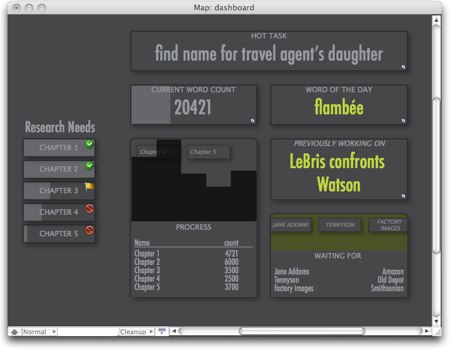
Operational Media: Functional Design Trends Online
Tuesday, February 16, 17.00-18.30, Helmore 252 at Anglia Ruskin, East Road, Cambridge
Two prominent visions have guided the development of Internet technology from its beginning: the never-ending information space of creativity and information; and the networked tool for action. Now that markets for media production and search are saturated and stalling, second generation web tech has shifted focus to media that helps people make decisions and get things done. This lecture provides an introduction to key issues in the information design and software engineering of operational media.
Bio: J. Nathan Matias is a software engineer and humanities academic based in Cambridge, UK. His work focuses on enhancing human capabilities and understanding with digital media. Recent work has included digital history exhibits, work in online documentary, research on visual collaboration, and a visual knowledge startup. He currently spends half of his time as a software engineer on SMS information services for the Knowledge Generation Bureau, and half on digital media projects.
All welcome!
War, scarcity and other playful things of life
Fun Inc. by Tom Chatfield was not as interesting as I hoped it is going to be. For most parts, it was telling what I already knew; that games are not played only by teenaged boys in their cellars, alone, with a blood-craving look in their eyes. No, instead they are social, reach various social layers, teach us a variety of skills from emotional to intellectual, and that also the army and the education institutions are interested in them. Fair enough, perhaps we still need such books to spread out the fact that games are not just games, but constitute a key feature of contemporary digital culture. Its not only “games” as objects or products but a whole set of patterns of behavior, gestures, affects and emotions that constitute a wider field of “gamelike” elements of which digital culture consists of. Hence, such seeming oxymorons as serious games (games used for learning or other “serious” activities like politics) are taking over. Or then casual games, used to fill in that 3 minutes you have of your personal time. I am still yet to see that perfect post-fordist analysis of the management of time and a care for the self in the context of casual gaming.
To be fair, Chatfield included some nice sections. His chapter on Second Lives pointed out the weird patterns of labour of social media platforms — from goldfarming to such original interventions as Jeff Crouse and Stephanie Rothenberg’s Invisible Thread’s project that staged a virtual sweatshop on Second Life.
Thinking about gaming cultures, I was reminded of (quasi-)Zizekian ideas concerning how people want their own slavery and such social media and game platforms are good examples of such. They are both able to articulate the real world cultures of scarcity, but at time same time showing how it seems impossible to even think/desire outside such modes of capitalist scarcity. Chatfield mentions one early virtual world The Palace (1995) that was supposed to introduce a world without real life limitations. As Chatfield writes, people were not however ready for such radical ideas, “People, it turned out, were extremely attached to scarcity. They liked it so much, in fact, that not only did they prefer virtual worlds in which there were strict limits on available resources over ones in which you would simply have anything you wanted; they were actually prepared to pay money to spend time in these scarce worlds.” (173) In Zizekian terms, even if such a world without limitations was somehow possible there, people did not find the needed cognitive and affective attitudes of how to cope with that. What to do with that lack of scarcity? In terms of how it articulates the artificial scarcity continuously maintained by neoliberalism, such virtual worlds become really interesting.
Finally, again from one of the better chapters, this one on the one on war, Chatfield seems to write suddenly like Friedrich Kittler. Hence, I could not resist quoting him in length (Chatfield that is):
“In this respect, it’s clear that being well prepared for modern warfare shares many elements with good preparation for modern life: you need to be able to live and breathe certain kinds of software and hardware. Most of your actions are mediated by complex machines, while your sphere of power and information extends well beyond the personal space you occupy. You are a networked individual, using multiple tools, often deluged with information and options.” (192-193)
Having just yesterday finally seen Gamer, something that Steven Shaviro has been going on about (and for a good reason), this description seems apt and accurate idea of some of the techno-affective links between gaming cultures and war; what Shaviro brings in his wonderful analysis of Gamer is of course neoliberalism. I cannot but warmly recommend his text on the topic.
Richard Grusin on affect, premediation and security — Anglia Ruskin ArcDigital talk
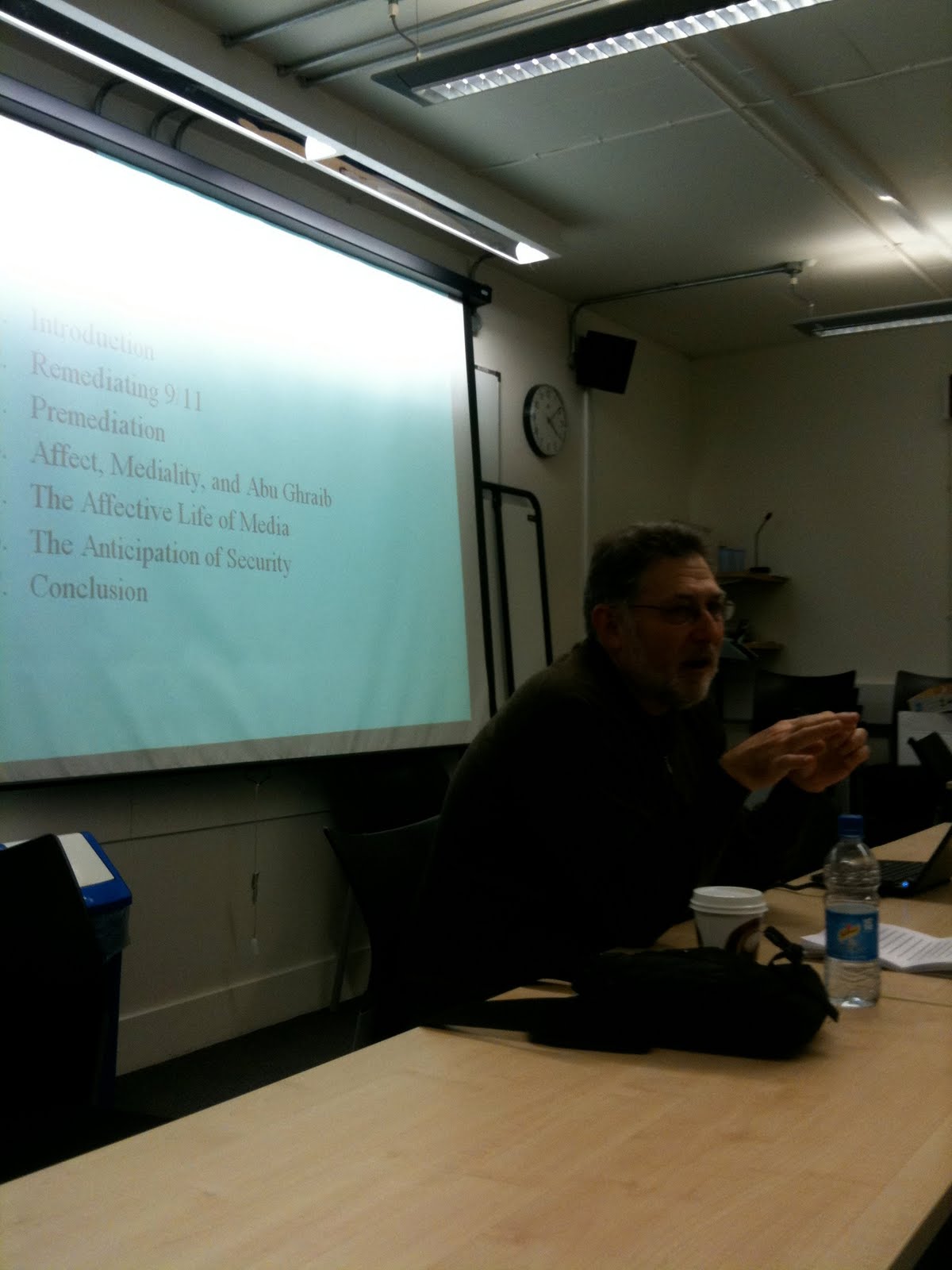
Talking of anticipation — It’s always wonderful to meet in person people whose texts you have read for years — and admired. Richard Grusin’s visit at Anglia Ruskin finally took place, and was as every bit interesting as I was expecting it to be. His and Jay David Bolter’s Remediation-book and thesis had a huge impact in combining my new media interests with my background and training in history, and now his new stuff on premediation promises to combine such theoretisations of temporality with the very current debates concerning affect, security and media culture.
Grusin’s talk was very much contextualised in his soon forthcoming book Premediation: Affect and Mediation after 9/11 (Palgrave). The book promises to be a mapping of the non-representational and non-cognitive forces of the securetized social media culture where affects (in the sense of also positive “good vibes” as well) and security are complementary states or atmospheres of bodies in relation. This includes not also human bodies (“having feelings”) but relations between humans, nonhumans and in general heterogeneous assemblages. This is the regime of affective flows between such objects/subjects.
The talk had four parts, or sections, that mapped out the various contexts of such flows:
1) premediation and security
2) anticipatory gestures
3) media theoria
4) premediation and politics
The richness of the talk is hard to convey through any summaries so my notes remain fragmented. The easiest would be to say: read the book!
For me, certain key points stood out. The point about our media culture based on the atmospheric affect of “anticipation” instead of e.g. distraction (Benjamin and Kracauer) is certainly one such; and applies in Grusin’s reading both to bodies in social media culture of expected, anticipated, potential social interaction through software-mediated platforms as well as to the inbuilt modes of anticipation in software. This “mediaphilia of anticipation” is a nice way to frame the software promoted anticipatory gestures that often are approached through medicalised conditions (ADD etc), but are in fact generalised modes of subjectification.
Grusin’s critique of Agamben and notions of “state of exception” were important as well, and resonate with recent Hardt and Negri points in Commonwealth. Instead of approaching contemporary constellations of power through such notions that hint of transcendent powers and sovereignty (state of exception and being able to rule such), immanent ways of how power operates take into account the much more “business-as-usual” type of handling events, establishing patterns, managing repetitions, actions and relations in everyday life. That’s software culture.
Affect is a way for Grusin (as for many others) a way to approach the non-cognitive and non-representational ways how media do not (just) signify but do things to us and with us. I think Grusin could have elaborated a bit more on this more virtual and somatic sphere of the affect when talking about gesturality in media culture — and how it is as I have used the word more “atmospheric” preparadness as a potentiality of the body as a tension, attention, than just actual gestures (which are important and through which the atmosphere of virtuality of such anticipation gets articulated). In any case, his critique of some nostalgic accounts of online activities that lie on politics of authenticity were to me spot on) as was Grusin’s discussion of the necessary preformatted modes of living; the patterns of repetition that are necessary for everyday realities. Any kind of resistance has to work immanently within such formations, not neglecting the reality of for example us needing habits. This opens a completely different political horizon.
In terms of how this position relies on rethinking some of the temporal ties — and temporality as a crucial feature of the affect-embedded security regimes — premediation-thesis comes close to for example Greg Elmer’s and Andy Opel’s notions concerning pre-emptive measures of control. Security measures happen pre-emptively, shooting before asking questions, making sure that the state of things is always such that any potential events that are undesirable do not take place. No wonder that Minority Report is here the key film for such social theory. I know that discussing such positions in relation to for example Erin Manning’s “preacceleration” would be fruitful as well (thanks to Andrew Murphie for flagging this potential connection), but I have to admit I have not anything that special to say (and that Manning’s book is at the office shelf at the moment). Her way of discussing movement and dance and bodies-in-movement through preacceleration refers to the primacy of the forthcoming-transformation that the body attunes to continuously. For Manning, bodies are not present but moving, prehending and in this sense ahead of their time a bit paradoxically — a realisation that comes through clearest in dance. Bodies catch wind, and move as part of such attractors that dance is filled with (whether “stable” objects, or dance partners). The anticipatory nature of such preaccelerated bodies is something that ties in with Grusin’s points that I would have to read more about as the mechanisms of anticipation as a way of orienting towards certain intensities and attractors (e.g. again social media culture features as banal as the commenting function and its potentiality to attract comments) is one way of thinking “bodies in speed” (Mackenzie).
Its clear that an increasing amount of accounts that want to articulate a material politics of software culture have to deal with temporality. This is a curious phenomenon and attempts for “solution” come from different directions, sharing a lot with each other. Of course, I could add that to my “things to write” list, but one has to be realistic…










 Machinology