OOO, OOP and OOMT (?)
Levi Bryant at Larval Subjects gives a good heads up on the link between Object-Oriented-Philosophy and John Johnston’s fabulous The Allure of Machinic Life — and that way hints of the still quite implicit links between such modes of philosophizing and contemporary media theory. For me, Johnston’s work became familiar through his editorial work with Kittler’s writings, and as such, The Allure is for me a work that is branded by that way of thinking the material media culture. Kittler and others for instance in “German media theory” rarely talk about objects – but of networks, inscription systems, materials of communication – but I can see where some of the arguments might resonate. In terms of links between the various theory scenes, some people such as Paul Caplan at The Internationale are picking up related themes, combining media archaeology with OOP/OOO (never sure which one to call it), and discussing the logic of technical media objects (in this case, the JPEG protocol) through Harman and others.
For me, the so-called material media theory lends itself to “new materialism”, and the material assemblages, networks, dynamic embodiments and intensive becomings investigated there. Whereas the relations between new materialisms and the speculative realism as well as object oriented philosophy are still to be investigated I guess, so are the possibilities that media theory offers too.
Related to such discussions, I learned from somewhere that Speculations – Journal of Speculative Realism is reviewing my Insect Media in its issue no 2, which also scares me – while of course finding it intriguing how it is going to be received on that side. I share a lot of the same references from Deleuze to Delanda to Latour, but never explicitly link up to any of the speculative realist discussions, nor object oriented philosophy.
(My short review of Johnston’s The Allure-book is found here.)
Oh and the title of the post? Clarification of terms:
OOO= Object Oriented Ontology
OOP = Object Oriented Philosophy
OOMT= Object Oriented Media Theory
New Materialism: Naturecultures in Utrecht
I will be giving two talks in Utrecht in April (6-7) – one based on Insect Media and more specifically on Roger Caillois (read as a media theorist of embodiment, psychastenic spatiality, mimicry), and the other one as part of the New Materialisms: Naturecultures-event. It follows up some of the themes of our last year’s symposium that we organized in Cambridge with Milla Tiainen – and now again with a wonderful line of speakers, including Donna Haraway.
My talk will touch on how to think the materialism of media in its specificity – and how to expand from German media theoretical materialism of for instance Friedrich Kittler’s work to medianatures. So I will probably will end up touching some of the media ecological themes I have been writing about recently. Below a short blurb about the event, and below that, my abstract for the event.
One of the conceptual innovations stirred by debates in contemporary cultural theory that want to rewrite the linguistic turn concerns ‘naturecultures’. This concept is created by Donna Haraway in The Companion Species Manifesto (2003) in order to write the necessary entanglement of the natural and the cultural, the bodily and the mind, the material and the semiotic, et cetera. ‘Naturecultures’ offers us an important route to rewrite these modernist oppositions in such a way that rather than representing parts of the world, a transcription with the world is being proposed. Concepts thus do not capture or mirror what is ‘out there’, but are fully immersed in a constantly changing reality. ‘Naturecultures’ rewrites not only femininity but in the end all subversive material practices as an ethical break through of for instance phallologocentrism. Karen Barad would call this ‘ethico-onto-epistemological’.
This conference uses ‘naturecultures’ as a point of departure. We intend to study conceptual innovation in contemporary cultural theory from seemingly different ‘disciplinary’ and ‘paradigmatic’ angles in order to demonstrate how similar movements in thought are at work in the emerging paradigms of new materialism, post-humanism, agential realism, and in fields ranging from philosophy to the humanities and to the natural sciences.
The first ‘New Materialism’ conference took place in June 2010 at Anglia Ruskin University in Cambridge, the UK. Organized by Dr. Jussi Parikka and Dr. Milla Tiainen, several scholars came together to discuss new materialism and digital cultures. This second conference is an initiative of the Center for the Humanities, the Graduate Gender Programme, and the Department of Media and Culture Studies, all located at the Faculty of Humanities of Utrecht University. It is funded by these three partners, as well as by the Netherlands Organisation for Scientific Research, the Center for the Study of Digital Games and Play (Utrecht University), and the Posthumanities Hub (Tema Genus, Linköping University).
And my abstract:
Media Milieus, or Why Does Nature Do It Better?
In terms of material media analysis, the German media theoretical directions at least since Friedrich A. Kittler’s influential writings have introduced an important agenda to think the specificity of media. In what could be termed the Kittler-effect in media theory (in Winthrop-Young’s words), the materially meticulous readings of technical media have forced a whole generation of new media studies to think through the technical and scientific specificity of contemporary media – beyond meaning, representation and the human body, the fact that technical media engage in such processes, speeds, and phenomena that escape the phenomenological human register per se. Media often hear more, see more and memorize much more than us humans.
Yet, I want to point towards a different kind of reading of media materiality, one that touches on the symposium theme Naturecultures more directly. We can question the notion of specificity and argue that there are various specificities to which we could tap into. While German media theory has been insisting on drawing on materialities that can be directly connected to the important scientific contexts of technical media, we can insist on what could be called a milieu theory of media: how media establish but also draw on nature, animals and other non-human intensities, forces and potentialities. Instead of thinking nature here in terms of the metaphorics it has offered for a long time for media cultural phenomena, and avoiding proposing any form of purity of nature, I want to look at the continuums of not only naturecultures, but medianatures that is slightly different from the emphasis of media cultures as the “new” environment for us human beings. Instead we approach medianatures as affordances, as intensities, as regimes of affects and relations and as processes of mediatic nature that offer a non-human view to new materialist media theory.
Metastable biomedia bodies: Paul Vanouse’s Fingerprints

The Suspect Inversion Center (SIC)
It is a beautifully created little exhibition; a dark room, three projects, all like spotlights into aspects where the biological is becoming media – and as such, part of the epistemic frameworks. These forms of mediated knowing are then of course themselves access points to a plethora of techniques of power, proof and aesthetics. Yet, as has been demonstrated the recent years in various bioart and biomedia-theoretical works, the biological just not is – but is created.
Hence, Paul Vanouse’s Fingerprints, curated by Jens Hauser, is one of such works that is able to extend the notion of “media” to processes deep inside the body, and yet abstract enough to encompass global transactions, economies, regimes of knowing. Exhibited at the Schering Stiftung, Berlin, three pieces (The Suspect Inversion Center, Relative Velocity Inscription Device, and Latent Figure Protocol) are on show. What Vanouse is able to show is the inherent instability, or perhaps metastability if we want to use concepts from Gilbert Simondon, of these constellations of production of “truth”. What kinds of truths? Truths about race, about culpability, about how DNA samples do not just stick to the body, or that the relation is fragile, sustained, maintained exactly by the techniques supposed to “find” them. This is basic stuff that Science and Technology Studies has given us: apparatuses, techniques and frameworks create, never just discover. The truths found are as much in the apparatus as in the body – and hence, more accurately in the various couplings of technologies, biological bodies, and the mentioned abstract frameworks.
It’s mediated, to amusing extents: From the mini-laboratories of Suspect Inversion Center that is an on-going performance aimed to demonstrate the manipulability of DNA samples and images (which involves a “becoming OJ Simpson” of Mr Vanouse’s DNA) to the game-like Relative Velocity Inscription Device where the DNA of four family members are staged to compete against each other in a race form (the pace of their DNA samples moving through the gel electrophoresis that is instrumental part of DNA imaging technologies).
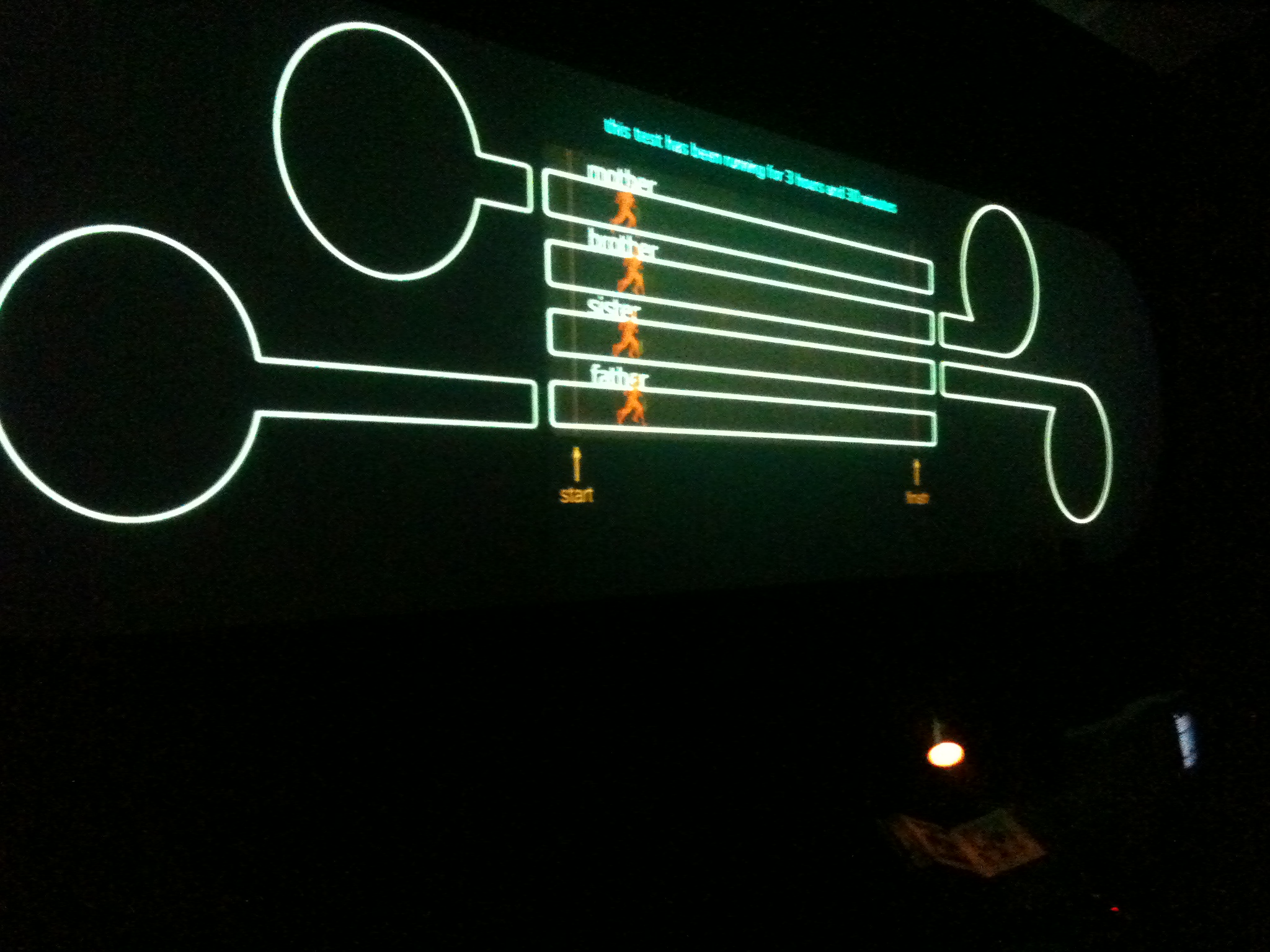
The Relative Velocity Inscription Device (RVID) - the biological body processes turned into a "game" for involuntary processes
Visible, invisible – or sustaining and stabilizing something that is dynamic in its radical temporality (such as the DNA in our bodies) as imaged is one of the most crucial questions for the interconnection of power/media (to modulate Foucault’s “power/knowledge-pairing). Such media and visual cultures are yet grounded in the wet fleshyness of the body, a further connection or demonstration of the idea of even biological bodies as media – and essential to mediated cultures. In this context, such pieces are to me much interesting than thinking them in terms of their genre of “bioart” – in the way they force us think nature-cultures, body-technologies, transversal links.
Things (even data) are rarely lost
I am trying to find the irony in writing recently about computer forensics and thinking about the archive in the digital age — and then being the one whose hard drive gets in such a shape it does not boot, and all my analytical eye for computer forensics and media archaeology turns to hours of panicking.
After extensive, non-analytical and very affective panicking, lots of traveling around Berlin for cure and a new Mac, I was able to restore most of my files, with something lost still.
One cannot hence help thinking the words of Matt Kirschenbaum (thanks to Shintaro Miyazaki for reminding me of the quote):
“Thus the cold truth of modern data storage: given sufficient resources — that is, elite technological and financial backing — data can be recovered from media even under the most extraordinary conditions.”
Information is rarely lost, as it is, after all, material and physical. The spinning hard drive tells usually a lot more than our ways of accessing files tell us, and it is on this physical level that the ephemeral has a materiality – even if fleeting, and very time-dependent (both in terms of its durability as well as its operationality as dynamic, in movement).
Media studies – studies of relations, ecology, waste
The best way for media studies to really make sense is to think outside media – of where it expands, takes us, if we persistently follow its lead. So far, for a long time, it took us to think about humans, human relations, intentions, unconscious desires, economics as much as politics as power. Such paths need to take us to the other direction too; to things less intentional, but as important; to nature, bacteria, chemicals, forms of life outside our headspace but inside our gut; to milieus of living in which our conscious agency is only a minor part of what matters. To such time scales which take into account uses and practices, but as part of larger concert where some things last thousands, millions, billions of years.
Just like humanities more widely, media studies needs to be transversal – perhaps a concept we can tightly link to “transdisciplinary” as well.
To quote Félix Guattari:
“Now more than ever, nature cannot be separated from culture; in order to comprehend the interactions between ecosystems, the mechanosphere and the social and individual Universes of reference, we must learn to think ‘transversally.’” (Three Ecologies, 2000:43).
The biggest reason why we should be worried about death and finitude is less in the existential manner, or even what makes our Dasein authentic, but in the way that milieus of life are dying. This relates to fears about “the sixth mass extension” of species, this time caused by humans. The only death we need is that of the subjectivity that cements the economic, political and aesthetic practices that kill nature. This is as much a question for the sciences and engineering, as it is for media theory, arts and humanities.
As Guattari argues, talking about ecosophy, we need to reinvent a multitude of relations where economic struggles, political struggles and struggles of representation, as well as aesthetics, are those that expand the horizon to nature. Hence, media – both in terms of the technologies that return to nature as heavy metals and toxins and as mediators of the mental ecologies in which our destructive tendencies are sustained – is surprisingly close to this problem too.
The affective regimes of media are affective in terms of the relations they sustain – relations between humans, but also to ecosystems, mechanospheres and more. Media studies is thus in a good position to really develop itself into a study of relations, of mediations in that much wider sense.
Monumental runs
Where I run, in the midst of monuments; gigantic heads of Lenin, monoliths, animal shaped, or just fallen from the sky.


Insect Media interview and more
A big thank you goes to John Protevi for this interview that came out on the Art, Politics, Philosophy, Science (APPS) blog. We talk about Insect Media, and some of its contexts, and chapters — including the one on Roger Caillois, who I read as a media theorist. Not the Caillois we know from game studies, and as a typologist of different affective/genre-classifications of games, but as someone who through his writings on mimicry, the praying mantis and other surprising topics discussed spatiality, imitation and loss of individuality. Picking up Elizabeth Grosz’s thoughts, but continuing towards a slightly different direction of Post-Fordism and the contemporary affective capitalism of games, I find Caillois a great guide in thinking not so much cognitive capitalism, but the intensive affective capitalism working through media technologies such as gaming…
Another heads up: Insect Media was also the book of the week in the last week of February for P2P Foundation site. Also in that context I brand my book as an “Anti-McLuhan” take on media theory and history.
Streets, music are contagious
At the moment, I am trying to blog most of my media archaeology related notes and images on Cartographies of Media Archaeology (the work blog for my in-progress Media Archaeology and Digital Culture-book that I am writing for Polity Press). However, could not resist putting this up here – a short story and image from Illustrated London News, 19 December 1846.
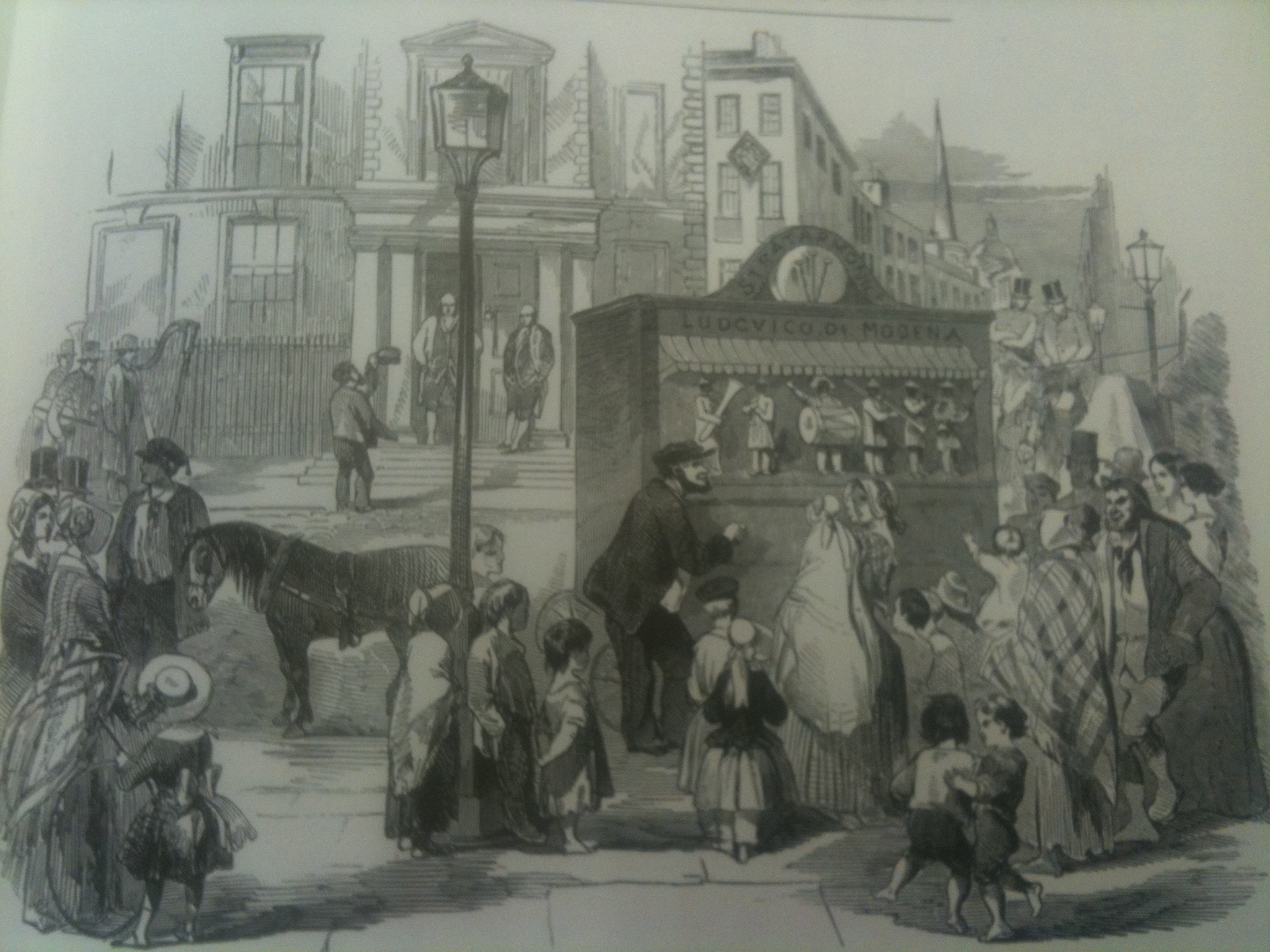
Illustrated London News, December 1846
“London Street Music” features the street musician as a performing artist, giving a glimpse both to the 19th century worlds of entertainment and performance of street life, but also the pre-post-fordist emphasis on performance and affect. What writers such as Paolo Virno have identified as the mode of production in aesthetizised regimes of work: the virtuoso, the performing artist, was already his focus in A Grammar of Multitude. As Raunig puts Virno’s position in a summarizing fashion, while also pointing towards the problematic of relience on language by Virno:
“In post-Fordist capitalism, labor increasingly develops into a virtuosic performance that does not objectify itself into an end product; at the same time, this virtuosic form of labor demands a space that is structured like the public sphere.”
In the 1846 short article, the almost dangerous powers of the street musician are described in how they can capture the affect life of the listeners in public sphere: “How many suicides have been committed under his melancholy has not yet been clearly ascertained; but the effects of the orgue de Barbarie on the nervous system have been well known since Hogarth gave to the world his ‘Enraged Musician’.”
The worlds of technology (the new special street organ that differentiates this new brand of talent from “amateurs and artists”) and the worlds of music, the ability to bring operatic cultures of Rossinian and Bellinian spheres to the wider public, make up this special brand of economies of cultural industry of affect. Naturally this reminds that the contagious force of affect has a longer history – in terms of the affect theories in music (baroque and the early 18th century for instance) as well as in social theory that emerged in the late 19th century where it was discussed in terms of public space, contagion, imitation and crowds.
Arts Future Book – Book Futures of Arts
I don’t think I have blogged this, so a heads up: a very interesting new series from Gylphi, Arts Future Book. If you have great projects that could fit in, get in touch (either via me, I am on the editorial board, or directly with the general editor Charlotte Frost):

Edited by Charlotte Frost, Arts Future Book is an academic book series aiming to publish texts on art and visual culture in both print and digital formats. The series seeks to foster new scholarship in the arts, and publish unique works that rethink contemporary visual culture and establish new systems for considering art. It will highlight aspects of the impact of digital technologies on contemporary culture and indicate the ways in which technology informs our knowledge of the arts. The series will exploit recent technological advances in publishing to better disseminate such bodies of arts knowledge and develop wider readership and new reader experiences. Its premise is the notion that ideas are formed in dialogue with the media that represent them and that authors can actively forge the future of disciplines by recreating their core media. Therefore, this series sets out to chart new territory in disciplines dealing with the criticism, theorization and historicization of the arts. Each book published within the series will respect established academic standards, while redefining what an academic text might be and how it might be used.
Whitehead into media theory
Complementing the biomedia-theme of the conference (Response:ability) of this year, the final panel of Transmediale 2011 featured two important writers in media theory and arts: Marie-Luise Angerer and Mark B.N. Hansen. Angerer was very interesting in her presentation that focused on the notion of affect, talking about Massumi, the disappearing half a second in registration of sensations, and dance, but I want to mention here especially Hansen (partly because of the selfish reason of having been recently occupied with the idea of time-critical media, and microtemporality).
Amusingly introduced in the programme as the other Mark Hansen – who teaches statistics at UCLA – this Mark Hansen at Transmediale is of course the author of New Philosophy for New Media and Bodies in Code; both important, interesting books in embodiment and the media artistic cultures of perception. As was pointed out during the session, partly by Hansen himself, his theoretical trajectory has moved in new directions during these years: from a very strong phenomenological focus influenced by Maurice Merleau-Ponty, to a much more Gilbert Simondon influenced Bodies in Code, and now he is framing his project through A.N.Whitehead. This is interesting, as it shows yet another contemporary cultural and media theorist moving in that direction. Well known are the Whitehead writings of Massumi and Manning in Montreal, and of course the recent Whitehead writings of Steven Shaviro, the debates around object oriented philosophy that take a lot aboard from Whitehead, and naturally the ideas of such pioneers as Isabelle Stengers and Bruno Latour. So Hansen as well has joined this crew enthusiastic about the superject instead of subject, and the distributed field of prehensions instead of the primacy of the human body and sensory system as the focal point in aesthetics.
Hansen’s current project is more generally framed as a move from objects to processes. Hansen argues that so much of media theory (including his own work) has been focusing on objects as the primary, uhm, object of media theory. Instead, contemporary culture of distributed ubiquitous media environments demands something else. The presentation itself was packed full of theoretical arguments that are hard to unpack in a good brief way, but I just want to point towards some key concepts.
Hansen argues that this new media culture demands new concepts – a new culture of media processes has to be complemented by a specificity paying attention to how it happens on such levels that are not always directly registered on the human sensorium. Interestingly, he pointed towards Guattari as well, even if not so strongly as talking about Whitehead. In short, the indebtedness to Guattari could be summarized through the idea that machines talk to machines before talking to us. Hansen takes this concretely, in a similar manner to Wendy Chun, and pays attention to how much happens in our media machines (take smart phones that all the time are connected due to the GPS system etc) before we actively use them. The sensibilities inherent in such regimes of software cultures are indeed beyond the normal accounted for 5 senses that media theory has traditionally recognized. And here kicks in Whitehead.
Instead of the body focus of previous (new) media theory, Whitehead offers ways to rethink embodiment. The body is in such a theoretical frame “a vast set, a society of sensibilities.” Similarly Whitehead complicates the notion of perception by two important specifications: perception as presentational immediacy, as it has been understood in so much of history of philosophy and perception as causal efficacy. Without me being able to go into enough detail here, causal efficacy points towards the way Whitehead wants to take into account the way actual entities in the world are created through their relations to other entities, preceding them, and in midst of which entities are determined. It points towards the processual nature of perception being born – not the end result, but the “sensory processes leading up to and informing perception.”
When Shaviro asked the question of how would contemporary cultural theory look like if we had focused more on Whitehead, instead of Heidegger as the 20th century philosopher, Hansen seems to ask: how could we bend Whitehead into a media theorist? Whitehead hardly wrote anything related to media or technology per se (even if writing lots on science which we can argue of course being of huge importance to any understanding of media culture). For Hansen, the key point is how Whitehead’s perspective affords us to think about nonperceptual sensation. It gives agency to the environment instead of the focal subject effected and affected by that environment, and offers the perspective of the superject for media theory: how the individual is the end result of the environmental datum prehended by this focal point.
This in a way pairs up with the nature of the processual environments – that when we need to talk about processes as the central “object” of media studies, we need to see this both in the sense how e.g. Whitehead can offer such theoretical perspectives (causal efficacy) as well as how the distributed, ubiquoitous software environments are processes, unfolding in their nature. This is where Hansen’s perspective ties together with the recent debates concerning time-critical perspectives that especially the Berlin Humboldt media theorists have promoted (again, see Axel Volmar’s Zeitkritische Medien, 2009, as well as Wolfgang Ernst’s writings). Yet, there is an important difference as Hansen seems to argue that it’s only the recent new media has made the processual approaches crucial. But is this not already the case for such earlier media as wireless, cinema even, and for example television? Hansen does not fully address why the earlier media of signal processing of various forms does not qualify for the microtemporal ideas he is arguing for, where the circulating nature of the electric, electromagnetic, and then electronic signal is processual. I would argue that here some media archaeology should step in and offer a broader perspective concerning technical media and time, affect of technological relations, and process.








 Machinology