Archive
Things (even data) are rarely lost
I am trying to find the irony in writing recently about computer forensics and thinking about the archive in the digital age — and then being the one whose hard drive gets in such a shape it does not boot, and all my analytical eye for computer forensics and media archaeology turns to hours of panicking.
After extensive, non-analytical and very affective panicking, lots of traveling around Berlin for cure and a new Mac, I was able to restore most of my files, with something lost still.
One cannot hence help thinking the words of Matt Kirschenbaum (thanks to Shintaro Miyazaki for reminding me of the quote):
“Thus the cold truth of modern data storage: given sufficient resources — that is, elite technological and financial backing — data can be recovered from media even under the most extraordinary conditions.”
Information is rarely lost, as it is, after all, material and physical. The spinning hard drive tells usually a lot more than our ways of accessing files tell us, and it is on this physical level that the ephemeral has a materiality – even if fleeting, and very time-dependent (both in terms of its durability as well as its operationality as dynamic, in movement).
Streets, music are contagious
At the moment, I am trying to blog most of my media archaeology related notes and images on Cartographies of Media Archaeology (the work blog for my in-progress Media Archaeology and Digital Culture-book that I am writing for Polity Press). However, could not resist putting this up here – a short story and image from Illustrated London News, 19 December 1846.
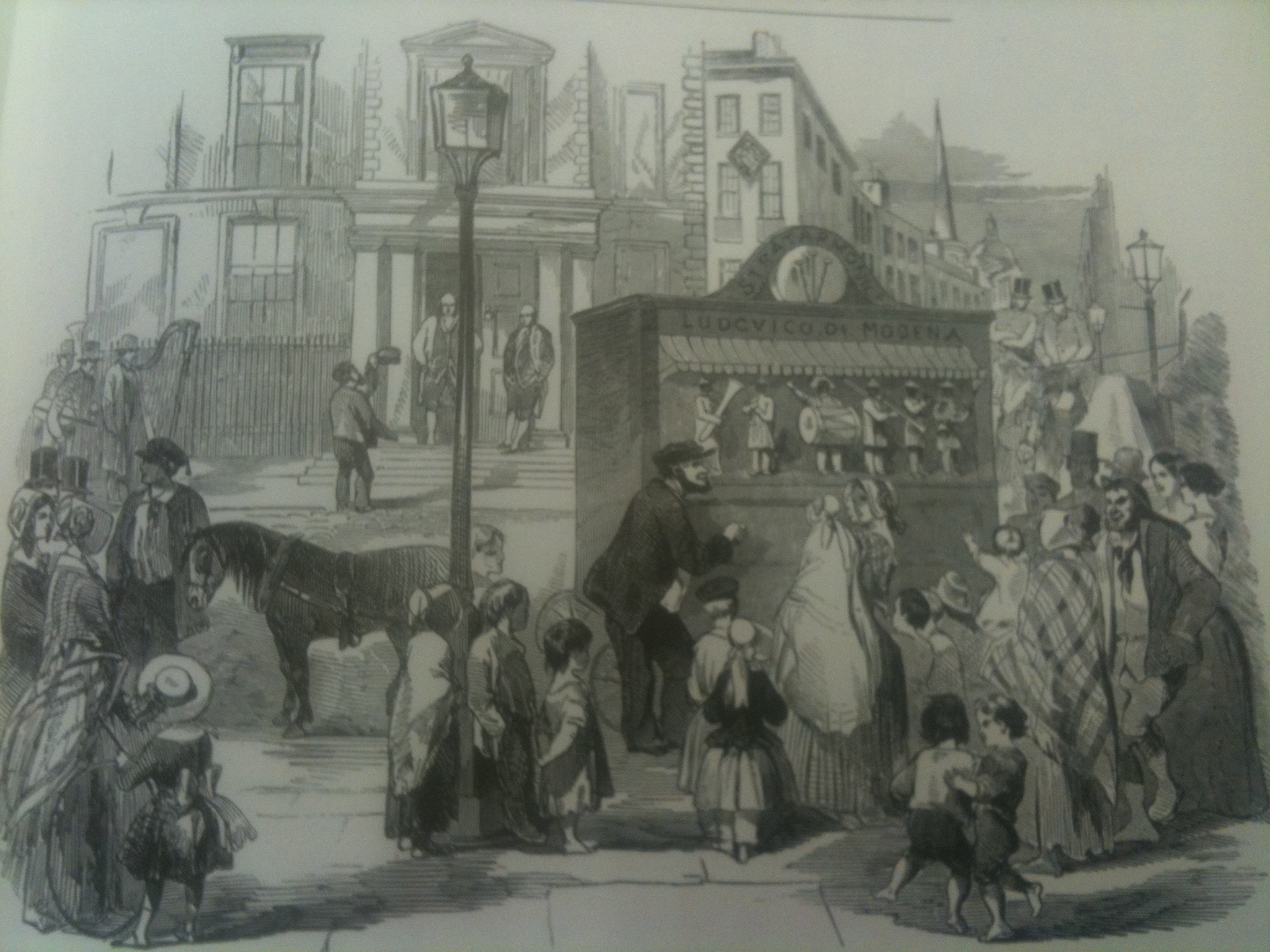
Illustrated London News, December 1846
“London Street Music” features the street musician as a performing artist, giving a glimpse both to the 19th century worlds of entertainment and performance of street life, but also the pre-post-fordist emphasis on performance and affect. What writers such as Paolo Virno have identified as the mode of production in aesthetizised regimes of work: the virtuoso, the performing artist, was already his focus in A Grammar of Multitude. As Raunig puts Virno’s position in a summarizing fashion, while also pointing towards the problematic of relience on language by Virno:
“In post-Fordist capitalism, labor increasingly develops into a virtuosic performance that does not objectify itself into an end product; at the same time, this virtuosic form of labor demands a space that is structured like the public sphere.”
In the 1846 short article, the almost dangerous powers of the street musician are described in how they can capture the affect life of the listeners in public sphere: “How many suicides have been committed under his melancholy has not yet been clearly ascertained; but the effects of the orgue de Barbarie on the nervous system have been well known since Hogarth gave to the world his ‘Enraged Musician’.”
The worlds of technology (the new special street organ that differentiates this new brand of talent from “amateurs and artists”) and the worlds of music, the ability to bring operatic cultures of Rossinian and Bellinian spheres to the wider public, make up this special brand of economies of cultural industry of affect. Naturally this reminds that the contagious force of affect has a longer history – in terms of the affect theories in music (baroque and the early 18th century for instance) as well as in social theory that emerged in the late 19th century where it was discussed in terms of public space, contagion, imitation and crowds.
Anna Munster talk at the CoDE-institute
The next CoDE-talk:
Dr Anna Munster on biopolitics, death and digital aesthetics
at Anglia Ruskin, East Road, Cambridge
Organized by Cultures of the Digital Economy institute, in collaboration with the New Network Politics-project
October 14, Thursday, 16.00-17.30
Room: Helmore 112
‘Out of the biopolitical frypan and into the noopolitical fire: death and finitude as emerging trends in digital culture and aesthetics’
Abstract:
This paper tracks the emergence of a digital ethos that is cognisant of consequence, finitude and even death. On the one hand, sectors of the digital entertainment industry – specifically computer games developers – and new start-up industries are concerned with the question of how to m…anage ‘death’ digitally. On the other hand, death and suicide have become the impetus for creative expression. Bernard Stiegler’s analysis of technicity goes some way toward unfolding a political analysis of the relations between ‘life’ and ‘death’ in the recent and current aesthetics of digital code. Specifically, his more recent work is concerned with the over-reaching of biopower into what he terms ‘psychopower’ and with inventing a ‘noopolitics’ that can respond to this.
But I will also argue that his articulation of noopolitics fails to provide us with a way to conduct ourselves digitally in the light of the spread of technologies and cultures of cognitive capitalism. It does not take account of either the recuperative noopolitics of aesthetic practices in an economy of cognitive capitalism or the productive and differentiating potential of aesthetic practices of digital ‘coding’ that suggest lines of flight for contemporary technoculture. I focus upon the relation between recuperated and critical software practices and the constitution of provisional networked publics that transversally produce lines of flight toward a more transformative noopolitics for digital aesthetics.
Bio:
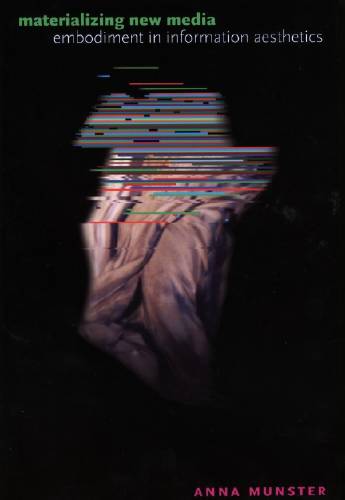
Anna Munster is a writer, artist and educator. She is the author of Materializing New Media (Dartmouth College Press, 2006) and one of the founders of the online open-access journal The Fibreculture Journal. Her theoretical and artistic research covers the politics and aesthetics of networks and media technologies, biopolitics and information societies, embodied perception and neuroscience. She is currently working on a database for generating dynamic concepts about contemporary media (http://www.dynamicmedianetwork.org/), and a book on how networks experience. She is an associate professor, College of Fine Arts, University of New South Wales, Sydney Australia.
Nauman-cum-Lynch
>My perspective to Bruce Nauman television art piece (at the Hamburger Bahnhof, Berlin, September 2010) becoming a David Lynchian experience.
RIP: A Remix Manifesto – film screening and panel discussion

A screening of the fantastic RIP: A Remix Manifesto and followed up by a panel discussion with some leading technology and culture writers, presented by CoDE (as part of the Festival of Ideas):
Arts Picturehouse, Cambridge
October 30, Saturday, 15.00-17.30
Tickets from the Picturehouse ticket counter
“In RIP: A Remix Manifesto, Web activist and filmmaker Brett Gaylor explores issues of copyright in the information age, mashing up the media landscape of the 20th century and shattering the wall between users and producers.
The film’s central protagonist is Girl Talk, a mash-up musician topping the charts with his sample-based songs. But is Girl Talk a paragon of people power or the Pied Piper of piracy? Crea…tive Commons founder, Lawrence Lessig, Brazil’s Minister of Culture Gilberto Gil and pop culture critic Cory Doctorow are also along for the ride.”
The screening is followed up by a panel discussion with
– Bill Thompson (technology writer and columnist for the BBC Online, as well as head of partnership development for Archive Development projects at the BBC)
– John Naughton (academic at Cambridge University, writer and columnist for the Observer),
– Becky Hogge (technology writer, columnist for the New Statesman and former executive director of the Open Rights Group),
– Jussi Parikka (media theorist and director of the CoDE-institute at Anglia Ruskin University)
and
– Geoff Gamlen (a founding member of the remix-music/video group Eclectic Method have been called upon by artists like Fatboy Slim & U2 and by film, video, and television companies such as New Line Cinema and Palm Pictures to create custom a/v remixes.)
The panelists address the themes raised by RIP: Remix Manifesto and a range of interesting and provocative approaches to cultural production in the digital age, copyright and its alternatives, and free culture.
>Summer readings
>Following Steven Shaviro’s and others’ lead, here is a brief summary of my summer’s reading list. Of course, this is more about good intensions, but in any way, represents some of the stuff I need to be catching up with. A painful reminder of things that should have been read ages ago. So read this post as masochism of sorts.
Karen Barad, Meeting the Universe Halfway (Duke 2007)
– such a crucial thinker for neomaterialist cultural analysis, one cannot neglect this book that ties Bohr’s quantum physics with feminist theory. She comes up with such great, and useful concepts as “agential realism” which I believe give tools to both science studies as well as posthuman theory. To quote: “… matter as a dynamic and shifting entanglement of relations, rather than a property of things.” (35).
Joanna Zylinska, Bioethics in the Age of New Media (MIT 2009)
– two reasons: going to Sussex Biodigital Lives conference soon, and wanted to catch up what Zylinska is saying in her new book; then doing a review of it for Leonardo Reviews. Zylinska offers a deeply ontologically rooted ideas concerning bioethics, and extends its regime from only medicine and the biodigital to such practices as blogging and phenomena such as make-up shows. Biopolitics is a parallel theme to bioethics, claims the book. Interestingly, the book tries to come up with Levinas something new, although claiming sympathy to Deleuzian approaches. Indeed, it seems that she shares a lot in this sense with some of Eugene Thacker’s Biomedia-ideas.
Eugene Thacker, Biomedia (Minnesota, 2004)
– a book I should have read a long time ago, but now trying to scan it through in its entirety, again partly because of the Sussex event. I think Thacker’s idea of biomedia as “enabling certain types of data to be mobilized across different media” – i.e. as a concept of mediation that does not lose sight of the material basis of such encodings and decodings is great also for a wider reconsideration of the agenda of media studies (media studies as the potentially key discipline to understand various exchanges happening across scales from science and technology to visual culture and for example science fiction).
Axel Volmar (ed.), Zeitkritische Medien (Kadmos 2009)
– a book that sums up many of the interest in Berlin media studies concerning “time critical media.” It looks like an excellent book that argues for the centrality of time as both an epistemological perspective for media studies and as an ontologically organizing principle for modern technical media culture. This is the stuff what Wolfgang Ernst is always on about (and for a good reason), and where the macrotemporal durations inspected by media archaeology could find a new ground in microtemporal modulations of technical media.
Charles Stross, Accelerando
– His Atrocity Archives was a bit of a disappointment (except for the excellent afterwords), but this one, a gift and a recommendation from Michael Goddard, is much more promising after 150 pages. Much more about political economy of ultra-technological culture. And hey, it’s got lobsters uploaded to computer networks, what more could you expect? I just wish I had read the lobster bits before submitting my Insect Media book to the publisher.
Axel Bruns, Blogs, Wikipedia, Second Life, and Beyond (Peter Lang, 2008)
– well, this is just one of the books you need to read to keep up with relevant social media stuff. Probably the best summarizing book on social media topics, something I should have digested a while ago.
Erin Manning, Relationscapes (MIT 2009)
– as with Barad, this connects with my interests in neomaterialist modes of analysing culture and arts. I have read some chapters, but I will try to go through the remaining as well. It’s an important book, and hopefully provides such a tool box that helps to articulate themes of event, relationality and movement not only in terms of dancing bodies but also e.g. such non-human topics I am working on as media ecologies. Having said that, we are just finishing an article on contemporary dance, movement and biopolitics, and it touches closely Manning’s themes. The article is on Tero Saarinen’s magnificent collaboration with Marita Liulia: Hunt.
Sven Spieker, The Big Archive (MIT Press)
– actually, just finished reading this but wanted to include it here because I liked it so much. In the midst of finishing the book on Media Archaeology, this spurred new ideas and summed some thoughts I also had. It focuses on the appropriation of the archive and other bureaucratic modes of data management with artistic methodologies, placing a lot of emphasis on early 20th century avant-garde. To my taste, it is a really good book not only on the artistic projects but on the “archival principle” of modernity in general. It touches on some of the key questions of 19th century archive and its change during 20th century. Where it stops is the digital; would have been interesting to look at the notion of the archive/database in the digital networked era through e.g. net art pieces.
Then there are other stuff that I really hope I can glance through, such as Michelle Hennings Museums, Media and Cultural Theory (in connection to a funding bid we have submitted with Robin Boast). Also, bubbling under so to speak is a something I ordered, by Gherasim Luca, something I really look forward as my holiday treat, but more on that later….
>Of Sheep and Women — from the Utrecht Feminist Research Conference
>
My attendance at the 7th Feminist Research conference in Utrecht will remain brief, but today’s two early keynotes were already enough to keep me happy. Instead of hazy “ideas in progress”, remediation of what the person did 20 years ago (and still doing) or unprepared ramble through of bullet points, we actually had two really nice presentations with good commentators after that.
What surprised me was that I actually liked Sara Ahmed’s paper, as she comes from a bit different direction to cultural analysis as I do. Her talk on “Killing Joy” focused on the notion of happiness — and feminism as a force of producing unhappiness, disruptions to expectations whether in dinner conversations or as a social cultural critical force. Despite the assumed natural goodness of happiness, we know little about what it is – this ontological question has always eluded philosophers as well with Kant already voicing critique of this notion: everybody wants happiness, but still we really don’t know much about what we want or will. Ahmed also pointed towards Betty Friedan’s early critique of the figure of “happy housewife”, and proceeded through a cartography of not only “archives of unhappiness” but contemporary field of knowledge production and feminism’s role in that.
So if the feminist is the kill joy at a coffee table, what does it mean more concretely as a horizon for production of knowledge? Ahmed was able to open up the concept’s etymology through its stem word “hap” – as in accidental, which pointed towards its role as something that happens to us, without control. Yet, it seems, especially in the midst of contemporary cultures of
standardized happiness production, there is much more to the notion than the early stems. In an interesting manner, Ahmed went through Nietzsche’s critique of habit and pointed out how its often more of a feeling of a feeling that an encounter of an object/event that causes happiness — or unhappiness. Such things are often so loaded that we feel them before they happen in a manner of anticipatory causality – and odd futurity of sorts, that as a notion sounds very Deleuzian and points towards some of the themes Brian Massumi is known of. Again, outside her presentation, I was left thinking of happiness as an order-word of sorts that organizes emotions and feelings, as well as affects outside the linguistic sphere into such patterns of expectation that can be packaged also for the consumer industry.
The critical point of her presentation followed from the fact that things are not always causing what they should. The pattern of dissonance amidst things/events/discourses that should be consumed as expected is what can trigger points of critique – affect aliens/alien affects. Ahmed’s notion of affect differs quite a lot I think from that of e.g. Massumi, but the point here is clear, and Ahmed did use quite a lot of examples that pointed towards the pre-linguistic and even the pre-individual. This is why I was a bit disappointed with her conclusions that were framed through the discourse of false consciousness: breaking out of habits and modes of discourse as a tactic of feminism/feminists is something known from everyday life to academic articles, but Ahmed’s examples could have pointed towards the spheres of non-conscious cognition as well – its role in the cultures of happiness and expectation, the strange futurities that guide the present.
The second speaker Claire Colebrook delivered quite well what I expected; solid Deleuzian viewpoints, although not really hammering home her own point. This is something I at times have noted with Milla of her articles too; excellent positioning of questions and agendas, but a stronger development of her own solution to the positions would be needed. Today Colebrook talked about the notion of vitalism, and started by dividing them into three:
1) Cartesian: vitalism of mind, that contrasts with matter (CC pointed well, how Descartes is almost a straw-man for much of later criticism, which neglect the fact that Descartes also was quite radical in his time, and raised a huge row among the Christians).
2) The vitalism we find in theories of emergence, a more contemporary notion. This is what recent theories of cognition among others have embraced from Damasio to Dennett and others. A new appreciation of dynamics and “being-in-the world” which has led to the discovery of e.g. Heidegger by brain scientists. Interestingly, a lot of them talk about the world as “meaningful”. Organism emerges from complex dynamics, and hence no duality of mind and matter. Yet, organism-centred.
3) A perverse nomadic vitalism of Braidottian sorts which is not a vitalism of the organism/organic, but a much more distributed way of questioning what even counts as “a body”, “a life”.
To put it shortly, Colebrook pointed out how feminism has always been ecofeminism of sorts (which, I may add as a footnote, is a point elaborated by Verena Andermatt Conley in her study Ecopolitics). It has always attended to notions of relationality, milieu and crossing of the boundary between self and others, but still we need to make a clear case how it does not mean a simple “care for the environment” – in her critique of the notion of environment, Colebrook claims that it still relies too much on the idea of the Human Agent as separated, only surrounded by nature, instead of the idea of milieu that is something that transversally cuts through the human and her outside (an idea stemming e.g. from Simondon that Colebrook did not mention.)
Whereas the ideas on environing “caring” notions of being in the world have spread in the sciences as well as management studies (as Colebrook dryly noted, it’s the middle-managers who are now anti-Cartesian), we need to develop much more radical and less organism centred notions of vitalism. The organic model, even if reliant on dynamics and emergence, still thinks too much of the human being as the key agent for example in terms of the crises circulating around (eco and financial), instead of a more radical opening by nomadic vitalism that starts with the questions: what counts as a life, what counts as a body, what is even worth saving, and preserving? We need to keep an eye on the inhuman temporalities in which such notions of vitalism, the body etc. are to be interrogated also because of the practical consequences in the midst of ecocrisis and the financial crisis. I like Colebrook points a lot, but a key question/comment rose to mind: I think the division between the good nomadic vitalism and the still bad emergent vitalisms is not that clear-cut even if she has a point re. organisms. This still needs more work, and was implicitly raised by Rosi Braidotti in her comment to Colebrook’s talk: how the sciences can feed into and destabilize notions within cultural analysis.
Braidotti was again her usual vital self, with an amazing charisma and charm in the way she both offered a lucid philosophical point but also political empowerment that was gender-specific but as much tending the crucial points about geopolitics.
Braidotti pointed towards the key axiomatics of the modern world (and philosophy!) and hence cultural studies in terms of “otherness” – and the relays through which otherness has been negotiated: sex, race, nature; also axes of theory as we know after some decades of

representational analysis and intersectionality. Yet, the point about vitalism is made concrete as a challenge when we realize how such Master Codes have been reshuffled and scrambled by developments in the biosciences, -technologies, cognitive sciences, etc. which very concretely force us to rethink what are the differences that articulate otherness. In her powerful and funny punch line, Braidotti said that if her generation was focused on Dolly Parton, for the younger one its Dolly the Sheep. In her sweep from the demand for a “philosophy with an accent”, or in the diasporic mode (a point that I as a non-native English speaker loved!) to the implications of sexual perversions and sexuality as a force to create novelties, Braidotti was unbeatable, again. Both Braidotti and Colebrook agreed of course of the need to develop such thought that does not stem from the organism, but develops new forms of imagining; polymorphic sexualities, novelties of the mind and the body, new accents that destabilize the master codes.
>Machinology – The Beginning
>The word machinology is something I tried to use as the English translation of the title of my first book, Koneoppi. As anyone knowledgeable of the Finnish language knows, its not a direct translation. “Koneoppi” is a bit old-fashioned word that was originally used for all those skills and practices related to greasier machines — mechanic machines. The term was also much more practical. I did a of concept-poaching and used the term in a more cultural theoretical fashion; to refer to the various practices and discourses (i.e. assemblages) in which modern technology is relayed, and relays culture. In English, “machinology” seemed to convey best the Deleuzian and Kittlerian in spired ideas that characterized that book. Machinology was not then reducible to the merely technical, but referred to the wider process ontology in which I wanted to approach modern media culture.








 Machinology