Archive
Launch events for Insect Media – Berlin and Cambridge
Now that Insect Media is out, I am organizing a couple of events sort of as book launches—with a little help from my friends!
One takes place in Berlin, at the Generalpublic.de cultural venue on Schönhauser Allee 167c ( 10435 Berlin) on March 4, Friday, 7 pm – Shintaro Miyazaki will be interviewing me , and hopefully with drinks and nibbles (there has been talk of some Japanese finger food!). Also the book is on sale there, with a small launch discount.
Even before that, in Cambridge, we are organizing a joint event with Joss Hands whose own book @ is for Activism came out in December as well! This takes place February 22, Tuesday, 5 pm at Anglia Ruskin University at 5 pm. The room will be Helmore 251.
Below, a short blurb about that event which we use to discuss more widely some interesting current and future directions of media studies as well:
‘New Directions in Media Studies: Questioning The Digital Turn’.
In their new books Anglia Ruskin lecturers Joss Hands (@ is for activism) and Jussi Parikka (Insect Media) address some of the pressing new issues in Media Studies emerging from the digital revolution in communication technology. This event will act as a book launch, but also offers the chance to address the relevancy of innovative cross disciplinary themes in contemporary Media Studies.
Both books are characterized by distinct theoretical and political perspectives on issues such as the impact of digital networks on collective action, the ontology of politics, economic production, the ‘post-human’ subject and science-arts interdisciplinarity.
Hands and Parikka will offer short introductions to key themes in their books and welcome questions and discussion over wine and nibbles.
The event is sponsored by CoDE – Cultures of the Digital Economy research institute at Anglia Ruskin, and the campus bookshop John Smith’s is offering both books to be purchased during the event.
>Dave Boothroyd talk on censorship, secrecy and memory in digital culture
>A forthcoming talk in Cambridge hosted by the Department of Humanities and Social Sciences and CoDE-institute, Anglia Ruskin University:
1 Feb, 17.00, Anglia Ruskin University, East Road, room Helmore 251
All welcome!
Dr Dave Boothroyd (University of Kent)
‘Lest we forget’: censorship, secrecy and memory in the age of total recall
Censorship and secrecy are widely regarded as antithetical to the open society and the public sphere. In the digital age the decentered communicative network of the internet facilitates the proliferation of data, data-storage capacity and the generalised intensification of surveillance as well as the apparent weakening of censorious control over information and the security of secrets all kinds. The ‘Wikileaks scenario’ not only exposes the easily ‘switchable’ nature of secrecy/disclosure in the context of digital communications culture, it raises issues pertaining to the technicisation of memory and the memorialisation of events.
In this paper I shall approach the interconnections between censorship, secrecy and memory in relation to contemporary techno-culture with a view to identifying the significance of this nexus for the cultural formation of ethical subjectivity (as Levinas, in particular, writes about this). I am not so much concerned here with normative ethical questions related to the technicisation of the censorship, secrecy and memory ‘nexus’ (interesting, even urgent as these often are) but more with how the ethical Subject is produced in this context.
Bio: Dave Boothroyd Director of Cultural Studies, School of Social Policy Sociology and Social Research, University of Kent. He’s the author of ‘Culture on Drugs: Narco-cultural studies of high modernity’ (Manchester University Press, 2006) and is currently writing a monograph for Edinburgh University Press, ‘Ethical Subjects in Contemporary Culture’. He’s a founding Co-Editor of the on-line journal ‘Culture Machine’.
>Wirelessness – radical empiricism in media theory

Adrian Mackenzie captures something extremely essential and apt in his fresh book Wirelessness – Radical Empiricism in Network Cultures (2010). Besides being an analysis of an aspect of contemporary “network” culture so neglected by cultural analysers, it offers a view into how does one conduct post-phenomenological analysis into the intensive, moving, profiliterating aspects of experience in current media culture. So much of what seems wired is actually wireless; so much of what seems experienced, is actually at the fringes of solid experience, which is why Mackenzie sets out to use William James’s exciting philosophical theories of radical empiricism as his guide to understanding wirelessness.
Let’s define it, or let Mackenzie define it:
“The key claim of the book is that the contemporary proliferation of wireless devices and modes of network connection can best be screened against the backdrop of a broadly diverting and converging set of tendencies that I call ‘wirelessness’. Wireless designates an experience trending toward entanglements with things, objects, gadgets, infrastructures, and services, and imbued with indistinct sensations and practices of network-associated changed. Wirelessness affects how people arrive, depart, and inhabit places, how they relate to others, and indeed how they embody change.” (5)
Indeed, Mackenzie does not remain content to just stick to the techy details or the phenomenology of how it feels to be surrounded by wireless devices and discourses, but sets out to treat these as a continuum. This too follows from James. Things go together well with our minds/brains. Thoughts are very much things even if at the other end of the spectrum than the more seemingly solid things of the world. Thinking and things cannot be separated. Mackenzie quotes James: “Thoughts in the concrete are made of the same stuff as things are.” The stuff of continuum.
Hence, what follows is also methodologically exemplary treatment of this weird phenomena of wireless communication. Already in its early phase, the fact that communication started to remove itself from solid bodies and the messaging human body, was a topic of awe and wonderment. James was roughly a contemporary to the buzzing discourses of electromagnetic fields and experiments in wireless communication closer to the end of the 19th century by such figures as Preece, Willoughby Smith and of course Marconi; this media archaeological aspect is not so much touched upon by Mackenzie. In any case, one would do well to look at it’s 19th century radical empiricist discourses as well, to examine the way bodies, solids, experience and media were being rethought in those early faces, here described in the words of one pioneer and early writer Sir William Crookes:
” Rays of light will not pierce through a wall, nor, as we know only too well, through London fog; but electrical vibrations of a yard or more in wave-length will easily pierce such media, which to them will be transparent.” (quoted in J.J.Fahie, Wireless Telegraphy, 1838-1899, p.197).
Even if not transparency, wirelessness affords new senses of mobility. For us, wireless is heavily an urban phenomena (even if touches on how rural areas are being connected, peripheries harnessed, and now, also, the human body and its organs individually connected to the internet with new wireless device surgery). For Mackenzie, the mobility relates to “transitions between places” and how such hotspotting of for example the urban sphere creates new forms of intensity that are not stable. In his earlier book Transductions Mackenzie was using Simondon’s vocabulary which offered the idea of the primacy of metastability, now James is doing the same trick with offering a conceptual vocabulary for an experience that is distributed, diffuse and coming and going.
What is fascinating is how Mackenzie moves between the various scales, and still is able to keep his methodology and writing intact. In addition the fact that the urban ex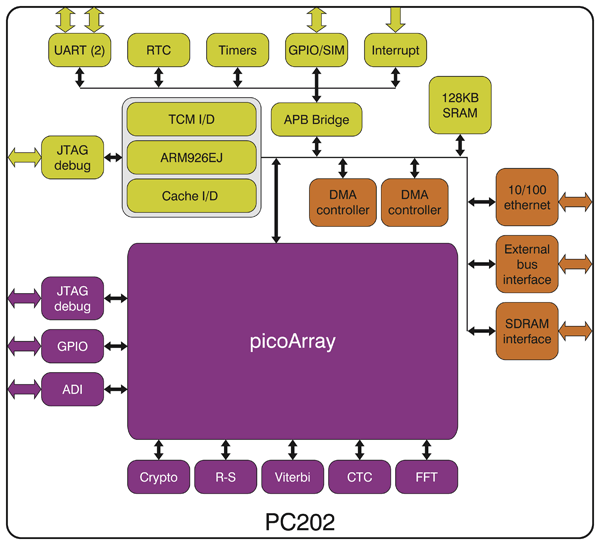 periences of humans is being enabled by the variety of wireles devices, networks, accesses, and so forth, he is after such radical technological experience where hardware and software relations within technology matter as well. Talking about chipsets such as the Picochip202, Mackenzie compares these to cities: “The ‘architectures’ of chipsets resemble cities viewed from above precisely because they internalize many of the relational processes of movement in cities.” (65).
The way bodies were moved and managed in urban environments has now been transposed as a problem on the level of chips and other seemingly “only” technical solutions. Yet, what Mackenzie does succesfully is to show how we need insights into such biopolitics that engage not only with human phenomenological bodies, but biopolitics of technological bodies too. This is what I find a very exciting and necessary direction, and while I know some of the great work done in Science and Technology studies, more media studies work in this direction of new materialism is very much welcome.
So now that we got talking about technological bodies in relation, and probably going soon so far that we could say that they have affects, would some critic say, does this not mean that we losing our grip on politics — that technology is such a crucial way of governing our worlds, offering meanings, and is itself embedded in a cultural field of representation and such?
Mackenzie does not however neglect representations, or the variety of materials of which the experience of wirelessness consists; from wireless routers to marketing discourses and adverts, the ontological claim that thinking and things do not differ work also as a methodological guideline for rigorous eclectism. Similarly, Mackenzie shows how his methodology and writing lends itself also to postcolonial theory in chapter 7 “Overconnected worlds”. Here, the claim is consist with a radical constructedness inherent in how transnationality and the global are created, not received, structures of experiencing; here, various wireless projects offer such platforms for both belief as well as physical connection.
Wirelessness overflows individual bodies and act as a catalyzer, intensifier, a field for experience perhaps in the sense as electromagnetic fields afford the technical signal between devices. What the book does as well is overflows in its richness – but it is clear that it is so rigorous in its take that media theory benefits from this for a long time. It picks up on some of the same inspiration that has been catalyzed into more philosophical takes on communication and contemporary culture by Brian Massumi, but is one of the first ones to take this mode of analysis of lived abstractions into concrete media analysis – similarly as he did with Simondon already in Transductions.
>Learning from Network Dysfunctionality: Accidents, Enterprise and Small Worlds of Infection (ISEA 2010 Version)
>
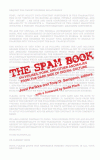
Before leaving finally for ISEA 2010 in Germany I shall post this — a short intro, or summary, or the extended abstract of what we are going to talk about there with Tony Sampson. It continues the Spam Book themes, and addresses more concretely the link between such processes as contagion (and in relation to heterogeneous bodies from social relations to software) and capitalism — more specifically marketing techniques, and various ways of harnessing the pull of connectedness.
Learning from Network Dysfunctionality: Accidents, Enterprise and Small Worlds of Infection
Tony D. Sampson (University of East London, UK)
Jussi Parikka (Anglia Ruskin University, UK)
In February 2010 an outbreak of media panic spread through the British tabloid press concerning a marketing campaign called DubitInsider. The DubitInsider website recruits 13-24 year olds who consider themselves to be “peer leader[s] with strong communication skills” to act as “Brand Ambassadors”. This requires the clandestine passing-on of product suggestions to peers via posting on message boards and social networks, emails and instant messenger conversations, organizing small events and parties. DubitInsider ignited the moral indignation of the tabloids not because of its covert nature, but since Brand Ambassadors were apparently paid to market “unhealthy” junk foods to minors. Tapping into the social influence of the consumer is nothing new. Seeking out so-called influentials is the basis of seasoned word-of-mouth campaigns and persists in “word-of-mouse” variations. For example, in4merz.com exploits the anticipated contagiousness of relations established between friends “on and offline” to promote music acts. “In4merz is about matching our artists to your friends who may like them.”
Young In4merz create posters, banners and videos about acts, Twitter about them, leave comments on Facebook etc. For each level of promotion, In4merz earn points that convert into CDs, DVDs, concert tickets and potential backstage access.
What interests us, as analysts of network dysfunctionality, is how the logic of these marketing strategies overlaps with the same anomalous abstract diagrams that distribute spam and viruses. In a different context, hiding unsolicited brand messages in social media and the potential for the bulk sending of veiled product promotions for financial reward could arguably be called spamming.
Furthermore, designed as they are to spread Trojan-like suggestions through imitative social networks, whether or not the strategies actually become contagious, their aim is to go viral. When removed from the context of the anomalous Nigerian cybercafe or computer virus writing scene, and played out in the marketplaces of food and pop culture, the emergent spam logic and virality of network capitalism becomes part of a broader indexical change concerning the way contagious communication networks, vulnerable bodies and unconscious behaviours can be harnessed.
The logic adopted becomes a normalized online marketing activity, not only performed by corporations, but embedded in social relations of individuals as part of the strategies of business enterprise and brand design.
Spamming and virality are no longer anomalies then, but are fast becoming the standard, acceptable way of doing business in the digital world. If the peer-to-peer recommendations and thumbs-up-buttons of “word-of-mouth 2.0” characterize the current paradigm of social media, these campaigns are indicative of a more aggressive and targeted Web 3.0 marketing of suggestion already on the horizon. This is a Web 3.0 that appeals directly to a user’s emotional landscape and desire for intimacy (Ludovico 2005), and exploits the ready made expediency of contagiousness networks that pass on suggestion.
Following a similar neo-monadological approach set out by Lazzarato (2004) we articulate the dynamics of spam, viruses, and other related “anomalies”, as constituent parts of new infectious worlds “created” by the business enterprise. We focus on the specific creative capacities of dysfunctionality in the production of network environments, and how “learning” from the irregularities of normalized communication adds new flesh to this world. We discuss how new knowledge concerning the productive powers of the anomalous is filtered through what Thrift (2005) calls the cultural circuit of capitalism: “… a feedback loop which is intended to keep capitalism surfing along the edge of its own contradictions”.
This new knowledge, acquired from the accidental events of the network, is seized upon by the business enterprise, leading to new consumer modeling intended to make ready environments so that the capricious spreading of social influence can be all the more effectively triggered and responded to.
Zittrain (2009) argues that viruses, spam and worms are threats to the generative principle of the Internet. Similarly, we contend that such software-driven social actions are exploitative of the open principles of the Internet, but further acknowledge the extent to which these practices have enthused and inspired the business enterprise. As we see it, “bad” software is not necessarily “malicious”. It becomes integral to an alternative generative logic of capture implicated in the production of new worlds of infection. We will discuss how these epidemiological worlds were mapped by computer scientists in the 1980s before they pervaded the burgeoning offshoots of the billion dollar network security industry. We further chart how they were modeled by network science as early as the 1960s and are currently being exported, via the circuitry of capitalism, to the business enterprise.
To be published in full as a chapter in The Blackwell Companion to New Media Dynamics, Hartley, Burgess and Bruns (eds.), Wiley-Blackwell, (forthcoming).
Affect, software, net art (or what can a digital body of code do-redux)
After visiting the Manchester University hosted Affective Fabrics of Digital Cultures-conference I thought for a fleeting second to have discovered affects; its the headache that you get from too much wine, and the ensuing emotional states inside you trying to gather your thoughts. I discovered soon that this is a very reductive account, of course — and in a true Deleuzian spirit was not ready to reduce affect into such emotional responses. Although, to be fair, hangover is a true state of affect – far from emotion — in its uncontrollability, deep embodiment.
What the conference did offer in addition to good social fun was a range of presentations on the topic that is defined in so many differing ways; whether in terms of conflation it with “emotions” and “feelings”, or then trying to carve out the level of affect as a pre-conscious one; from a wide range of topics on affective labour (Melissa Gregg did a keynote on white collar work) to aesthetic capitalism (Patricia Clough for example) which in a more Deleuzian spirit insisted on the non-representational. (If the occasional, affective reader is interested in a short but well summarizing account of differing notions of affect to guide his/her feelings about the topic, have a look at Andrew Murphie’s fine blog posting here – good theory topped up with a cute kitty.)
My take was to emphasise the non-organic affects inherent in technology — more specifically software, which I read through a Spinozian-Uexkullian lense as a forcefield of relationality. Drawing on for example Casey Alt’s forthcoming chapter in Media Archaeologies (coming out later this year/early next year), I concluded with object-oriented programming as a good example of how affects can be read to be part of software as well so that the technical specificity of our software embedded culture reaches out to other levels. Affects are not states of things, but the modes in which things reach out to each other — and are defined by those reachings out, i.e. relations. I was specifically amused that I could throw in a one-liner of “not really being interested in humans anyway” — even better would have been “I don’t get humans or emotions”, but I shall leave that for another public talk. “I don’t do emotions” is another of my favourite one’s, that will end up on either a t-shirt or an academic paper.
The presentation was a modified version from a chapter that is just out in Simon O’Sullivan and Stephen Zepke’s Deleuze and Contemporary Art-book even if in that chapter, the focus is more on net and software art. I am going to give the same paper in the Amsterdam Deleuze-conference, but as a teaser to the actual written chapter, here is the beginning of that text from the book…

1. Art of the Imperceptible
In a Deleuze-Guattarian sense, we can appreciate the idea of software art as the art of the imperceptible. Instead of representational visual identities, a politics of the art of the imperceptible can be elaborated in terms of affects, sensations, relations and forces (see Grosz). Such notions are primarily non-human and exceed the modes of organisation and recognition of the human being, whilst addressing themselves to the element of becoming within the latter. Such notions, which involve both the incorporeal (the ephemeral nature of the event as a temporal unfolding instead of a stable spatial identity) and the material (as an intensive differentiation that stems from the virtual principle of creativity of matter), incorporate ‘the imperceptible’ as a futurity that escapes recognition. In terms of software, this reference to non-human forces and to imperceptibility is relevant on at least two levels. Software is not (solely) visual and representational, but works through a logic of translation. But what is translated (or transposed) is not content, but intensities, information that individuates and in-forms agency; software is a translation between the (potentially) visual interface, the source code and the machinic processes at the core of any computer. Secondly, software art is often not even recognized as ‘art’ but is defined more by the difficulty of pinning it down as a social and cultural practice. To put it bluntly, quite often what could be called software art is reduced to processes such as sabotage, illegal software actions, crime or pure vandalism. It is instructive in this respect that in the archives of the Runme.org software art repository the categories contain less references to traditional terms of aesthetics than to ‘appropriation and plagiarism’, ‘dysfunctionality’, ‘illicit software’ and ‘denial of service’, for example. One subcategory, ‘obfuscation’, seems to sum up many of the wider implications of software art as resisting identification.[i]
However, this variety of terms doesn’t stem from a merely deconstructionist desire to unravel the political logic of software expression, or from the archivists nightmare á la Foucault/Borges, but from a poetics of potentiality, as Matthew Fuller (2003: 61) has called it. This is evident in projects like the I/O/D Webstalker browser and other software art projects. Such a summoning of potentiality refers to the way experimental software is a creation of the world in an ontogenetic sense. Art becomes ‘not-just-art’ in its wild (but rigorously methodological) dispersal across a whole media-ecology. Indeed, it partly gathers its strength from the imperceptibility so crucial for a post-representational logic of resistance. As writers such as Florian Cramer and Inke Arns have noted, software art can be seen as a tactical move through which to highlight political contexts, or subtexts, of ‘seemingly neutral technical commands.’ (Arns, 3)
Arns’ text highlights the politics of software and its experimental and non-pragmatic nature, and resonates with what I outline here. Nevertheless, I want to transport these art practices into another philosophical context, more closely tuned with Deleuze, and others able to contribute to thinking the intensive relations and dimensions of technology such as Simondon, Spinoza and von Uexküll. To this end I will contextualise some Deleuzian notions in the practices and projects of software and net art through thinking code not only as the stratification of reality and of its molecular tendencies but as an ethological experimentation with the order-words that execute and command.
The Google-Will-Eat-Itself project (released 2005) is exemplary of such creative dimensions of software art. Authored by Ubermorgen.com (featuring Alessandro Ludovico vs. Paolo Cirio), the project is a parasitic tapping in to the logic of Google and especially its Adsense program. By setting up spoof Adsense-accounts the project is able to collect micropayments from the Google corporation and use that money to buy Google shares – a cannibalistic eating of Google by itself. At the time of writing, the project estimated that it will take 202 345 117 years until GWEI fully owns Google. The project works as a bizarre intervention into the logic of software advertisements and the new media economy. It resides somewhere on the border of sabotage and illegal action – or what Google in their letter to the artists called ‘invalid clicks.’ Imperceptibility is the general requirement for the success of the project as it tries to use the software and business logic of the corporation through piggy-backing on the latter’s modus operandi.
What is interesting here is that in addition to being a tactic in some software art projects, the culture of software in current network society can be characterised by a logic of imperceptibility. Although this logic has been cynically described as ‘what you don’t see is what you get’, it is an important characteristic identified by writers such as Friedrich Kittler. Code is imperceptible in the phenomenological sense of evading the human sensorium, but also in the political and economic sense of being guarded against the end user (even though this has been changing with the move towards more supposedly open systems). Large and pervasive software systems like Google are imperceptible in their code but also in the complexity of the relations it establishes (and what GWEI aims to tap into). Furthermore, as the logic of identification becomes a more pervasive strategy contributing to this diagram of control, imperceptibility can be seen as one crucial mode of experimental and tactical projects. Indeed, resistance works immanently to the diagram of power and instead of refusing its strategies, it adopts them as part of its tactics. Here, the imperceptibility of artistic projects can be seen resonating with the micropolitical mode of disappearance and what Galloway and Thacker call ‘tactics of non-existence’ (135-136). Not being identified as a stable object or an institutional practice is one way of creating vacuoles of non-communication though a camouflage of sorts. Escaping detection and surveillance becomes the necessary prerequisite for various guerrilla-like actions that stay ‘off the radar.’
Security and Self-regulation in Software Visual Culture

“Not long ago it would have been an absolutely absurd action to purchase a television or acquire a computer software to intentionally disable its capabilities, whereas today’s media technology is marketed for what it does not contain and what it will not deliver.” The basic argument in Raiford Guins’ Edited Clean Version is so striking in its simplicity but aptness that my copy of the book is now filled with exclamation marks and other scribblings in the margins that shout how I loved it. At times dense but elegantly written, I am so tempted to say that this is the direction where media studies should be going if it did not sound a bit too grand (suitable for a blurb at the back cover perhaps!).
I shall not do a full-fledged review of the book but just flag that its an important study for anyone who wants to understand processes of censorship, surveillance and control. Guins starts from a theoretical set that contains Foucault’s governmentality, Kittler’s materialism and Deleuze’s notion of control, but breathes concrete specificity to the latter making it really a wonderful addition to media studies literature on contemporary culture. At times perhaps a bit repetitive, yet it delivers a strong sense of how power works through control which works through technological assemblages that organize time, spatiality and desire. For Guins, media is security (even if embedding Foucault’s writings on security would have been in this context spot on) — entertainment media is so infiltrated by the logic of blocking, filtering, sanitizing, cleaning and patching (all chapters in the book) that I might even have to rethink my own ideas of seeing media technologies as Spinozian bodies defined by what they can do…Although, in a Deleuzian fashion, control works through enabling. In this case, it enables choice (even if reducing freedom into a selection from pre-defined, preprogrammed articulations). Control is the highway on which you are free to drive as far, and to many places, but it still guides you to destinations. Control works through destinations, addresses — and incidentally, its addresses that structure for example Internet-“space”.
Guins’ demonstrates how it still is the family that is a focal point of media but through new techniques and technologies. Software is at the centre of this regime – software such as the V-Chip that helps parents to plan and govern their children’s TV-consumption. Guins writes: “The embedding of the V-Chip within television manifests a new visual protocol; it makes visible the positive effects of television that it enables: choice, self-regulation, interaction, safe images, and security.” What is exciting about this work is how it deals with such hugely important political themes and logics of control, but is able to do it so immanently with the technological platform he is talking about. Highly recommended, and thumbs up.
>Networkpolitics-poster
>Here is the poster for our forthcoming Network-politics event, full title: Thinking Network Politics: Methods, Epistemology, Process. Its the first in series for the AHRC funded project, followed up by next one in Toronto around end of October and the final one in Cambridge, next year.
This promises to be an exciting event, where most of the emphasis is on emerging discussions instead of “only” academic talks; the length of talks is reduced to give time to what follows from the position papers that touch media arts and artistic methods, activism, network ontology and methodology, media archaeology, clouds and love. A whole range of themes, indeed.
Registration here.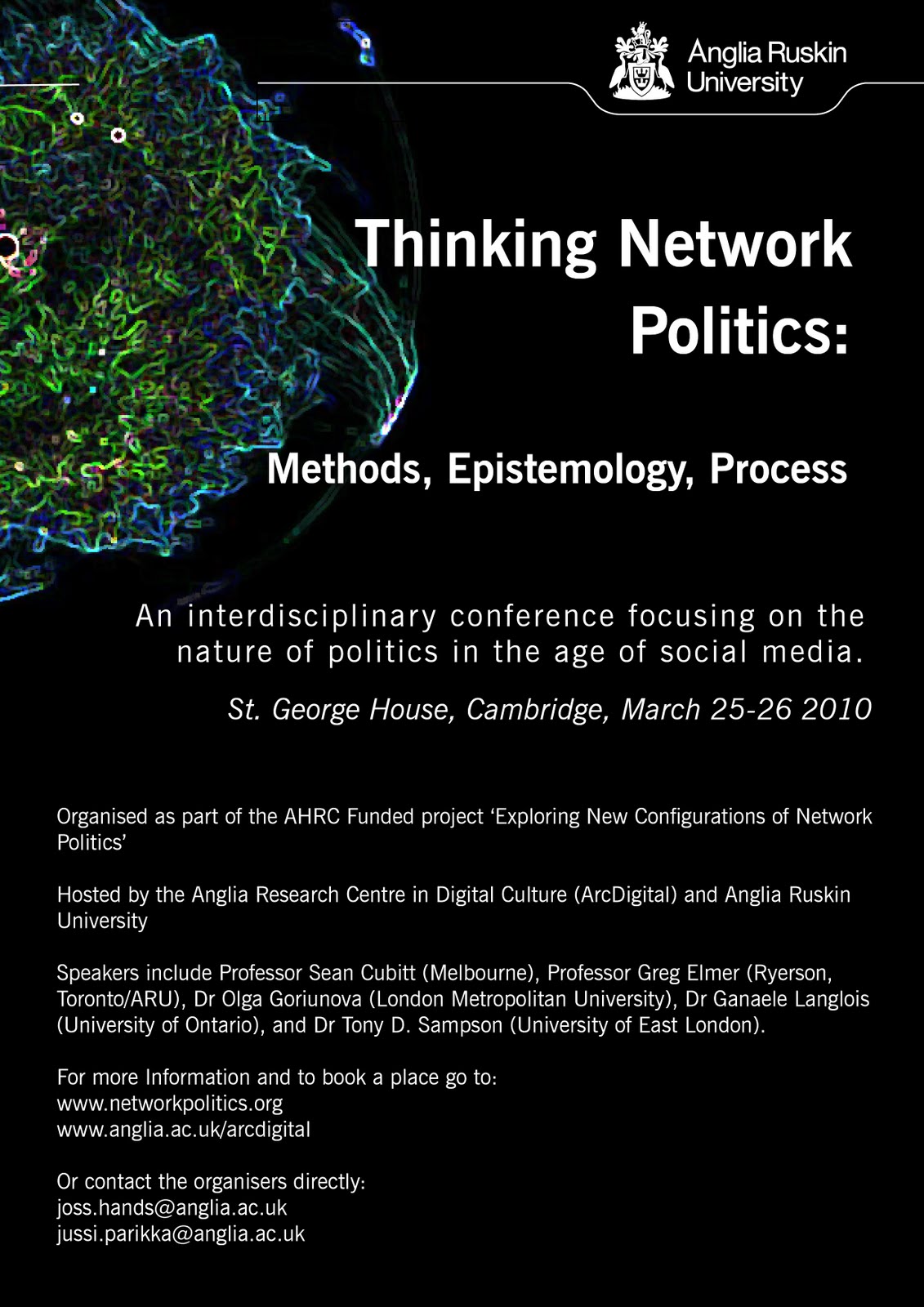
From Cybertext to Produsage. Functioning and Production of Digital Texts
ArcDigital and Cultures of the Digital Economy (CoDE) institute guest talk:
From Cybertext to Produsage. Functioning and Production of Digital Texts
By Dr Robert Arpo, Helsinki Metropolia University of Applied Sciences
Monday 30/11, 16.00-17.30
Anglia Ruskin University, East Road, Cambridge
Room: Helmore 252
Norwegian Espen Aarseth formulated his theory of cybertext and ergodic literature in mid 1990´s and focused his attention on how user, verbal sign and medium form a textual machine called cybertext. His point of view to the digital texts was user oriented, but the user was seen as an individual reader, whose actions were in the center of textual meaning construction.
Australian Axel Bruns has been formulating his theory of produsage recently and in context of so called social media. Bruns´s point of view raises questions on collective production of digital texts and is linked strongly to the dynamics of participatory economy.
When we look at theories of Aarseth and Bruns, they show us the changes in thinking on digital cultures. Technologies give nowadays users much more freedom to produce their own digital contents whereas in 1990´s user did not have access to for example source code of a publication platform like now the situation is with open access applications. Freedom brings also the need for taking responsibility of one´s own actions. Produser cultures are good examples of ways to control, direct and negotiate practices and principles in collective digital content production communities.
Robert Arpo, Ph.D. is principal lecturer in MA programme for media production and management, Helsinki Metropolia University of Applied Sciences, Finland. His research interests are in the area of virtual communities, digital dialogue, theories of information society and social media.
>CFP: Thinking Network Politics: Methods, Epistemology, Process
>
Call For Papers
Thinking Network Politics: Methods, Epistemology, Process
We invite the submission of abstracts for the first event of the AHRC funded networking project ‘Exploring New Configurations of Network Politics’. The event will combine a series of position papers followed by round table discussions and interventions exploring the issues and challenges raised by those papers.
The attempt to grasp the depth and breadth of network politics demands novel and transdisciplinary approaches not always native to the humanities and social sciences, such as graph theory and the study of code as cultural practice. Thus there is a drive to explore the broad spectrum of practices and discourses to help rethink the articulations of politics in network culture. New modes of political activity that take advantage of new platforms from Twitter to YouTube necessitate new conceptual positions for network culture, counter-power and resistance. The papers should work towards adapting concepts such as, for example but by no means exclusively, the Multitude, free and immaterial labour, emergence, swarms and ‘smart mobs’ and new forms of creation, activism and engagement in civil society. The aim is to rethink what we understand by politics. Further questions which need to be asked include: what kind of epistemologies do we need to incorporate into our analysis? How can we take into account the particularities of networks when approaching the elusive, ephemeral nature of politics of/in networks? These are just examples of the directions into which considerations of “network politics” might lead us. Because this is such a fast developing and challenging arena of research the event will aim to be open and fluid, encouraging engagement, conversation and innovation wherever possible, while focusing on this core problematic of the tools and processes for thinking network politics.
The papers for this event will thus ideally investigate the methods and innovative approaches to mapping and thinking such new network politics. The March event will thus aim elaborate on the nature of the network and forge new routes to thinking about the processual, dynamic nature of networks as well as the particular “objects” such approaches fabricate.
The papers should be in the format of short (10 min) position papers on key concepts or keywords that lead into group work and discussions into the questions of network politics and methods and approaches for analysis. Instead of normal academic papers followed by a short Q&A, we would like the event to encourage collaboration, collective discussions and agenda setting.
——————————————————————————————————————————————————
The event takes place in Cambridge, UK, Anglia Ruskin University, on Thursday 25 and Friday 26 March 2010.
Please submit your abstracts and any suggestions (max 300 words) by January 8, 2010 to
joss.hands@anglia.ac.uk and/or jussi.parikka@anglia.ac.uk.
The research project functions under the auspices of the Anglia Research Centre in Digital Culture (ArcDigital )
>On Network Politics — notes to self and the unknown reader
>Our network politics networking-project kicks off officially October 1st, and we are in the midst of organizing some of the activities and themes which will form the backbone of the project. The project will feature both online-presence and activities, as well as events taking place in Cambridge and New York. We had yesterday the interesting idea of using the Request for Comments-format (RFC) as a media theoretical method of sorts, that kicks off from the initial question of “what is network politics?” and then proceeds through the RFC method – forking into new questions, streams, agendas. As the project is about networking, we find its important to map the field and crucial agendas, not just yet hope to provide final solutions. This is why the RFC idea (to quote from Wikipedia!) is intriguing: “Through the Internet Society, engineers and computer scientists may publish discourse in the form of an RFC, either for peer review or simply to convey new concepts, information, or (occasionally) engineering humor. The IETF adopts some of the proposals published as RFCs as Internet Standards.” To adopt that to media theoretical and practical aims to facilitate discussion is an idea worthwhile to have a shot at, and to use it to develop concept-labs/networks for conveying new concepts, information…
Anyhow, I need to start writing some notes to self in terms of possible ways to go with the agenda, of what could be relevant in terms of topics to be covered somehow:
– politics of new networks and code platforms such as Twitter. E.g. Greg Elmer has been actively involved in this research. What kind of modes of organization, action and for example campaigning for political agencies such forms offer? This stream perhaps focuses on the question of how such technologies might deterritorialize the political landscape and praxis.
– Politics of networks as politics of invisibility: what kinds of forms of politics there are out there that are not even recognized as politics? This is a multilayered question, and relates both to perception of politics as well as the tactics of politics in the age of surveillance, visibility and software. Firstly, how should we address certain forms of tactical media, net art, etc. as forms of politics (and what are the tools to develop such understanding). Secondly, take Galloway and Thacker: “Future avant-garde practices will be those of nonexistence.” Network politics can take as its form also becoming-invisible, becoming-nonexistent in order to avoid both the politics of representation as well as the techniques of trackings, surveillance and control. All of this relates to thinking of modes of activism, as well.
– Biopolitics of network culture that is characterized by “immaterial projects, including ideas, images, affects and relationships” (Hardt and Negri); how do such forms of production take form through social media as a standardisation and distribution of specific forms of relations, sociability, affects, and community? There is a wide range of excellent work already on this stream, from Tiziana Terranova’s Network Culture-book (2004) to the forthcoming The Internet as Playground and Factory-conference in New York. (For a taste of what’s coming, see e.g. McKenzie Wark’s video interview on the topic.)
– The need for new tools for academic interaction — tools which do not only quantifiably ease distribution and storage of research etc., but qualitatively enact a change in how academic institutions work in the age of late capitalism. Gary Hall’s Digitize This Book! is a good point of entry to these debates, and what we hope to address somehow (e.g. through methods such as RFC potentially) is how the modes of relating to other scholars and production of information can be rethought in the context of network culture. Taking aboard Jodi Dean’s excellent “warnings” in her “Communicative Capitalism”-article, this mode of academic interaction should not fall prey to any automated sociability that is offered as part of the assumption of goodness of all communication in network culture, but it should critically inspect ideas of open source, multimodal forms of academic debate and possibilities of network technologies to facilitate not just more-of-the-same but visions of 21st century arts and humanities agenda (which are not detached from science and tech.)














 Machinology