Archive
Complicity with Anonymous Media
Thomas Pynchon’s Gravity’s Rainbow (1973) and its paranoid military-scientific worlds of technology, sexuality and hallucination became one inspirational figure for a whole wave of media theory. What could we do with Reza Negarestani’s Cyclonopedia (2008) then, which seems to include some similar stylistic elements, of transdisciplinary writing that wanders across rats and soil, petrol(ology) and archaeology to understand Middle-East? From Pynchon’s WWII Europe, to Negarestani’s Middle-East, politics of petrol.
The archaeological method of Negarestani’s Cyclonopedia represents a theory-fiction alternative for media archaeology too. What if we employ the same hallucinatory, inspiring way of investigating the subterranean, the secret, the ground that is not defined by stability but dynamic flux of sediments alive, burrowed by rats, worms and archaeologists? We can call this investigation new materialist because it believes in agency of matter, and multiplicity of things both organic and non-organic. What does this multiplicity mean? It means a microworld that unravels when you zoom close: close enough, and the skin is not a unity, but porous folding, layered, and filled with bacteria. The soil is not stable, but a constantly slowly pulsating topology, with its own affordances, and indeed, again, bacteria and other forms of life. Same applies to everything, even metal, or as Deleuze and Guattari would say, especially to metal. In their metallurgical thinking, it is the body without organs, here better understood through the idea of what flows through everything – metallurgical cosmology. This is why they insist on the relatedness of machinic phylum and metal – and why they say that everything is a machine (not because it would be modelled on any already existing machine or technology!)
“Even the waters, the grasses and varieties of wood, the animals are populated by salts or mineral elements. Not everything is metal, but metal is everywhere.” (DG)
In Cyclonopedia, the character Parsani calls the approach to the subterranean “bacterial archaeology” – an archaeology that starts from the non-human agents and microscopic attraction points within matter. And the matter extends to politics, society, and power:
“Bacterial Archeology. It is imperative for Parsani, in his approach to the Middle East, to make clear that everything related to the Middle East emerges, moves, diffuses, escalates and engenders itself through and out of the holey Hezar’to (A Thousand Insides; the Persian word for labyrinth) and the Petrologies of Bacterial Archeology.’”
The earth moves, and hums.
The methodology is that of exhuming, which both archaeologists and rats share.
“If archeologists, cultists, worms and crawling entities almost always undertake an act of exhumation (surfaces, tombs, cosmic comers, dreams, etc.), it is because exhumation is equal to ungrounding, incapacitating surfaces ability to operate according to topologies of the whole, or on a mereotopological level. In exhumation, the distribution of surfaces is thoroughly undermined and the movements associated with them are derailed; the edge no longer belongs to the periphery, anterior surfaces come after all other surfaces, layers of strata are displaced and perforated, peripheries and the last protecting surfaces become the very conductors of invasion. Exhumation is defined as a collapse and trauma introduced to the solid part by vermiculate activities; it is the body of solidity replaced by the full body of trauma. As in disinterment — scarring the hot and cold surfaces of a grave — exhumation proliferates surfaces through each other. Exhumation transmutes architectures into excessive scarring processes, fibroses of tissues, membranes and surfaces of the solid body.”
Just for speculative reasons, let’s use the same logic of thought to our technological excavations and use this as inspiration to think of the exhuming we do with media cultural topics – or machines themselves. One cannot help relating this to the epistemology and hallucinatory methods of Microresearch Lab, where the processes of soil and nature already technological are excavated in order to proliferate new surfaces – like the skin of the machine, that does not stop at the visible surface (interface/cover). It is topological, and folds in to a multiple surfaces, some inside, some abstract, some irrational.
In terms of animality, Cyclonopedia talks about rats as one agency of exhuming, parallel to archaeologists. How about then: Rats as archaeologists, or rats as media theorists? Such animals work less as metaphors than as vectors to think through the non-human force of analysis. To actually end up somewhere else than with more human focused vocabulary of cultural theory and methodology.
Furthermore, can we even extract ideas for archaeological politics – a politics for the military-industrial complex in the age of advanced science and technology?
“Parsani claims that ‘archeology, with it’s ingrained understanding of Hidden Writing, will dominate the politics of future and will be the military science of twenty-first century’.”
Announcing Medianatures and Living Books About Life
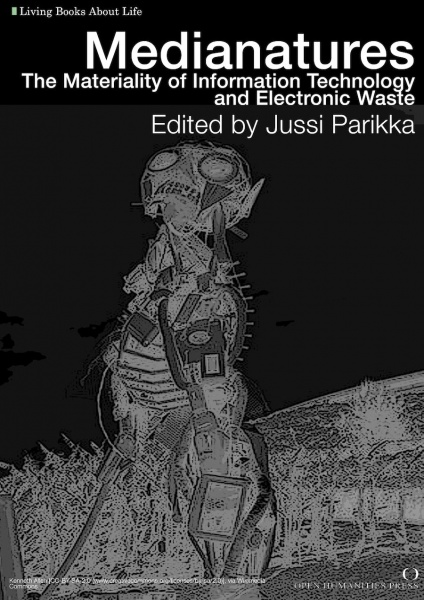 It’s (a)live! Medianatures: The Materiality of Information Technology and Electronic Waste and the whole impressive series of 21 open access books about humanities-science-themes, commissioned by Gary Hall, Joanna Zylinska and Clare Birchall, published by Open Humanities Press and funded by JISC: Living Books About Life.
My edited book was inspired by Sean Cubitt’s (and others, see the Acknowledgements of the introduction) recent research into media and waste, and I owe full thanks to him. What I wanted to investigate was the question of how materiality can be thought through such “bad matter” of waste, and related to for instance energy (consumption). The introduction outlines my approach, and ties it together with some debates in new materialism (this side of the argument is more fully outlined in a short text of mine “New Materialism as Media Theory”, forthcoming very soon in Communication and Critical/Cultural Studies-journal).
The best introduction to the whole project is however found in this press release by Hall, Zylinska and Birchall:
____________
Open Humanities Press publishes twenty-one open access Living Books About Life
LIVING BOOKS ABOUT LIFE
http://www.livingbooksaboutlife.org
The pioneering open access humanities publishing initiative, Open Humanities Press (OHP) (http://openhumanitiespress.org), is pleased to announce the release of 21 open access books in its series Living Books About Life (http://www.livingbooksaboutlife.org).
Funded by the Joint Information Systems Committee (JISC), and edited by Gary Hall, Joanna Zylinska and Clare Birchall, Living Books About Life is a series of curated, open access books about life — with life understood both philosophically and biologically — which provide a bridge between the humanities and the sciences. Produced by a globally-distributed network of writers and editors, the books in the series repackage existing open access science research by clustering it around selected topics whose unifying theme is life: e.g., air, agriculture, bioethics, cosmetic surgery, electronic waste, energy, neurology and pharmacology.
Peter Suber, Open Access Project Director, Public Knowledge, said: ‘This book series would not be possible without open access. On the author side, it takes splendid advantage of the freedom to reuse and repurpose open-access research articles. On the other side, it passes on that freedom to readers. In between, the editors made intelligent selections and wrote original introductions, enhancing each article by placing it in the new context of an ambitious, integrated understanding of life, drawing equally from the sciences and humanities’.
By creating twenty one ‘living books about life’ in just seven months, the series represents an exciting new model for publishing, in a sustainable, low-cost, low-tech manner, many more such books in the future. These books can be freely shared with other academic and non-academic institutions and individuals.
Nicholas Mirzoeff, Professor of Media, Culture and Communication at New York University, commented: ‘This remarkable series transforms the humble Reader into a living form, while breaking down the conceptual barrier between the humanities and the sciences in a time when scholars and activists of all kinds have taken the understanding of life to be central. Brilliant in its simplicity and concept, this series is a leap towards an exciting new future’.
One of the most important aspects of the Living Books About Life series is the impact it has had on the attitudes of the researchers taking part, changing their views on open access and raising awareness of issues around publishers’ licensing and copyright agreements. Many have become open access advocates themselves, keen to disseminate this model among their own scholarly and student communities. As Professor Erica Fudge of the University of Strathclyde and co-editor of the living book on Veterinary Science, put it, ‘I am now evangelical about making work publicly available, and am really encouraging colleagues to put things out there’.
These ‘books about life’ are themselves ‘living’, in the sense they are open to ongoing collaborative processes of writing, editing, updating, remixing and commenting by readers. As well as repackaging open access science research — together with interactive maps and audio-visual material — into a series of books, Living Books About Life is thus involved in rethinking ‘the book’ itself as a living, collaborative endeavour in the age of open science, open education, open data, iPad apps and e-book readers such as Kindle.
Tara McPherson, editor of VECTORS, Journal of Culture and Technology in a Dynamic Vernacular, said: ‘It is no hyperbole to say that this series will help us reimagine everything we think we know about academic publishing. It points to a future that is interdisciplinary, open access, and expansive.’
Funded by JISC, Living Books About Life is a collaboration between Open Humanities Press and three academic institutions, Coventry University, Goldsmiths, University of London, and the University of Kent.
Books:
* Astrobiology and the Search for Life on Mars, edited by Sarah Kember (Goldsmiths, University of London)
* Bioethics™: Life, Politics, Economics, edited by Joanna Zylinska (Goldsmiths, University of London)
* Biosemiotics: Nature, Culture, Science, Semiosis, edited by Wendy Wheeler (London Metropolitan University)
* Cognition and Decision in Non-Human Biological Organisms, edited by Steven Shaviro (Wayne State University)
* Cosmetic Surgery: Medicine, Culture, Beauty, edited by Bernadette Wegenstein (Johns Hopkins University)
* Creative Evolution: Natural Selection and the Urge to Remix, edited by Mark Amerika (University of Colorado at Boulder)
* Digitize Me, Visualize Me, Search Me: Open Science and its Discontents, edited by Gary Hall (Coventry University)
* Energy Connections: Living Forces in Creative Inter/Intra-Action, edited by Manuela Rossini (td-net for Transdisciplinary Research, Switzerland)
* Human Genomics: From Hypothetical Genes to Biodigital Materialisations, edited by Kate O’Riordan (Sussex University)
* Medianatures: The Materiality of Information Technology and Electronic Waste, edited by Jussi Parikka (Winchester School of Art, University of Southampton)
* Nerves of Perception: Motor and Sensory Experience in Neuroscience, edited by Anna Munster (University of New South Wales)
* Neurofutures, edited by Timothy Lenoir (Duke University)
* Partial Life, edited by Oron Catts and Ionat Zurr (SymbioticA, University of Western Australia)
* Pharmacology, edited by Dave Boothroyd (University of Kent)
* Symbiosis, edited by Janneke Adema and Pete Woodbridge (Coventry University)
* Another Technoscience is Possible: Agricultural Lessons for the Posthumanities, edited by Gabriela Mendez Cota (Goldsmiths, University of London)
* The In/visible, edited by Clare Birchall (University of Kent)
* The Life of Air: Dwelling, Communicating, Manipulating, edited by Monika Bakke (University of Poznan)
* The Mediations of Consciousness, edited by Alberto López Cuenca (Universidad de las Américas, Puebla)
* Ubiquitous Surveillance, edited by David Parry (University of Texas at Dallas)
* Veterinary Science: Animals, Humans and Health, edited by Erica Fudge (Strathclyde University) and Clare Palmer (Texas A&M University)
W: http://www.livingbooksaboutlife.org
Open Humanities Press is a non-profit, international Open Access publishing collective specializing in critical and cultural theory. OHP was formed by academics to overcome the current crisis in scholarly publishing that threatens intellectual freedom and academic rigor worldwide. OHP journals are academically certified by OHP’s independent board of international scholars. All OHP publications are peer-reviewed, published under open access licenses, and freely and immediately available online at http://openhumanitiespress.org
Dirty Matter
I was asked to write a short forum piece on “new materialism” for Communication and Critical/Cultural Studies-journal and I wrote a piece called “New Materialism as Media Theory: Dirty Matter and Medianatures”. It partly picks up on some of the themes I have been recently talking and writing about, influenced by such scholars as Sean Cubitt. It also articulated – albeit briefly – some points concerning German media theory as new materialism, even if going the quickly to a different direction concerning materiality. Here is a short taster of what’s to come.
The key points of the text were in short: 1) we need to understand how media technologies themselves already incorporate and suggest “new materialism” of non-solids, non-objects and this is part of technical modernity (the age of Hertzian vibrations); 2) we need also to understand bad matter – not just the new materialism that is empowering, but one that is depowering: the matter that is toxic, leaking from abandoned electronic media, attaching to internal organs, skins of low paid workers in developing countries. In this context, “medianatures” is the term I use to theoretically track the continuums from matter to media, and from media back to (waste) matter.
I believe that it is this continuum that is crucial in terms of a developed material understanding of media cultures. Hence, it’s a shame from a new materialist point of view that even such pioneering thinkers as Michel Serres miss this point concerning the weird materialities of contemporary technological culture – weird in the sense that they remain irreducible to either their “hard” contexts and pollution (CO2, toxic materials, minerals, and other component parts) or their “soft” bits – signs, meanings, attractions, desires. In Malfeasance. Appropriation Through Pollution? Trans. Anne-Marie Feenberg-Dibon (Stanford: Stanford University Press 2011), these are the two levels Serres proposes as crucial from an environmental point of view but he ignores the continuum between the two. And yet, signs are transmitted as signals, through cables, in hardware, in a mesh of various components from heavy metals to PVC coatings.
Perhaps a good alternative perspective to Serres’ is found in how both Félix Guattari and Gilles Deleuze conceive of a-signification as a regime of signs beyond signification and meaning: Gary Genosko’s apt example (in: Félix Guattari. A Critical Introduction London: Pluto 2009, 95-99 ) is the case of magnetic stripes on for instance your bank card as a form of automatized and operationalized local power that is not about interpretation, but a different set of signal work. Elaborating signaletic material – electronic signals and software – through a reference to Deleuze’s film theory and a-signification by Bodil Marie Stavning Thomsen is also useful. As she elaborates – and this much we know from years of intensive reading of Deleuze in screen based analyses – Deleuze wanted to include much more than signification into the cinematic impact, and mapped a whole field of a-signifying matter in film: “sensory (visual and sound), kinetic, intensive, affective, rhythmic, tonal, and even verbal (oral and written).” (“The Haptic Interface. On Signal Transmissions and Events” in Interface Criticism. Aesthetics Beyond Buttons, edited by Christian Ulrik Andersen and Søren Bro Pold, Aarhus University Press 2011, 59) What she points out in terms of signal media is as important: after signs come signals, and the media of signals needs a similar move as Deleuze did with film: to carve out the a-signifying material components for digital media too.
Such a-signifying components are rarely content to stay on one level, despite a lot of theory often placing primacy to software, hardware, or some other level. Various levels feed into each other; this relates to what Guattari calls mixed semiotics, and we can here employ the idea of a medianature-continuum. The a-signifying level of signs is embedded in the a-signifying materiality of processes and components.
In short, it’s continuums all the way down (and up again), soft to hard, hardware to signs. In software studies (see: David M. Berry, The Philosophy of Software. Code and Mediation in the Digital Age, Palgrave Macmillan 2011, 95-96), the continuum from the symbol functions on higher levels of coding practices to voltage differences as a “lower hardware level” has been recognized: assembly language needs to be compiled, binary is what the computer “reads”, and yet such binaries take effect only through transistors; and if we really want to be hardcore, we just insist that in the end, it comes back to voltage differences (Kittler’s famous “There is no Software”-text and argument). Such is the methodology of “descent” that Foucault introduced as genealogy, but German media theory takes as a call to open up the machine physically and methodologically to its physics – and which leads into a range of artistic methodologies too, from computer forensics to data carvery. In other words, recognizing the way abstraction works in technical media from voltages and components to the more symbolic levels allows us to track back, as well, from the world of meanings and symbols – but also a-signification – to level of dirty matter.







 Machinology