Archive
Announcing Medianatures and Living Books About Life
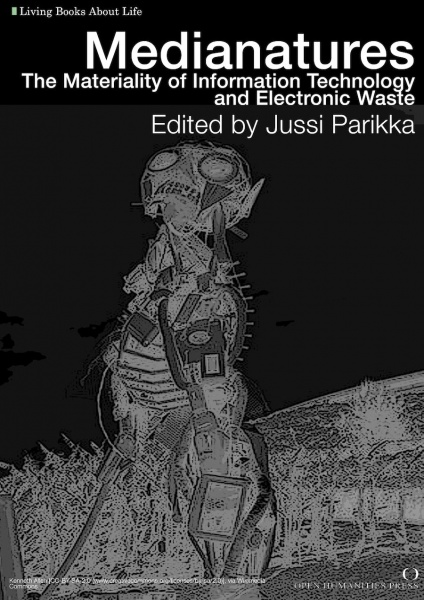 It’s (a)live! Medianatures: The Materiality of Information Technology and Electronic Waste and the whole impressive series of 21 open access books about humanities-science-themes, commissioned by Gary Hall, Joanna Zylinska and Clare Birchall, published by Open Humanities Press and funded by JISC: Living Books About Life.
My edited book was inspired by Sean Cubitt’s (and others, see the Acknowledgements of the introduction) recent research into media and waste, and I owe full thanks to him. What I wanted to investigate was the question of how materiality can be thought through such “bad matter” of waste, and related to for instance energy (consumption). The introduction outlines my approach, and ties it together with some debates in new materialism (this side of the argument is more fully outlined in a short text of mine “New Materialism as Media Theory”, forthcoming very soon in Communication and Critical/Cultural Studies-journal).
The best introduction to the whole project is however found in this press release by Hall, Zylinska and Birchall:
____________
Open Humanities Press publishes twenty-one open access Living Books About Life
LIVING BOOKS ABOUT LIFE
http://www.livingbooksaboutlife.org
The pioneering open access humanities publishing initiative, Open Humanities Press (OHP) (http://openhumanitiespress.org), is pleased to announce the release of 21 open access books in its series Living Books About Life (http://www.livingbooksaboutlife.org).
Funded by the Joint Information Systems Committee (JISC), and edited by Gary Hall, Joanna Zylinska and Clare Birchall, Living Books About Life is a series of curated, open access books about life — with life understood both philosophically and biologically — which provide a bridge between the humanities and the sciences. Produced by a globally-distributed network of writers and editors, the books in the series repackage existing open access science research by clustering it around selected topics whose unifying theme is life: e.g., air, agriculture, bioethics, cosmetic surgery, electronic waste, energy, neurology and pharmacology.
Peter Suber, Open Access Project Director, Public Knowledge, said: ‘This book series would not be possible without open access. On the author side, it takes splendid advantage of the freedom to reuse and repurpose open-access research articles. On the other side, it passes on that freedom to readers. In between, the editors made intelligent selections and wrote original introductions, enhancing each article by placing it in the new context of an ambitious, integrated understanding of life, drawing equally from the sciences and humanities’.
By creating twenty one ‘living books about life’ in just seven months, the series represents an exciting new model for publishing, in a sustainable, low-cost, low-tech manner, many more such books in the future. These books can be freely shared with other academic and non-academic institutions and individuals.
Nicholas Mirzoeff, Professor of Media, Culture and Communication at New York University, commented: ‘This remarkable series transforms the humble Reader into a living form, while breaking down the conceptual barrier between the humanities and the sciences in a time when scholars and activists of all kinds have taken the understanding of life to be central. Brilliant in its simplicity and concept, this series is a leap towards an exciting new future’.
One of the most important aspects of the Living Books About Life series is the impact it has had on the attitudes of the researchers taking part, changing their views on open access and raising awareness of issues around publishers’ licensing and copyright agreements. Many have become open access advocates themselves, keen to disseminate this model among their own scholarly and student communities. As Professor Erica Fudge of the University of Strathclyde and co-editor of the living book on Veterinary Science, put it, ‘I am now evangelical about making work publicly available, and am really encouraging colleagues to put things out there’.
These ‘books about life’ are themselves ‘living’, in the sense they are open to ongoing collaborative processes of writing, editing, updating, remixing and commenting by readers. As well as repackaging open access science research — together with interactive maps and audio-visual material — into a series of books, Living Books About Life is thus involved in rethinking ‘the book’ itself as a living, collaborative endeavour in the age of open science, open education, open data, iPad apps and e-book readers such as Kindle.
Tara McPherson, editor of VECTORS, Journal of Culture and Technology in a Dynamic Vernacular, said: ‘It is no hyperbole to say that this series will help us reimagine everything we think we know about academic publishing. It points to a future that is interdisciplinary, open access, and expansive.’
Funded by JISC, Living Books About Life is a collaboration between Open Humanities Press and three academic institutions, Coventry University, Goldsmiths, University of London, and the University of Kent.
Books:
* Astrobiology and the Search for Life on Mars, edited by Sarah Kember (Goldsmiths, University of London)
* Bioethics™: Life, Politics, Economics, edited by Joanna Zylinska (Goldsmiths, University of London)
* Biosemiotics: Nature, Culture, Science, Semiosis, edited by Wendy Wheeler (London Metropolitan University)
* Cognition and Decision in Non-Human Biological Organisms, edited by Steven Shaviro (Wayne State University)
* Cosmetic Surgery: Medicine, Culture, Beauty, edited by Bernadette Wegenstein (Johns Hopkins University)
* Creative Evolution: Natural Selection and the Urge to Remix, edited by Mark Amerika (University of Colorado at Boulder)
* Digitize Me, Visualize Me, Search Me: Open Science and its Discontents, edited by Gary Hall (Coventry University)
* Energy Connections: Living Forces in Creative Inter/Intra-Action, edited by Manuela Rossini (td-net for Transdisciplinary Research, Switzerland)
* Human Genomics: From Hypothetical Genes to Biodigital Materialisations, edited by Kate O’Riordan (Sussex University)
* Medianatures: The Materiality of Information Technology and Electronic Waste, edited by Jussi Parikka (Winchester School of Art, University of Southampton)
* Nerves of Perception: Motor and Sensory Experience in Neuroscience, edited by Anna Munster (University of New South Wales)
* Neurofutures, edited by Timothy Lenoir (Duke University)
* Partial Life, edited by Oron Catts and Ionat Zurr (SymbioticA, University of Western Australia)
* Pharmacology, edited by Dave Boothroyd (University of Kent)
* Symbiosis, edited by Janneke Adema and Pete Woodbridge (Coventry University)
* Another Technoscience is Possible: Agricultural Lessons for the Posthumanities, edited by Gabriela Mendez Cota (Goldsmiths, University of London)
* The In/visible, edited by Clare Birchall (University of Kent)
* The Life of Air: Dwelling, Communicating, Manipulating, edited by Monika Bakke (University of Poznan)
* The Mediations of Consciousness, edited by Alberto López Cuenca (Universidad de las Américas, Puebla)
* Ubiquitous Surveillance, edited by David Parry (University of Texas at Dallas)
* Veterinary Science: Animals, Humans and Health, edited by Erica Fudge (Strathclyde University) and Clare Palmer (Texas A&M University)
W: http://www.livingbooksaboutlife.org
Open Humanities Press is a non-profit, international Open Access publishing collective specializing in critical and cultural theory. OHP was formed by academics to overcome the current crisis in scholarly publishing that threatens intellectual freedom and academic rigor worldwide. OHP journals are academically certified by OHP’s independent board of international scholars. All OHP publications are peer-reviewed, published under open access licenses, and freely and immediately available online at http://openhumanitiespress.org
Dirty Matter
I was asked to write a short forum piece on “new materialism” for Communication and Critical/Cultural Studies-journal and I wrote a piece called “New Materialism as Media Theory: Dirty Matter and Medianatures”. It partly picks up on some of the themes I have been recently talking and writing about, influenced by such scholars as Sean Cubitt. It also articulated – albeit briefly – some points concerning German media theory as new materialism, even if going the quickly to a different direction concerning materiality. Here is a short taster of what’s to come.
The key points of the text were in short: 1) we need to understand how media technologies themselves already incorporate and suggest “new materialism” of non-solids, non-objects and this is part of technical modernity (the age of Hertzian vibrations); 2) we need also to understand bad matter – not just the new materialism that is empowering, but one that is depowering: the matter that is toxic, leaking from abandoned electronic media, attaching to internal organs, skins of low paid workers in developing countries. In this context, “medianatures” is the term I use to theoretically track the continuums from matter to media, and from media back to (waste) matter.
I believe that it is this continuum that is crucial in terms of a developed material understanding of media cultures. Hence, it’s a shame from a new materialist point of view that even such pioneering thinkers as Michel Serres miss this point concerning the weird materialities of contemporary technological culture – weird in the sense that they remain irreducible to either their “hard” contexts and pollution (CO2, toxic materials, minerals, and other component parts) or their “soft” bits – signs, meanings, attractions, desires. In Malfeasance. Appropriation Through Pollution? Trans. Anne-Marie Feenberg-Dibon (Stanford: Stanford University Press 2011), these are the two levels Serres proposes as crucial from an environmental point of view but he ignores the continuum between the two. And yet, signs are transmitted as signals, through cables, in hardware, in a mesh of various components from heavy metals to PVC coatings.
Perhaps a good alternative perspective to Serres’ is found in how both Félix Guattari and Gilles Deleuze conceive of a-signification as a regime of signs beyond signification and meaning: Gary Genosko’s apt example (in: Félix Guattari. A Critical Introduction London: Pluto 2009, 95-99 ) is the case of magnetic stripes on for instance your bank card as a form of automatized and operationalized local power that is not about interpretation, but a different set of signal work. Elaborating signaletic material – electronic signals and software – through a reference to Deleuze’s film theory and a-signification by Bodil Marie Stavning Thomsen is also useful. As she elaborates – and this much we know from years of intensive reading of Deleuze in screen based analyses – Deleuze wanted to include much more than signification into the cinematic impact, and mapped a whole field of a-signifying matter in film: “sensory (visual and sound), kinetic, intensive, affective, rhythmic, tonal, and even verbal (oral and written).” (“The Haptic Interface. On Signal Transmissions and Events” in Interface Criticism. Aesthetics Beyond Buttons, edited by Christian Ulrik Andersen and Søren Bro Pold, Aarhus University Press 2011, 59) What she points out in terms of signal media is as important: after signs come signals, and the media of signals needs a similar move as Deleuze did with film: to carve out the a-signifying material components for digital media too.
Such a-signifying components are rarely content to stay on one level, despite a lot of theory often placing primacy to software, hardware, or some other level. Various levels feed into each other; this relates to what Guattari calls mixed semiotics, and we can here employ the idea of a medianature-continuum. The a-signifying level of signs is embedded in the a-signifying materiality of processes and components.
In short, it’s continuums all the way down (and up again), soft to hard, hardware to signs. In software studies (see: David M. Berry, The Philosophy of Software. Code and Mediation in the Digital Age, Palgrave Macmillan 2011, 95-96), the continuum from the symbol functions on higher levels of coding practices to voltage differences as a “lower hardware level” has been recognized: assembly language needs to be compiled, binary is what the computer “reads”, and yet such binaries take effect only through transistors; and if we really want to be hardcore, we just insist that in the end, it comes back to voltage differences (Kittler’s famous “There is no Software”-text and argument). Such is the methodology of “descent” that Foucault introduced as genealogy, but German media theory takes as a call to open up the machine physically and methodologically to its physics – and which leads into a range of artistic methodologies too, from computer forensics to data carvery. In other words, recognizing the way abstraction works in technical media from voltages and components to the more symbolic levels allows us to track back, as well, from the world of meanings and symbols – but also a-signification – to level of dirty matter.
MediaNatures-talk in Berlin (June 8)
I am giving a talk in Berlin as part of the MediaSoup-colloquium convened by Paul Feigelfeld (Institut für Medienwissenschaft at Humboldt University where I am a visiting research fellow for this Spring and Summer). On June 8, 6 pm (starts 6.15) I will be talking on MediaNatures, abstract below.
Place: Medientheater. Institut für Medienwissenschaft, Humboldt Universität Berlin, Sophienstraße 22A, 10178 Berlin.
MediaNatures
This talk riffs off from Donna Haraway’s influential concept of naturecultures which established one framework to think about the topological continuity from nature to culture. As such, it was an important spark for the discourse on “new materialism” in cultural studies, a form of rethinking materiality in new ways outside a Marxist or a representational framework. Naturecultures – also resonating with a range of positions such as Latour’s – is a way to think through the multiple materialities we encounter in terms of contemporary technological society.
The talk extends naturecultures into a more medium-specific direction with the concept of medianatures. By discussing media materialism and its relation to “new materialist” debates as well as “medium-specificity”, the talk addresses ways to think through the technical and scientific specificity of contemporary media – beyond meaning, representation and the human body, the fact that technical media engage in such processes, speeds, and phenomena that escape the phenomenological human register per se.
Yet, the talk points towards a different kind of reading of media materiality than often found in accounts for instance in media theory. We can question the notion of specificity and argue that there are various specificities from which we can draw upon. While German media theory (acknowledging that the term is in itself not very apt) has been insisting on drawing on materialities that can be directly connected to the important scientific contexts of technical media, we can think through a milieu theory of media: how media establish but also draw on nature, animals and other non-human intensities, forces and potentialities. Instead of thinking nature here in terms of the metaphorics it has offered for a long time for media cultural phenomena, and avoiding proposing any form of purity of nature, I want to look at the continuums of not only naturecultures, but medianatures that is slightly different from the emphasis of media cultures as the “new” environment for us human beings. Instead we approach medianatures as affordances, as intensities, as regimes of affects and relations and as processes of mediatic nature that offer a non-human view to new materialist media theory. Hence, we end up talking about minerals, waste and nature.
Unnatural (Media) Ecologies
 After a long wait, it’s out like nature itself! The Fibreculture-journal Media Ecology-special issue, titled “Unnatural Ecologies”, and edited by me and Michael Goddard.
The idea for a journal issue was picked up and continued from a panel organized for the MeCCSA conference in Bradford (2009) where I spoke with Matt Fuller and Michael Goddard on the media ecological approach in media and cultural studies. With Michael, we picked up on the idea of rethinking media ecology “after Matt Fuller’s work”, i.e. how we can transport the concept and practices into new directions that differ from those of the more classical media ecology work by (post-)McLuhan scholars. Hence, we ended up thinking more about Guattari’s three ecologies, Simondon, political and art practices, as well as nature itself as media. One of the leading ideas that Michael emphasized was how to think media ecology as a practice itself – how to understand it as a set of theories in practice.
Hope you enjoy the issue!
(My own text addresses “ecomedia”, nature as a communication framework [Harwood-Wright-Yokokoji and Mediashed art project] and extending that towards imaginary media as a reimagining how far back in time and as practices we can extend “media”.)
New Materialism: Naturecultures in Utrecht
I will be giving two talks in Utrecht in April (6-7) – one based on Insect Media and more specifically on Roger Caillois (read as a media theorist of embodiment, psychastenic spatiality, mimicry), and the other one as part of the New Materialisms: Naturecultures-event. It follows up some of the themes of our last year’s symposium that we organized in Cambridge with Milla Tiainen – and now again with a wonderful line of speakers, including Donna Haraway.
My talk will touch on how to think the materialism of media in its specificity – and how to expand from German media theoretical materialism of for instance Friedrich Kittler’s work to medianatures. So I will probably will end up touching some of the media ecological themes I have been writing about recently. Below a short blurb about the event, and below that, my abstract for the event.
One of the conceptual innovations stirred by debates in contemporary cultural theory that want to rewrite the linguistic turn concerns ‘naturecultures’. This concept is created by Donna Haraway in The Companion Species Manifesto (2003) in order to write the necessary entanglement of the natural and the cultural, the bodily and the mind, the material and the semiotic, et cetera. ‘Naturecultures’ offers us an important route to rewrite these modernist oppositions in such a way that rather than representing parts of the world, a transcription with the world is being proposed. Concepts thus do not capture or mirror what is ‘out there’, but are fully immersed in a constantly changing reality. ‘Naturecultures’ rewrites not only femininity but in the end all subversive material practices as an ethical break through of for instance phallologocentrism. Karen Barad would call this ‘ethico-onto-epistemological’.
This conference uses ‘naturecultures’ as a point of departure. We intend to study conceptual innovation in contemporary cultural theory from seemingly different ‘disciplinary’ and ‘paradigmatic’ angles in order to demonstrate how similar movements in thought are at work in the emerging paradigms of new materialism, post-humanism, agential realism, and in fields ranging from philosophy to the humanities and to the natural sciences.
The first ‘New Materialism’ conference took place in June 2010 at Anglia Ruskin University in Cambridge, the UK. Organized by Dr. Jussi Parikka and Dr. Milla Tiainen, several scholars came together to discuss new materialism and digital cultures. This second conference is an initiative of the Center for the Humanities, the Graduate Gender Programme, and the Department of Media and Culture Studies, all located at the Faculty of Humanities of Utrecht University. It is funded by these three partners, as well as by the Netherlands Organisation for Scientific Research, the Center for the Study of Digital Games and Play (Utrecht University), and the Posthumanities Hub (Tema Genus, Linköping University).
And my abstract:
Media Milieus, or Why Does Nature Do It Better?
In terms of material media analysis, the German media theoretical directions at least since Friedrich A. Kittler’s influential writings have introduced an important agenda to think the specificity of media. In what could be termed the Kittler-effect in media theory (in Winthrop-Young’s words), the materially meticulous readings of technical media have forced a whole generation of new media studies to think through the technical and scientific specificity of contemporary media – beyond meaning, representation and the human body, the fact that technical media engage in such processes, speeds, and phenomena that escape the phenomenological human register per se. Media often hear more, see more and memorize much more than us humans.
Yet, I want to point towards a different kind of reading of media materiality, one that touches on the symposium theme Naturecultures more directly. We can question the notion of specificity and argue that there are various specificities to which we could tap into. While German media theory has been insisting on drawing on materialities that can be directly connected to the important scientific contexts of technical media, we can insist on what could be called a milieu theory of media: how media establish but also draw on nature, animals and other non-human intensities, forces and potentialities. Instead of thinking nature here in terms of the metaphorics it has offered for a long time for media cultural phenomena, and avoiding proposing any form of purity of nature, I want to look at the continuums of not only naturecultures, but medianatures that is slightly different from the emphasis of media cultures as the “new” environment for us human beings. Instead we approach medianatures as affordances, as intensities, as regimes of affects and relations and as processes of mediatic nature that offer a non-human view to new materialist media theory.
Metastable biomedia bodies: Paul Vanouse’s Fingerprints

The Suspect Inversion Center (SIC)
It is a beautifully created little exhibition; a dark room, three projects, all like spotlights into aspects where the biological is becoming media – and as such, part of the epistemic frameworks. These forms of mediated knowing are then of course themselves access points to a plethora of techniques of power, proof and aesthetics. Yet, as has been demonstrated the recent years in various bioart and biomedia-theoretical works, the biological just not is – but is created.
Hence, Paul Vanouse’s Fingerprints, curated by Jens Hauser, is one of such works that is able to extend the notion of “media” to processes deep inside the body, and yet abstract enough to encompass global transactions, economies, regimes of knowing. Exhibited at the Schering Stiftung, Berlin, three pieces (The Suspect Inversion Center, Relative Velocity Inscription Device, and Latent Figure Protocol) are on show. What Vanouse is able to show is the inherent instability, or perhaps metastability if we want to use concepts from Gilbert Simondon, of these constellations of production of “truth”. What kinds of truths? Truths about race, about culpability, about how DNA samples do not just stick to the body, or that the relation is fragile, sustained, maintained exactly by the techniques supposed to “find” them. This is basic stuff that Science and Technology Studies has given us: apparatuses, techniques and frameworks create, never just discover. The truths found are as much in the apparatus as in the body – and hence, more accurately in the various couplings of technologies, biological bodies, and the mentioned abstract frameworks.
It’s mediated, to amusing extents: From the mini-laboratories of Suspect Inversion Center that is an on-going performance aimed to demonstrate the manipulability of DNA samples and images (which involves a “becoming OJ Simpson” of Mr Vanouse’s DNA) to the game-like Relative Velocity Inscription Device where the DNA of four family members are staged to compete against each other in a race form (the pace of their DNA samples moving through the gel electrophoresis that is instrumental part of DNA imaging technologies).
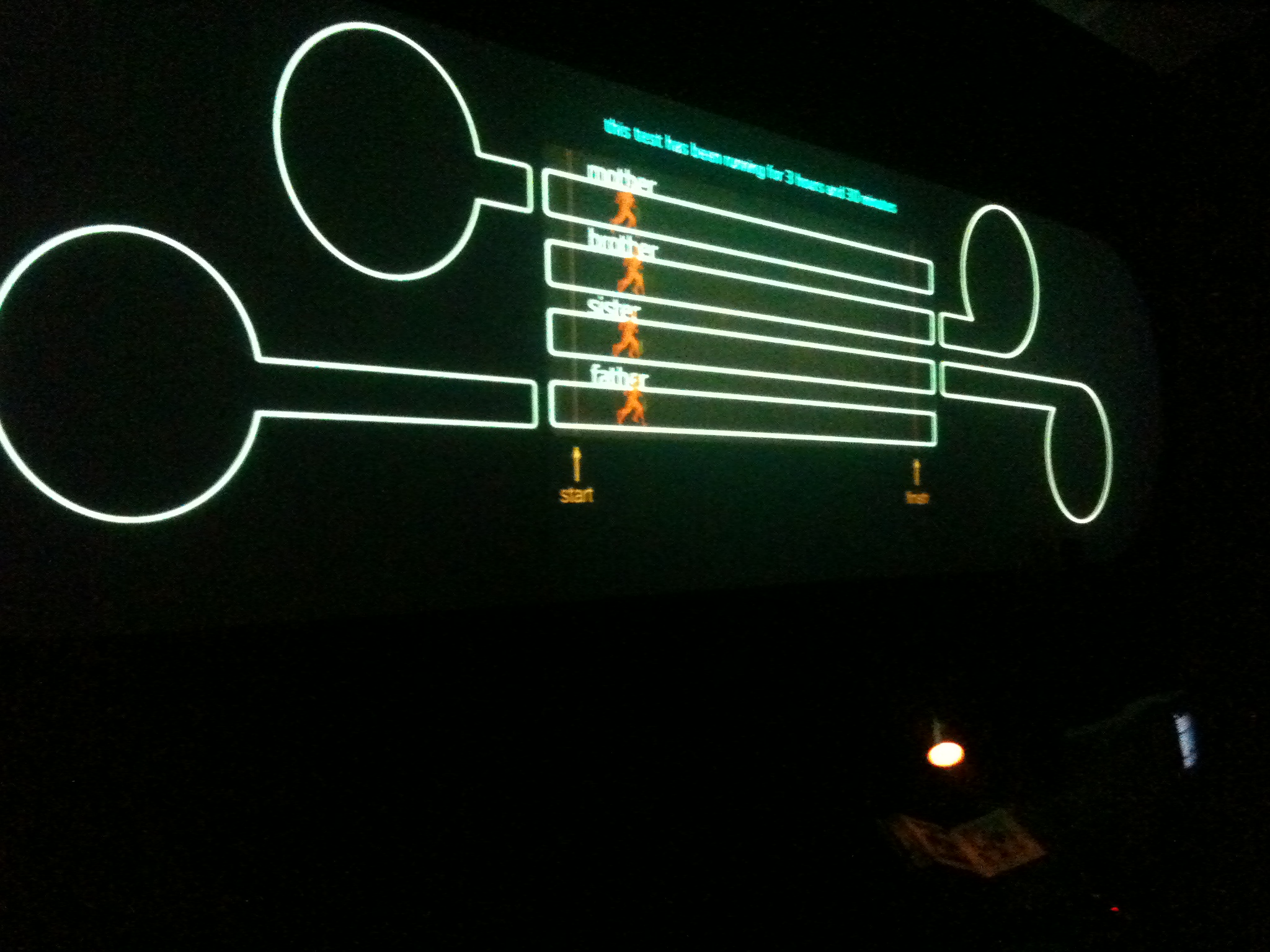
The Relative Velocity Inscription Device (RVID) - the biological body processes turned into a "game" for involuntary processes
Visible, invisible – or sustaining and stabilizing something that is dynamic in its radical temporality (such as the DNA in our bodies) as imaged is one of the most crucial questions for the interconnection of power/media (to modulate Foucault’s “power/knowledge-pairing). Such media and visual cultures are yet grounded in the wet fleshyness of the body, a further connection or demonstration of the idea of even biological bodies as media – and essential to mediated cultures. In this context, such pieces are to me much interesting than thinking them in terms of their genre of “bioart” – in the way they force us think nature-cultures, body-technologies, transversal links.
Media studies – studies of relations, ecology, waste
The best way for media studies to really make sense is to think outside media – of where it expands, takes us, if we persistently follow its lead. So far, for a long time, it took us to think about humans, human relations, intentions, unconscious desires, economics as much as politics as power. Such paths need to take us to the other direction too; to things less intentional, but as important; to nature, bacteria, chemicals, forms of life outside our headspace but inside our gut; to milieus of living in which our conscious agency is only a minor part of what matters. To such time scales which take into account uses and practices, but as part of larger concert where some things last thousands, millions, billions of years.
Just like humanities more widely, media studies needs to be transversal – perhaps a concept we can tightly link to “transdisciplinary” as well.
To quote Félix Guattari:
“Now more than ever, nature cannot be separated from culture; in order to comprehend the interactions between ecosystems, the mechanosphere and the social and individual Universes of reference, we must learn to think ‘transversally.’” (Three Ecologies, 2000:43).
The biggest reason why we should be worried about death and finitude is less in the existential manner, or even what makes our Dasein authentic, but in the way that milieus of life are dying. This relates to fears about “the sixth mass extension” of species, this time caused by humans. The only death we need is that of the subjectivity that cements the economic, political and aesthetic practices that kill nature. This is as much a question for the sciences and engineering, as it is for media theory, arts and humanities.
As Guattari argues, talking about ecosophy, we need to reinvent a multitude of relations where economic struggles, political struggles and struggles of representation, as well as aesthetics, are those that expand the horizon to nature. Hence, media – both in terms of the technologies that return to nature as heavy metals and toxins and as mediators of the mental ecologies in which our destructive tendencies are sustained – is surprisingly close to this problem too.
The affective regimes of media are affective in terms of the relations they sustain – relations between humans, but also to ecosystems, mechanospheres and more. Media studies is thus in a good position to really develop itself into a study of relations, of mediations in that much wider sense.
Across scales, contagious movement
I wrote this short text as a response, inspired by Stamatia Portanova’s recent introduction to her concept of movement-object…published on the In Medias Res-website.
Why is global capitalism so interested in dance? Why is it so interested in flexible, able, creative bodies that show virtuosity and skill? It seems that the emblematic body of contemporary network(ed) capitalism of creative industries and digital economy is that of the dancer, the performer, what Virno referred to as virtuosity; not solely the individual performer however, but indeed a collective quite often. Its flash mobs on train stations, not the worker at the conveyer belt; indeed, train stations instead of factories. What is being produced is movement, or perhaps, from a moving, creative, related set of bodies something emerges; what is that what interests capitalism in that sense? Of course, football is the great art of relationality (think of Douglas Gordon’s Zidane-film!) but as much a condensation of creative capitalism; a condensation of not only flows of skill, but flows of capital and profit. In South-Africa, at the moment, with the World Cup approaching, new territories of security are being created where wrong bodies (street kids, and other not-wanted-disturbances) are being cleaned out from the streets in preparation for the celebration of global society under the banner of football.
An excerpt from another text, forthcoming:
“Indeed, the dancing and moving body can be seen in historical terms as a specific form of knowledge production with an increasing economic importance. Dance is the perfect interface for cultural theories of movement (bodies in variation) to understand the complexity of interaction, an ethology of forces/bodies and the object of cultural industries of affect and experiences. Nigel Thrift writes: ‘[…] dance can sensitize us to the bodily sensorium of a culture, to touch, force, tension, weight, shape, tempo, phrasing, intervalation, even coalescence, to the serial mimesis of not quite a copy through which we are reconstituted moment by moment’ (2008: 140).”
“Not quite a copy” seems to be the contagious element of propagation.
You (referring to Stamatia) start with viruses, with bacteria, which is apt in terms of thinking the contagious nature of gesturality/movement (despite a post-fordist emphasis on flexible bodies, actually the mapping of the gestural, flexible body was part of the earlier phase of capitalism, the cinematic one already since he 19th century) and movement-objects as you call them. It seems to convey the idea of such objects themselves as condensations of intensities that can spread across levels, in this case from the thickness of the event/bodies performing in relation to e.g. algorithmic environments, digital techniques/milieus of creation. Indeed, its not only an abstraction of lived relations of organic kinds, but another scale of relations that is being superposed, or ties in with bodies, and that intertwining of scales and techniques interests me a lot. The digital object is far from static but incorporates too an intensity that stems from its relational status. We can also approach digital objects through the notion of affect whether on the level of design where e.g. object-orientated-design deals with such relations, or then more widely through the assemblage nature of digital nature. Digital objects, software and such, are, for me, characterised by their translational capacities. Not only that through algorithmic measures we are able to abstract etc. things into datasets, but that such abstractions return to organic bodies and their actions; they return as sounds and visions, as actions or frameworks for action (operating systems, bank cash dispensers, and such). This generative circuit that software participates in between a variety of bodies, this relationality, is how I would read also “movement-objects” circulating and distributing certain relations and gesturality even.
I think this multiplicity of ecologies is one thing that strikes me about your movement-objects; they always creatively “mediate” between scales; whether digital objects-organics, or then the idea about beats, where the beat-object is formed through combination of grains, as you put it following Alanna, and where on another scale of bodies’ beats create combinations; bodies pulsating together at a disco! Or again, at the train station as with flash mobs harnessed as part of mobile operator adverts! Its contagious, indeed, and again ties in these contemporary themes together with crowds, social imitation as creativity of bodies in concert, all symptomatic of modernity already in the sense Gabriel Tarde talked about (and more recently Tony Sampson has been interested in!).
>Dead Media/Live Nature
>I am going to give a talk in a couple of weeks in Amsterdam as part of the matinees of the Imaginary Futures research group. I was kindly invited there by Wanda Strauven. Its on Friday the 30th of October, I think starting around 10.30 or 11, and located at Bungehuis, Spuistraat 210, room 101.
Here is the abstract:
The talk Dead Media/Live Nature focuses on the transpositions of media and nature through recent art projects such as Harwood-Wright-Yokokoji’s Eco Media (Cross Talk) and Garnet Hertz’s Dead Media. The Eco Media project developed new modes of thinking and doing media (ecology) through a tracking of the intensities of nature. However, in this case the medium was understood in a very broad sense to cover the ecosystem as a communication network of atmospheric flows, tides, reproductive hormones, scent markers, migrations or geological distributions. The project does not focus solely on the ecological crisis that has been a topic of media representations for years, but also engages with a more immanent level of media ecology in a manner that resembles Matthew Fuller’s call for Art for Animals. Media is approached from the viewpoint of animal perceptions, motilities and energies (such as wind) that escape the frameworks of “human media.” In this context the rhetorical question of the Eco Media project concerning non-human media is intriguing: “Can ‘natural media’ with its different agencies and sensorium help to rethink human media, revealing opportunities for action or areas of mutual interest?” In addition the talk will expand the notion of “dead media” as articulated recently by Garnet Hertz, and discuss its relevance for establishing a connection between media ecology and media archaeology.
>A review of Digital Contagions
>
Anthony Enns raises good points in his flattering review of my Digital Contagions-book that just came out in the most recent issue of Leonardo Digital Review. Enns is himself well familiar with the debates in German media theory, having sat in the seminars of Friedrich Kittler and Wolfgang Ernst for years – and being still an avid visitor of Berlin like myself. Hence, it is no wonder that he places more emphasis on my book’s connections with the certain Kittlerian-mindset (but the “old”-Kittler of Discourse Networks and critic of digital culture). Enns is able to pick up on some really good points, but I just want to tackle some questions raised by the review.
1) Enns writes quoting me that viruses work through the principles of bottom-up emergence; I think this is only part of the picture, and I try to place them on the much wider strategic webs of definitions and articulations in which such ideas of emergence are read in their political contexts as well paying attention to the work of stratification that is as important as the idea of any distributed nature of viral networks. Such a focus on emergence is problematic if it is not specified, and instead of thinking virus software as a form of emergence, I try to think “emergence” as a form of interconnected complexity, a media ecology of sorts, where various scales of this phenomena are in constant interaction. We need to steer clear of the old ideas of internet as a distributed random network for emergence, and pay attention to for example the scale-free nature of contagions, as Tony D. Sampson has pointed out very well: we need to specify what kind of topologies are we dealing with in these milieus of accidents.
Later on in the book I refer to Katherine Hayles’s ideas relating to emergence: “Structures that lead to emergence typically involve complex feedback loops in which the outputs of a system are repeatedly fed back as input.” In other words, I also try to articulate how viruses are much a more systemic part of the loops in which software and even malicious accidents are tied to the new software business that was emerging, e.g. in the form of digital security.
2) This is why I want to steer clear of the idea that viruses are automatically vehicles of resistance; It’s not only that I reject that “viruses might represent the resistant logic of hackers attempting to subvert or appropriate corporate technologies” but that again, this image that stems from some 1990s tactical media inspired accounts, as well as a Deleuzian focus on viruses as tools of sabotage and non-communication, needs to be complexified. We need to pay attention to the singular modes of functioning of this specific software type, as well as the uses and misuses of the discursive iterations of its characteristics. This does not necessarily mean a straightforward failure of such programs of resistance, but a recognition of the multiple contextual forces in which resistance always takes place. In the Deleuzian context the idea of virus as a cut in communication made perhaps sense, but not in such contexts where accidents can be turned so easily as part of the strengthening of the security industry in itself – and this of course applies to much wider trends in security, as demonstrated after 9/11.
3) The first point also relates to how I don’t see capitalism as potentially even benevolent force, but as itself “viral” — viral capitalism is characterized less by substance than through its forces of deterritorialisation, variation, modulation. It feeds through differences, it spreads virally to a variety of practices and discourses that might superficially seem contradictory to itself. It’s not enough, as I argue following e.g. Luciana Parisi, to posit a dualism between the living “good” multitude and the big bad capitalism that sucks power out of the creativity of people, but to actually track the modes of invention, change and appropriation inherent in capitalism’s apparatus of capture. In other words, the only way I see capitalism as a living force is due to its powers of/for change. This follows from a variety of Marxist positions as well – and one could find really nice passages from Marx himself about capitalism & crises.








 Machinology