Archive
Deleuze and the New Humanities in Hong Kong
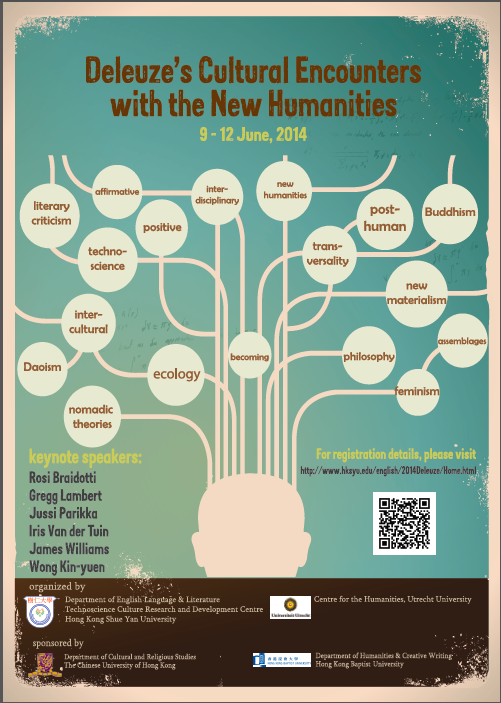
I will be speaking in Hong Kong in June and addressing Deleuze and digital culture. However, my argument is that instead of the usual suspect of starting with the Control Societies-text, Deleuze affords an understanding of the materialities of technological and scientific culture in many other ways too. As part of the geophysical materiality, we can talk about desire’s investment as an infrastructural issue of power – not ideology, just desire but that is infrastructurally effective.
Media & Materiality: A New Issue of Artnodes
The new issue of Artnodes is dedicated to matter. In the wake of different discussions concerning new materialism, speculative realism, objects and processes, I am glad to see this issue out: it takes a more mediatic and experimental view to some of these theoretical themes! Thanks to Jamie Allen and Pau Alsina for getting it done and published.
The issue papers are in Spanish, Catalan and English.
My little text on “new materialism of dust” is a follow-up and extension of the one in Depletion Design. It continues the same theme, and now has inspired me to write a longer essay on dust that will be published in Russian as a stand-alone booklet. The English draft of that is available on Academia.edu.
Zombie Media in Leonardo
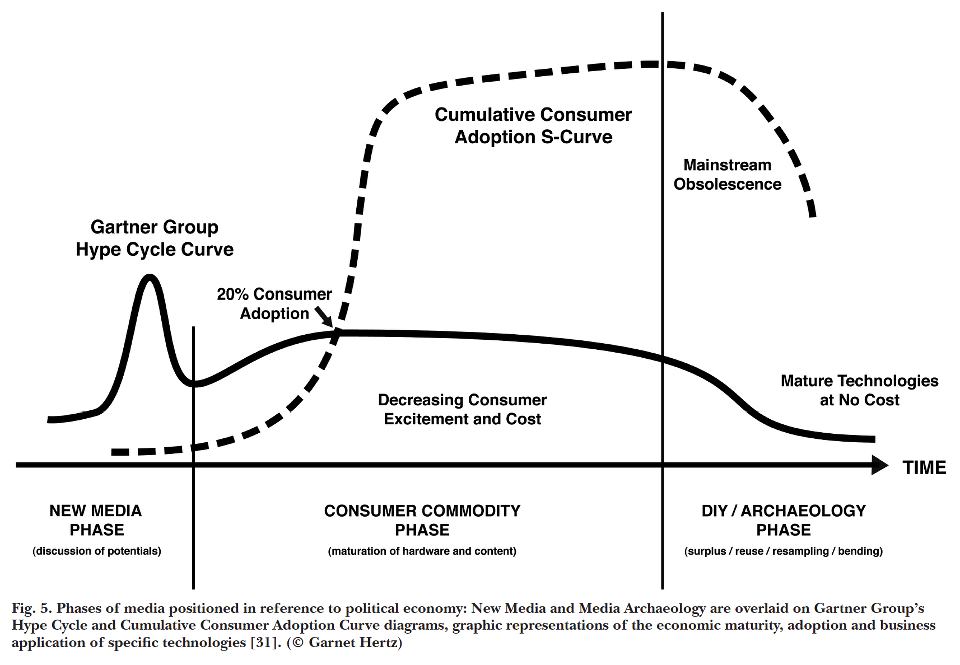
The circuit bended and definitely (re)modified fruits of our collaboration with Garnet Hertz are out. True, “Zombie Media” has been circulating as an unborn living dead text for a longer while, ever since it was part of the Transmediale 2010 Theory Award competition — but now it is finally officially out in Leonardo (vol. 45, no 5)!
Working with someone like Garnet is a pure joy, and demonstrates why collaboration is good for you: you learn a lot. A lot lot.
As a teaser to the longer “Zombie Media: Circuit Bending Media Archaeology into an Art Method”-article, please find below the short “manifesto” on “Five Principles of Zombie Media” we co-wrote for the Defunct/Refunct-catalogue (PDF).
———-
Zombie media addresses the living deads of media culture. As such, it is clearly related
to the earlier calls to investigate “dead media” by Bruce Sterling and others: to map
the forgotten, out-of-use, obsolete and declared dysfunctional technologies in order
to understand better the nature of media cultural development. And yet, we want to
point to a further issue when it comes to abandoned media: the amount of discarded
electronic media is not only the excavation ground for quirky media archaeological
interests, but one of the biggest threats for ecology in terms of the various toxins they
are leaking back to nature. A discarded piece of media technology is never just discarded
but part of a wider pattern of circulation that ties the obsolete to recycling centers,
dismantling centres in Asia, markets in Nigeria, and so forth – a whole global political
ecology of different sorts where one of the biggest questions is the material toxicity of
our electronic media. Media kills nature as they remain as living deads.
Hence, we believe that media archaeology – the media theoretical stance interested
in forgotten paths and quirky ideas of past media cultures – needs to become more
political, and articulate its relation to design practices more clearly. We are not the only
ones that have made that call recently – for instance Timothy Druckrey writes:
“The mere rediscovery of the forgotten, the establishment of oddball paleontologies, of
idiosyncratic genealogies, uncertain lineages, the excavation of antique technologies or
images, the account of erratic technical developments, are, in themselves, insufficient to
the building of a coherent discursive methodology.” [2]
We would want to add that in addition to developing discursive methodologies, we
need to develop methodologies that are theoretically rich as well as practice-oriented –
where ontologies of technical media meet up with innovative ideas concerning design
in an ecological context.
As such, the other part of the zombie media call is the work of reappropriation
through circuit bending and hardware hacking methodologies – to extend the media
archaeological as well as ecosophic interest into design issues. By actively repurposing
things considered dead – things you find from your attic, the second hand market, or
amongst waste – the zombiefication of media is to address the planned obsolescence of
media technologies which is part of their material nature. In reference to contemporary
consumer products, planned obsolescence takes many forms. It is not only an ideology,
or a discourse, but more accurately takes place on a micropolitical level of design:
difficult to replace batteries in personal MP3 audio players, proprietary cables and
chargers that are only manufactured for a short period of time, discontinued customer
support, or plastic enclosures impossible to open without breaking them. Whether you
can open up things – the famous black boxes of media culture characterized by iPhones
and iPads – is one of the biggest political and ecological questions facing our media
theory and practices too.
As a manifesto, five points of zombie media stand out:
1/ We oppose the idea of dead media. Although death of media may be useful as a tactic to
oppose dialog that only focuses on the newness of media, we believe that media never
dies. Media may disappear in a popular sense, but it never dies: it decays, rots, reforms,
remixes, and gets historicized, reinterpreted and collected. It either stays as a residue
in the soil and in the air as concrete dead media, or is reappropriated through artistic,
tinkering methodologies.
2/ We oppose planned obsolescence. As one corner stone in the mental ecology of
circulation of desires, planned obsolescence maintains ecologically unsupportable
death drive that is destroying our milieus of living.
3/ We propose a depunctualization of media and the opening, understanding and hacking
of concealed or blackboxed systems: whether as consumer products or historical
archives.
4/ We propose media archaeology as an artistic methodology that follows in the traditions
of appropriation, collage and remixing of materials and archives. Media archaeology
has been successful in excavating histories of dead media, forgotten ideas, sidekicks and
minor narratives, but now its time to develop it from a textual method into a material
methodology that takes into account the political economy of contemporary media
culture.
5/ We propose that reuse is an important dynamic of contemporary culture, especially
within the context of electronic waste. “If it snaps shut, it shall snap open.” We agree in
that open and remix culture should be extended to physical artifacts.
WSA MA Degree Show 2011
My new job at Winchester School of Art – and the students graduating of the 2010-2011 courses – is having its annual Masters Degree show. Chuffed about this. Includes a wide range of expertise from fine art to communication design, (advertising) design management to fashion and textile design.The Degree show kicks of September 1st with a Private View.
WSAMA 2011 launch and private view = 01/09/11 1800-2000 HRS
(Warning: the video has strong flicker).
For more info (and no-flicker), see the blog at http://wsama.wordpress.com/.
Operational Management of Life

Management of life — in terms of processes, decisions and consequences — is probably an emblematic part of life in post-industrial societies. Increasingly, such management does not take place only on the level individuality, but dividuality — i.e. managing the data clouds, traces, and avataric transpositions of subjectivity in online environments. This is the context in which J. Nathan Matias’ talk on operational media design made sense (among other contexts of course), and provided an apt, and exciting, example of how through media design we are able to understand wider social processes.
Nathan addressed “operationalisation” as a trend that can be incorporated in various platforms from SMS to online self-management and operationalisation. More concretely, “operational media” can be seen as a management, filtering and decision mechanism that can be incorporated into services and apps of various kinds. Nathan’s talk moved from military contexts of “command and control” (operationalisation of strategic ways into tactical operations) to such Apps as the blatantly sexist Pepsi Amp up before you score which allowed the (male) user to find “correct” and functional responses to a variety of female types. In addition to such, Nathan’s talk was able to introduce the general idea of computer assisted information retrieval and management which to me was a great way of branding a variety of trends into “operational media”. He talked about visualisation of data, augmented reality, filtering of data, expert, crowd and computer assisted information gathering, and a variety of other contexts in which the idea works.
“Should I eat this croissant” considering its calories, the needed time I need to work out to get it again out of my system, the time available etc. is one example of operationalisation of decisions in post-fordist societies of high-tech mobile tools that tap into work and leisure activities.
Another example is the service offered by Nathan’s employed KGB (not the spies, but Knowledge Generation Bureau. See their recent Superbowl ad here. The KGB service is one example of mobile based operational services which in the character space of an SMS try to provide accurate answers to specific questions and hence differ from e.g. search engines.
Of course, one could from a critical theory perspective start to contextualise “operational media”. Is it a form of digital apps enhanced behavioralism that does not only assume but strengthens assumptions about the possibility of streamlining complex human actions? Is it a mode of media design that further distances management of life into external services? Is it hence a form of biopower of commercial kinds that ties in with the various processes from the physiological to cultural such as labour and provides its design-solutions for them? In any case, Nathan’s expertise in this field was a very enjoyable, and a good demonstration of a scholar/designer working in software studies.








 Machinology