Archive
Metastable biomedia bodies: Paul Vanouse’s Fingerprints

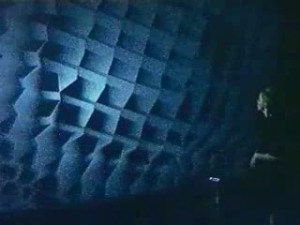
The Suspect Inversion Center (SIC)
It is a beautifully created little exhibition; a dark room, three projects, all like spotlights into aspects where the biological is becoming media – and as such, part of the epistemic frameworks. These forms of mediated knowing are then of course themselves access points to a plethora of techniques of power, proof and aesthetics. Yet, as has been demonstrated the recent years in various bioart and biomedia-theoretical works, the biological just not is – but is created.
Hence, Paul Vanouse’s Fingerprints, curated by Jens Hauser, is one of such works that is able to extend the notion of “media” to processes deep inside the body, and yet abstract enough to encompass global transactions, economies, regimes of knowing. Exhibited at the Schering Stiftung, Berlin, three pieces (The Suspect Inversion Center, Relative Velocity Inscription Device, and Latent Figure Protocol) are on show. What Vanouse is able to show is the inherent instability, or perhaps metastability if we want to use concepts from Gilbert Simondon, of these constellations of production of “truth”. What kinds of truths? Truths about race, about culpability, about how DNA samples do not just stick to the body, or that the relation is fragile, sustained, maintained exactly by the techniques supposed to “find” them. This is basic stuff that Science and Technology Studies has given us: apparatuses, techniques and frameworks create, never just discover. The truths found are as much in the apparatus as in the body – and hence, more accurately in the various couplings of technologies, biological bodies, and the mentioned abstract frameworks.
It’s mediated, to amusing extents: From the mini-laboratories of Suspect Inversion Center that is an on-going performance aimed to demonstrate the manipulability of DNA samples and images (which involves a “becoming OJ Simpson” of Mr Vanouse’s DNA) to the game-like Relative Velocity Inscription Device where the DNA of four family members are staged to compete against each other in a race form (the pace of their DNA samples moving through the gel electrophoresis that is instrumental part of DNA imaging technologies).
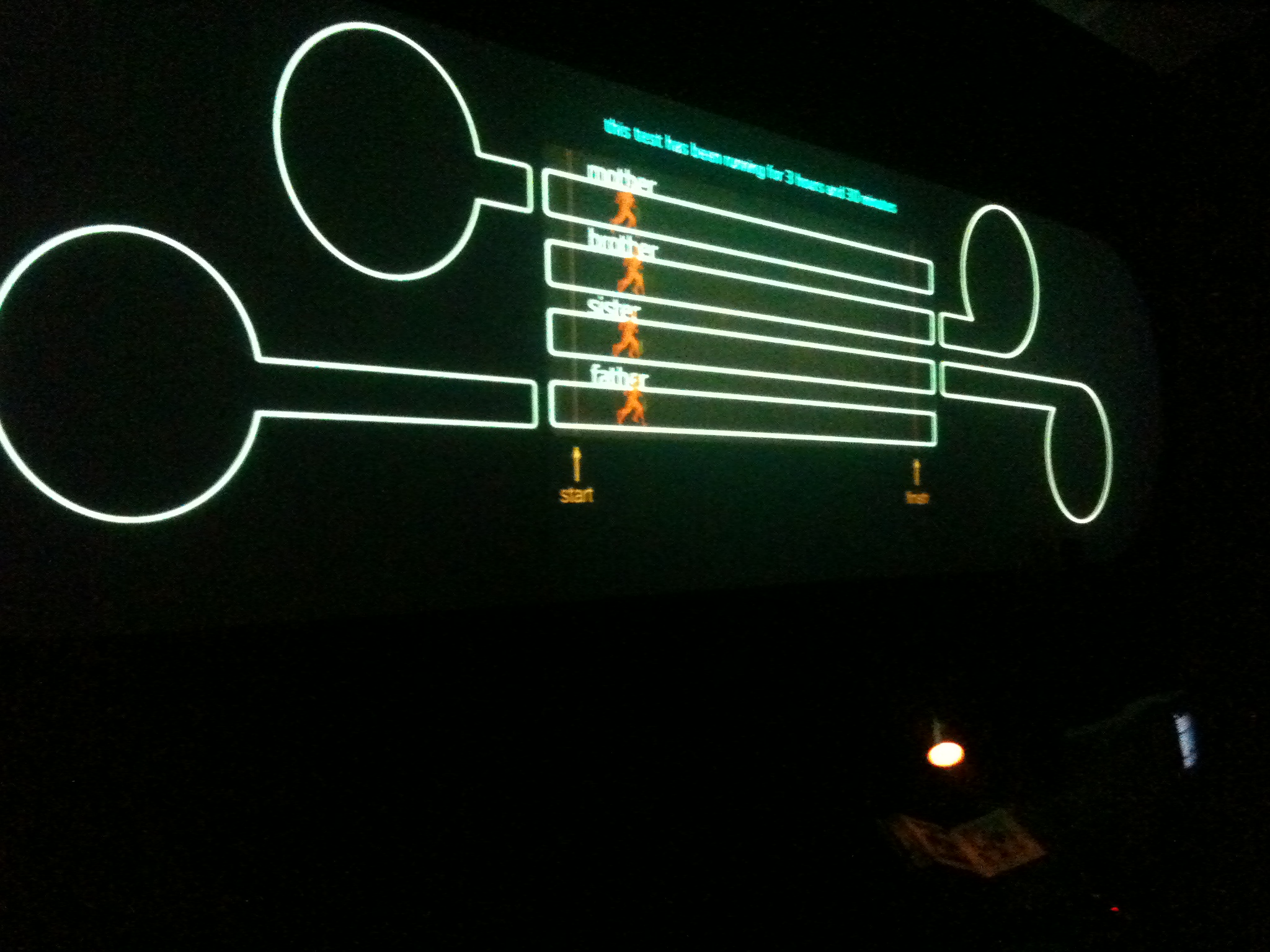
The Relative Velocity Inscription Device (RVID) - the biological body processes turned into a "game" for involuntary processes
Visible, invisible – or sustaining and stabilizing something that is dynamic in its radical temporality (such as the DNA in our bodies) as imaged is one of the most crucial questions for the interconnection of power/media (to modulate Foucault’s “power/knowledge-pairing). Such media and visual cultures are yet grounded in the wet fleshyness of the body, a further connection or demonstration of the idea of even biological bodies as media – and essential to mediated cultures. In this context, such pieces are to me much interesting than thinking them in terms of their genre of “bioart” – in the way they force us think nature-cultures, body-technologies, transversal links.
Arts Future Book – Book Futures of Arts
I don’t think I have blogged this, so a heads up: a very interesting new series from Gylphi, Arts Future Book. If you have great projects that could fit in, get in touch (either via me, I am on the editorial board, or directly with the general editor Charlotte Frost):

Edited by Charlotte Frost, Arts Future Book is an academic book series aiming to publish texts on art and visual culture in both print and digital formats. The series seeks to foster new scholarship in the arts, and publish unique works that rethink contemporary visual culture and establish new systems for considering art. It will highlight aspects of the impact of digital technologies on contemporary culture and indicate the ways in which technology informs our knowledge of the arts. The series will exploit recent technological advances in publishing to better disseminate such bodies of arts knowledge and develop wider readership and new reader experiences. Its premise is the notion that ideas are formed in dialogue with the media that represent them and that authors can actively forge the future of disciplines by recreating their core media. Therefore, this series sets out to chart new territory in disciplines dealing with the criticism, theorization and historicization of the arts. Each book published within the series will respect established academic standards, while redefining what an academic text might be and how it might be used.
TOC for Media Archaeology
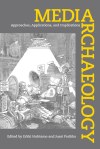
Some information on our forthcoming Media Archaeology: Approaches, Applications, Implications-book that we edited together with Erkki Huhtamo, forthcoming Spring 2011 from University of California Press… no cover image yet, and no table of contents online, hence I am posting at least the contents here! For clarity’s sake, this is the one that is ready, and I am writing at the moment another book, a single authored one on the same topic.
1. Introduction: An Archaeology of Media Archaeology –Erkki Huhtamo and Jussi Parikka
Part I: Engines of/in the Imaginary
2. Dismantling the Fairy Engine: Media Archaeology as Topos Study –Erkki Huhtamo
3. On the Archaeology of Imaginary Media –Eric Kluitenberg
4. On the Origins of the Origins of the Influencing Machine –Jeffrey Sconce
5. Freud and the Technical Media: The Enduring Magic of the Wunderblock –Thomas Elsaesser
Part II: (Inter)facing Media
6. The “Baby Talkie,” Domestic Media, and the Japanese Modern –Machiko Kusahara
7. The Observer’s Dilemma: To Touch or Not to Touch –Wanda Strauven
8. The Game Player’s Duty: The User as the Gestalt of the Ports –Claus Pias
9. The Enduring Ephemeral, or The Future Is a Memory –Wendy Hui Kyong Chun
Part III: Between Analogue and Digital
10. Erased Dots and Rotten Dashes or How to Wire Your Head for a Preservation –Paul DeMarinis
11. Media Archaeography: Method and Machine versus History and Narrative of Media –Wolfgang Ernst
12. Mapping Noise: Techniques and Tactics of Irregularities, Interception, and Disturbance
–Jussi Parikka
13. Objects of Our Affection: How Object Orientation Made Computers a Medium –Casey Alt
14. Digital Media Archaeology: Interpreting Computational Processes –Noah Wardrip-Fruin
15. Afterword: Media Archaeology and Re-presencing the Past –Vivian Sobchack
[edit 21/12/10]: Endorsement by Sean Cubitt:
“Huhtamo and Parikka, from the first and second generations of media archaeology, have brought together the best writings from almost all of the best authors in the field. Whether we speak of cultural materialism, media art history, new historicism or software studies, the essays compiled here provide not only an anthology of innovative historical case studies, but also a methodology for the future of media studies as material and historical analysis. Media Archaeology is destined to be a key handbook for a new generation of media scholars.”
– Sean Cubitt, author of The Cinema Effect
The Creative Technologies Review-podcasts
One of the highlights of my pre-academia career as a freelance journalist when during a phone interview the interviewee, a female at a telecommunications company marketing department or something of approx. 35 years of age, interrupted me: “Oh I am sorry to interrupt the interview but I just have to say you have an amazing telephone voice.”
I blush, stutter, and for a second wonder if my future career is somewhere where I could put my voice into better use, such as in some of those dubious 0800-numbers that offer services of very wide variety.
Instead, I end up as an academic.
Despite the shortness of the flirtation with the idea of using my voice to make money, I have been drawn into something again where I need to talk – publicly. The shock horror at first, but then realizing its actually enjoyable despite the fact that there is always a tiny region in your brain that is probably trying to say something very inappropriate.
Anyhow, CoDE-institute and me with Julio D’Escrivan (whose original idea this was) present: the Creative Technologies Review-podcasting series that commenced in August 2010.
We label it as
“A podcast on technology and creativity, technology mostly misused, unintentionally artistic technology and music technology with the odd splattering of digital economies” and hope it to be usually a 30 min aberration into the interminglings of technology, net culture, a slight dash of political economy, academic stuff and lots of media arts.
It features interviews of creatives, techs and academics, and aims to throw a spotlight both on the work done at CoDE institute in Cambridge but also more widely (as in globally) on creative technology and arts. I am suspecting it turns out to be quite focused on sound, knowing Julio’s interests and expertise in sound art, sonicity, but it will definitely splash into other fields of expression too and I am sure to throw in a nice dose of media theoretical meditation.
Its hopefully soon available on Itunes, but meanwhile episodes can be downloaded here.
Please get in touch if you have feedback, or suggestions for themes, sites, projects, etc. to be featured!
>New Materialism abstracts
>
David M. Berry: Software Avidities: Latour and the Materialities of Code
The first difficultly in understanding software is located within the notion of software/code itself and its perceived immateriality. Here it is useful to draw an analytical distinction between ‘code’ and ‘software’. Throughout this paper I shall be using code to refer to the textual and social practices of source code writing, testing and distribution. In contrast, I would like to use ‘software’ to include products, such as operating systems, applications or fixed products of code such as Photoshop, Word and Excel and the cultural practices that surround the use of it. This further allows us to think about the hacking as the transformation of software back into code for the purposes of changing its normal execution or subverting its intended (prescribed) functions. However, this difficulty should not mean that we stay at the level of the screen, so-called screen essentialism, nor at the level of information theory, where the analysis focuses on the way information is moved between different points disembedded from its material carrier, nor indeed at the level of a mere literary reading of the textual form of code. Rather code needs to be approached in its multiplicity, that is as a literature, a mechanism, a spatial form (organisation), and as a repository of social norms, values, patterns and processes. In order to focus on the element of materiality I want to use Latour’s notion of the ‘test of strength’ to see how the materiality of code, its obduracy and its concreteness are tested within computer programming contests. To do this I want to look at two case studies: (1) the Underhanded C Contest, which is a contest which asks the programmer to write code that is as readable, clear, innocent and straightforward as possible, and yet it must fail to perform at its apparent function. To be more specific, it should do something subtly evil; and (2) The International Obfuscated C Code Contest, which is a contest to write the most Obscure/Obfuscated C program possible that is as difficult to understand and follow (through the source code) as possible. By following the rules of the contest, and by pitting each program, which must be made available to compile and execute by the judges (as well as the other competitors and the wider public by open sourcing the code), the code is then shown to be material providing it passes these tests of strength.
Rick Dolphijn: The Intense Exterior of Another Geometry
Eleni Ikoniadou: Transversal digitality and the relational dynamics of a new materialism
The relationship between digital technology and matter has preoccupied media and cultural theorists for the last two decades. During the 90s it was articulated through a celebration of the disembodied, immaterial and probabilistic properties of information (cybercultural theory). More recently, it has been asserted through a reliance on sensory perception for the construction of a predominantly observable, otherwise void, digital space (digital philosophy). However, alternative materialist accounts may be able to offer more dynamic ways of understanding the heterogeneity, materiality and novelty of digital culture (Kittler, 1999; Mackenzie, 2002; Fuller, 2005; Munster, 2006). Following on their footsteps, this presentation will aim to rethink the ontological status of the digital as immanent to the flows of a ‘new materialism’. The latter is understood as a transversal process that cuts across seemingly distinguished fields and disciplines, such as the arts and sciences, establishing new connections between them. New materialism, then, becomes a concept and a method proper for investigating digital media and their tendency to bring together different aspects of the world in new ways. The paper discusses how an abstract materialist new media theory can enable transversal relations between science studies, philosophy and media art, as well as between the actual and the virtual dimensions of reality; allowing the emergence of heterogeneous digital assemblages of material, aesthetic and scientific combination.
Adrian Mackenzie: Believing in and desiring data: ‘R’ as the next ‘big thing’
How could materialist analysis come to grips with the seeming immateriality of data network media? This paper attempts to think through some of the many flows of desire and belief concerning data. In the so-called ‘data deluges’ generated by the searches, queries, captures, links and aggregates of network media, key points of friction occur around sharing and pattern perception. I focus on how sharing and pattern perception fare in the case of the scripting language R, an open source statistical ‘data-intensive’ programming language heavily used across the sciences (including social sciences), in public and private settings, from CERN to Wall Street and the Googleplex. R, it is said, is a ‘next big thing’ in the world of analytics and data mining, with thousands of packages and visualizations, hundreds of books and publications (including its own journal, /R Journal/) appearing in the last few years. In this activity, we can discern vectors of belief and desire concerning data. The tools and techniques developed in R can be seen both intensifying data, and at times, making the contingencies of data more palpable.
Stamatia Portanova: The materiality of the abstract (or how movement-objects ‘thrill’ the world)
Anna Powell: Affections in their pure state? The digital event as immersive encounter
Iris Van der Tuin: A Different Starting Point, A Different Metaphysics: Reading Bergson and Barad Diffractively
Affect, software, net art (or what can a digital body of code do-redux)
After visiting the Manchester University hosted Affective Fabrics of Digital Cultures-conference I thought for a fleeting second to have discovered affects; its the headache that you get from too much wine, and the ensuing emotional states inside you trying to gather your thoughts. I discovered soon that this is a very reductive account, of course — and in a true Deleuzian spirit was not ready to reduce affect into such emotional responses. Although, to be fair, hangover is a true state of affect – far from emotion — in its uncontrollability, deep embodiment.
What the conference did offer in addition to good social fun was a range of presentations on the topic that is defined in so many differing ways; whether in terms of conflation it with “emotions” and “feelings”, or then trying to carve out the level of affect as a pre-conscious one; from a wide range of topics on affective labour (Melissa Gregg did a keynote on white collar work) to aesthetic capitalism (Patricia Clough for example) which in a more Deleuzian spirit insisted on the non-representational. (If the occasional, affective reader is interested in a short but well summarizing account of differing notions of affect to guide his/her feelings about the topic, have a look at Andrew Murphie’s fine blog posting here – good theory topped up with a cute kitty.)
My take was to emphasise the non-organic affects inherent in technology — more specifically software, which I read through a Spinozian-Uexkullian lense as a forcefield of relationality. Drawing on for example Casey Alt’s forthcoming chapter in Media Archaeologies (coming out later this year/early next year), I concluded with object-oriented programming as a good example of how affects can be read to be part of software as well so that the technical specificity of our software embedded culture reaches out to other levels. Affects are not states of things, but the modes in which things reach out to each other — and are defined by those reachings out, i.e. relations. I was specifically amused that I could throw in a one-liner of “not really being interested in humans anyway” — even better would have been “I don’t get humans or emotions”, but I shall leave that for another public talk. “I don’t do emotions” is another of my favourite one’s, that will end up on either a t-shirt or an academic paper.
The presentation was a modified version from a chapter that is just out in Simon O’Sullivan and Stephen Zepke’s Deleuze and Contemporary Art-book even if in that chapter, the focus is more on net and software art. I am going to give the same paper in the Amsterdam Deleuze-conference, but as a teaser to the actual written chapter, here is the beginning of that text from the book…

1. Art of the Imperceptible
In a Deleuze-Guattarian sense, we can appreciate the idea of software art as the art of the imperceptible. Instead of representational visual identities, a politics of the art of the imperceptible can be elaborated in terms of affects, sensations, relations and forces (see Grosz). Such notions are primarily non-human and exceed the modes of organisation and recognition of the human being, whilst addressing themselves to the element of becoming within the latter. Such notions, which involve both the incorporeal (the ephemeral nature of the event as a temporal unfolding instead of a stable spatial identity) and the material (as an intensive differentiation that stems from the virtual principle of creativity of matter), incorporate ‘the imperceptible’ as a futurity that escapes recognition. In terms of software, this reference to non-human forces and to imperceptibility is relevant on at least two levels. Software is not (solely) visual and representational, but works through a logic of translation. But what is translated (or transposed) is not content, but intensities, information that individuates and in-forms agency; software is a translation between the (potentially) visual interface, the source code and the machinic processes at the core of any computer. Secondly, software art is often not even recognized as ‘art’ but is defined more by the difficulty of pinning it down as a social and cultural practice. To put it bluntly, quite often what could be called software art is reduced to processes such as sabotage, illegal software actions, crime or pure vandalism. It is instructive in this respect that in the archives of the Runme.org software art repository the categories contain less references to traditional terms of aesthetics than to ‘appropriation and plagiarism’, ‘dysfunctionality’, ‘illicit software’ and ‘denial of service’, for example. One subcategory, ‘obfuscation’, seems to sum up many of the wider implications of software art as resisting identification.[i]
However, this variety of terms doesn’t stem from a merely deconstructionist desire to unravel the political logic of software expression, or from the archivists nightmare á la Foucault/Borges, but from a poetics of potentiality, as Matthew Fuller (2003: 61) has called it. This is evident in projects like the I/O/D Webstalker browser and other software art projects. Such a summoning of potentiality refers to the way experimental software is a creation of the world in an ontogenetic sense. Art becomes ‘not-just-art’ in its wild (but rigorously methodological) dispersal across a whole media-ecology. Indeed, it partly gathers its strength from the imperceptibility so crucial for a post-representational logic of resistance. As writers such as Florian Cramer and Inke Arns have noted, software art can be seen as a tactical move through which to highlight political contexts, or subtexts, of ‘seemingly neutral technical commands.’ (Arns, 3)
Arns’ text highlights the politics of software and its experimental and non-pragmatic nature, and resonates with what I outline here. Nevertheless, I want to transport these art practices into another philosophical context, more closely tuned with Deleuze, and others able to contribute to thinking the intensive relations and dimensions of technology such as Simondon, Spinoza and von Uexküll. To this end I will contextualise some Deleuzian notions in the practices and projects of software and net art through thinking code not only as the stratification of reality and of its molecular tendencies but as an ethological experimentation with the order-words that execute and command.
The Google-Will-Eat-Itself project (released 2005) is exemplary of such creative dimensions of software art. Authored by Ubermorgen.com (featuring Alessandro Ludovico vs. Paolo Cirio), the project is a parasitic tapping in to the logic of Google and especially its Adsense program. By setting up spoof Adsense-accounts the project is able to collect micropayments from the Google corporation and use that money to buy Google shares – a cannibalistic eating of Google by itself. At the time of writing, the project estimated that it will take 202 345 117 years until GWEI fully owns Google. The project works as a bizarre intervention into the logic of software advertisements and the new media economy. It resides somewhere on the border of sabotage and illegal action – or what Google in their letter to the artists called ‘invalid clicks.’ Imperceptibility is the general requirement for the success of the project as it tries to use the software and business logic of the corporation through piggy-backing on the latter’s modus operandi.
What is interesting here is that in addition to being a tactic in some software art projects, the culture of software in current network society can be characterised by a logic of imperceptibility. Although this logic has been cynically described as ‘what you don’t see is what you get’, it is an important characteristic identified by writers such as Friedrich Kittler. Code is imperceptible in the phenomenological sense of evading the human sensorium, but also in the political and economic sense of being guarded against the end user (even though this has been changing with the move towards more supposedly open systems). Large and pervasive software systems like Google are imperceptible in their code but also in the complexity of the relations it establishes (and what GWEI aims to tap into). Furthermore, as the logic of identification becomes a more pervasive strategy contributing to this diagram of control, imperceptibility can be seen as one crucial mode of experimental and tactical projects. Indeed, resistance works immanently to the diagram of power and instead of refusing its strategies, it adopts them as part of its tactics. Here, the imperceptibility of artistic projects can be seen resonating with the micropolitical mode of disappearance and what Galloway and Thacker call ‘tactics of non-existence’ (135-136). Not being identified as a stable object or an institutional practice is one way of creating vacuoles of non-communication though a camouflage of sorts. Escaping detection and surveillance becomes the necessary prerequisite for various guerrilla-like actions that stay ‘off the radar.’
Bookmachines, Soundmachines
Kettle’s Yard had today a CoDEful of people performing on “Musical and Poetic Approaches to Technology, from subversive, DIY and historical perspectives.” By CoDEful I mean Katy Price, Tom Hall and Richard Hoadley, all affiliated with our institute.
The experimental takes on sound, music and performance moved from digital investigations into soundscapes (Katherine Norman’s pieces) to for example physical computing and interface experiments as with Richard Hoadley who performed with his self designed Gaggle too — along with two new devices, Wired and Gagglina.
I truly enjoyed Katy Price’s performance piece Bookmachine which is described as “found poem drawn from three sources about books and machines.” The opening line “the book is a machine to think with” is a declaration of book’s haptic, sonic, material qualities; an exploration into the pragmatics of the book. (And as I learned, comes from I.A.Richard’s). Indeed, the book is touched, scraped, made into a sonic platform; it is torn, taped back together, punctured. The book is less read, and when its read, its not a work of extracting meanings from it, for sure. The book is “typed into a BBC Microcomputer simulator running ‘Speech’ and the speech facility in a Macbook.” The book does, and is an object of doing much more than meaning in a Deleuzian spirit.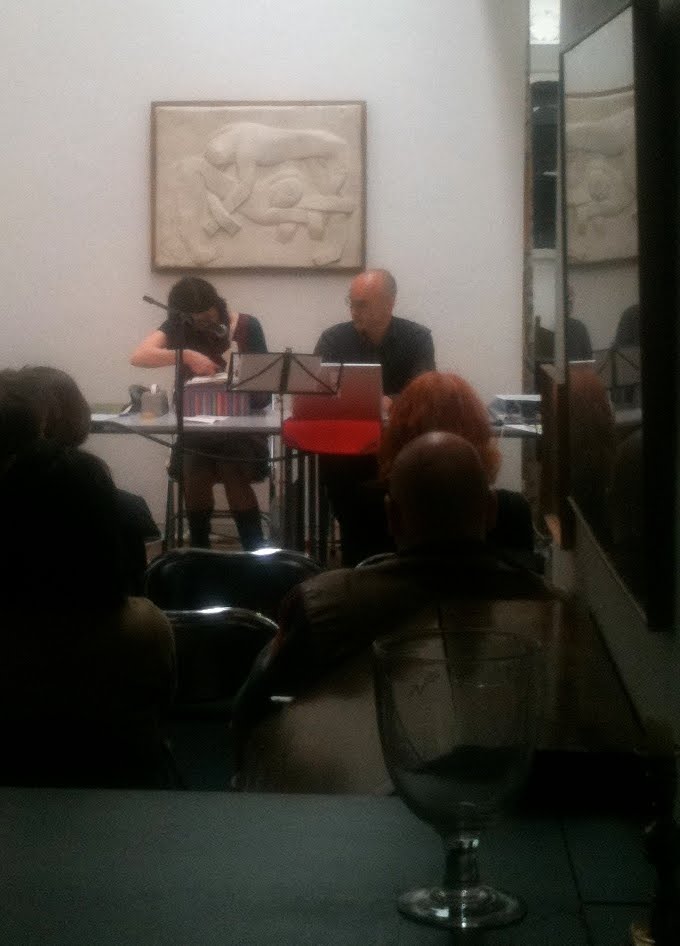
This is where I am alluding to, Deleuze and Guattari on the book: the root-book is very different even if its the classical form of the book; hierarchical and full of meaning. We read such books as we should read books — the way we are taught. Start in the beginning, think of what it means. The modernists then were already cutting up books (cut-ups by Burroughs) and making new kinds of series proliferate. But books can be made to do other kinds of things; books are machines, and machines connect. They connect to senses, new uses, making books into objects, trajectories, surfaces, scapes. A machine to think with alludes to the fact that books always function as part of assemblages. We like to think of book’s as organic and self-sustaining, but they always are there to help to do stuff, to think with, to accompany. We become with books. And if the book is a machine to think with, it also alludes that there are other machines to think with too; that the book is a machine similarly as computers and such are.
Book as a machinic assemblage is much more than we usually attribute to literature, and sees it even as a , well, war-machine (in the DeleuzeGuattarian-sense again). To quote Gregg Lambert:
“…literature functions as a war machine. ‘The only way to defend language is to attack it'(Proust, quoted in CC4). This could be the principle of much of modern literature and capture the sense of process that aims beyond the limit of language. As noted above, however, this limit beyond which the outside of language appears is not outside language, but appears in its points of rupture, in the gaps, or tears, in the interstices between words, or between one word and the next.” (Lambert, The Non-Philosophy of Deleuze, 141).
Literally, what lies between words are blank gaps on the page, but also paper, and the porous surface of inscription. There is always a lot that goes on between any word – much more than hallucination of meaning. The stuttering “and” is what constitutes an experimental assemblage of the book machine which tries out the various material modalities in which text, covers, paper, expose much more than meaning. The rhizome-book is the bookmachine, it reaches to outsides and neglects illusions of books as images of the world. It represents less, but sounds a lot more.
The book too has its on level of “body without organs” — the final phrase from the performance. Much more, such perspectives relate to futures of literature and literature studies. New territories of how we approach literature, books, meanings do not take at face value the idea of hermeneutics and deciphering meanings in that traditional sense, but are open to, well, opening up the book in different ways. Literature can be made into such new contexts of use and imagination where semantics and interpretation can be seen as only one way of “practicing literature”. This is where the translation of literature whether into data open to algorithmic manipulations, or then new realms of sensation in terms of multimodality, or part of other creative, experimental takes finds its futures.
>Dead Media/Live Nature
>I am going to give a talk in a couple of weeks in Amsterdam as part of the matinees of the Imaginary Futures research group. I was kindly invited there by Wanda Strauven. Its on Friday the 30th of October, I think starting around 10.30 or 11, and located at Bungehuis, Spuistraat 210, room 101.
Here is the abstract:
The talk Dead Media/Live Nature focuses on the transpositions of media and nature through recent art projects such as Harwood-Wright-Yokokoji’s Eco Media (Cross Talk) and Garnet Hertz’s Dead Media. The Eco Media project developed new modes of thinking and doing media (ecology) through a tracking of the intensities of nature. However, in this case the medium was understood in a very broad sense to cover the ecosystem as a communication network of atmospheric flows, tides, reproductive hormones, scent markers, migrations or geological distributions. The project does not focus solely on the ecological crisis that has been a topic of media representations for years, but also engages with a more immanent level of media ecology in a manner that resembles Matthew Fuller’s call for Art for Animals. Media is approached from the viewpoint of animal perceptions, motilities and energies (such as wind) that escape the frameworks of “human media.” In this context the rhetorical question of the Eco Media project concerning non-human media is intriguing: “Can ‘natural media’ with its different agencies and sensorium help to rethink human media, revealing opportunities for action or areas of mutual interest?” In addition the talk will expand the notion of “dead media” as articulated recently by Garnet Hertz, and discuss its relevance for establishing a connection between media ecology and media archaeology.
>First ArcDigital talk of the Semester: Dr Joyce Shintani
>A big thanks to Dr Joyce Shintani for kicking off ArcDigital talks for this semester! We started these lectures last academic year in order to excavate the interzone between theory and practice of/in digital culture, the trandisciplinary zones often left untouched by the established disciplines of academia. Last year we had a range of excellent speakers from Espen Aarseth to Steven Shaviro and Gary Genosko (and a number of others!), and this year we continue from Shintani to Greg Elmer, Wolfgang Ernst, Richard Grusin…and so on.
Shintani’s talk focused on music and sound in recent media art — and she presented an overview of s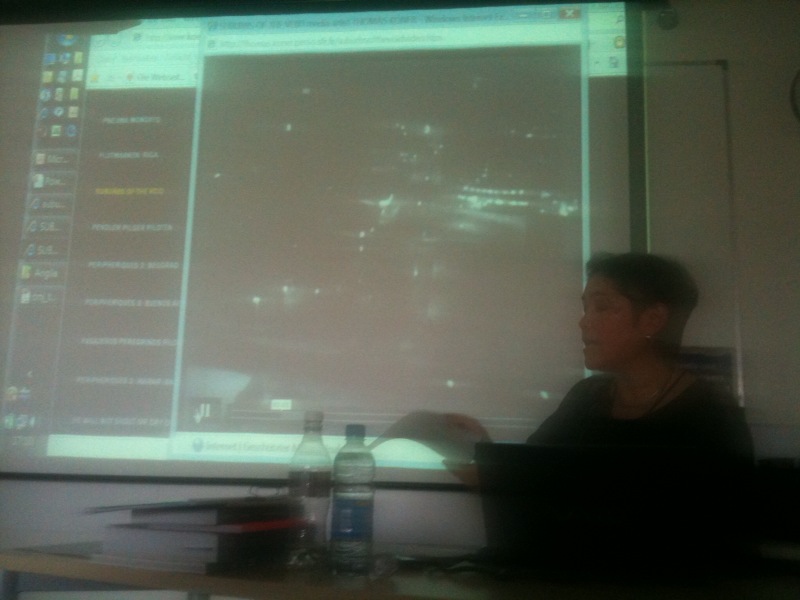 ome of the themes in recent exhibitions such as Art Basel, Ars Electronica and Sonar (Barcelona). By focusing on the element of music, Shintani was touching on such regimes of sensibility too often left untouched by the visual emphasis of media art/theory — an idea that resonates strongly with such claims for a “sonic turn” in cultural theory. Turn or not, such a multimodal perspective is much needed to understand multimedia as something more than just multiple media put together. Indeed, its not only sound and something else, but a focus on sound that deterritorialises our perspective on works of art from visual screen based to installations. Its not only about music per se, in that sense, but about sound as an attraction point for the user and for the analyst. Shintani pointed to some implications:
– music has been built upon the centrality of the word (as already Adorno argued); hence a much more multimodal approach is needed — media is not only literature based, but interfaces of direct bodily sensations, musical expectations etc. demand a different focus
– This has implications in terms of institutions from teaching to performance
– a post object-subject approach demands a much more refined idea of embodiment and interaction than has been catered in the word-biased approaches.
All this is clear and stems from what she identified as current “trends” — not in terms of fashionability but the singularity of some of the works she is interested in;
– Increasing minituarization
– Enabling ease of access to sound/music — i.e. a certain DIY approach
– cooperation and collaboration in the process of art making
– “sophistication” of interactivity in connection with easing of access
– a strong focus on mixed media — “Continuation of breaking down of barriers, mixing of media that stems from Adorno’s “Verfransung” — a wandering crossover, aberrant paths of and in media production).
In this context, Shintani is working on her new project: “Embodiment and “the Other”. A multidisciplinary Comparison of Changing Aspects of the Subject in Musical Multimedia Works.
>Art and Electronic Media
>
I wrote a review of Edward Shanken’s huge Art and Electronic Media just recently for the Finnish journal of audiovisual culture, Lähikuva. Well, the review is not out yet, and even when it will be, it’s of course in Finnish, so just a short summary. Any book that due to its size could be a proper murder weapon merits a word or two.








 Machinology