Archive
What is Media Archaeology, beta definition ver. 0.9
What is Media Archaeology? gives no direct answer to the question that it poses. Instead, it gives a map – a cartography of how to see the field of media archaeology defined by various theories and directions, that help us to go to places – and think things. However, I remember trying to think through definitions of media archaeology – a useful task to bring clarity. I originally doodled something like this for my working blog for that WiMA book, but let’s return to that now. This thinking aloud was partly triggered by my soon to be new colleague Sunil Manghani’s question…so how does media archaeology differ from media history.
Here is one attempt to give a definition – sort of coordinates, although this does not exhaust the richness of MA and its various traditions.
Media archaeology can be understood as a heterogeneous set of theories and methods that investigate media history through its alternative roots, forgotten paths, neglected ideas and machines. It explicitly challenges the supposed newness of digital culture. Media archaeology gives new ideas to understand media cultural temporality. The definitions have ranged from emphasising the recurring nature of media cultural discourses (Huhtamo) to media archaeology as an-archaeology, or variantology (Zielinski) which in its excavation of the deep time layers of our means of seeing and hearing tries to find an alternative route to dismantle the fallacy of linear development.
Furthermore, I see media archaeology as a joint history & theory venture in which temporal excavation of media functions as a theoretical force as well; it can be characterised as a reading of old media and new media in parallel lines. Media archaeology is decisively non-linear, and rigorously theoretical in its media historical interest of knowledge. In a Benjaminian vein, it abandons historicism when by it is meant the idea that the past is given and out there waiting for us to find it; instead, it believes in the radical assembling of history, and histories in the plural, but so that it is not only a subset of cultural historical writing. Instead, media archaeology needs to insist both on the material nature of its enterprise – that media are always articulated in material, also in non-narrative frameworks whether technical media such as photography, or algorithmic media features such as databases and software networks – and that the work of assembling temporal mediations takes place in an increasingly varied and distributed network of institutions, practices and technological platforms.
Indeed, what media archaeology investigates are also the practical rewirings of time, as is done in media artistic and creative practice work, through archives digital and traditional, as well as DIY and circuit bending which recycle, and remix obsolete technology as much as they investigate aesthetic and political economic conditions of technical media.
Media archaeology takes place in artistic labs, laboratories where hardware and software are hacked and opened, but also in in conceptual labs for experimenting with concepts and ideas.
So as you can see, it moves into certain material characteristics that I want to keep close to media archaeology. It does not mean that this it the only to approach MA. For instance, here is what Huhtamo wrote.
Don’t call him a media philosopher!
It was one year ago that Friedrich A. Kittler died. The German newspapers reacted, and slowly, The Guardian too, with a couple of writings and a podcast. I think that was it, for the English-speaking mainstream press. Besides some short notes on my blog, I wrote this short piece for The Guardian.
Academic discussions concerning his work have increased even more: such also include fantastic pieces like the memoir by Geoffrey Winthrop-Young of the Kittler-before-Kittler (i.e. the early 1980s one) ‘”Well What Socks is Pynchon Wearing Today?” A Freiburg Scrapbook in Memory of Friedrich Kittler’ in Cultural Politics Volume 8, Issue 3, and a forthcoming ZKM conference Of Gods and Scripts around the Mediterranean.
Of last year’s obituaries, some are circulating again online. Here is for instance FAZ: Jede Liebe war eine auf den ersten Blick.
Indeed, Kittler got the human (well, actually “spirit”, “the mind”, Geist – Geisteswissenschaften) out of humanities, and inserted the machine. Suddenly, inside the human(ities) we found all kinds of hardware. Typewriters, gramophones, circuit boards, computer chips, probably even a bit of internet cable in there somewhere.
However, don’t inscribe “media philosopher” on his grave stone.
And no, he did not call himself a media archaeologist either.

Kittler’s last tape

Friedrich Kittler’s tape recorder – but I have to admit, it’s not his last tape in the machine. I was just too tempted to make the reference to the Beckett play.
Image from the Media Archaeological Fundus, Humboldt University Institute for Media Studies.
What is Media Archaeology? — out now
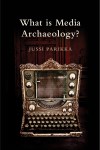
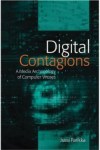
It’s out, and gradually in book stores — What is Media Archaeology? (Polity),
my new book about media archaeology (what a surprise)!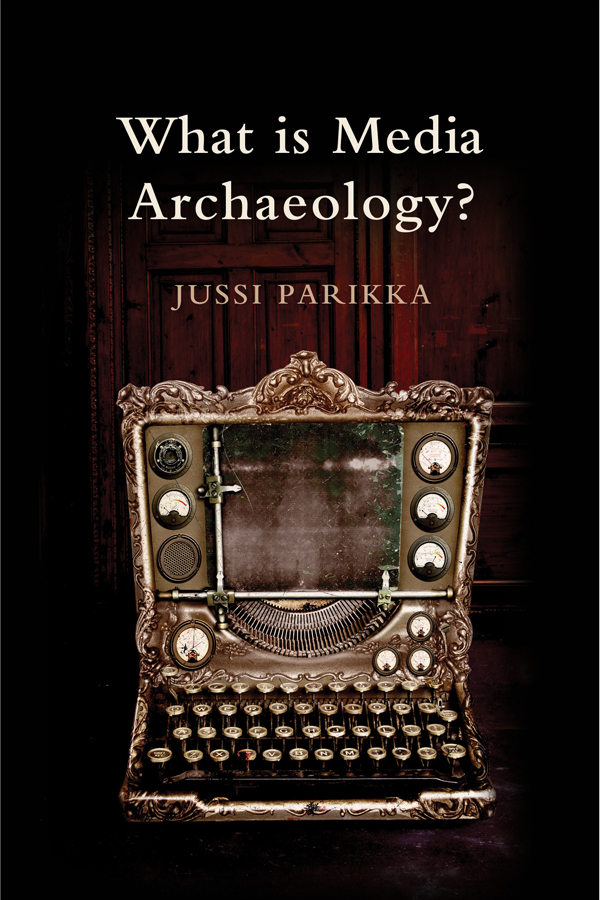
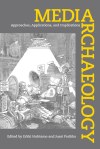
It picks up where the edited volume Media Archaeology: Approaches, Applications, and Implications (Huhtamo and Parikka) left off; this means the implications bit, and how media archaeology relates to other recent discussions in art, cultural and media theory: software studies, new materialism, archives, and more. In other words, it complements the earlier collection.
So in short,
1) What IS media archaeology?
– depends who you ask. If you ask Erkki Huhtamo or Siegfried Zielinski, you might get a different answer than from asking me. For Huhtamo, it is the recurring topoi/topics of media culture; for Zielinski, a poetic exploration of deep times and variantology; and so forth. For me, it is an exciting theoretical opening to think about material media cultures in a historical perspective. However, it expands into an experimental set of questioning about time, obsolescence, and alternative histories as well. In one way, it is about analyzing the conditions of existence of media cultural objects, processes and phenomena. It picks up on some strands of “German media theory”, but connects that to other debates in cultural theory too.I like what Bernhard Siegert has said about the early ethos of media archaeology being that of Nietzschean gay science — experimental, exploratory, radical. Perhaps in this vein, media archaeology is one answer to the need to think transdiscplinary questions of art, science, philosophy and technology.
2) Isn’t it just media history that tries to rebrand itself?
– No, not really. A lot of the media archaeological work expands to strong theoretical arguments as well as quite different sorts of historical inquiry than one recognizes in media historical work. Having said that, perhaps this is where the interesting connections are emerging; how media archaeology can contribute to media historical inquiry as well as to thinking about archives and cultural memory. There is one chapter on archives in this new book. A lot of media archaeology owes to earlier new cultural histories and new historicism, so the link is there.
3) Isn’t media archaeology only a footnote to Kittler’s work?
– That would be unfair towards a bunch of other theorists, German and non-German. Kittler himself denied being a media archaeologist, even if a lot of the stuff has taken much inspiration from him and the idea of looking at “conditions of existence” of cultural formations through (technical) media. Even Germany is filled with media archaeological work, since 1980s, and a lot of that expands to such new directions as Cultural Techniques (Siegert, Krajewski, Vissman, and others) as well as other media archaeologists — not least Wolfgang Ernst. In addition, the book offers an insight to other media archaeological theories, such as Huhtamo’s, Zielinski’s, new film history (Elsaesser et al) as well as the links to emerging media studies fields such as digital humanities (eg Kirschenbaum’s work).
4) Sounds like the book is all theory, huh?
There is more than just media theory — although I admit, that because of the nature of the book, was not able to work too much of new empirical material there. However, one key thing that pops up in the book is the use of media archaeology as an artistic method. There is a whole chapter dedicated to that. I think one of the most exciting directions is to see how these methodologies can be used in design, arts and other fields of creative practice that anyway are interested in themes of obsolescence, media and technological affordance, the environment and ecology, remix and for instance hardware (even analogue!).
5) What next?
– No more media archaeology for me. Well, I have jokingly promised that I won’t use the term anymore, even if I am interested in seeing where this term might take us. I will come up with a disguise, a theoretical disguise.
6) your chance to ask me a question!
– and I will answer, if I can.
Meanwhile, here is the info about the book:
(From the Publisher’s catalogue and website):
This cutting-edge text offers an introduction to the emerging field of media archaeology and analyses the innovative theoretical and artistic methodology used to excavate current media through its past.
Written with a steampunk attitude, What is Media Archaeology? examines the theoretical challenges of studying digital culture and memory and opens up the sedimented layers of contemporary media culture. The author contextualizes media archaeology in relation to other key media studies debates including software studies, German media theory, imaginary media research, new materialism and digital humanities.
What is Media Archaeology? advances an innovative theoretical position while also presenting an engaging and accessible overview for students of media, film and cultural studies. It will be essential reading for anyone interested in the interdisciplinary ties between art, technology and media.
And the blurbs:
‘Jussi Parikka offers a lucid, concise, and highly readable account of a new and exciting field – media archaeology. He demonstrates that contemporary media forms are rooted to the past by multiple threads – untangling them helps us understand the media frenzy that currently surrounds us.’
Erkki Huhtamo, University of California Los Angeles
‘A fabulous map of media archaeology that, as its subject compels, produces its territory anew.’
Matthew Fuller, Goldsmiths
‘The most comprehensive coverage to date of this fascinating area of study. Parikka’s book offers an excellent overview of connections between the material and social aspects of media technology. He provides a thorough review of the diverse and sometimes contrasting theoretical foundations and provides a host of concrete examples of media-archaeological practice that serve to bridge the gap between heady theoretical trajectories and the concerns of practicing artists, users and other readers who take their technology seriously.’
Paul DeMarinis, Stanford University
Table of Contents
Chapter 1
Introduction: Cartographies of the Old and the New
Chapter 2
Media Archaeology of the Senses: Audiovisual, Affective, Algorithmic
Chapter 3
Imaginary Media: Mapping Weird Objects
Chapter 4
Media Theory and New Materialism
Chapter 5
Mapping Noise and Accidents
Chapter 6
Archive Dynamics: Software Culture and Digital Heritage
Chapter 7
Practicing Media Archaeology: Creative Methodologies for Remediation
Conclusions: Media Archaeology in Digital Culture
Note: the book is hitting the bookstores now in the UK (May), and soon in North-America (June) and rest of the world.
Cultural Techniques of Things that Matter
One of the luxuries of being academic is that you should contradict yourself – on purpose and on a regular basis. Actually, when refined to its best, this can be an art of argumentation (and arguing) as in the wonderful public self-critique by Søren Kierkegaard. Writing under many aliases, he was his own fiercest critic. This might not be a contradiction, but let’s say a minor defense of something I have critiqued before.
As for me, promoting “primacy of non-humans” and being enthusiastic about “new materialism”, I find myself with this odd feeling that I have felt the need to defend “texts” and “discourse” as I have recently started to (well, kinda). Usually rather more being interested in post-representational thought (Thrift 2007) and indeed new materialism (Braidotti, Massumi, Delanda, Grosz, Barad, and many others) it has been for me much more interesting to think what takes materially place, how and when, than what things mean, signify, represent. Besides the enthusiasm for representations that took a central place in cultural studies vocabulary since the 1980s, or even with the performative that happens inside discourse, I did enjoy the idea that bodies have a materiality that is irreducible to such dimensions.
Now this brand of recent aberration from signification goes often under the name of anti-correlationism, and critique of such a modern framework of thought, indeed, which grabbed even a lot of post-structuralism. Quentin Meillaissoux’s texts, and especially mediation of such ideas in speculative realism or object-oriented-ontology, is of course central, even if I would claim his arguments are not completely unique.
A lot of this discourse (!) is well captured at the beginning of The Speculative Turn: Continental Materialism and Realism:
[In] ‘The Speculative Turn’, one can detect the hints of something new. By contrast with the repetitive continental focus on texts, discourses, social practices, and human finitude, the new breed of thinkers is turning once more towards reality itself. While it is difficult to find explicit positions common to all the thinkers… all have certainly rejected the traditional focus on textual critique… all of them, in one way or another, have begun speculating once more about the nature of reality independently of thought and of humans more generally (Bryant, Srnicek and Harman 2011: 3).
I am not disagreeing, of course, as this path articulated by Delanda, and what I wrote about in 2006 (Parikka & Tiainen 2006) with similar arguments (more in the context of cultural studies though, than philosophy) is what I still find necessary as a way to specify what we mean by critique. (One should at this point nod towards Latour 2004 for instance).
What I am however interested in adding is to point to the longer disciplinary histories of alternative, material takes on textuality and discourse (or let’s say, variations of such post-structuralist themes) as well as the theme of cultural techniques. Besides various cultural histories of reading and related practices (my own background training was in cultural history), one finds lots of strong theoretical takes on such matters.
Indeed, to think of something close to my own turf, German media theory has been for a longer time, since 1980s, been successful in turning for instance Lacan, Foucault and Derrida into historically contextualised and materialised sets of theoretical affordances. Their post-structural notions, at times indeed very textually oriented (and yes, it did always rub me the wrong way) are de-territorialized so as to become more suitable to understand the variety of material modalities of expression. For Kittler, it was a matter of taking Foucault but showing there are other things in the world besides books and textual archives; the world of machines, circuits, and computers.
Indeed, take Markus Krajewski’s (2011: 34) recent memoir of Kittler’s class from early 1990s:
“Kittler, […]pointed out what was required to attend and complete the class successfully: the minimum precondition for this course was the ability to handle the Linux free c compiler ‘gcc’ with all flags and options on the command line. Silence in the room. For those who were willingto learn directly how to handle the beast he would briefly give an introduction to this art. He, then, went to the chalk board and – with verve – wrote one line:
gcc -ansi -pedantic -Wall -Wextra -Werror -o myprog file1.c file2.c –lm”
Much more than textual critique, Kittler’s methodology in teaching and research related to understanding the materialities of the computer on various levels – from software (he wrote in low-level Assembler himself) to hardware (having built his own synthesizer in the 1970s).
For such as Bernhard Siegert, a lot of the discourse of Foucault but also for instance Derrida is taken only as a starting point to analyses that take more interest in materialities such as paper, or bibliographic and typographic details – like the point/full stop (Punkt). His Passage des Digital is such a rich body of work that spans different notation systems, materialities, elements (not least water!!) into a historically continuously specified argument.
A lot of such approaches go under the name of cultural techniques – an approach to investigate textualities, but also other forms of knowledge and expression.
Histories of knowledge, science and media are understood not through texts as semiotics, but texts as part of complex spatial and temporal knowledge systems, cultural techniques completely material where things from the material characteristics of the inscription surface (what kind of paper used) to the wider spatial and temporal infrastructures matters. In Passage des Digitalen, this task comes out as:
1) instead of semiotics, let’s focus on cultural techniques of reading, writing, signs and counting
2) not ideal objects, signs are actually in the world as res extensa; symbols are always machinated
3) Sign practices are specified to certain institutional spaces, of which for Siegert interest are the office, the ship, the atelier, the laboratory, the academia, etc. (this threefold definition loosely translated/paraphrased from Siegert 2003: 14)
In short, discourse is mobilized as material. Another simple, often quoted definition of cultural techniques goes like this:
“Cultural techniques—such as writing, reading, painting, counting, making music—are always older than the concepts that are generated from them. People wrote long before they conceptualized writing or alphabets; millennia passed before pictures and statues gave rise to the concept of the image; and still today, people sing or make music without knowing anything about tones or musical notation systems. Counting, too, is older than the notion of numbers. To be sure, most cultures counted or performed certain mathematical operations, but they did not necessarily derive from this a concept of number.” (Macho 2003: 179)
What this approach is useful for is indeed how far we can go with it. It does not make such strong claims of ontology as in some more recent philosophical debates, but tries methodologically to mobilize approaches that take into materiality. What this does is a more historically embedded understanding that we do things, and that things do us (?).
Besides the German heritage of materialist media theory, we can look at work that takes inspiration from science and technology studies as much as media studies. Jonathan Sterne is a perfect example here, of a mix of various traditions to highlight the complexity of such objects as Mp3 – part of cultural techniques non-reducible to the technological details, where however the latter afford specific bodily practices too. In other words, it’s not only about the human:
“Mp3 technology also has an interesting relationship with other bodily technologies of communication. The mp3 works automatically on the body. Mp3 listening might involve ‘practical knowledge’ (Bourdieu, 1990), where the body goes through routines that do not enter the conscious mind. Certainly, mp3 listening requires a whole set of bodily techniques, dispositions and attitudes. But the mp3 goes even further than this. The encoded mathematical table inside the mp3 that represents psychoacoustic response suggests less a ‘technique of the body’ as these authors would have it, than a concordance of signals among computers, electrical components and auditory nerves.” (Sterne 2006: 837)
Such objects as Mp3 are stretched across a variety of materialities, from bodily techniques to mathematics at the core of it as a technological artifact – a connection obviously to Meillassoux’s mathematical ontology. A weird object indeed (btw. Keep your eyes open to Sterne’s MP3 book coming out I believe soon).
Now it would be easy to counter that by saying that such approaches do not really tap into the reality of the objects – the non-human nature of objects outside the correlationist relation, and having an autonomy non-reducible to relations or practices.. Yet, this is where for me the notion of materiality is more useful than that of reality. As Grosz has pointed out, talk of realism – even non-human – is still tied to positions of epistemology, not ontology; she prefers to call herself a materialist even if soon using the term “real” to refer to dynamics of production: “I am much more interested in the dynamic force of the real itself and how the real enables representation and what of the real is captured by representation.” (Grosz in Kontturi & Tiainen 2007, 247) In any case, if we approach things through materiality, we might be closer to the dynamics of production of realities (sic), of relevance to issues historically significant from political, mediatic and economic points of view. Indeed, such an approach maintains closer ties with the longer traditions of historical materialism (thanks to Alex Galloway for the heads up on this, and his insightful articulation in another context on similar issues), and flags the difference between realism and materialism – and perhaps is able to take further some of the limitations of earlier traditions.
References:
Bryant, L., Srnicek, N., and Harman, G. (2011) The Speculative Turn: Continental Materialism and Realism, Melbourne: Re:Press.
Kontturi, Katve-Kaisa & Tiainen, Milla (2007) “Feminism, Art, Deleuze and Darwin: An Interview with Elizabeth Grosz” Nora—Nordic Journal of Women’s Studies, Vol. 15, No. 4, 246–256, November 2007.
Krajewski, Markus (2011) “On Kittler applied: A technical memoir of a specific configuration in the 1990s” Thesis Eleven 2011, 107: 33.
Latour, Bruno (2004) Why Has Critique Run Out of Steam? Critical Inquiry Volume: 30, Issue: 2: 225-248
Macho, Thomas (2003) “Zeit und Zahl: Kalender- und Zeitrechnung als Kulturtechniken,” in Bild-Schrift-Zahl, ed. Sybille Krämer and Horst Bredekamp (Munich: Wilhelm Fink Verlag, 2003), 179. (The passage translated by Geoffrey Winthrop-Young).
Parikka, Jussi & Tiainen, Milla (2006) “Kohti materiaalisen ja uuden kulttuurianalyysia, eli representaation hyödystä ja haitasta elämälle.” Kulttuurintutkimus 2/2006)
Siegert, Bernhard (2003) Passage des Digitalen. Zeichenpraktiken der neuzeitlichen Wissenschaften 1500-1900 (Berlin: Brinkmann & Bose)
Sterne, Jonathan (2006) “The MP3 as a Cultural Artefact” New Media & Society, Vol8(5):825–842.
Thrift, Nigel (2007) Post-Representational Theory (London and New York: Routledge)
Friedrich Kittler (1943-2011)
Writing anything after hearing about the death of Friedrich Kittler (1943-2011) is not really easy, even if it surely will boost the academic publishing industry into a range of publications. Somewhere I read him characterized as the “Derrida of media theory” and where the writer (probably Winthrop-Young or Peters) added that of course, Kittler would like to be called “Foucault of media theory”. But then again,
I think he would have liked to be thought of as, well, I guess “Any-Band-Member-of-Pink-Floyd – of Media Theory”.
Quite emblematically, as happened with the translation and cultural import of French theory to English speaking academia, things got mixed. German media theory became a general term that mostly hide a lot of differences between writers. Same thing had happened with French Theory when it arrived in the US. In media theory, Kittler became however the leading figure, due to the two translations: in 1990, Aufschreibesystem got its English form as Discourse Networks, and in 1999 Gramophone Film Typewriter came out. Meanwhile, his essays started to pour into English language. On computers, literature, psychoanalysis, music and sound, and optical media – the classes he gave in 1999, translated into English later as Optical Media (2010). He wrote a lot, and his amazing expertise from literature to physics and engineering produced something eclectic – a weird world of Pynchon and voltages, of Goethe and dead voices of phonographic recordings, a mix of sex, Rock’n’Roll and philosophy. Pink Floyd was as important to him as Foucault (see the wonderful little book by Winthrop-Young), and he never really believed in Cultural Studies.
We had the honour of hosting his last talk at Sophienstrasse, and probably his last public talk ever. The Medientheater was jam packed, primarily because of Kittler, talking at the last event of the Sophienstrasse 22 address. Even then he continued along the same line of thought: critique of the standardization of university worlds. He was an adamant defender of the old(er) ideas of university, before the subsuming of the education system to short-term market terms, the creative industries, the psychobabble that is unscientific and leads to a deterioration of intellectual goals. Despite being a fan of “Old Europe”, he was against the BA-MA structure reforms (the Bologna process) that offered standards for degrees across Europe. Similarly as he was offering meticulous analysis of the work of standards in computing, he did so in terms of education system, which, as we know, is just another program. It programs us, into suitable subjects – from Goethe-zeit, to the neoliberal programming of little entrepreneurs.
For such universities, Heidegger, Deleuze, Whitehead, Kittler might be seen at times too difficult, which means that we should push them more. The legacy of Kittler has been debated already during his lifetime, with Winthrop-Young in Kittler and the Media nicely remarking: “Is there a ‘Kittler School’? Yes, but it is not worth talking about. As in the case of Heidegger, clones can be dismissed, for those who choose to think and write like Kittler are condemned to forever repeat him.” Instead, continues Winthrop-Young, we need to be aware of the Kittler-effect and the impact he had to so many discussions. For me, personally, this happened through the combination of Kittler and Deleuze; reading groups in the late 1990s in Turku (largely because of a couple of people at the University: professor Jukka Sihvonen, and my friend, colleague Pasi Väliaho, along with our Deleuze-reading group together with Teemu Taira). That provided another road already, one that Kittler never really took, and which lead to thinking technics and Deleuze-Guattarian philosophy in parallel lines. Kittler might have hated that, but that is the point; keeping his legacy alive means new ideas and combinations. What I would like to sustain from his fresh, radical, anarchist ideas are the eclectic method of crisscrossing ontological regimes across science and arts; his keen historical (some would say “archaeological”) focus even if not always correct in details; his materiality, and no-nonsense attitude to theories and analysis of for instance digital media. That is much more than most of the current writing can still offer. Of course, there is so much that I refuse to take aboard, but that should be part of any intellectual reading and adaptation.
People often remember his older writings – and the idea of discourse networks, then developed into media theory. Yet, the past years he was occupied with the Greeks and what remained mostly an unfinished project: Music and Mathematics. He never reached the final book of the series on Turing-zeit, unless somewhere in his study there is a manuscript waiting to be found. Fragments for sure.
The amount of inspiring ideas he was able to pack even to a one sentence – where you were not always sure what it even meant, but you got the affective power of it. One of my favourites was the quote from Pynchon with which he started his Gramophone Film Typewriter: “Tap my head and mike my brain, Stick that needle in my vein”.
In a way, Kittler wrote media theory with Heidegger, but also with Pynchon. Gravity’s Rainbow is one key to his early writings, when you realize the style, but also the ontology behind it. Subjectivities wired to technologies, and high physics being the language “behind” the everyday appearance and seeming randomness that is just an effect of the complexity of science and engineering. The V-2 is one reference point for modern technology in general. It has a special relation to human sensorium:
“As the pendulum was pushed off center by the acceleration of launch, current would flow—the more acceleration, the more flow. So the Rocket, on its own side of the flight, sensed acceleration first. Men, tracking it, sensed position or distance first. To get to distance from acceleration, the Rocket had to integrate twice—needed a moving coil, transformers, electrolytic cell, bridge of diodes, one tetrode (an extra grid to screen away capacitive coupling inside the tube), an elaborate dance of design precautions to get to what human eyes saw first of all—the distance along the flight path.”
In short, what Guattari summed up in short that “machines talk to machines before talking to humans”, for Kittler is an elaborate work of physics and engineering, even before we see what hit us. And hear it afterwards.
Pynchon, and Gravity’s Rainbow, tie of course to Kittler’s other passion where the rocket technology took us after the war. The moon, Pink Floyd‘s moon to be specific. One is almost expecting to hear Kittler’s rusty voice whispering at the end, after the crackling LP almost finishes…”There is no dark side of the moon really…as a matter of fact, it’s all dark.”
Operative Media Archaeology
If interested in Friedrich Kittler, German media theory, and new approaches to archives, technical media and media archaeology – check out Wolfgang Ernst’s work. My article on his media archaeology is out now, in Theory, Culture & Society.
Having said that, Ernst is someone who is not – despite some misunderstandings in especially Anglo-American reception – a student of Kittler’s, and to make things even more complex, Kittler himself denounced being a media archaeologist. Despite such figures even in Germany as Bernhard Siegert referring to the 1980s and 1990s vibrant German media theory discussions as an age of media archaeology & Nietzschean Gay Science, Kittler himself recently took a bit distance from this particular term (even if, underlining how symphathetic he is to Ernst’s approach).
In any case, you can find the article here. I hope it to work as an introduction to Ernst’s work which is still not very well known in Anglo-American discussions. And more to come: next year or so, University of Minnesota Press is putting out a collection of Ernst writings (edited by me), which gives a deeper insight of why he might just be relevant not only as a “post-Kittler” theorist to spike up our theory discussions from that Berlin directions but also as someone who could bring an additional angle to thinking about archives and digital humanities.
Dirty Matter
I was asked to write a short forum piece on “new materialism” for Communication and Critical/Cultural Studies-journal and I wrote a piece called “New Materialism as Media Theory: Dirty Matter and Medianatures”. It partly picks up on some of the themes I have been recently talking and writing about, influenced by such scholars as Sean Cubitt. It also articulated – albeit briefly – some points concerning German media theory as new materialism, even if going the quickly to a different direction concerning materiality. Here is a short taster of what’s to come.
The key points of the text were in short: 1) we need to understand how media technologies themselves already incorporate and suggest “new materialism” of non-solids, non-objects and this is part of technical modernity (the age of Hertzian vibrations); 2) we need also to understand bad matter – not just the new materialism that is empowering, but one that is depowering: the matter that is toxic, leaking from abandoned electronic media, attaching to internal organs, skins of low paid workers in developing countries. In this context, “medianatures” is the term I use to theoretically track the continuums from matter to media, and from media back to (waste) matter.
I believe that it is this continuum that is crucial in terms of a developed material understanding of media cultures. Hence, it’s a shame from a new materialist point of view that even such pioneering thinkers as Michel Serres miss this point concerning the weird materialities of contemporary technological culture – weird in the sense that they remain irreducible to either their “hard” contexts and pollution (CO2, toxic materials, minerals, and other component parts) or their “soft” bits – signs, meanings, attractions, desires. In Malfeasance. Appropriation Through Pollution? Trans. Anne-Marie Feenberg-Dibon (Stanford: Stanford University Press 2011), these are the two levels Serres proposes as crucial from an environmental point of view but he ignores the continuum between the two. And yet, signs are transmitted as signals, through cables, in hardware, in a mesh of various components from heavy metals to PVC coatings.
Perhaps a good alternative perspective to Serres’ is found in how both Félix Guattari and Gilles Deleuze conceive of a-signification as a regime of signs beyond signification and meaning: Gary Genosko’s apt example (in: Félix Guattari. A Critical Introduction London: Pluto 2009, 95-99 ) is the case of magnetic stripes on for instance your bank card as a form of automatized and operationalized local power that is not about interpretation, but a different set of signal work. Elaborating signaletic material – electronic signals and software – through a reference to Deleuze’s film theory and a-signification by Bodil Marie Stavning Thomsen is also useful. As she elaborates – and this much we know from years of intensive reading of Deleuze in screen based analyses – Deleuze wanted to include much more than signification into the cinematic impact, and mapped a whole field of a-signifying matter in film: “sensory (visual and sound), kinetic, intensive, affective, rhythmic, tonal, and even verbal (oral and written).” (“The Haptic Interface. On Signal Transmissions and Events” in Interface Criticism. Aesthetics Beyond Buttons, edited by Christian Ulrik Andersen and Søren Bro Pold, Aarhus University Press 2011, 59) What she points out in terms of signal media is as important: after signs come signals, and the media of signals needs a similar move as Deleuze did with film: to carve out the a-signifying material components for digital media too.
Such a-signifying components are rarely content to stay on one level, despite a lot of theory often placing primacy to software, hardware, or some other level. Various levels feed into each other; this relates to what Guattari calls mixed semiotics, and we can here employ the idea of a medianature-continuum. The a-signifying level of signs is embedded in the a-signifying materiality of processes and components.
In short, it’s continuums all the way down (and up again), soft to hard, hardware to signs. In software studies (see: David M. Berry, The Philosophy of Software. Code and Mediation in the Digital Age, Palgrave Macmillan 2011, 95-96), the continuum from the symbol functions on higher levels of coding practices to voltage differences as a “lower hardware level” has been recognized: assembly language needs to be compiled, binary is what the computer “reads”, and yet such binaries take effect only through transistors; and if we really want to be hardcore, we just insist that in the end, it comes back to voltage differences (Kittler’s famous “There is no Software”-text and argument). Such is the methodology of “descent” that Foucault introduced as genealogy, but German media theory takes as a call to open up the machine physically and methodologically to its physics – and which leads into a range of artistic methodologies too, from computer forensics to data carvery. In other words, recognizing the way abstraction works in technical media from voltages and components to the more symbolic levels allows us to track back, as well, from the world of meanings and symbols – but also a-signification – to level of dirty matter.
The Physicist of Media Theory – Friedrich Kittler’s Optical Media
Oops. I should have done this a long time ago, but better late than never. Anyhow, it took several years anyway before it came out in English – Friedrich Kittler’s Optical Media (Polity Press 2010, orig. 2002) – so a little delay in writing about the translation does not hurt.
It would be tempting to emphasize the radical alterity of the “Kittler-effect” (as named by Winthrop-Young) in relation to the more standardized and domestic Anglo-American discourses in media and cultural studies. Even the word “studies” is an abomination for Kittler, who is of the German tradition where “sciences” is still the word for humanities too. For Kittler, this is to be taken to its hard core: sciences stand at the centre of arts and humanities in the age of technical media, and a failure to take this into account would be like a bratwurst without sauerkraut. Nice, but not really the real thing.
This is one of the crucial points that a “German perspective” to media studies has promoted: media are not only the mass media of television, newspapers and such, but a technical constellation that at its core is based on scientific principles of coding, channeling and decoding of signals. When Kittler says the lectures (Optical Media is based on a lecture series he gave at Humboldt University, Sophienstrasse, Berlin, in 1999) are an investigation into man-made images, we should remember his earlier predisposition and tendency to talk of the “so-called-man. Kittler is after all a sort of a Foucault of the technical age (as also John Durham Peters in the foreword notes, instead of the usual label of Kittler as the Derrida of the digital age). Man is a temporary solution, a crossroad in the complex practices and epistemologies of knowledge that might (has?) proved to be not so useful anymore when media can communicated to each other without human intervention. Ask your plugged-in Ethernet cable, it knows the amount of data that goes through it without you pushing even a single key (as Wendy Chun reminds us in her Control and Freedom).
Kittler’s hostility towards any human-centred history of invention is well summed up for instance in this quote:
“And when Liesegang edited his Contributions to the Problem of Electrical Television in 1899, thus naming the medium, the principle had already been converted into a basic circuit. Television was and is not a desire of so-called humans, but rather it is largely a civilian byproduct of military electronics. That much should be clear.” (208)
That much should be clear, right? And Kittler is a techno-determinist, right? Well, as Winthrop-Young has in his wonderful little intro Kittler and the Media articulated, this judgment seems to be worse than claiming that someone enjoys strangling cute puppies, and hence needs no more than the accusation – whereas exactly this point needs elaboration. I am not promising to do that in this review, but just a quick point. One thing that we need to remember is that for Kittler, media are about science and engineering, and some of the confusions relate to how people are trying to read and apply him out of those contexts. Calling someone techno-determinist when he has continuously underlined that this is what he does – investigates the engineering aspects of media – is, well, redundant. Naturally this does not solve the whole question, but at least points to something we need to keep in our minds when reading Kittler.
His media theory is not about the media as interpreted, consumed and produced by creative industries, digital humanists, or such, but about the long genealogies of science, engineering and the qualities of matter that allow the event of media to take place. Media is displaced from McLuhanite considerations to “where it is most at home: the field of physics in general and telecommunications in particular.” Kittler is the physicist of media theory.
Optical Media is in that sense reader-friendly (if Kittler ever is) that it takes as its clear methodological point of departure Shannon’s communication theory. Slightly anachronistically Kittler transposes this as a model to understand media history. How coding, channeling and decoding takes places in material channels that are surrounded by noise.
Kittler’s Optical Media has several problematic statements, exaggerations and mistakes too – some of which the translator Anthony Enns has picked up on and made corrective notes. In other ways too, the translation is excellent, and presents us with a Kittler that is smooth to read. Translating Kittler is not easy, and much gets lost in translation but Enns is excellently equipped to present us media theory that is vibrant and readable.
It will be interesting to see how Kittler’s impact will be continued. Despite the rhetorical distanciation from US and UK that one encounters in this Sophienstrasse brand of media theory – which is wary of the Bologna Process of education standardisation in Europe threatening academic freedom, of Anglo-American monetarized neoliberal discourses of knowledge, and the general forgetting of old Europe and its philosophical traditions – recent years of English speaking media studies picked up at least indirectly from material media theory. Such ways of making sense of technical media are visible in software studies, platform studies, digital forensics à la Matthew Kirschenbaum and other recent, exciting theory debates. Kittler is being read. We don’t need a Kittler-jugend as Winthrop-Young has pointed out, but Kittler-effect is hard to escape; the big question is how to take that forward to as innovative directions as Kittler produced.
What is interesting is that the lack of German language in Anglo-American circles has produced a situation where most scholars are reliant on translations (I am glad to see Polity Press putting out Kittler-related literature). Hence, a lot have also missed the “turn” Kittler has taken during the past 10 years from war to love. The writer of post-humna media theory talks about love, sex and Antique Greece in his magnum opus project that could be summed as the attempt to place Jimi Hendrix (Electric Ladyland, And the Gods Made Love) in the age of Homer. The other Homer than a representation analysis of Simpsons’ Homer.
Notes:
1) Disclosure statement: My own new book is also contracted with Polity Press – Media Archaeology and Digital Culture (2012)
2) Friedrich Kittler’s last talk at the Sophienstrasse 22 address, Berlin. The Institutes are moving premises during summer 2011.
So22
Media theory has a place – and last night it was very much about Sophienstrasse 22, Berlin. Friedrich Kittler was running his institute there, and developed it over years into a classic Berlin location, that was also internationally known not only as the place of Berlin media theory (material, historical, technically specific, and weird) but more specifically as Sophienstrasse 22. This is not to say it’s the only place, and dissemination has worked – in Germany, and internationally.
Yesterday was the final academic event at Sophienstrasse, and our cadre of speakers was spectacular: Ernst, Pias, Hagen, and of course, with his red wine, his cigarettes, his Greek – Kittler. After that, our book presentation on Media Archaeology with some of the same speakers as well as Anthony Enns – a Kittler translator.

Wolfgang Ernst
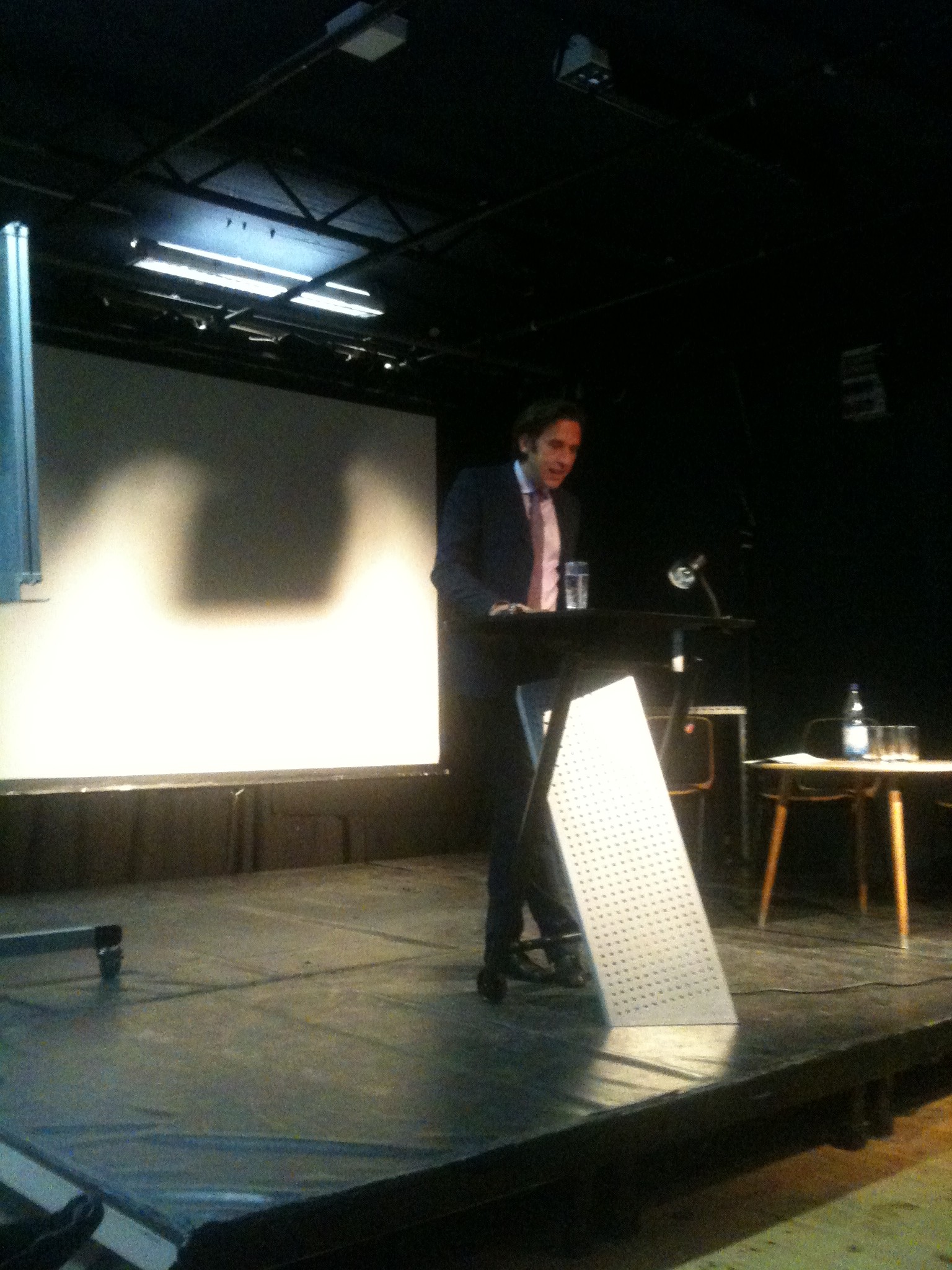
Claus Pias
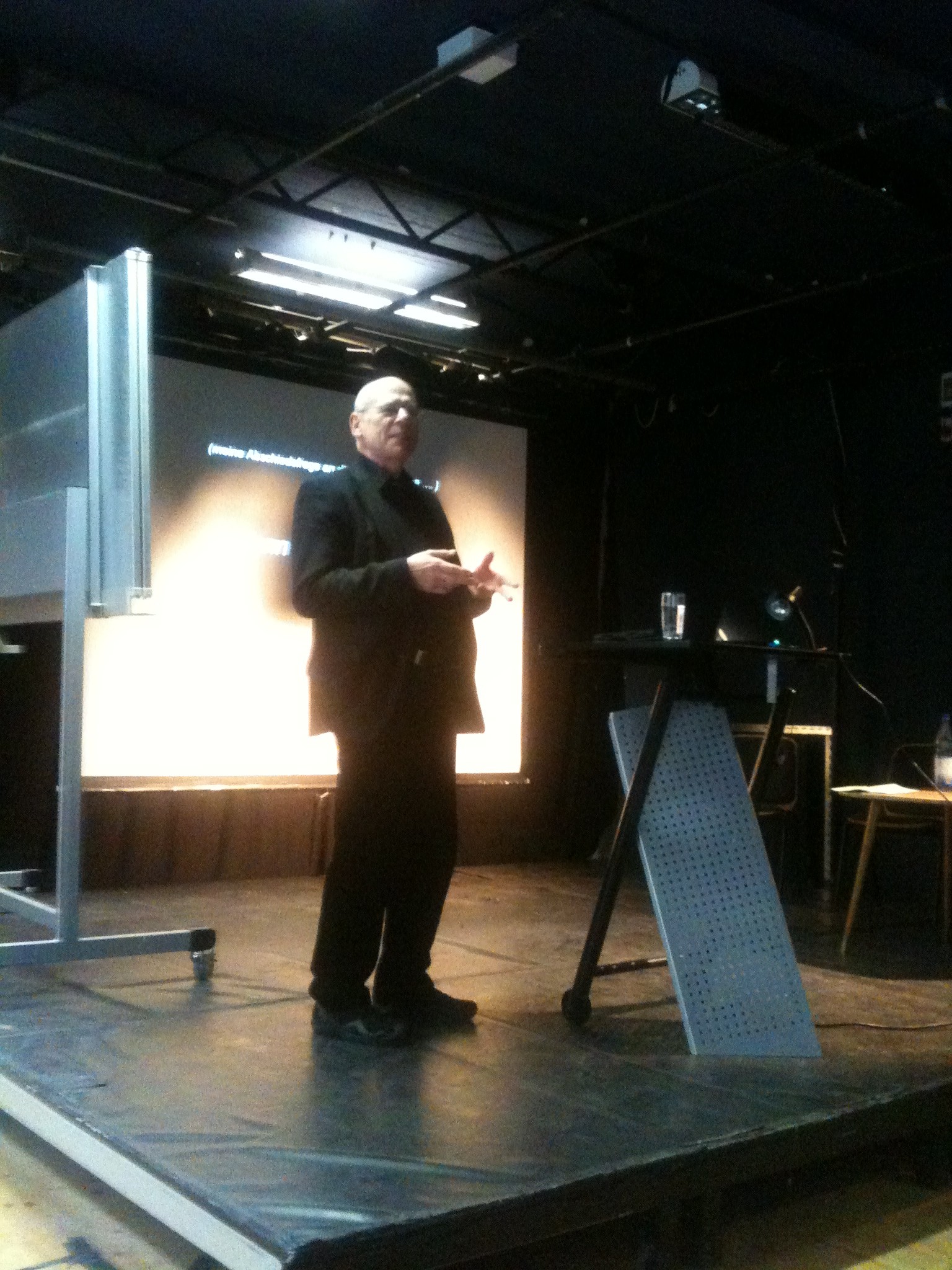
Wolfgang Hagen

Friedrich Kittler and the red wine.








 Machinology