Archive
What Capitalism Does to Cities
Capitalism is good in incentivising corporations and money to leave cities and leave them to rot: moving where labour and other costs are cheaper is made easier by various measures that enable this inhale, exhale. Money moves swifly, breathes, but also inhales vacuuming air out of towns and cities. I know that from a personal experience, having grown up next to paper factories in Southern Finland: now places are abandoned, towns shrinking and trying to invent new business models to sustain jobs and life there.
Capitalism however destroys cities also by staying there: breathing “life” into cities is often a process of destruction of other sorts. It pushes the limits of endurance of ecology, animals and humans.
This example is about Istanbul, describing the booming construction industry of the city that is still imagined as one of the major economic centres of the future: “the damage now being done to Istanbul rivals the damage done to Constantinople by the Fourth Crusade. The so-called Latin invaders of 1202 looted Byzantium in the name of religion; today the city is being pillaged in the name of progress and profit.”
Read the full piece “Destroying Istanbul” by Andrew Finkel here.
Saved As: Today’s Media, Tomorrow’s Archive
Our co-organised event at SALT Galata in Istanbul gathered quite a good crowd of people interested in politics and software practices of archives. Together with Burak Arikan, and support from SALT and Winchester School of Art, we were able to get together great insights from academic, curatorial, and software art practice angles on how to think about cultural memory in the technological age. Our initial plan was to focus more on software art and archival question but in the light of past month or so, we wanted to make sure some sort of a connection to Gezi park, Istanbul and Turkey becomes visible. The talks are being uploaded online as video – below mine for those interested. It focused on questions of circulation, media practices, memory and archives in the techno-political context and asked the question of why might a future archivist suddenly find not only cute cat pictures circulating in the internet spaces of June 2013, but also so many penguins. I wanted to reflect on questions of memory and media practices through various examples of the creative visual culture surrounding the past events in Istanbul and Turkey.
We also gathered some follow-up interest. For instance the Today’s Zaman-newspaper interviewed me about the event: “is today’s media tomorrow’s archive?”
Here is Ebru Yetiskin’s article after the event: “Farklı Kaydet: Yeni Medya, Toplumsal Bellekler ve Başka Gelecekler” (in Turkish).
Save as: Social Memory
 An event in Istanbul – welcome!
Save as: Social Memory
Convened by Burak Arıkan and Jussi Parikka, and in collaboration with SALT and support of Winchester School of Art.
June 26-27, 2013 19:00
SALT Galata Atelier IV, Istanbul
Participants: Burak Arıkan, Joasia Krysia, Nicolas Malevé, Ali Miharbi, Jussi Parikka
One of the major concerns during the Gezi resistance was how to keep our memories, our pain and grief, our anger, our gains, and our losses alive. We tried to preserve our experiences and present them in numerous media. However, we haven’t had the time and means to critically approach to the rapidly growing archives or to create technologically enhanced curated content.
This symposium brings together three artists, a curator, and an academic who works in the area of software art, archive, and media archaeology. Cultural practices that use the language of technology and digital born content from different perspectives of preservation and memory will be debated. How can we preserve the software itself along with the content it generates? In what way should we consider software itself as the creative archive, arche, of our digital culture? What new archival practices does technology-based art and culture present? How do software, social media, and network practices introduce a sphere of counter-representation which curate alternative narratives of the present? Panelists will discuss the topics of archiving the present as we live, algorithmic curating in crisis, critical collective intelligence, and language of technology as a thinking tool.
Programme schedule:
Wednesday June 26th
19:00 Introduction
19:15 Jussi Parikka – Media Archaeology: Archives of the Present
20:00 Nicolas Malevé – Sniff and sneak through my archives
20:45 Ali Miharbi – Language of technology as a thinking tool
Thursday June 27th
19:00 Joasia Krysia – Speculations on Algorithmic Curating
19:45 Burak Arıkan – Counter Collective Intelligence
20:30 Round Table
Abstracts and bios of speakers:
Jussi Parikka – Media Archaeology: Archives of the Present
Media Archaeology has emerged the past years as a dynamic theory about media culture. This refers to the impact it has had in giving a vocabulary for the material constitution of contemporary technical media culture. Media archaeology examines media technical conditions of existence of culture, and as such, is in a good position to frame the relevance of software for questions of the archive.
However, media archaeology is also a way to investigate the ontology of the present: it asks what sorts of mechanisms of inclusion and exclusion constitute what we perceive, and what remains unperceived? How is the network conditioning our sense of knowledge and our sense of the everyday? How will the speculative future archivist, looking back at June 2013, see and understand our events and networked condition, conditioned by software as well as its political context.
Jussi Parikka Bio
Dr Jussi Parikka is a media theorist who writes on media archaeology, digital culture and obscure topics from insects to viruses. He is Reader in Media & Design at Winchester School of Art, University of Southampton and author of various books, essays and other writings. His monographs include the award-winning Insect Media: An Archaeology of Insects and Technology, as well as the recent What is Media Archaeology? He blogs at http://jussiparikka.net
Nicolas Malevé – Sniff and sneak through my archives
‘(6/24/1996 9:44pm, Personal)”
Will she (either of them) share the love of pornography? Or at least, art? I shall present myself to both of them as a geniality self-flagellat%n machine. Just one bottle tonight, ok? I shall invite them on to my journey of change, showing the way ahead. Immortality. I will let them to sniff and sneak through my archives. (Erkki Kurenniemi, Newton diary, 1996).
The presentation will take as a point of departure the rich set of documents collected and created by Erkki Kurenniemi, Finnish pioneering electro acoustic musician and inventor of early synthesizers, who obsessively recorded his life. The talk will introduce to the different tools and methods we, Michael Murtaugh and Nicolas Malevé, members of the Belgian collective Constant, used to enter in dialog with the vast amount of unclassified documents that constitute the humus for an archive of Kurenniemi’s work.
These tools are our intermediaries, our extra senses to “read” the images, to “listen” to the sounds, to “watch” the videos. The algorithms we borrow, design or customize become our interlocutors. They report back from what they detect, correlate and connect in the different layers of data. They are different voices, each telling a its own story. Having presented these different voices, we will see what happens when other human agents (lawyers, archive institutions) join the dialogue between these intermediaries and ourselves.
Nicolas Malevé Bio
Since 1998 Nicolas Malevé, multimedia artist, has been an active member of the association Constant. As such, he has taken part in organizing various activities to do with alternatives to copyrights, such as Copy.cult & The Original Si(g)n, held in 2000. He has been developing multimedia projects and web applications for cultural organisations. His research work is currently focused on information structures, metadata and the semantic web and the means to visually represent them.
Ali Miharbi – Language of technology as a thinking tool
In this presentation I will sketch the potential of the language of technology as a tool to open up, enrich or simply illustrate our current discussions on social/political issues. Using examples of my work as points of departure I will touch on a variety of concepts like performativity, humor and the problem of representation.
Ali Miharbi Bio
Ali Miharbi (b. 1976) lives and works in Istanbul. He acquired a dual degree in Electrical & Computer Engineering (BS, 2000) and Art Theory & Practice – Painting (BA, 2000) at Northwestern University. In 2010 he completed his MFA from Virginia Commonwealth University. He opened his first solo exhibition at Interstate Projects, Brooklyn, NY. His recent group exhibitions include “Commons Tense”, Electriciteitsfabriek, The Hague (2012), “Turkish Art New and Superb”, TANAS, Berlin (2012), “Consequences are no coincidence”, Pilot Galeri, Istanbul (2012), “video_dumbo: Quasi Cinema”, Dumbo Arts Center, Brooklyn, New York (2011), “FILE 2011″, FIESP Cultural Center, São Paulo (2010), “When Ideas Become Crime”, Depo, Istanbul (2010). His work can take many forms from photographic, graphic or sculptural pieces to dynamic systems driven by live or stored data where he investigates mechanisms that underlie or are constituted by the flows of daily life.
Joasia Krysia – Speculations on Algorithmic Curating
Between the 1960s and 2005, Erkki Kurenniemi, the Finnish artist, scientist, futurologist and technology pioneer set out to document his everyday life with the intention to create a template for all human life that could be reenacted by algorithms to be written in a future quantum world (with the date 2048 in mind). In a wider sense Kurenniemi acted not only as an archivist of his life but also a kind of curator – working with materials not simply to collect and store but to shape using computational power once it is sufficient for purpose. In 2012 Constant Association for Art and Media began to develop some experiments, making programs to begin to understand Kurenniemi’s materials in ways that go beyond the traditional archiving procedures of ordering and classifying. I would like to argue that their approach is not simply archival either but curatorial in as much as they uncover aspects of what is not directly apparent in the material and produce meaning out of the work. This talk speculates further on this algorithmic approach and extend it to possibilities of thinking about the curatorial process in this way. I want to speculate on the use of algorithms in producing small curatorial experiments that begin to suggest new ways of understanding materials that are not directly apparent to human curators. Can we begin to think of curatorial processes and the production of curatorial knowledge that extends human agency and uncovers dynamic qualities of materials?
Joasia Krysia Bio
Joasia Krysa is Artistic Director of Kunsthal Aarhus (Denmark), and prior to this she was Associate Professor (Reader) in Art and Technology at Plymouth University, UK (2000 – 2012). She is co-founder of KURATOR, an association of curators and researchers interested in algorithmic culture, and was part of curatorial team for dOCUMENTA (13). She has a background in political sciences and cultural theory, and has PhD in the the field of curating. Her academic and curatorial work is located across contemporary art, digital culture, and critical theory.
She is series co-editor of the DATA browser books (New York), author of Ada Lovelace, notebook no 055 in the dOCUMENTA (13) series 100 Thoughts – 100 Notes (Hatje Cantz 2012) and the edited anthology Curating Immateriality (Autonomedia, 2006). She has contributed chapters to, amongst others, Software Studies: A Lexicon (MIT Press, 2008), and New Media in the White Cube and Beyond (University of California Press, 2008). Her current curatorial work include Systemic Series, a two year programme developed for Kunsthal Aarhus (2013-2014).
Burak Arıkan – Counter Collective Intelligence
Arıkan will pursue a traversal in his works, starting from MyPocket (2008) and raising questions on the preservation of immateriality; discussing Network Map of Foundations and Corporations in Turkey (2010) in relation to power and governence during the Gezi protests; narrating the collective network diagrams generated on the Graph Commons platform (2011-); and finally calling for action for a recent data research and mapping project, code named “Network of Dispossessions”, mapping of government-corporate partnerships in urban transformation.
Burak Arıkan Bio
Burak Arıkan is an artist working with complex networks. He takes the obvious social, economical, and political issues as input and runs through an abstract machinery, which generates network maps and algorithmic interfaces, results in performances, and procreates predictions to render inherent power relationships visible, thus discussable. Recent exhibitions include: Home Works 6 (2013), 11th Sharjah Biennial (2013), 7th Berlin Biennale (2012), and Nam June Paik Award Exhibition (2012). Arıkan is the founder of Graph Commons platform, dedicated to provide “network intelligence” for everyone.
Image: Network Map of Foundations and Corporations in Turkey-project by Burak Arikan.
Breathless
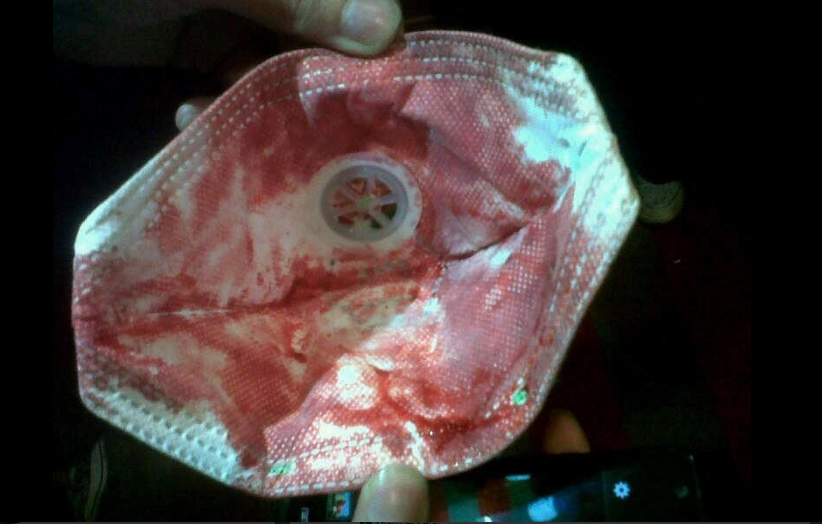
“My eyes were burning, and my nose running and my face was also burning”. These are ensations across the body, demonstrating the effectiveness of technologies of security. Your eyes and nose and mouth feel it. It burns across your body, an involuntary body panic from the fear of choking.

Gas is a rather peculiar weapon. It is atmospheric in the manner German philosopher Peter Sloterdijk talks about: it conditions the environment and breathing and as such invades one of the most intimate areas of our life: our lungs and sense of being alive. Naturally, this is not only a sense of being alive, but its very condition. Gas warfare is not only about biopolitical invasions but also the raw animal life being controlled: the zoe.
Gas is spatial and ephemeral at the same time. The wind can carry it across distances, although it is used as a very localized measure. It divides space in new ways: those able to breath with gas masks, and those suffocating, denied their participation in that space. You can control territories through a control of who is allowed to breath air in there. Tear gas, pepper gas, water cannons infused with chemicals: meticulous information on what the body can just about take. This information is always escorted by the possible deviations from the norm: for instance children’s lungs as well as elderly lungs.
Modern chemical attacks against humans date back to the first World War and the trench warfare. The Germans started using toxic clouds in April, 1915. As Sloterdijk notes, what makes this manner of suffering and even death more painful is how the suffocating is made to participate in his and her own condition: the body is made to turn against itself, gasping for breath, convulsions. The organic tissue becomes an archive of atrocities, a registering surface of the effects of modern science and technology employed in military and security regimes.
Of course you can shoot and aim with gas canisters, to ensure the good ol’ blunt hit. The effects of this hit can be rather horrific.
Considering gas, Sloterdijk speaks of “terror from the air”, and associates terrorism as a feature of modernity:
“It is crucial to identify terrorism as a child of modernity, insofar as its exact definition was forged only after the principle of attacking an organism’s , or a life form’s, environment and immune defences was shown in its perfect technical explication.”
There is a technological condition of this state of breathlessness and it has to do with the history of modern synthetic biology: the measurement of human capacities for breathing as well as the necessary measures for inhibiting the use of air for the organism.
And in Timothy C. Campbell’s words, referring to Sloterdijk, “terrorism is always ecologically directed”.
We need to turn meditations of air, soul and breathing into a bio- and zoepolitics of breathing and an analysis the systematic ecological and health abuses: from the minuscules particles of gas and dust, to how they constitute more abstract but as real security operations.
Sources:
Campbell, T. (2011) Improper Life. Technology and Biopolitcs from Heidegger to Agamben. University of Minnesota Press.
Sloterdijk, P. (2009) Terror from the Air. Semiotext(e).
Images via Twitter.
Istanbul: Becoming People
No smoke without fire, although with the tear gassed Istanbul, Ankara and numerous other cities, one should say: no smoke without tears.
While things are unfolding on the streets of Turkey, the international audience of the events are trying to figure out: what is going on. Who are the demonstrators? Hence, kicks in the usual suspects of repertoire of explanations: is this like Occupy Wall St.? Is this the Turkish version of Arab Spring? Are the demonstrators a vocal minority, and we are just misperceiving lots of social media traffic as a major event?
Perhaps the question itself should be differently posed. There are lots of great commentaries floating around, longer texts with already now some excellent contexts of the events. Some of it suggests in a rather good way that we need alternatives than just choosing one existing model of explanation.
Perhaps what is unfolding in front of the international community is what Turkish people already knew: a corrupted and authoritarian culture of politics and business where having firm relations with the ruling party AKP is a benefit for a variety of jobs and economic success for private sector companies (see here for some context); lack of transparency in political decisions that however affect the majority of the people, such as the building of the third bridge or for instance in this Istanbul case, the demolition of Gezi park. The sentiment of dissatisfaction was there already in a way that was not just about secular vs. Islamists.
What is already being voiced is that “This is not about secularists versus Islamists, it’s about pluralism versus authoritarianism,” (quoted in The Economist).
Besides internally about Turkey, the events reveal a lot about the logic of capital: it benefits from authoritarian state measures and tight security controls. As for the case of Turkey, things are supposed to be fine on the economic front.
Interestingly, The Economist writes:
“Like most people, Turks tend to vote with their pockets. A decade of AK rule has brought unprecedented prosperity. Per-capita income has trebled, exports have increased nearly tenfold and Turkish banks are in good health”
But the problem is how much of this growth is exactly focused on the banks as main benefactors and how much of the consumption and investments is done only on credit money. If there is a major economic (read: construction business) bubble growing in Turkey and it bursts, things might very soon be very different – economically and politically. Even a lot of the middle class is actually still, despite university degrees and stable jobs, in a precarious situation.
In any case, the question “Occupy or Tahrir” is actually: what is the specific case of Turkey? Besides revealing details of more global trends of how capitalism enjoys authoritarian regimes (see Zizek on this point) it demands the continuous question of what then is happening specifically in Turkey.
Discussing with my friends in Istanbul, one thing popped up when they narrate the events of the past days: even they, participating, just don’t know everything. They are not sure how things will develop, but they remain hopeful. There is a sense of momentum and an affect that binds across groups, but also the question “who are we”, referring to the protestors, is an open one. Perhaps it is open for a good reason, summarised in one of the placards from Istanbul.
It refers to the various attempts by the prime minister to publicly discredit the demonstrators. But it also gives an affective response, one example of the various texts and visuals that express a strong positive sentiment.
We are not sure who we are, but we will be the people.

A placard from Istanbul:
Day 1 we were the terrorists
Day 2 we were the provocateurs
Day 3 we were the protestors
Day 4 we became the people
Photograph by Baris Safran (via Jodi Dean).
Park Life: Occupy Istanbul?
It was summed up in a tweet: this could be the Turkish Spring. The person was referring to a CNNturk broadcast, which finally had picked up the story of the past days of occupation of the Gezi park in Istanbul and the following police violence. A peaceful protest turned into widely circulating images of tear gas, facial injuries, and a range of police measures that anyone seeing the pictures could not see as proportionate, despite some government officials trying to dismiss the events. Some tweeters escorted their images of tear gas filled Taksim with a reminder: “this is not Middle East, this is Istanbul”.

The occupations had to do with a tactical colonialisation of both hashtag space and real lived urban space. The fit to purpose and inevitable hashtags had already paved the way on Twitter: #Occupygezi and #Occupytaksim signalled the connection to the widely known occupation of the Zuccotti Park in New York that spread as model for global reappropriations: occupation of public streets as a form of reclaiming the commons. Such occupations were never really only about that particular space, but also more abstract but as real features: protests against the logic of financial capitalism and their relation to the securitization of public space.
The events at the Gezi Park might have started with protection of trees planned to be bulldozed to make space for yet another city mall, but they revealed much about the recent urban planning of Istanbul as well as global capitalism.
Istanbul had seen rather worrying street action the past months already: For instance the movement against the demolishing of the historical Emek film theatre was met by water cannons and tear gas. In less violent news, which however have to do with public space as well, the new legislation restricts retail sales of alcohol during the night and bans selling of alcohol near mosques.
Besides urban space, natural space has been another target. The plan to build a third bridge over Bosphorus has been fiercely criticized by a range of environmental and other groups for its clear madness: in addition to the massive cutting down of trees, such building projects including the new airport set to open in 2018 are a threat to the water resources of the area.

Of course slogans and hashtags matter in how they condense and collect a range of different images, narratives, participant accounts and political sentiments. Social media acted as a way to quick and dirty collating of material, not least images like on the tumblr site: http://occupygezipics.tumblr.com/ . Hence the reference to “Arab Spring” was something of a rather successful slogan. After all, Turkey was supposed to be the democratic moderate Muslim country acting as a role for the uprising Arab countries.
However, the past years have seen more of international attention to the range of human rights violations against journalists and activists. The events at Gezi Park are in this sense a rather logical continuation of control of public space that in Istanbul is paradoxically mixed with a political ignorance of specialist urban planners voicing their concerns. On the one hand, lots of the massive sizes building projects are short-sighted in terms of their implications for the environment and the long term future of the city. This includes lack of planning for instance for public transport, which in a city completely congested by millions of cars is not a minor feature. On the other hand, the police measures that restrict the public space and political protest are showing how the major financial investments and projects are tightly linked with authoritarian security.
Indeed, besides being able to tap into the past years of legacy of Occupy-movements as well as Arab Spring, the case for OccupyIstanbul is emblematic of bigger contexts. Like seemingly every contemporary struggle, the urban battle of Gezi park and the real-world struggle with capitalist development and authoritarian policing exists at in real spaces and commons and in digital hashtag spaces with established news agencies covering the former by following the latter.
But it also should be read again as part of a longer development: the exploitation of ecological resources and the public urban commons, and the connection between short-sighted economically driven planning with totalitarian security is something we should understand is not restricted to Istanbul.
People might be now wondering how can a city that is applying for the Olympics 2020 demonstrate such reckless behaviour. Unfortunately, this is actually not that contradictory. It also shows the capacity to control the public space, protect the commercial environments and brands and take necessary measures in construction projects to pave the way for global cultural events. In London, the Olympic year of 2012 London was also the year of Occupy movement camping front of St. Paul’s Cathedral. London 2012 might not have been a violent affair but it demonstrated a link between police-governed high tech security and global brands.
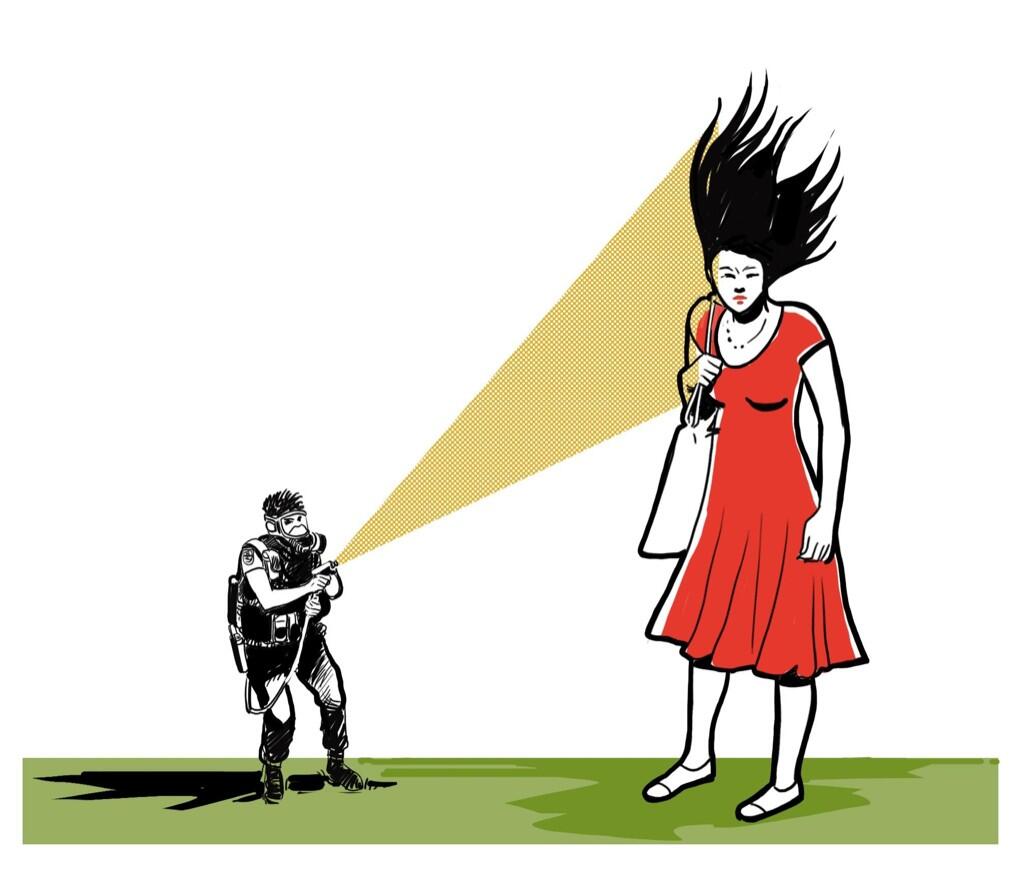
(images from Reuters and via Twitter. Thanks for feedback to Paul Caplan and for the constant stream of information to Emre Kizilkaya and dozens of others via Twitter…)
Downtime
When things break down, they are much more interesting than the gadgets that function, channel and regulate our lives. Broken things might poetically and with a Heideggerian hum say to reveal their essence. This is the other side of the apocalyptic – to be understood as “apo-kalyptein – an uncovering or disclosing of what had previously been hidden.” (Gere 2008: 13)
It is in this sense that we should talk of “downtime” not as an accidental misfortune, a temporary hiccup and denial of service of intentional nature or just infrastructural/hardware failure. Instead, it is part of how media, tech and things just are (in consumer cultures); that they break down, fail in their intended task, and refuse to switch on. Indeed downtime is the time of permanent breaking down, crisis and one is tempted to start unraveling a wider transversal notion of downtime from the microscale of technological circuits to macroscales of economy. But indeed, if it is a transversal notion it cuts across such traditional divisions of micro and macro and forces a different dimensionality. A molecular level of connections which forces the technological to be tightly articulated as part of political economy; an articulation of politics must take into account the technological conditioning of itself – the political action; the (media) technological sustains and operates the processes of subjectification; the social starts from the circuit.
An installation, Downtime (post-domestic fiction), I saw as part of Amber 2012 exhibition in Istanbul, November 2012, plays with the idea of broken down electronic and other gadgets, from scientific measurement units to an old telephone, television, kitchen utensils (a hand mixer) and an old Spectrum ZX computer. The practice relates to the recent years of circuit bending and hardware hacking, as well as critical design/(re)making, from Garnet Hertz to Benjamin Gaulon and glitchers Jon Satrom to Rosa Menkman, and it might be said to relate to zombie media too–repurposing discarded/dysfunctional gadgets.
For the group, “downtime refers to the period of time during which a system remains unavailable or fails to provide or perform its primary function.” The installation covers a wall with its recircuited works, reminescent of for instance ReFunct Media 2.0. Indeed, this is the interesting bit; it is not so much about the object, but the materiality of its dysfunctionality is articulated as a temporal relation; “the period during which…”. Even downtime unfolds as a duration.
I would argue that there is a twisted permanence, or at least a horizon, a duration, of such a downtime that is as significant as its functionality. “Through the active participation of the viewer, the objects are examined within a new context, in terms of how these are kept active and accessible by its reuse and manipulation”, the group writes. We of course need to investigate the wider sense and rationale of why things should be kept active, and the horizon of that. For me, the interesting bit is as said the temporal dimension, and the new materialist discourse and media technological theory needs to be able to tackle with this too. Whether it is about the temporality of the accident, or the break down, downtime — or then the microtemporality Wolfgang Ernst is after (see also Algorhythmics).

Indeed, the accident and downtime is not only an event that disrupts the running of temporality, but incorporates its own duration that we have to understand too. Downtime is a switch concept for notions of time – functional and dysfunctional, and as such tries to act as an anthropological operator for cultural techniques of temporality.









 Machinology