Archive
Cultural Techniques-special issue
Our book-length special issue on Cultural Techniques (Kulturtechniken) is out. Co-edited by Geoffrey Winthrop-Young, Ilinca Iurascu and myself, the special edition in Theory, Culture & Society is a significant introduction to the term that stems from German academic discussions in cultural and media studies. One could say it offers a significant variation on themes familiar from postwar German humanities’ focus on media, technologies and epistemo-ontological questions of culture in a post-representational and post-textual mode.
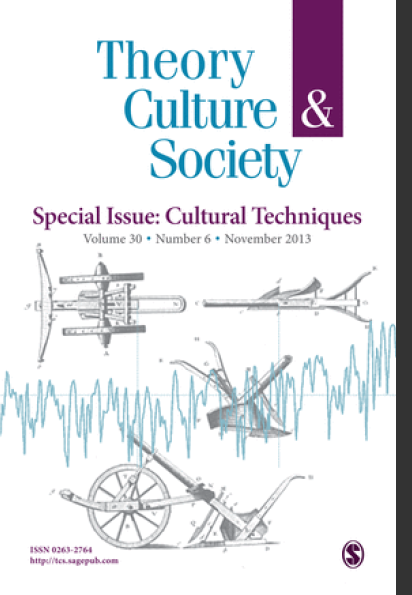
By way of some significant translations as well as new articles the issue pitches a way to understand cultural reality through its techniques. The usual definition is from Thomas Macho:
“Cultural techniques – such as writing, reading, painting, counting,
making music – are always older than the concepts that are generated
from them. People wrote long before they conceptualized writing
or alphabets; millennia passed before pictures and statues gave
rise to the concept of the image; and until today, people sing or
make music without knowing anything about tones or musical notation
systems. Counting, too, is older than the notion of numbers. To
be sure, most cultures counted or performed certain mathematical
operations; but they did not necessarily derive from this a concept
of number.” (Macho, 2003: 179)
But as the issue demonstrates, there is more in this mix. The multiplicity of positions and inplications is well articulated in Winthrop-Young’s Introduction to the issue. He articulates how not only in Macho, but in different ways in Cornelia Vismann’s and Bernhard Siegert’s work the constitutive role of cultural techniques functions. In fact, could say that this is the German media theory version of the hominization-thesis: how we become humans; how agency is constituted by cultural techniques which allow us to occupy subject positions. Space, enclosures and passages between them is one way to understand the idea:
“Thus the difference between human beings and animals is one that
could not be thought without the mediation of a cultural technique.
In this not only tools and weapons . . . play an essential role; so, too,
does the invention of the door, whose first form was presumably the
gate [Gatter] . . . The door appears much more as a medium of coevolutionary
domestication of animals and human beings.” (Siegert, 2012: 8)
Key here is the way in which cultural techniques process distinctions with material and aesthetic means. In Winthrop-Young’s lucid words, “Procedural chains and connecting techniques give rise to notions and objects that are then endowed with essentialized identities.Underneath our ontological distinctions (if not even our own evolution) are constitutive, media-dependent ontic operations that need to be teased out by means of techno-material deconstruction.” The implications for a range of recent years of theory-debates are intriguing; it refers to the fact how we need to address practices of theory and techniques of theory as part of the work of concepts and philosophy of contemporary culture. Besides it also shows some early ideas that resonate with a post-textual approach to cultural analysis (for instance in Sybille Krämer and Horst Bredekamp’s article).
I was asked to produce a short video abstract of my own contribution. In addition, find below the table of contents.
Special Issue: Cultural Techniques
Edited by Geoffrey Winthrop-Young, Ilinca Iurascu and
Jussi Parikka
Articles
Cultural Techniques: Preliminary Remarks by Geoffrey Winthrop-Young
Culture, Technology, Cultural Techniques – Moving Beyond Text by Sybille Krämer and Horst Bredekamp
Second-Order Animals: Cultural Techniques of Identity and Identification by Thomas Macho
Cultural Techniques: Or the End of the Intellectual Postwar Era in German Media Theory by Bernhard Siegert
After Kittler: On the Cultural Techniques of Recent German Media Theory by Bernard Dionysius Geoghegan
Cultural Techniques and Sovereignty by Cornelia Vismann
The Power of Small Gestures: On the Cultural Technique of Service by Markus Krajewski
Zootechnologies: Swarming as a Cultural Technique by Sebastian Vehlken
From Media History to Zeitkritik by Wolfgang Ernst
Afterword: Cultural Techniques and Media Studies by Jussi Parikka
Review Article
Files, Lists, and the Material History of the Law by Liam Cole Young
Breathless
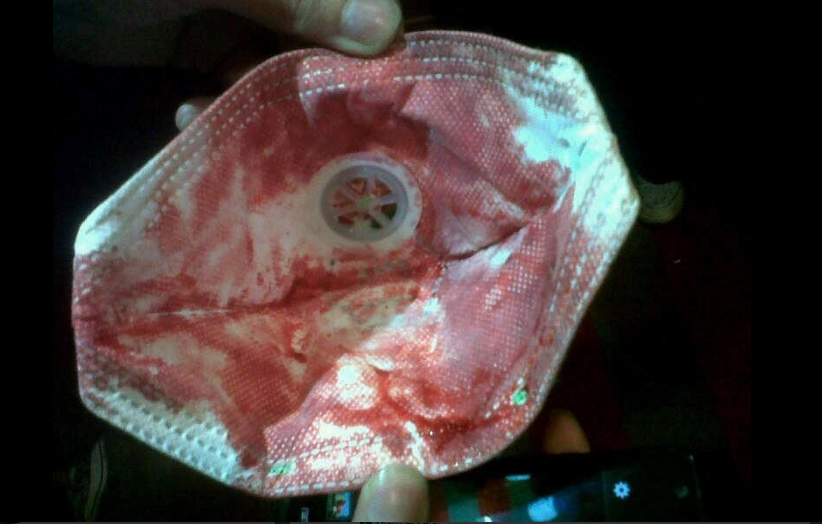
“My eyes were burning, and my nose running and my face was also burning”. These are ensations across the body, demonstrating the effectiveness of technologies of security. Your eyes and nose and mouth feel it. It burns across your body, an involuntary body panic from the fear of choking.

Gas is a rather peculiar weapon. It is atmospheric in the manner German philosopher Peter Sloterdijk talks about: it conditions the environment and breathing and as such invades one of the most intimate areas of our life: our lungs and sense of being alive. Naturally, this is not only a sense of being alive, but its very condition. Gas warfare is not only about biopolitical invasions but also the raw animal life being controlled: the zoe.
Gas is spatial and ephemeral at the same time. The wind can carry it across distances, although it is used as a very localized measure. It divides space in new ways: those able to breath with gas masks, and those suffocating, denied their participation in that space. You can control territories through a control of who is allowed to breath air in there. Tear gas, pepper gas, water cannons infused with chemicals: meticulous information on what the body can just about take. This information is always escorted by the possible deviations from the norm: for instance children’s lungs as well as elderly lungs.
Modern chemical attacks against humans date back to the first World War and the trench warfare. The Germans started using toxic clouds in April, 1915. As Sloterdijk notes, what makes this manner of suffering and even death more painful is how the suffocating is made to participate in his and her own condition: the body is made to turn against itself, gasping for breath, convulsions. The organic tissue becomes an archive of atrocities, a registering surface of the effects of modern science and technology employed in military and security regimes.
Of course you can shoot and aim with gas canisters, to ensure the good ol’ blunt hit. The effects of this hit can be rather horrific.
Considering gas, Sloterdijk speaks of “terror from the air”, and associates terrorism as a feature of modernity:
“It is crucial to identify terrorism as a child of modernity, insofar as its exact definition was forged only after the principle of attacking an organism’s , or a life form’s, environment and immune defences was shown in its perfect technical explication.”
There is a technological condition of this state of breathlessness and it has to do with the history of modern synthetic biology: the measurement of human capacities for breathing as well as the necessary measures for inhibiting the use of air for the organism.
And in Timothy C. Campbell’s words, referring to Sloterdijk, “terrorism is always ecologically directed”.
We need to turn meditations of air, soul and breathing into a bio- and zoepolitics of breathing and an analysis the systematic ecological and health abuses: from the minuscules particles of gas and dust, to how they constitute more abstract but as real security operations.
Sources:
Campbell, T. (2011) Improper Life. Technology and Biopolitcs from Heidegger to Agamben. University of Minnesota Press.
Sloterdijk, P. (2009) Terror from the Air. Semiotext(e).
Images via Twitter.
Ernst on Time-Critical Media: A mini-interview
One of my interests of the recent times has been “microtemporality”. This interest has been spurred both by Wolfgang Ernst’s media archaeological theory and publications such as Axel Volmar’s 2009 edited volume on time-critical media. Indeed, notions of microtemporality offer ways to understand the technical conditioning of social/cultural processes on a level that is irreducible to the phenomenological. With different emphases to those of Ernst’s I know that for instance Katherine Hayles is nowadays looking at algorithmic trading from the temporal perspective too and Mark Hansen is from a more Whitehead perspective investigating ubiquitous media environments and that what escapes conscious cognition. See also Shintaro Miyazaki on these topics through the concept of Algorhythmics in Computational Culture.
In the midst of my own research into different temporalities that media archaeology offers, as well as network times/politics, I wanted to conduct a mini-interview with Wolfgang Ernst. Hence, please find below Wolfgang Ernst, responding to my question “what is time-critical media and microtemporality?”
Wolfgang Ernst:
“Technological media have a distinct quality: They are in their medium-being only in operation (“under current”). This specificity makes them especially sensitive to micro-temporal intrusion, irritation and manipulation – much more than previous cultural techniques like alphabetic writing which became time-critical only when electrically coded into telegraphy.
It was Gotthold Ephraim Lessing who in his treatise on the comparative aesthetics of poetry and visual arts Laokoon in 1766 identified what the called the “pregnant moment” in the representation of action. In electronic television the exact synchronisation, thus timing, of signals becomes crucial for the human aisthesis of image perception indeed. With techno-mathematical computing where minimal temporal moments become critical for the success of the whole process of internal calculation and human-machine communication (“interrupt”), time-criticality becomes a new object of epistemological attention in the economy of knowledge. When culture is rather counted than narrated, time-criticality needs to be focussed by process-oriented (thus dynamic) media archaeology.
Time-criticality in its media-technological context does not refer to a philosophical or critique of contemporary politics or ethics but rather to a special class of events where exact timing and the temporal momentum is “decisive” for the processes to take place and succeed at all. In its ancient Greek sense, crisis refers to the chances of decision, with its temporal form being an impulse rather than a duration or narrative – kairotic time. Kairos – the ancient Greek god of the decisive moment – becomes proverbial in post-modern just-in-time production in both industry and technologies, as well as in deadly situations like antiaircraft prediction in Second World War.
In its etymological roots, “time” itself refers to divisions of continuity, to the cutting edge. Apart from its long aesthetic tradition, the cultural impact of time-criticality escalates with (and within) technological media, starting from photographic exposure time which almost shrank towards zero. Signals which are operated with electronic speed can hardly be followed by human consciousness like, for example, symbols (printed letters) in textual reading. When signal transfer happens below human sensation, it can be spotted only by time-critical observation. For subliminal events the true archaeologist of time-critical knowledge are technical media themselves; only with the emergence of hightly sensitive measuring instruments since the 19th century time-critical processes like the runtime of signals within human nerves became analyzable at all.”
What is Media Archaeology, beta definition ver. 0.9
What is Media Archaeology? gives no direct answer to the question that it poses. Instead, it gives a map – a cartography of how to see the field of media archaeology defined by various theories and directions, that help us to go to places – and think things. However, I remember trying to think through definitions of media archaeology – a useful task to bring clarity. I originally doodled something like this for my working blog for that WiMA book, but let’s return to that now. This thinking aloud was partly triggered by my soon to be new colleague Sunil Manghani’s question…so how does media archaeology differ from media history.
Here is one attempt to give a definition – sort of coordinates, although this does not exhaust the richness of MA and its various traditions.
Media archaeology can be understood as a heterogeneous set of theories and methods that investigate media history through its alternative roots, forgotten paths, neglected ideas and machines. It explicitly challenges the supposed newness of digital culture. Media archaeology gives new ideas to understand media cultural temporality. The definitions have ranged from emphasising the recurring nature of media cultural discourses (Huhtamo) to media archaeology as an-archaeology, or variantology (Zielinski) which in its excavation of the deep time layers of our means of seeing and hearing tries to find an alternative route to dismantle the fallacy of linear development.
Furthermore, I see media archaeology as a joint history & theory venture in which temporal excavation of media functions as a theoretical force as well; it can be characterised as a reading of old media and new media in parallel lines. Media archaeology is decisively non-linear, and rigorously theoretical in its media historical interest of knowledge. In a Benjaminian vein, it abandons historicism when by it is meant the idea that the past is given and out there waiting for us to find it; instead, it believes in the radical assembling of history, and histories in the plural, but so that it is not only a subset of cultural historical writing. Instead, media archaeology needs to insist both on the material nature of its enterprise – that media are always articulated in material, also in non-narrative frameworks whether technical media such as photography, or algorithmic media features such as databases and software networks – and that the work of assembling temporal mediations takes place in an increasingly varied and distributed network of institutions, practices and technological platforms.
Indeed, what media archaeology investigates are also the practical rewirings of time, as is done in media artistic and creative practice work, through archives digital and traditional, as well as DIY and circuit bending which recycle, and remix obsolete technology as much as they investigate aesthetic and political economic conditions of technical media.
Media archaeology takes place in artistic labs, laboratories where hardware and software are hacked and opened, but also in in conceptual labs for experimenting with concepts and ideas.
So as you can see, it moves into certain material characteristics that I want to keep close to media archaeology. It does not mean that this it the only to approach MA. For instance, here is what Huhtamo wrote.
#code2k12
I am not the most qualified person to analyse the political economy and at times slightly exaggerated role of conferences; I do not really too often go to the big ones where the whole system of recruitment and other sort of social/affective work of academia happens. I am sure there are loads of management books on such topics and their importance. Not that I have anything against being social – just being a Finn you have to limit it a bit, not to get exhausted with the overwhelming number of people that would amount to the total number of a small Finnish village easily. However, at times events really strike a chord – like Code at the Swinburne University of Technology, Melbourne: a fantastic combination of academic quality and lovely people.

I am a firm believer in that the more interesting academic benefit of such events is not hearing someone speak, but that you are able to meet and talk outside the sessions; whether casual chattering or on the topic of the presentation. This is hardly a surprise. But it is not only the meet & greet networking silly management culture that we are persuaded to pursue, but actually having some affective pleasure from finding out that academics are not completely subsumed into corporate climb-the-ladder assholism.
Of course, talks can be really good in triggering ideas. What I mean by that is at least my own prespective that I have often trouble in immediately summarizing someone’s talk in its entirety, and instead I get nuggets, something that triggers an idea. In this sense as well, Code was a success.
The event was not focused down solely on software culture or critical code studies despite the frequent references to Chun, Galloway and Kittler – and some other usual suspects. I perceived something of an expanded notion of code in the sense that through the theme, a lot of presentations pointed to a broader context of materialities in which code takes place; logistics, management, intermedial relations, aesthetic, and non-computer placed coding of social actions/events like with the Human Fax Machine-experiment. Talks ranged from reddit to Ring(u), cars to Erica T. Carter, commandline to Google, and signal to Simondon. Code had already introduced its own approach to the idea even with a conference reading list!
Besides having the pleasure of listening to the fantastic keynotes by Anna Munster and Christian McCrea, for instance the plenary panel of Melissa Gregg, Ned Rossiter, Soenke Zehle and Mark Coté was the best one can hope for. Brilliant speakers all of whose I work admire a lot, and the topics were nicely resonating. For instance Gregg’s take on the Getting Things Done (GTD) software was something that illuminates what I tried to just briefly address in my own keynote on Cultural Techniques of Cognitive Capitalism (more on that later in a separate blog post): the entanglement of media, management, affect and modes of production in contemporary digital culture. Such practices, techniques and technologies frame the will for more time and freedom, as well as creativity, which ground notions such as cognitive capitalism, and in Gregg’s case she was able to show the deep layers of such ideas of “work smarter, not harder”. Exhaustion, tiredness and fatigue have not disappeared from the gendered worlds of management of office and post-office work. Such affect management and self control are excellent ways of articulating the curious emphasis on the cognitive and affective in relation to modes of production: they hover somewhere between of the tiring and energizing, of repetitive and creative. In this context, see also the Zooming Secretary game that Gregg started with — filing cabinets, telephones and coffee boosts; affective attunement.
It was also pleasure to hear Coté talk of his book project on Data Motility which is one of those great moments when we get someone with a fantastic knowledge of Italian political theory and current media theory talking about a topic of Digital Humanities. DH at times “forgets” the existence of media theory, as well as the longer history of humanities-technology partnering, but at the same time of course we need to be ready to update our theoretical perspectives in relation to new modes of quantities, qualities, and abstractions.
Coté ‘s book promises to be really exciting, offering an insight to data having a self-generated sense of movement as well as being the object of value creation: big social data is the sociality of the data for instance collected on social media, which highlights its polyvalence and social and economic valorisation. According to Coté big social data can be seen constituting a certain mode of humanness that humanities should tackle with. This sort of conditioning is the sort you get from the directions of Leroi-Gourhan and others. But it also points to the direction of debt, an interesting idea Coté suggests: what if we understand our relation with the data collected as one of debt, as analysed by for instance Lazzarato. Big social data in social media contexts is one of endless payments and demands of creating the social through actions, in order to justify our existence.
Both Rossiter and Zehle talked of logistics; Rossiter towards the worlds of media and management, transposition of labour to code & algorithms (which probably would resonate with some insights from Fuller & Goffey’s recent Evil Media) and Zehle in relation to gestures. Indeed, listening the two talks in the same panel made the audience aware of the multiscalar worlds of logistics – from human social affect and gestures, to the abstracted worlds of simulations and games in which management and logistics can be rehearsed.
Even if I mention only some of the papers here, throughout the conference I felt more inspired than in most of the events I visit. As said, this extends to the time outside the actual talks; people are engaged in several interesting projects, which made me actually, and without irony, feel rather ok about being an academic. And in that context, it was less painful to visit the other side of the world, Melbourne, and do two long haul flights within 10 days. I myself talked about some new things I am engaged in – a sort of a project pitch for something that might turn out to be a bigger project event – and gave a “master class” on Media Archaeology & Cultural Techniques.
CODE
Folks at Swinburne University, Melbourne have organised quite the event — CODE – A Media, Games & Art Conference. This means my first trip to Australia ever, with that slightly surreal feeling plane trip ahead of me. It is at such moments that you better trust media technological arrangements; the radio and computer controlled cockpit media; and the entertainment media lull in the economy class (see John Johnston’s intro to the Kittler-essay collection Literature, Media, Information Systems).
My talk will be something new I wrote, on “Cultural Techniques of Cognitive Capitalism”. The idea is to do a crosswiring between two traditions; the German media studies type of undertanding of media technologies coupled with the more Italian style political theory of Post-Fordist cultures. The previous has not been so good on the political front, the latter not always been specific enough when talking of media cultures/technologies. Who knows, this talk might form a part of a bigger project that I have been drafting as well.
Don’t call him a media philosopher!
It was one year ago that Friedrich A. Kittler died. The German newspapers reacted, and slowly, The Guardian too, with a couple of writings and a podcast. I think that was it, for the English-speaking mainstream press. Besides some short notes on my blog, I wrote this short piece for The Guardian.
Academic discussions concerning his work have increased even more: such also include fantastic pieces like the memoir by Geoffrey Winthrop-Young of the Kittler-before-Kittler (i.e. the early 1980s one) ‘”Well What Socks is Pynchon Wearing Today?” A Freiburg Scrapbook in Memory of Friedrich Kittler’ in Cultural Politics Volume 8, Issue 3, and a forthcoming ZKM conference Of Gods and Scripts around the Mediterranean.
Of last year’s obituaries, some are circulating again online. Here is for instance FAZ: Jede Liebe war eine auf den ersten Blick.
Indeed, Kittler got the human (well, actually “spirit”, “the mind”, Geist – Geisteswissenschaften) out of humanities, and inserted the machine. Suddenly, inside the human(ities) we found all kinds of hardware. Typewriters, gramophones, circuit boards, computer chips, probably even a bit of internet cable in there somewhere.
However, don’t inscribe “media philosopher” on his grave stone.
And no, he did not call himself a media archaeologist either.

A Call for An Alternative Deep Time of the Media
I am here recapping some ideas from an earlier post, but I wanted to flag this as a separate theme…
I want to pick up on Siegfried Zielinski’s notion of deep time of the media — not straightforwardly media archaeological, but an anarchaeological call for methodology of deep time research into technical means of hearing and seeing. In Zielinski’s vision, which poetically borrows from Stephen Jay Gould’s paleontological epistemology at least in its vision, the superficiality of media cultural temporality is exposed with antecedents, hidden ideas, false but inspiring paths of earlier experimenters from Empedocles to Athanius Kircher, Johann Wilhelm Ritter to Cesare Lombroso.
Zielinski’s excavations are not content to stay within the regime of media archaeology, but want to uncover a non-linear layering of variations. Indeed, in a manner that seems to be borrowing from a Deleuze-Guattarian ontology of nomadism and the primacy of variation (I don’t however think that Z makes the link to DG explicit), Zielinski’s methodology is in this sense a refusal of any master plans of media development and a plea against both the drive towards psychopathia medialis (the standardization and uniformity as well as illusions of teleology). Instead, the paleontological conceptualisation of a media history of variations finds surprising case studies of aberrants paths for hearing and seeing, of optics and acoustics, of technical means of guiding, misguiding, educating and mocking the senses.
And yet, as an alternative deep time, I suggest that instead of male heroes, we approach a more geologically tuned deep time – deep in various senses, down to mineral excavation, and picking up some themes of media ecological sort. I want to speculate with a more geologically oriented notion of depth of media that is interested in truly deep times – of thousands, millions, billions of years and in depth of the earth; A media excavation into the mineral and raw material basis of technological development, through which to present some media historical arguments as to how one might adopt a material perspective in terms of ecological temporality.
For instance for the European Union, the future of information technology has to be planned starting from a material level up: The EU does not hold much in terms of critical raw material resources when it comes to advanced technology that are identified crucial for a longer term socio-economic change. Obviously, such issues are always voiced with a concern for the geopolitical-economic consequences. In short, this refers to the crucial status of China, Russia, Brazil, Congo and for instance South-Africa as producers of raw materials, and an alternative material future of technological culture. This connects to a realisation: the materiality of information technology starts from the soil, and underground – 500 meters, and preferably (for the mining companies) lower as the earth’s crust is dozens of kilometres deep.
Cobalt —- Lithium-ion batteries, synthetic fuels
Gallium —- Thin layer photovoltaics, IC, WLED
Indium —– Displays, thin layer photovoltaics
Tantalum —- Micro capacitors, medical technology
Antimony —– ATO, micro capacitors
Germanium —– Fibre optic cable, IR optical technologies
Niobium —– Micro capacitors, ferroalloys
Neodymium —- Permanent magnets, laser technology[1]
From animals to nature as a resource, a material ecology for media is an increasingly important topic. This is the double bind that relates media technologies to ecological issues; on the one hand, acting as raw material for the actual hardware, from cables to cell phones; on the other hand, as an important epistemological framework whether in relation to mapping of climate change or in terms of further resources for exploitation, as in the recent proposal not just for Internet of Things – but Internet of Underwater Things.
Perhaps an alternative sort of a deep time of the media is needed – one that does not excavate deep times of human inventions, successful or just imagined, but deep times of animal and geological sort, and the cultural techniques that are affiliated with such non-human regimes? This could be a further advance to consolidate the work of media ecology and zootechnics (cf. Sebastian Vehlken’s recent work in this area, as well as Insect Media).
[1] European Union Critical Raw Materials Analysis, By the European Commission Raw Materials Supply Group, July 30, 2010. Executive Summary by Swiss Metal Assets, October 1, 2011, under www.swissmetalassets.com (24.7.2012).
Turf instead of Turf Wars
I was recently invited to deliver the annual keynote lecture for the graduates of Amsterdam University New Media Studies MA cohort. Below is the talk (August 29, 2012) that I did – sorry for the length of this post, but might interest some.
Turf Instead of Turf Wars:
The Future of Media Theory (as Bin Theory)
I was asked to talk about the Future of Media Theory – but I have to admit, talking about the future of anything has never been one of my strengths. Trained as a historian, a cultural historian to be accurate, one of my fortes was to engage with the past. Surrounded by other PhD students and colleagues who were doing research on Antique Greece, Early Modern Cultures, or for instance Victorian travel writing, I was often in a mixed peer group when trying to figure my head around historical aspects of new media culture. There seemed to be something comforting thinking that the old was always at some point new (as a reference to Carolyn Marvin’s pioneering research from the 1980s). However that sort of escape route proved early on to be an asset: I sort of consoled myself that at least, this way, I do not have to worry about keeping up; the hyperbolic pace of media cultural discourse, of shifts, moving forward, sideways, changing its object of desire from one gadget to another, screen innovation to next, network buzz word to the next buzz, theory to another turn – all of this could be, perhaps, bypassed the other way; what was the new of the past, or the novelty that again feels fresh – something that a brand of theorists call media archaeology. Or, if you prefer, call it bin theory; about things discarded, waste(d), sometimes yuckily stuck together so as to lose their individual contours, and where digging in the dumpster will get your hands dirty. Digging in the ruins to discover new things. Not just being behind of the curve, but actually turned back to look at the previous alley, probably its dumpster, for something slightly more curious of an example than the emergence of the new – to paraphrase one Finnish scholar (Mika Pantzar), there is nothing more worn out than the continuous talk of the new.
I want to talk about one of the benefits of media theory as part of media studies – of theoretical absurdities that make sense; and sense-making that should be at times discarded; this approach relates to the speculative power of such an interdisciplinary field and its way to tackle with much more than media, or perhaps other formulation would be “not-just-media”. Let me get back to that formulation soon, but before that, just open up the agenda a bit more; so what if, instead of the normal media studies check list that gives you a nice, predictable list of “media” from television to other screens, from network media to more specifically software, games, and so forth – what if instead, you start to look at media in all sorts of weird places?
Indeed, people in media studies, for instance the prestigious Bernhard Siegert in Germany, have approached things like doors and ships as media of sorts. Consider it for a while: what is a door if not a mediating factor between insides and outsides, a basic anthropological element that divides spaces and as such, stands at the beginning of any power relation; how thresholds are controlled in terms of access, people, goods, traffic of various sorts? All these sound like questions an analyst of network culture might ask but we can transpose the question to such archaic thresholds too. Indeed, as Siegert reminds us, there are a lot of non-humans involved too. Of course, there are very human cultural techniques concerning doors, like how loud or quietly you are trained and educated to shut it and yet the materiality of the door (which as we know, can come in many guises from household doors to gates to automatic doors, sliding doors, to those logic gates you find inside computers…) is what itself plays a role as an agency.
Besides doors, we could consider, as does Siegert and other scholars engaged in analysis of cultural techniques, maps, diagrams, graphs, practices such as servantry (see Markus Krajewski’s work) and more as ways to open up the media studies checklist – media studies becomes more than just media, not just media, as a way to understand a range of technologies, gestures, practices and techniques which consolidate a range of things under the umbrella of what we blandly call media. Such are part of the necessary gestures of extending the boundaries of what we do, just for the sake of getting away of the stuffy indoors and knocking on the doors of other disciplinary huts; don’t always even knock and be pollite but poach and steal, smuggle and translate, transform – a range of pirate practices for theory production too, which constitute what a bit tiredly is often called interdiscplinarity. For what is media studies already from the outset if not interdisciplinary? It deals with themes familiar from science and engineering, of cultural studies and anthropology, of social sciences and, if you want to push your boundaries, mathematics too – for some theorists, including Wolfgang Ernst, it is with mathematics that our specific understanding of technical media should start. From Pythagoras to time-critical processes of current computers, mathematics opens a whole media epistemology.
For sure, media is definitely not only about mediating or communicating. We need to stir up things with theory, and theory itself has a peculiar place in contemporary academia. While an increasing amount of for instance institutions try to purge theory out from their media studies courses in order to gain street cred in terms of vocational skills deemed necessary for the digital economy (such a British buzz word), the other side of the coin in our field of arts and humanities and philosophy is the lust for glamour of theory. Theoretical turns and trendification of even metaphysical speak is an index of both looming turf wars as well as theory as a brand; in the current attempts to neoliberalise universities, theory becomes work of heroes (and still, slightly less often heroines), often described in the language of war; wars on social media from Twitter and blogs as platforms much quicker than in the age of David Hume and Jean Jacques Rousseu, the quarrelling philosophers of the 18th century – for them, the media of turf wars were letters. In wars, and neoliberalist managerial wet fantasies, theory becomes performed as slick and without hiccups. Theory becomes confused with Ted –talks and the theorist as a brand, smooth and convincing salesperson, demonstrating also the powers of performance (see Paolo Virno on these points) on stage that one demands both as a visual culture phenomena but also increasingly in terms of scholarship as customer service as in the UK.
But there are more acute reasons for our expansion of media theory than just for the sake of avoiding stuffy academic air. What interests me in this case are not turf wars, but more closely turf itself, as well as things below the turf; we can use theory as a pathway itself to open up and question lists of things, as well as old habits, and include a range of new things for our conceptualisations. There is a practice of theory as well. In relation to my bigger theme today, the past years have seen a whole media zoology (and Zootechnics, see Vehlken’s recent book) emerge, with animals and animal studies finding a joint tune with some media studies theories; similarly things ecological, even under another theoretical theme of past years, media ecology, are mapped as part of the very concrete material contexts in which media takes place and displace. Rubbish, electronic waste, and the concretely ecological contexts of media are what constitute another way of seeing where things come from and end up – and using seemingly insignificant themes to track and map what is the more abstract and still yet one of widespread effects. Such media cartography is one way to see that task of a much more world oriented, and even object-oriented route for some. This also might be an arena for bin theory – clearly a relative of what McKenzie Wark calls P(OO): Praxis (object oriented): “A praxis which knows itself to be limited, but which constructs a praxis of praxis, aimed at a useful knowledge of the strange praxis of objects entertain amongst themselves. And to make it possible, a certain conversation. One which does not have a stake in the language-game of professional philosophy, but which raids it for the odd useful thing, for hammers and such.” (Wark 2012: 161)
As cartography, let us remind ourselves that the map is the territory (to refer to Bernhard Siegert’s text in Radical Philosophy in 2011). Such a mapping that has to mistake the object as part of the praxis is not content to come up with representative lists of media studies topics, but wants itself to participate as an agent in social discussions – a technology of mapping that as technique caters objects, things and more to be even recognized as such. It steps from metaphysics to practices, historically existing. This is, as mentioned above, the thing about not-just-media, which is a variant of the media scholar Matthew Fuller’s (2003) phrase “not-just-art”. Without going into more details, Fuller’s note in the context of software points towards “a poetics of the potential” and how a piece of software – and/or art – can elaborate a range of other critical techniques that are not just critique; not just a deconstruction of the notion of art into ironic twists of anti-art, but ways to forge, create worlds, and modalities of experience. For us, not just media, or not just media theory is a way to call into focus the fact that we just don’t talk of media, and we just don’t do media to theorise, but to action things – to enact. Theory actually does a lot, through it’s work of concepts.
But in terms of speculations and not-just-typical media theory, let me explain more about what I mean with turf, with animal approaches, as well as the emphasis on junk as well as energy – all things quite physical, and definitely not purely semiotic. To start with animals, a for purpose simplifying claim gets us on the pitch; that so much of media theory has been branded by a focus on the human; as an analysis of human communication, we have tended to focus on linguistic models and a variety of social and interpersonal themes, or as an analysis of worlds of perception, to see media as extensions of Man. The Marshall McLuhan phrase however is not very satisfactory if you start to realise the amount of very non-human aspects when it comes down to media environments that are by definition so quick and so puzzling even on a physical level that it would not merit them well to call them an extension of myself. Indeed, the recent years have seen various well grounded and even provocative attacks against a human centered humanities.
As for media of the other sort, namely of animal worlds, there are obvious routes as well. One could now claim this territory to for instance biomedia: the biological as something that is taken to support what usually would call high tech processes; besides metaphors, the harnessing of for instance magnetic bacteria to become grown harddrives is under way, as are other plans that try to fit (and/or modify) the historically quite recent ideas of computer architectures as part biological and ecological affordances.
But other sorts of animal worlds are involved too. Hence, take science fiction as a way to understand what I am to try to get with, in terms of this mild zoophilia. If you want to be futuristic, you do not anymore fantasize in reference to humans or even androids, but animals, and preferably insects (as I tried to argue in Insect Media too). This is the lesson one gets even from a glimpse of past years of science-fiction discourse, such as Ian McDonald’s Dervish House. The nanotechnological future Istanbul is pitched as the 21st century version of the Silk Road node, defined by its booming nanotech cluster of businesses and tech companies. The David Cronenberg 1980s fantasies of human-insect –hybrid (as in the Fly) is superseded by the fiction version of spider robotics and insectoid-drones part of security and surveillance regimes in Istanbul plagued by various suicide sects.
Animals abound in media talk too, as well as to refer to trends in current digital society. Swarms and more, such terms as pollen society float about (a term by Yann Moulier Boutang)– here to refer to the specific collaborative and cognitive modes of value production in current creative industries culture.
There is a bit of a similar thrust to be noticed in how marketing researchers are trying to convince that we need to look at the reptilian brain, the unconscious and unrational parts, in order to find what triggers us to brands; social networks bloat with links about news stories in which insect research demonstrates how ants do it, termites do it, even Facebook does it: clusters around common interests, sharing, collaboration — a nice way of trying to convince that companies from Silicon Valley with their own specific quite cunning business models that aim to accumulate social behaviour as an inroad to capital accumulation are as natural as hive formations. More recently, this has taken place by talk of Anternets even, an idea that certain ants’ foraging patterns are like the invention of TCP/IP protocol but some millions years earlier.
Such examples demonstrate a scientific keenness in media, animals and behaviour as somehow interlinked, a weird rhetorical connection established through scientific research that seems to link up evolutionary aspects of animals to specific technological platforms. Don’t get me wrong – I do like animals, at least some, and I am an active Twitter user, and it is for sure that most of my actions happen on a very non-rational level of my own lizard brain – but what this more specifically points out is a terribly weird new version of sociobiologism, but on the level of animal behaviour and modes of organisation. Indeed, there is an interesting relation to the sociological interest in crowd behaviour in cities at the end of the 19th century and early 20th, and our current forms of crowds online – both demonstrating for researchers patterns of such behaviour that seem of the lower level; It begs the question concerning the “social” in social media, and the wider pitching of sociability as the natural protocol of the world. Instead, we should shout out that there is nothing natural about sociability, not at least in this articulation of corporate platforms as so inherently connected to biology and evolution! Instead, we need to pick open such creations, imaginations of the social, inventions of forms of life that take detours at times through the natural.
As a cultural historical theme, we can talk of the dual bind of modern urban technological landscapes and animals: disappearance of farm animals, rodents and so forth is paralleled by the animalisation of media, which seems to be clear from even a cursory representational analysis of early media, so fascinated by agility of animal bodies as well as animation worlds of rodents and animal farms – a whole media zoology (see Akira Mizuta Lippit’s Electric Animal on this topic). This idea of media zoology used in a parallel sense to that of a “zootechnical” approach (Vehlken) to elaborate the wider entanglement of communication practices in relation to animal research – and in addition, as we will see below, to a wider media ecological stance.
But of course there is more to this grounding of media zoology than looking at media through its content and what is on the screen. Indeed, the worlds of such fiction as The Dervish House remind that media as technologies – as abstract, yet embodied, as concrete but massively distributed in the current wireless network age – work much more efficiently when they are not modelled on the human form. This is why marine biologists turned US military and security advisors, talking about octopus tentacles make international news: this refers to the University of Arizona marine ecologist Rafe Sagarin advising on learning about decentralised organisational methods from the tentacled marine creatures. “What the Octopus Can Teach Us About National Security”, ran the BBC headline which we can tweak to: “What the Discourse About the Octopus and National Security Can Teach Us Media Theorists”.
In terms of media theory, such voices relate to necessary complements to the traditions of theory of technology from Ernst Kapp to Marshall McLuhan. There are predecessors, and is a whole another tradition of media theory taking aboard animals in various forms, and starting the theoretisation of media from a different set of affordances (Insect Media). Indeed, when talking of media ecology, one should not forget the early writings of Harold Innis, which features such literally ecological themes as rivers, fur and , yes, beavers as well as the more conceptual reminders that medium did not always refer to what you think it does on a media studies course.
Besides quirky examples about beavers and protocols, ants and Ivy league scholars, we can point towards a gloomy side of this development as well. So allow me the role of a doomsday narrator in terms of ecological effects of media technologies. This itself is not that difficult, acknowledging the amount of electronic waste we discard every year – millions, hundreds of millions of electronic devices that are still operational, and besides that, packed with a range of hazardous material. Media are, by definition and in their material constitution, toxic. This is not a gloomy statement of the sort that media content ecologists like Neil Postman voiced while opening his telly – that it is ruining our world, our social relations, and amuses us to death (incidentally, I always liked more the ex Pink Floyd member Roger Waters’ version of this theme); instead, it is the material existence of media that is directly hazardous to our bodies. Instead of semiotics of media, we approach materialities of media, to be understood for instance through a “mineral per disease syndrome” chart:
Lead — damage to the central and peripheral nervous systems, blood systems, kidney and reproductive system.
Cadmium –— accumulates for instance in the kidney
Mercury — brain and kidneys, as well as the fetus.
Hexavalent Chromium/Chromium VI — passes through cell membranes, producing various toxic effects in contaminated cells.
Barium — brain swelling, muscle weakness, damage to the heart, liver, and spleen. (Source: Exporting Harm, )
Such are only a couple of examples of things that constitute our information technology, a wide range of examples of refined minerals, metals, and chemicals that are essential as ever so material things inside our media, which paradoxically has meant neglecting them as any part of the courses concerned with Understanding Media . With a way too serious eye have we tried to approach media only as media, and ignored the much lower, physical level on which media takes place. (For alternatives, see for instance Sean Cubitt in Grau 2011).
Those underpaid workers, in non-Western locations, dismantling the media devices for the valuable parts, are the ones exposed to the above-mentioned list of health hazards. (As always, see the wonderful Digital Rubbish by Jennifer Gabrys) Methods as crude as riverside dumping, burning old computer parts, and so forth are also part of the life – and death – cycle of our digital culture, as methods of displacing obsolescent products as well as retrieving what they were made: copper, gold, and so forth. Of course, this is the part of the cycle we rarely see, as such media practices are reserved for developing countries, as end placement for stuff we don’t want to view, listen or play anymore. Junk media does not stop being media, and similarly if we speculate about futures of media theory, we need to quite concretely speculate futures of our media devices – where do they end up, quite physically, as part of container shipments, logistics routes, and a grey economy of the zombie life of media devices. (On logistics, see for instance Ned Rossiter’s work.).
With such speculation, we rediscover a materiality of the mediatic. This extends to what I would call a material speculative take on media history. Think of it this way:
Media history is one big “story” of experimenting with different materials from glass plates to chemicals, from selenium to coltan, from dilute suphuric acid to shellac silk and classic insulation material from gutta percha trees essential for underwater cables, to processes such as crystallization, ionization, and so forth. They also are media practices. Our screen technologies, cables, networks, technical means of seeing and hearing are partly results of meticulous – and sometimes just purely accidental – experimentation with how materials work; what works, what doesn’t, whether you are talking of materials for insulation, conduction, projection or recording. Same thing with processing and its materiality.
The transistor based information tech culture would not be thinkable without the various meticulous insights into the material characteristics and differences between germanium and silicon – or the energetic regimes; whether that involves the consideration of current clouds (as in server farms), or the constant attempts to manage power consumption.
What such geeky historical mapping reveals is just part of a bigger story that demands even more urgent attention in the age of the high energy consumption age of server farms and cloud computing (Cubitt, Hassan and Volkmer 2011): that story is not about frictionless clouds and sweetly mobile technologies with an ideal sense of displacement; this story is more about physics, and entropy, and exhausted resources;
Media and information technology are far from zero entropy mathematical dreams, and embedded in physical networks, afforded by hardware and hardwork – practices of mining, shipping, polishing, constructing, and then the other way round, when disgorging such machines.
This is the mirror side of the question about resources on governmental levels, also multinational governmental levels; Whereas on EU policy level, directives about electronic waste have focused on collecting and appropriate treatment, in terms of economic planning for the information technology age, there is a different challenge to face
From the European Union perspective, the future of information technology has to be planned below the turf: EU does not hold much in terms of critical raw material resources when it comes to advanced technology that are identified crucial for a longer term socio-economic change, something identified to have geopolitical-economic consequences. In short, this refers to the crucial status of China, Russia, Brazil, Congo and for instance South-Africa as producers of raw materials, and an alternative material future of technological culture. Suddenly, it is realized how the materiality of information technology starts from the soil, and underground – 500 meters, and preferably (for the mining companies) lower as the earth’s crust is dozens of kilometres deep.
Cobalt Lithium-ion batteries, synthetic fuels
Gallium Thin layer photovoltaics, IC, WLED
Indium Displays, thin layer photovoltaics
Tantalum Micro capacitors, medical technology
Antimony ATO, micro capacitors
Germanium Fibre optic cable, IR optical technologies
Platinum (PGM) Fuel cells, catalysts
Palladium (PGM) Catalysts, seawater desalination
Niobium Micro capacitors, ferroalloys
Neodymium Permanent magnets, laser technology (source)
Such an underground is slightly different from the discourse of underground art or activism.
Siegfried Zielinski, the Berlin situated media variantologist, writes about “deep time of the media” referring to extensively long historical durations for media inquiry; of looking at Antique times, of medieval alchemists, of 19th century science-art collaborations as such deep times of media practice. But what if we need to account for an alternative deep time, that reaches for this depth of even kilometres down the earth? This extends the historical interest into alchemists towards contemporary mining practices, minerals and a different sort of wizardry than those of celebrated geniuses of steve jobses. Instead, would this sort of an approach be something that is comfortable to tackle with materiality on its below the ground level (such theory is definitely “low theory”, to refer to McKenzie Wark’s notion), stretched between political economy of resources and for instance art practices: I am here thinking such examples as Florian Dombois’ “Auditory Seismology” work that sonifies earthquakes – usually of a frequency range that does not reach the human ear, but that can be modified, instead of the usual visualisation. Digging into the earth is a methodology that lets us look at what affords our media, and theorise such regimes of perception, of sensation that are immediately catered for us. For instance sonification of such earth sounds one can justify from a point Dombois also makes, that is how the “the eye is good for recognizing structure, surface and steadiness, whereas the ear is good for recognizing time, continuum, remembrance and expectation.”
The ear as a media theorist (an idea embraced by Wolfgang Ernst as well) is more suited to theoretical analysis of temporalities, for instance. Temporalities of deep earth. Despite my historical training, I am more convinced that these are the temporalities we should be looking at and listening to.
A lot of what I have been talking about boils down to the following themes, in the mode of ecological mapping an alternative, more “natural” list of media studies.
More accurately than a call for naturalisation, it is a list that acknowledges the various sedimentations, geologies and garbologies of media that we need to account for: worlds of animal energies, also in terms of their exploitation, whether just through bad use of ideas from biological and ethological studies, or directly through the linkages of animal testing with consumer industries;
Through minerals, as a resource for that physical, hard layer of information technology that gets too often press only as creative industries and digital economy of networks;
And then energy; not just the exploitation of human energies as with cheap physical labour or the exhausted creative industries freelancers, but also energy production – of which a big part still unrenewable.
Such aspects of media theory – of animals, rubbish, energy is not just to talk rubbish, but to continue the earlier idea; of our field of not just as media theory. We nod towards the bin, and bin theory. Instead, to an extent that some media theorists claim that the whole term is becoming useless because of its ubiquity, we can see the rapidly infecting impact of things mediatic. This is not a closed list, just like speculative media theory should not stop at the definitions handed down to you in some classical textbooks. Instead, the speculative enterprise, nowadays consolidated also in such waves of philosophical inquiry as speculative realism, is one of not really knowing what to expect; for speculative realism, it corresponds to an ontological attitude about the non-human constitution of the world – that there is much more than we expect in terms of our epistemological categories. And yet, we speculate in so many ways – even the term has been corrupted by financial capitalism adapting it as one of its techniques that presents its own version of future-orientedness;
We need to grab speculation back, as an inquiry into things more than is the assumed, or more than is expected, so that we can really dig down to something deeper than turf wars of theory. Turf is already enough to start theorising, as a way to go deeper, (be)low theory, and towards the crust.
Teufelsberg – The Listening Post
Teufelsberg, Berlin.

After the humans had left, what stayed were the ruins of buildings. Time had passed for the place to reach this silence; the graffiti filled walls, beer cans, glass from broken bottles stayed after as such monuments. There was something else too, in the air. A radio signal lost, a ghost signal. It is completely silent for human ears. Only the buildings echo, concrete walls.

The listening post, a Cold War relic. It had that Soviet science fiction quality about it, even if it exactly tried to listen to signals of communist origin. The ferris wheel in nearby Zehlendorf acted as an amplifier of its signals.

If Cold War started in Potsdam, then it primarily took place in non-places — like on this hill. Itself a monument, built from the rubble from the bombings during the 1940s War. And yet, non-place is hardly the term when you look at the concrete and now weirdly past-utopian looking listening domes. They stand out. You can imagine this as a setting for a Thomas Pynchon novel.

But it is a non-place because probably nothing much happened. Signal traffic, capture, listening. Procedures of monitoring, reporting, and then it starts again. Signals don’t occupy a place anyway, just a time and a pattern of regularity. And yet this place is one of those iconic, media theoretically significant places: Bletchley Park, Peenemünde, etc.

It starts to make sense when you think of it as a network of such posts. ECHELON – characterised by a European Parliament report much later:”If U.K.U.S.A states operate listening stations in the relevant regions of the earth, in principle they can intercept all telephone, fax and data traffic transmitted via such satellites.” There are no borders to national security.
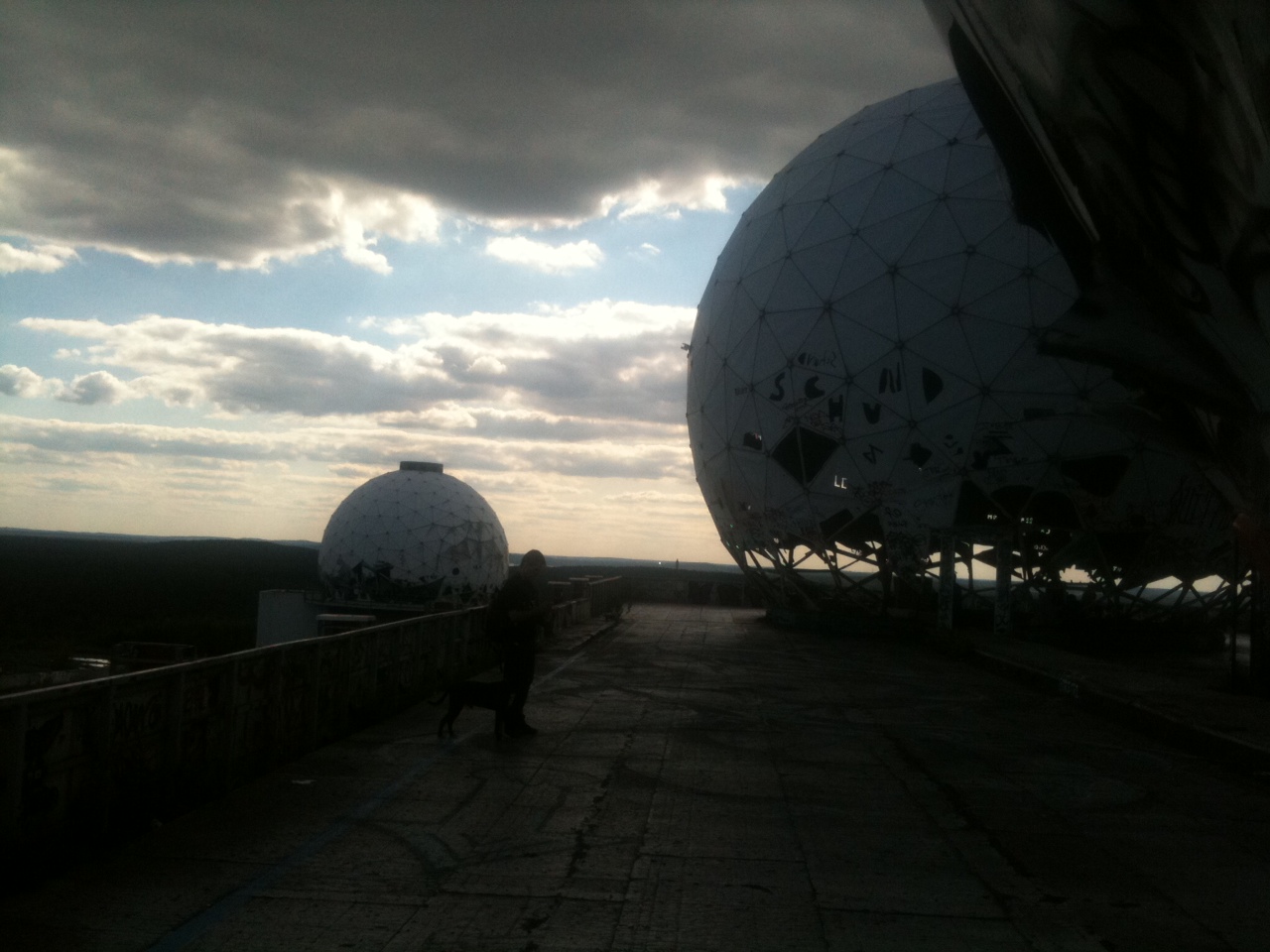
It feels natural to imagine this place without any humans, just like mathematical communication theory works best without them. Only the ghostly shouts and echoes that ensue. Ping, echo request.








 Machinology