Archive
Carnal Knowledge: Towards a New Materialism Through the Arts
Some years ago, probably in 2008 or so, I remember pitching with another writer a book proposal to a publisher. It would have been a short introduction to “new materialism”, a theoretical wave that argued/s for there to be much more in the world than representations, signifying structures and ideologies — that non-human things exist, independently of us, and that for us to understand matter and embodiment, we need to see it as active, dynamic and stemming from the primacy of relations. Well, the proposal did not get too far. The other reviewer was more or less puzzled about the whole existence of the term, writing that it was just invented for the purposes of the proposal and did not have currency outside in academic debates — in other words, new materialism does not exist (despite the proposal flagging that it is not only Manuel Delanda who had used the term but also Rosi Braidotti, with significant theoretical debates in material feminisms of for instance Grosz and Barad, and of course theoretical ideas since Lawrence Grossberg to the very different ideas of matter and the non-human by Latour and even Kittler!).
 Only within months books with “new materialism” in their title, or with allusions to it, like Jane Bennett’s Vibrant Matter, started to come out and even more strongly identify a field and a wave of interest. This theoretical discourse has been recently continued with publications such as New Materialism: Interviews & Cartographies. For me, it is important to really understand the multiplicity in debates concerning matter, the real and non-human — something that at times get understood very narrowly and in a very recent context, despite the longer roots of such ideas. Dolphjin and van der Tuin write nicely that “Our proposition is that new materialism is itself a distinctive trend, both in feminist theory and in cultural theory more broadly, and a device or tool for opening up theory formation.” (100)
Another book discussing new materialism – especially in art theory and practice – is now out. Edited by Barbara Bolt and Estelle Barrett Carnal Knowledge: Towads a New Materialism Through the Arts engages with a range of practices and artistic media, from painting to video, film to dance in order to elaborate new vocabularies of materiality. I have not seen the whole book yet, but I myself co-authored a piece on dance — on a fantastic choreography performed by himself, Tero Saarinen: a modulation of Stravinsky’s Rite of Spring, now called Hunt. The media artist Marita Liulia did the visuals. The piece is explosive. The angle of the text is on dynamics of movement, primacy of relations and biopolitics of dance.

White Stripes to Zombie Media – A Theme Tune
Jack White might not agree but White Stripes’ “Rag & Bone” goes at the top of my list for the theme tune for zombie media and media archaeology. Listen to it.
If you don’t want it, we’ll take it; if you don’t want to give it to us, we keep walking by.
Keep going, we’re not tired.
Got plenty of places to go, lots of homes we ain’t been to yet.
West side, southwest side, middle-east, rich house, dog house, outhouse, old folks house, house for unwed mothers, halfway homes, catacombs, twilight zones.
Looking for techniques, turntables to gramophones.
So take a last lick of your ice cream cone.
And lock up what you still want to own.
But please be kind.
And don’t rewind.
All of your pretty, your pretty little rags and bones.
All that obsolete stuff and junk, piled up, ready to be used, reused, modified and reappropriated – your rags and bones that fill the attic, the junkyard, the garage.
Of course, this applies to Jack White/White Stripes more generally too. He might not acknowledge that also the pre-digital is technological but still, this is where it actually gets interesting. For instance recording in non-digital studios (Elephant was recorded in London, at Toerag Studios):
It’s all tech, and scholars of music technologies and sound recording could tell much more about that. For Kittler, of course, it was about the reuse of war technologies in the studio, from Stockhausen’s late 1950s use of “the pulse generator, indicating amplifier, band-pass filter, as
well as the sine and square wave oscillators “, all remnants “ discarded U.S. Army equipment” (1999: 97) to Abbey Road . Microphones and tape technologies, all points to the primacy of the studio as this set, place of experimental modes of time axis manipulation and hence reality manipulation. Continuing with Kittler: “Berliner’s primitive recording technology turns into a Magical Mystery Tour. In 195 4 , Abbey Road Studios, which not coincidentally produced the Beatles’ sound, first used stereo audiotapes; by 1970 eight-track machines had become the standard; today discos utilize 3 2 or 64 tracks, each of which can be manipulated on its own and in unison.226 “Welcome to the machine, ” Pink Floyd sang, by which they meant, “tape for its own ends-a form of collage using sound .” In the Funkspiele of the Abwehr, Morse hands could be corrected; in today’s studios, stars do not even have to be able to sing anymore. When the voices of Waters and Gilmour were unable to hit the high notes in “Welcome to the Machine,” they simply resorted to time axis manipulation: they dropped the tape down half a semitone while recording and then dropped the line in on the track.” (109)
Similarly, it’s the operative technics that allows Jack White to do his rag & bone sort of technicity, completely technological too, and why not even a bit of zombie mediaesque in some of its valorisation of the media archaeological moment. Obviously, part of the narrative of rock is the insistance on the authencity which itself is consolidated through technical media.
And that is the trick. In the perceptive note by Ryan Bishop and John Phillips, in their book on avantgarde aesthetics and military/modern technologies they write of this constitutive role of media as environments for such a narrative that keeps on recurring — and is itself recursive in relation to the technological platform sustainining it: ” […] recording technology – like military surveillance technology – is designed to reduce the evidence of the technology itself, bringing the performance into your living room or bar, replacing “live” music, perhaps to the detriment of live performers.” (2011: 89).
Rhythm & Event: The Aesthetico-Technical
I am giving a talk here: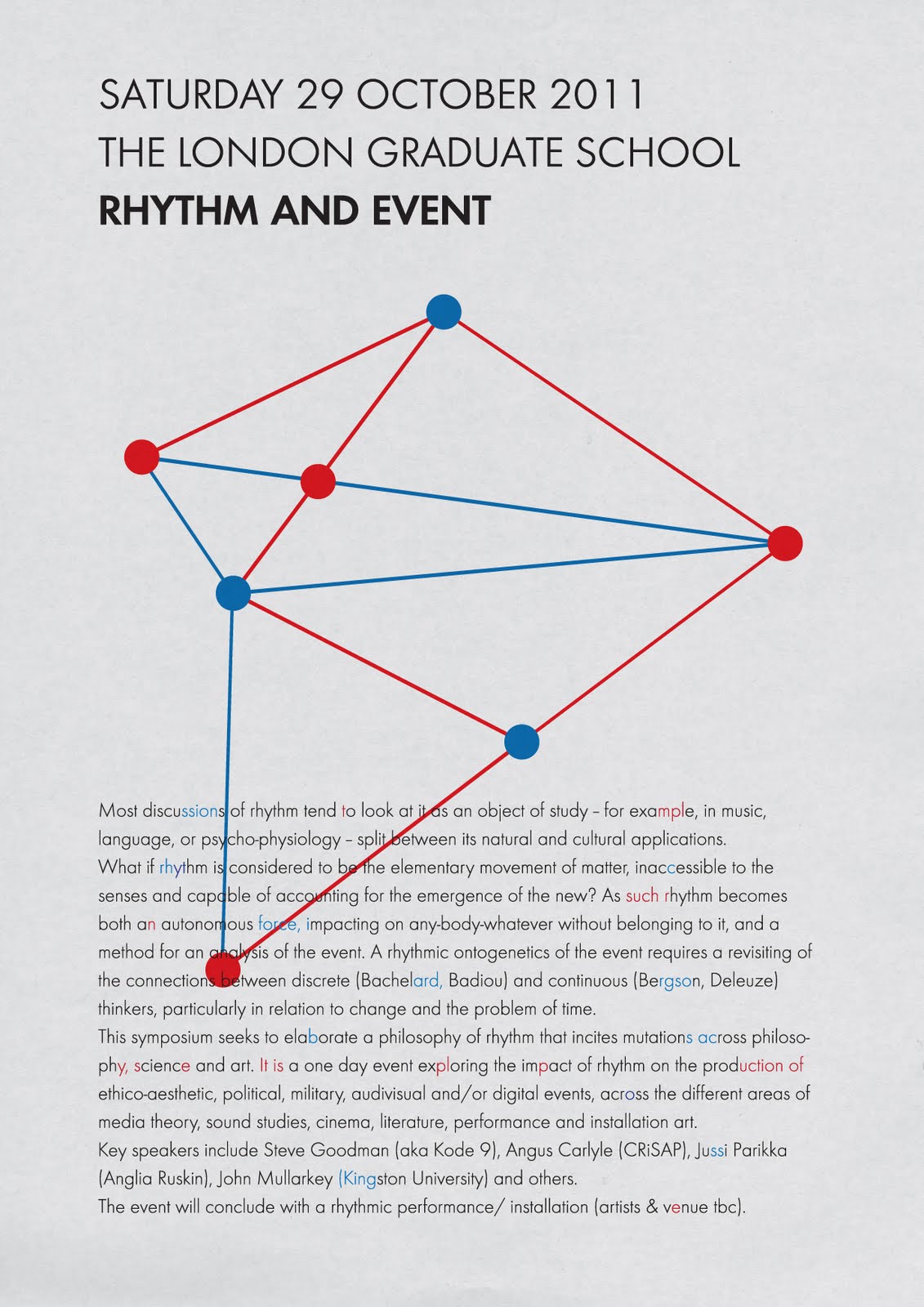
The London Graduate School, Kingston University, presents a one day symposium on Rhythm & Event, Saturday 29 October 2011, King’s Anatomy Theatre and Museum.
Can a concept of rhythm, understood as a vibrational, irregular, abstract-yet-real movement, lurking at the unknown dimensions of the event, bridge the gap between actual & virtual, analog & digital, spatial & temporal, as well as between theories & practices of sound? The purpose of this symposium is to elaborate a philosophy of rhythm as an appropriate mode of analysis of the event, and a method with which to account for the process of change and the production of novelty in contemporary environments.
Plenary speakers include, Matthew Fuller (Goldsmiths College) & Andrew Goffey (Middlesex University), Angus Carlyle (LCC, CRiSAP), and Jussi Parikka (Winchester School of Art/ University of Southampton). The event will conclude with an electronic audiovisual performance and wine reception.
For details and registration, please visit this link: tiny.cc/rhythm-lgs
And my talk at the event, at least an approximation of this summary:
The Aesthetico-Technical Rhythm
Despite the insistence on the objective materiality as a grounding for technical media culture, a key realization that framed also technical media was that of rhythm – or more widely vibrations, waves, rhythms, and patterns. From the 19th century discoveries concerning Hertzian waves and Fourier transformations, Helmholtz and Nikola Tesla to mid 20th century research into brains and brain waves mapped and modulated through EEG (W.Grey Walter and the British Cybernetics), and onto contemporary digital culture of algo-rhythms (Miyazaki 2011), this talk maps a short genealogy of rhythmic technical media. The talk focuses especially on the epistemological mapping of sound words by the Institute for Algorhythmics (Berlin), and argues for an aesthetic-technical connection to think through the sonification of non-sensuous digital worlds. Referring to Wendy Chun’s (2011) ideas concerning the invisibility-visibility pairing in digital culture, the talk addresses not code, but rhythm as the constituting element for technical media.








 Machinology