Archive
Lab Work in Linköping
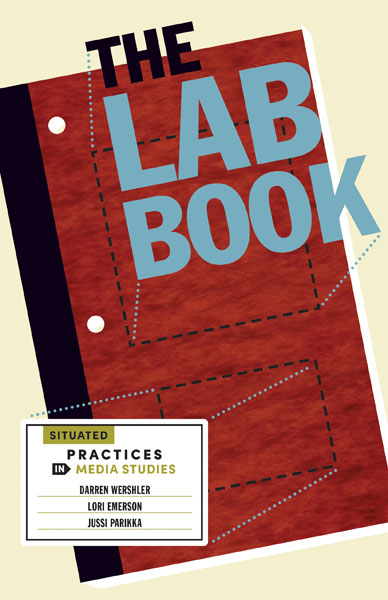
On Thursday, I am one of the participants in a symposium on labs in the humanities and media archaeology. In Linköping (Sweden), the event organised by Jesper Olsson addresses the question of institutional forms of media and humanities work.
 It is an exciting event for many reasons, andit is a good platform for some of the ideas me and Lori Emerson together with Darren Wershler have been thinking about relating to the genealogies and current institutional forms of the lab in digital humanities but also in those practices (such as Media Archaeology) that border digital humanities and might help to extend its reach to address the material cultural reality.
Indeed, in a recent interview I conducted with Wolfgang Ernst, he underlined that we also need to address the “humanities of the digital” that could then offer also a longer historical trajectory to the question of technology in humanities theory and pedagogy. This would also include a reflection on the specific institutional sites for such scholarly activity. It also continues my interest in “techniques and practices of theory”.
A follow-up to the Linköping discussions is organised as part of the Media Art Histories 2015 event in Montreal in November where we have a panel on this topic of labs across digital humanities, media archaeology and more.
The Media Philosophy of Messengers and Transmission
 Sybille Krämer’s Medium, Messenger, Transmission: An Approach to Media Philosophy is the first book in our new book series Recursions (Amsterdam University Press). The influential book that represents one significant strand of so-called German media theory is translated by Anthony Enns and is now available!
Enns has also written a very good introduction to the book that offers a context in which to understand Krämer’s impact in the field of media theory and media philosophy. Her work has over the years addressed philosophy of technology, cultural techniques and processes of formalisation in mathematics, as well as themes relating to artificial intelligence, language and rationalism. Krämer is interested in how a focus on the technical apparatuses is not sufficient for us to understand the wider field in which media works – she is interested in mediality. Krämer’s take on media philosophy introduces different models for such medial operations of transmission and messaging.
As Enns outlines in his translator’s introduction, Krämer’s position suggests that:
“(1) A philosophy of mediality can only begin by recognizing that there is an unbridgeable distance between the sender and the receiver ‒ a distance that can never be overcome.
(2) The medium occupies the intervening space between the sender and the receiver, and it is able to facilitate their connection while still maintaining the distance that separates them.
(3) All forms of communication are reducible to acts of (non-reciprocal) transmission between the sender and the receiver, as unification and dialogue remain impossible.
(4) Transmission is an embodied, material process, yet it is frequently understood as disembodied, as the medium is supposed to be invisible through its (noise-free) usage.” (Enns 2015, p.13).
Enns outlines how Krämer’s phlosophical position refuses technological determinism but is constantly interested in how the non-human participates in communication even if we often mistake and reduce agency to the humans participating in the event. Hence it is a take different from Friedrich Kittler’s but also differs from the hermeneutical accounts to understand mediality. Enns continues how “[a]ccording to Krämer, all of these various forms of transmission ‒ angels,
viruses, money, translators, psychoanalysts, witnesses, and maps ‒ can be seen as media in the sense that they simultaneously bridge and maintain differences between heterogeneous worlds. The messenger model thus depends on the basic insight that a community of different individuals is founded on the distance that separates them, which precludes the possibility of unification or intersubjectivity, and all attempts at communication are actually acts of transmission, as communication is fundamentally unidirectional, asymmetrical, and non-reciprocal.” (Enns 2015, p. 16).
As series editors, we hope that the book will have the wide impact it deserves, being such an important take on fundamental issues that speak to media and communication scholars but also to the wider philosophical and cultural discourse concerning what mediation means.
You can find the introduction to the Recursions book series online (Academia.edu) and copied below.
Please consider asking your library to order a copy of Krämer’s exciting study!
For review copies, you can contact AUP or one of us series editors.
***
Recursions: Editors’ Introduction by Jussi Parikka, Anna Tuschling and Geoffrey Winthrop-Young
Recursions: Theories of Media, Materiality and Cultural Techniques is a book series about media theory. But instead of dealing with theory in its most classical sense of theoria as something separate from practice that looks at objects and phenomena from a distance, we want to promote a more situated understanding of theory. Theory, too, is a practice and it has an address: it unfolds in specific situations, historical contexts and geographical places.
As this book series demonstrates, theory can emerge from historical sources and speculations still closely attached to material details. We therefore speak of the recursive nature of theory: It is composed of concepts that cut across the social and aesthetic reality of technological culture, and that are picked up and reprocessed by other means, including the many media techniques featured in this book series. The recursive loops of theory and practice fold and define each other. The genealogies of media theory, in turn, unfold in recursive variations that open up new questions, agendas, methodologies, which transform many of the humanities topics into media theory.
The Recursions series revolves around the material and hardware understanding of media as well as media archaeology – a body of work that addresses the contingent historical trajectories of modern media technologies as well their technological condition. But we are also interested in addressing the wider field of cultural techniques. The notion of cultural
techniques serves to conceptualize how human and nonhuman agencies interact in historical settings as well as to expand the notion of media to include the many techniques and technologies of knowledge and aesthetics. This expansive – and yet theoretically rigorous – sense of understanding media is also of great use when considering the relations to biology and other sciences that deal with life and the living; another field where media studies has been able to operate in ways that fruitfully overlap with social studies of science and technology (STS).
Overall, the themes emerging from the Recursions book series resonate with some of the most interesting debates in international media studies, including issues of non-representational thought, the technicity of knowledge formations, and the dimensions of materialities expressed through biological and technological developments that are changing the vocabularies of cultural theory. We are interested in the mediatic conditions of such theoretical ideas and developing them as new forms of media theory. Over the last twenty years, and following in the footsteps of such media theorists as Marshall McLuhan, Friedrich Kittler, Vilem Flusser and others, a series of scholars working in Germany, the United States, Canada and other countries have turned assumptions concerning communication on their head by shifting the focus of research from communication to media. The strong – and at times polemical – focus on technological aspects (frequently referred to as the ‘materialities of communication’) has since given way to a more nuanced approach evident in appellations such as ‘media archaeology’ and ‘media ecology’. These scholars have produced an important series of works on such diverse topics as computer games, media of education and individuation, the epistemology of filing cabinets, or the media theories underlying the nascent discipline of anthropology at the end of the nineteenth century, thereby opening up an entirely new field of research which reframes our understanding of media culture and the relationship be tween media, culture, politics, and society.
In other words, these approaches are distinguished by the emphasis on the materiality of media practices as well as the long historical perspectives they offer. A major part of the influences of recent years of media theory, including fields such as software and platform studies, digital forensics and media ecology, has been a conjunction of German media theory with other European and trans-Atlantic influences. The brand name of ‘German media theory’ commonly associated with, though not restricted to, the work of Friedrich Kittler – is a helpful label when trying to attempt to identify a lot of the theoretical themes the book series addresses. However, we want to argue for a more international take that takes into account the hyphenated nature of such influences and to continue those in refreshing ways that do not just reproduce existing theory formations. We also want to challenge them, which, once again, refers to the core meaning of recursions: variation with a difference.
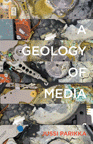
A Geology of Media – out and available
So this is a sort of an announcement: I was happy to receive my first copy of A Geology of Media during my visit to UNSW in Sydney. In other words, the book is now more or less out – a bit ahead of schedule and gradually available in online and offline bookshops, and of course in different e-formats (Kindle, epub, etc) already!
The earlier published little e-booklet The Anthrobscene was a short preview single of this main book that is also now out!

My talk in Sydney was the first “book talk” after the book is actually out, and it will be followed by several more during the Spring. The talks are primarily in Europe, and some launch celebrations are planned for May in Winchester (at WSA), and also London, Vienna, Utrecht and Stockholm. More details of dates and places to follow.
Please find below the official release text with information on how to obtain a review copy! Please spread the word to people who might be interested and consider asking your university library to order a copy.
A sweeping new ecological take on technology

A GEOLOGY OF MEDIA
By Jussi Parikka
University of Minnesota Press l 224 pages l April 2015
ISBN 978-0-8166-9552-2 | paperback | $24.95
ISBN 978-0-8166-9551-5 | hard cover | $87.50
Electronic Mediations, Volume 46
Media history is millions, even billions, of years old. That is the premise of Jussi Parikka’s pioneering and provocative book, A Geology of Media, which argues that to adequately understand contemporary media culture we must set out from material realities that precede media themselves – Earth’s history, geological formations, minerals, and energy.
PRAISE FOR A GEOLOGY OF MEDIA:
“Jussi Parikka’s A Geology of Media really expands what media theory can do. The materiality of media is no longer restricted to questions of economies of technics but extends all the way to its molecular composition. It connects the fast calculations of digital time to the deepest of temporalities, that of the earth itself. An essential contribution to a media theory for the Anthropocene.”—McKenzie Wark, author of Molecular Red
“A Geology of Media does not complete or close down an area of research, but rather opens one up. This book is vital to any continuing consideration of media today.”
— Steven Shaviro, author of The Universe of Things: On Speculative Realism
ABOUT THE AUTHOR:
Jussi Parikka is professor in technological culture and aesthetics at Winchester School of Art, University of Southampton. He is the author of Insect Media (Minnesota, 2010), Digital Contagions, and What is Media Archaeology?
For more information, including the table of contents, visit the book’s webpage:
http://www.upress.umn.edu/book-division/books/a-geology-of-media
Electronic Mediations-series.
For review copies or author interview requests, contact:
Heather Skinner, Publicist
University of Minnesota Press
111 3rd Ave S, Ste. 290
Minneapolis, MN 55401-2520
skinn077 — at — umn.edu
v * 612-627-1932
f * 612-627-1980
Made By: The Finnish Institute
The Finnish Institute in London has an interview series “Made By”. Alongside earlier interviews with designers, artists, etc., they did a little chat with me which you can find here.
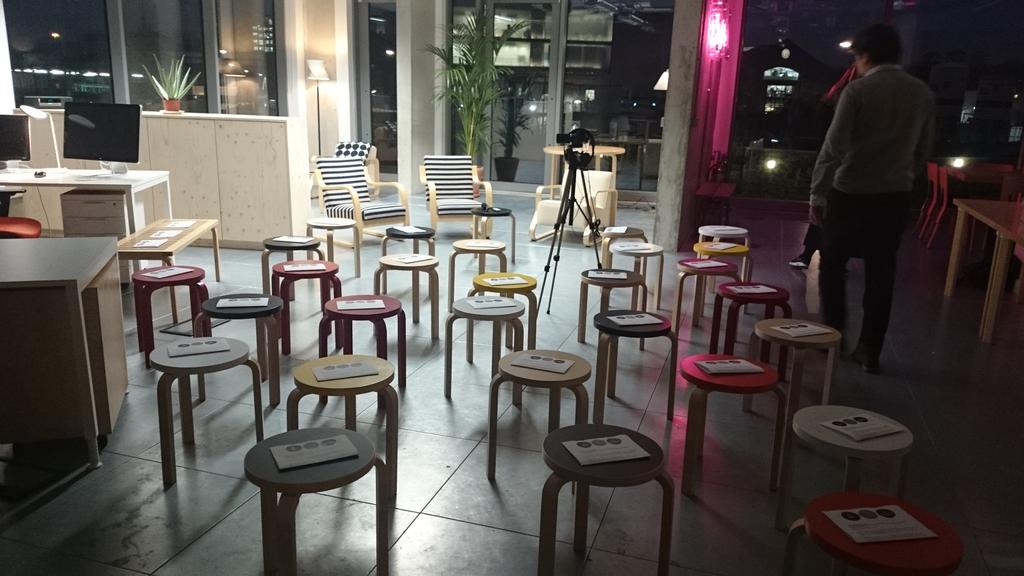
Around the same time as this came out, early February, we had a conversation event at the Institute on historical knowledge, technology and the digital humanities. Notice the Finnish design and wooden materials that characterize the space – a sea of Aalto waiting for the audience.
The Consortium: On Autonomous Sensing
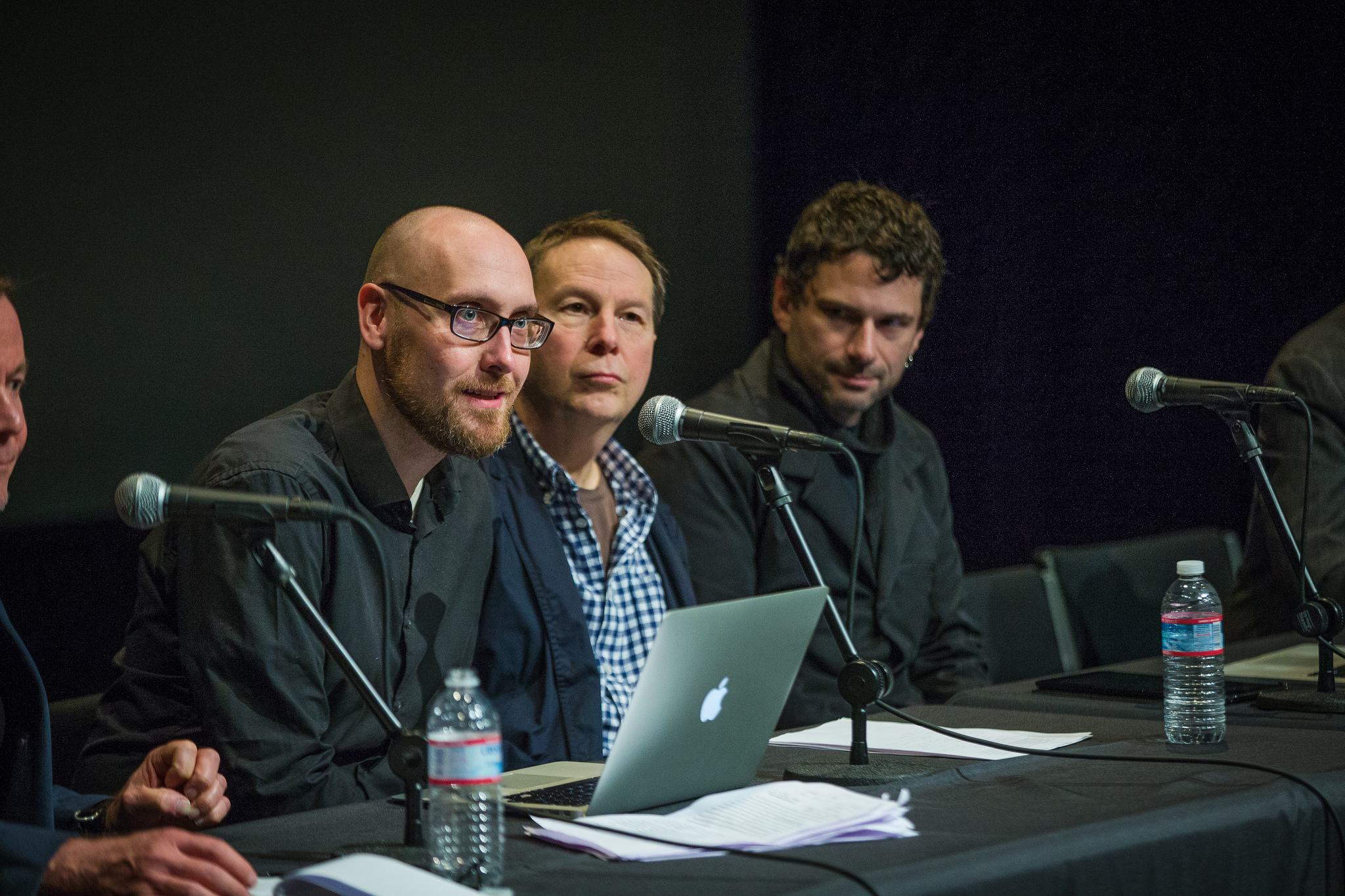
Last Spring we at #WSA started a consortium partnership with two other universities: University of California (San Diego) and Parsons School of Design (New School, NYC). Together with Jordan Crandall and Benjamin Bratton from USCD and Ed Keller from Parsons we are addressing themes such as machine perception, remote sensing, synthetic intelligence, etc. We are also organising a panel for transmediale 2015 – and Jordan Crandall will be in performing his drone performance Unmanned.
But already before transmediale at the end of this month, we are organising a group meeting and a public panel this week in San Diego under the rubric of “Autonomous: Sensing“.
Last Spring, we organised a panel in Winchester on Design and Contemporary Technological Realities and we aim to continue these meetings alongside some publications and curating exhibitions with the consortium partners.
— update —
Below some pictures from the San Diego-event and our panel.

A Post-MECS Interview
I was Senior Fellow last year at MECS at Leuphana University in Germany – here’s one of the things I did there, an interview now online:
Forerunners
As a follow-up to the previous post about the Anthrobscene-publication, you can find the press release for the Forerunners-series here.
In the Press Release, the editor of the series Danielle Kasprzak outlines:
“Forerunners gives authors space to explore idea-driven works that often aren’t taken up by university presses. These pieces are shorter and more speculative than traditional monographs, and we see them reaching a wider, interdisciplinary (even general) audience. Our goal with Forerunners is to combine the value of an academic publisher—peer review, editorial guidance, copyediting, and production—with the timeliness of agile publishing tools. These pieces are out in twelve weeks instead of twelve months, and they’re affordable and accessible.”

Ubiq Computing And Smart Cities – a write-up
Here’s a nice short write-up of the Computing the City-event that took place at the Leuphana University in Germany in July. The various papers addressed several analytical, historical and ethical aspects of ubiquitous computing in the context of smart cities. We will be continuing on similar themes in one of the panels we (Winchester School of Art) curated for the forthcoming transmediale-festival.
A Mini-Interview: Mercedes Bunz explains meson press
meson press’ first book, Rethinking Gamification (PDF), was just released in Lüneburg. Part of the Hybrid Publishing Lab at the Leuphana University, the press focuses on digital culture and network media with the aim to “challenge contemporary theories and advance key debates in the humanities today.” I was interested in inviting one of the representatives of the press, Mercedes Bunz, to share in the style of some earlier mini-interviews I have conducted what she sees as the stakes in coming up with a multiple-format publishing house that focuses on theory.
Most of scholars are increasingly frustrated with the dinosauric habits of big academic publishers, but how to establish alternatives in the academic world that is challenged both by the necessity of new formats and by the only slowly changing recognition systems of the academic world?
The burning questions in publishing seem to be about the changing media ecology of academia of which publishing is one part – and inherently connected to institutional settings and subject-positions.
In other words, the question posed to Bunz: 
“What and why is meson press as a theory publishing project and does it connect with the wider question of the “post-digital scholar?”
Mercedes Bunz: “You are right: publishing itself gets profoundly questioned by digital media, it isn’t just that digital media is an exciting field for theory because it never stands still.
The interesting thing: while we all know that within publishing there is “disruption”, oddly enough this doesn’t necessarily mean that there will be change. It might be true that technology offers alternative ways of publishing. However, reputation management and academic recognition systems stand in the way and ensure that nothing changes. Thus, the situation we find ourselves in is slightly mad: technically there are many ways to publish and share intelligent thoughts by now. However, young academics can’t use those alternatives because then their book a) can’t find its way into academic libraries which means b) they don’t get cited, or c) the book isn’t recognized for their CV. For all of that it still needs an approved publisher. Our technical super-connected, post-digital world is left helpless.
Of course, one can’t accept this.
meson press works its way through this situation. Naturally as academics who are also media scholars, we are quite interested in exploring the question: What chances are there in digital book production for theory debates? Our answer so far is the following: We publish open access, and this makes books easily findable and pushes citation. Also we foster the findability of our books regarding search engines and catalogues, and take marketing quite serious. However, the most important difference in my opinion is the conceptual understanding of what this is: a book.
Similar to Mattering Press, or Christopher Kelty’s scholarly magazine Limn http://limn.it/ our publishing project is an academic cooperative: from academics for academics. This means in our view, a book becomes a place to meet and debate, similar to a lecture, a workshop, or a seminar. Editing a book was always a starting point for a discussion, copy-editing was always a way to connect or disagree. It is this tendency which now needs to be further amplified. In other words, we take quality assessment very serious and try to turn it into a concept: A book isn’t just a product that starts a dialogue between author and reader. It is accompanied by lots of other academic conversations – peer review, co-authors, copy editors – and these conversations deserve to be taken more serious. In a post-digital world one needs to understand that a book is a process that gives good reason to meet in person. Formats like book sprints have lead the way. Wendy Chun has also inspired us to create a writing group in which we constructively discuss a non-completed essay or chapter.
So I suppose this is how meson press connects to our situation as post-digital scholars. As a publishing house which is also a publishing project, we focus on the book as a form of communication, and this communication is an important part of its production. This is a way to optimize its task: to intervene, and challenge (which is not an easy task in our neoliberal societies). But we like the humanities, and we like them alive and kicking.
If I may give you a little overview of our upcoming publishing projects: After”Rethinking Gamification” we will publish two forgotten classics: The first will be by the Greek-French philosopher Kostas Axelos “On Marx and Heidegger”, which is edited with great care and expertise by Stuart Elden. We are very interested in Axelos’ take on technology and alienation. The second will be by Antonia Caronia “The Cyborg”.
Also we are very proud that Yuk Hui and Erich Hörl have started editing the series “After Simondon” with us, and we are preparing two edited collections “Diffracting Kittler: German Media Theory and Beyond” and “Critical Keywords for the Digital Humanities”.
Sorry, but may I end this little interview with an appeal? If anyone has an idea for a thrilling book proposal in the context of digital culture and media studies, please send us a short trenchant abstract and chapter overview to: mesonpress@hybridpublishing.org.”
Designing Techno-Political Realities and Imaginaries
We at the Winchester School of Art (#WSA) are hosting this lovely little event – with quite the trio: Benjamin Bratton, Jordan Crandall and Ed Keller are coming to Winchester for meetings and agreed to give a joint panel on Design, Biopolitics and Contemporary Technological Realities – and imaginaries we might want to add.
More info here, and below their titles for the short interventions in the panel:
Benjamin H. Bratton: “On Platform-Based on Robotics”
Jordan Crandall: “The Materiality of Drones”
Ed Keller: “Shadow Ecologies, An Alternate Biopolitical History”









 Machinology