Platform Politics-conference: Opening Words
 We organized a very successful Platform Politics-conference in Cambridge, May 11-13, where our speakers included such exciting scholars and writers as Michel Bauwens, Michael Goddard, Tiziana Terranova, Nick Couldry, Nick Dyer-Witheford, Felix Stalder, and Tim Jordan.
These are my short opening words to the event:
Platform Politics takes place as part of the Arts and Humanities Research Council founded networking project on Network Politics. We pitched it to the AHRC with the suggestion that it takes one to know one: to understand emerging forms of social action and politics on networks and in network society, one has to develop networks, to crowdsource ideas from leading scholars, activists, artists; to map and to bring through various channels such partipants together in order to identity themes and directions which need more focus. Hence, we have arrived at the third and final event of the project – now on Platform Politics, following the first event in Cambridge on Methodologies of Network Politics research, and last year in Toronto at the Infoscape research lab with help from Greg Elmer, Ganaele Langlois and Alessandra Renzi we discussed object oriented and affect approaches to network politics.
We wanted to keep the notion of platform quite broad in order to solicit a more open range of papers. Hence, from software platforms such as Twitter and Facebook to robotics, from theoretical insights that draw from post-Fordist theories of politics and labour to object oriented philosophy, and much more, we have a privileged position to think through the platform (often seen as technological, as in platform studies) as a platform for our investigations (hence, also as a conceptual affordance). This does not mean to say that platform studies as represented in the Bogost and Montfort led series is techno-determinist, and solely focuses on such – quite the contrary, it tries to find a specific relation between technology and aesthetics. Yet, it is good to emphasize the mobilization of the concept as part of various transitions, and translations: platforms in technological (and again there various levels from apps to clouds, online platforms to technological hardware structures), conceptual, economic and of course political sense (expect at least a couple of references to Lenin in this conference).
So if Bogost and Montfort make sense of platform studies through this kind of layering:

Bogost and Montfort: Platform Studies
I would add that the notion of platform politics is able to articulate various levels together, and bring smoothness and movement to the interaction of the layers. In other words, in addition to the specific level of “platforms” we can think of the platform itself as distributed on a variety of layers as assemblages (in the manner Manuel Delanda uses the term?). A good example of this – something we were unable to pursue because of the problem of finding the slot for it! – was the idea of organizing a circuit bending/hardware hacking workshop (with Seb Franklin). The idea was to follow Garnet Hertz’s lead, and the way he has organized such workshops both to kids as well as to media theorists — and to use hands-on tinkering, opening up technology such as battery-operated toys, as a way to think through hardware platforms, how design solutions incorporate politics, how they afford conceptual approaches, and act as one node across a variety of other platforms. (An example of such is articulated in the forthcoming “Zombie Media: Circuit Bending Media Archaeology into an Art Method”-text, by myself and Hertz, in Leonardo-journal where we tie the question of such design politics of hardware to media archaeology, art methods and the political economy of network culture).
Platforms reveal to be ontogenetic – i.e. creative forms of interaction, not just stable backgrounds for a continuation of the social. They organize social action in a double bind where social action organizes them. Platforms rearticulate the social. For instance software platforms constitute a catalyzer for specific social forms, and as such incorporate in themselves a multitude of social, political, economic forces. It is a question of production – and of what kinds of social relations are being produced, a good example being the Telecommunist project and the Thimbl open source distributed microblogging service that incorporates a different sociability than proprietorial web 2.0 business and software models. And yet, this sociability is grounded on the level of the potentials of networks, the P2P instead of Web 2.0, distributed instead of the centralized client-server-model.
At the beginning of the project, we started with the question of “”what is network politics?”” and requested initial position papers from some key writers in the field – today of those we have Tiziana Terranova and Greg Elmer attending. Other theorists included Alex Galloway, Eugene Thacker, Katrien Jacobs and Geert Lovink.
The idea was to organize this as a form of request for comments – the RFC format, familiar from internet design culture, of questioning, lining up comments and positions, which however did not pan out as extensively as we wanted (this has to do with other organizationally interesting themes concerning spam management in participatory platforms, and so forth). However, what we got from the position papers were some initial leads. Furthermore, we started with some assumptions where to start tracking network politics:
– politics of new network clusters, services, platforms – Twitter, Facebook, as well as mapping alternative forms of software-based ways of organizing traditional political parties as well as new formations, NGOs, and temporally very different groupings/phenomena – whether the suddenly emerging and as suddenly disappearing “like” protests for instance on Facebook, or the more long-term effects of Wikileaks– leak not only in the meaning of leaking secret information, but leaking across media platforms, and reaching a long term sustainability through “old” media trying to come grips with such online activities.
– biopolitics of network culture, or in other words, the various practices which form internet cultures – hence a step outside of the technological focus, to look at what practices define network politics, and as such the links between work and free time, of play and labour, the circulation of affects, sociability, and so forth. Cognitive capitalism but as much affective capitalism. Yesterday (referring to the pre-conference event with Michel Bauwens and Michael Goddard) we got a bit into talking about investments of affect, desire and such topics.
– we were interested too in the metaquestion: what form would investigating network politics have to take? Outside the normal practice of humanities, writing and meeting up in conferences, what are the specific pedagogic and research tools/platforms that are actively changing the politics of education and research inside/outside academia. What are the research/creation platforms that are able to articulate this, so that we are not only stuck with “master’s tools”?
– And in a way, as a more unspecified but as important was the question of politics of the imperceptible: what kinds of forms of politics there are out there that are not even recognized as politics? From artistic practices to the grey work of engineers, new arenas of expertise, skill and again, social action contribute to the way in which politics is fleeing from traditional institutions.
The project has been able to map various positions to such questions, and raise new ones – which has been the purpose of this all: to produce more leads for further work. The same thing applies to this conference, and we are hoping to come out with excellent contributions, that do not fall within such original ideas. During the project’s unfolding, “network politics” became a wider popular media phenomenon too, where old media started to focus on what is was able to brand as “twitter-revolutions, or facebook-revolutions” – and yet this only emphasized the need to complexify the notions, and the histories of such events and platforms, as has been done on various email lists, and various other debate forums already. I am sure we can continue on that, and produce some really exciting discussions – and as always in our events, we really hope that a lot of the emphasis is on discussions in the sessions, as well as outside them.
New reviews of Insect Media
The new issue  of Speculations: The Journal of Speculative Realism is now out, and includes a nice review of my Insect Media. The issue (vol 2) can be downloaded as PDF from this page. The issue includes essays by Levi Bryant, Christopher Norris and for instance Robert Jackson.
And another review came out on Rhizome.org just recently. Thanks to both reviewers for perceptive comments and feedback.
Train/Cinema
I was lucky to visit Malmö (and the Medea Lab too) to talk about media archaeology just a couple of days ago and on the way back saw this attractive public art projection of remediative proportions. At the Malmö train station platform a projection that imitates the windows of a screen is a nod towards the train passenger’s view as cinematic glimpse into landscapes, people, things passing by, as well as a form of cinematic spectatorship where the projection wall could be seen as stabilized frames – a frozen film, or actually where the frames are frozen but the image magically carries on. As such, the train platform was a great location for this as a small but somehow silently beautiful nod to this historical conjunction between technologies of transport and technologies of vision. How we move (and are moved) is mediatic as well.

And thought just to mention that I am writing this post on the train.
Unnatural (Media) Ecologies
 After a long wait, it’s out like nature itself! The Fibreculture-journal Media Ecology-special issue, titled “Unnatural Ecologies”, and edited by me and Michael Goddard.
The idea for a journal issue was picked up and continued from a panel organized for the MeCCSA conference in Bradford (2009) where I spoke with Matt Fuller and Michael Goddard on the media ecological approach in media and cultural studies. With Michael, we picked up on the idea of rethinking media ecology “after Matt Fuller’s work”, i.e. how we can transport the concept and practices into new directions that differ from those of the more classical media ecology work by (post-)McLuhan scholars. Hence, we ended up thinking more about Guattari’s three ecologies, Simondon, political and art practices, as well as nature itself as media. One of the leading ideas that Michael emphasized was how to think media ecology as a practice itself – how to understand it as a set of theories in practice.
Hope you enjoy the issue!
(My own text addresses “ecomedia”, nature as a communication framework [Harwood-Wright-Yokokoji and Mediashed art project] and extending that towards imaginary media as a reimagining how far back in time and as practices we can extend “media”.)
Ghostly reincarnations: an interview with Katy Price
This one-question mini-interview with Dr Katy Price (Anglia Ruskin University) is a follow-up on the interview I did with Aleks Kolkowski. Katy has collaborated with Kolkowski on the old sound machine remediations, and has herself done various projects on sound and word art – as well as being a researcher interested in the interchanges between science and literature. I find her take on materialities, appropriation of science and tech, and experimental, playful and inventive take on these themes fascinating. I asked Katy to elaborate a bit how she sees working with obsolete technologies, and how does her word art intertwine with media archaeological themes and Kolkowski’s work with old recording tech:
Katy, you have recently collaborated with Aleks Kolkowski on a project that involves working with old media, appropriating old recording technologies such as Edison wax cylinder discs for creative practice, creative writing. Already before you have been interested in your word art (see for instance here) in working with sound, and creative music technologies, but what specifically makes working with these kinds of “obsolete” technologies interesting? Could you elaborate a bit on your artistic methodologies and interest in these themes (old media, co-curation with audiences as the project now with Science Museum, etc)?
Dr Katy Price: Thanks for asking about this Jussi. For me it is all about the relationship between our use of the latest consumer items and our making through history. A heightened awareness of this relationship – and ways to share this as entertainment.
The past informs how we use and think about our bodies and their companions or additions or substitutes. One way to experience this is through reading about the past and receiving inspiration from historians. Somebody like Paul Fussell points out that memory of the First World War – mud, wire, slaughter and filling in surreal forms – shapes everyone’s identities, even if we weren’t born yet. Or Paul Théberge traces how we assumed the identity and practices of consumers: not just of music but consumers in the act of music-making. All the way from the pianola to MIDI and sampling.
Those are both stories that begin around the start of the twentieth century and there is a great appeal for me in this period because you can almost see, taste, hear the past and the future washing up against each other on the street and in people’s homes: bowler hats and horse-drawn carriages collide with illuminated advertising, cinema, ‘noiseless’ typewriters. I think we would laugh so hard if we suddenly found ourselves on Piccadilly in 1925. And instantly want one of everything. People had a lot of hopes and vision – you could dream about inventing anything, from a new type of escalator to a new society. At the same time there was a lot holding people back – no such thing as maternity leave; lots of brothers, fathers, lovers, left behind in the mud in France or falling apart at home. Under those circumstances, dreaming about the future is both necessary and tough, even impossible. I think we could do with knowing how to be a bit like that now.
The audience for academic books is quite restricted and also the mode of experiencing messages from / about the past is limited to reading the book and perhaps making images in your mind or writing some notes. I found a different angle from the experience of musical artefacts on display and in performance. At the Science Museum in London there is a brilliant case in the Making the Modern World gallery. It is a jumble of items (actually organised by inspiration from a curious thinker called Patrick Geddes) and in one corner you have a Stroh violin next to an ammoniaphone – for use by opera singers and the clergy, to improve their voice before performance with a gust of ammonia – phew! Nearby there is a prosthetic arm. Because the case isn’t directly telling me how to relate these items or how to think of their place in history, I feel almost the privilege of having come across them in a curiosity shop.
But you can’t play with the items in the museum case, or see them in use.
Aleks Kolkowski has collected and restored the only working Stroh quartet: two violins, viola and cello. Instead of wooden bodies they have a metal horn (enormous on the cello). Completely mechanical: no electricity! The horn is attached to a diaphragm which picks up the sound – you play it with the bow as normal, but it sounds almost reedy, and much louder in the direction of the horn. It was used until the 1920s to make the strings audible on early gramophone recordings, before microphones. The group Apartment House played a concert on the Strohs in Cambridge a few years ago, including a piece by Aleks which incorporated two cylinder phonographs. They were all attached together with plastic tubes, which struck me as a mechanical parody of electronic connectivity. It got me thinking about how artefacts in performance can give the audience a chance to think about today’s technology in our lives by seeing an amusing or strange performance with obsolete items.
The next thing I saw was a concerto for Pianola and iPhone composed by Julio d’Escriván, which he performed with Rex Lawson. Rex is a great showman and he is happy to show the audience how the pianola works. Julio is interested in how audiences perceive the minimal gestures of laptop musicans, and he works with the iPhone in ways that make us aware of our own need for a correlation between gesture and output sound. The combination made me think that performances like this can invite us to see the new gadgets as artefacts for a moment.
I am now working a little bit with the Science Museum on how to use creative writing as part of the process of co-curation / co-creation. This means that audience groups are invited to select objects and tell stories about or through them, for display in an exhibition. So far we spent 2 days with a group of young people. Aleks showed them his phonographs and gramophones, and talked about these mechanical objects. I got them to write monologues and poems. For example: what the gramophone said to the ipod and the other way round. Then we recorded these works onto wax cylinders and gramophone discs. They were captivated by the items from Aleks’ collection: the look and feel, the sound of themselves coming back in this ghostly form. They found the mechanical process mysterious and intriguing – which it is. How can sound be captured and played back without electricity?They learned a bit about the history of sound recording and we had a lot of fun. Their writing was amazing and I think there is a lot more we could do with speaking through these artefacts: unlike other forms of object writing, you have the opportunity for double voicing when it is recorded and played back using this item.
Aleks is building up a phonograph archive of wax cylinder recordings of contemporary artists and musicians. I won’t say too much about this for now but prepare to be amazed when it is launched… I have heard some of the cylinders and the effects are stunning. They will be digitised and online soon. For the archive I wrote a poem in two voices: Thomas Edison and Charles Cros, who had the idea for the phonograph at the same time but Edison got it on the market first. We recorded one voice on the cylinder and the other one over the top, so that they weave in and out of each other. When Aleks told me about Cros, his interest in language and plans for communication with extra-terrestrials, I recognised him as one of those hopeful impossible figures of his time. He clearly deserved to be reincarnated on a wax cylinder, interfering with Edison’s confidence.
“Cine-Variety and Spectacular Entertainments”
Something warmly recommended – organized by my colleague and film scholar Tina Kendall with partners – and that has a nice media archaeological quality to it: revisiting the origins of cinematic cultures, through the late-Victorian and Edwardian cultures of performance. While this resonates with our current enthusiasm with performance, liveness and embodiment, it also is a wonderful time trip to early cinema contexts.
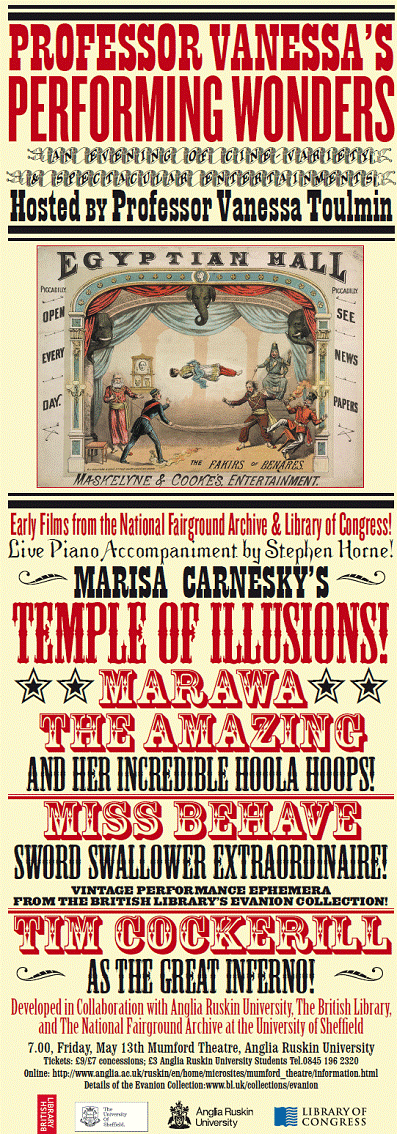
Friday 13 May, 7.00pm
Mumford Theatre
Cambridge, UK – Anglia Ruskin University
Curated and hosted by Professor Vanessa Toulmin (the National Fairground Archive, University of Sheffield), join us for an evening of cine-variety and spectacular entertainments. Featuring early films with live piano accompaniment by Stephen Horne, vintage ephemera from the British Library’s Evanion collection, and performances by internationally renowned artists including Olivier award winning showwoman and artiste Marisa Carnesky, Swordswallower and eccentric comedienne Miss Behave, Hoola Hoop legend Marawa the Amazing, and fire eater Tim Cockerill appearing as The Great Inferno. Don’t miss this extravagant showcase of neo-variety acts and the late-Victorian and Edwardian performance cultures that inspire them!
Developed in collaboration with Anglia Ruskin University, The British Library, and the National Fairground Archive, University of Sheffield. Films preserved by the Library of Congress Packard Campus for Audio-visual Conservation.
Tickets: £9.00 (£7.00 concessions, £3.00 Anglia Ruskin students)
Book online, call the Box Office on 0845 196 2320 or see our booking information page for more options.
“Sonic Alchemy”: an interview with Aleks Kolkowski
“Sonic Alchemy” – an interview with Aleks Kolkowski on his media archaeologically tuned sonic art methods
London-based musician and composer Aleksander Kolkowski occupies himself with the sound of the obsolete. This means working both with techniques and technologies of sound recording from past times, as well as investigating the nature of sound cultures through creative clashes between the old and the new. He has a long and extensive career as musician and performer, and has recently in his performances engaged with such technologies as Stroh instruments, wind-up Gramophones, shellac discs and wax-cylinder Phonographs. Aleksander Kolkowski also ran workshops at the Science Museum as part of the Museum’s Oramics-project.
The interview (March 2011) w as conducted to elaborate Kolkowski’s artistic methods and interests, especially in relation to “media archaeology” as a creative form of crossbreeding and producing hybrids from old and new media innovations and artistic experiments. Juss i Parikka was affiliated with the Science Museum early this year as a short term research fellow, working on his new book on media archaeological theory and methods.
Jussi Parikka: Aleks, a big thank you for having the time to this interview. I am fascinated in how your work is very much embedded in old media – an inventive engagement with old recording technologies from wax-cylinders to gramophones and with instruments such as the Stroh violin. Why engage with old media? Can you tell a bit more about your “artistic methodology”?
Aleksander Kolkowski: Thank you for asking. I’m reminded of a quote by David Tudor, the New York avant-garde musician and John Cage’s muse, who in response to being asked about the then late ’80s electronic music scene said ” if you look at the background of the analog technology, there are marvellous things from two centuries ago that are worthy of being investigated.” For creative musicians, old recording technologies and related instruments are rich veins from which to draw from, but this has as much to do with current artistic practices and handling of modern technology as it has to do with an interest in the past.
In today’s culture, computers, turntables, electronic devises and smartphones can all be considered as ‘instruments’ for music-making, that’s to say they are being played with or manipulated, rather than passively emitting or processing sounds. Additionally, the noises produced by altered or malfunctioning media, be it hacked electronics, feedback, scratched records or skipping CDs, have been used as material by artists for sometime now. It’s in this same spirit of actively engaging and interfering with media technology and re-purposing it, rather than merely consuming it, that we can re-examine the media technology from the distant past and use it creatively. I’ll add that this has nothing to do with nostalgia, but with a belief that we can use these bygone technologies to offer an alternative perspective in our digital media-fixated society – to listen to the present through the pioneering audio technologies from well over a hundred years ago.
While there is a delight in playing with old machines and instruments, bringing them ‘back to life’ and engaging with the past through a mixture of research and practical experience, there is a feeling that this somehow challenges the very notion of their obsolescence. It has something to do with a reaction to consumerism and to the disposable nature of current media technology, its intangibility and limited shelf-life.
I began this work twelve years ago and I suppose it started as a personal response to the techno-fetishism that was prevalent in much of the experimental music-making at the time. Instead of electronic interfaces, I performed with wind-up gramophones, phonographs, and a mechanically amplified violin in unusual ways to make what sounded like contemporary electronic music, but using no electricity whatsoever. Since then I’ve been incorporating modern digital as well vintage analogue electronics in my work. Software programs have become important tools in my recent compositions and installation work where the historic and the modern are combined.
In a way, you work as a creative researcher, a historian, or an archaeologist, then?

Research played a part from the very beginning, investigating the origins of the Stroh violin is what really got me started on this journey. So histories to do with sound recording and its reproduction and early recordings became integrated in the fabric of the work I’ve produced at every level, from the concept stage, as narratives to provide structure right to the actual content itself, be it treating the first ever recordings of music as the basis for acoustic and electronic explorations or using the first morse code telegraph message to create rhythmic structures in a composition.
These creatively inspired explorations have actually led, in recent years, to more conventional, academic research (at Brunel University) into little known forms of mechanical amplification and an involvement with artefacts from museum collections in the UK and abroad.
You do not only tinker with old technologies but perform music with them live as well. How do people react to your work and instruments?
The reaction of audiences has had quite an important effect on my work. I found that people would marvel not only at the sight of these splendid old instruments and machines, but where captivated by the sound in interesting ways. Playing back a newly recorded wax cylinder on a phonograph to a modern audience is taken by many as a kind of sonic alchemy, and it requires a very different kind of listening than what we’ve all become used to. Rather than hearing a virtual copy, it’s closer to a memory of something. So it seemed possible to work with the relationship of sound and temporality by ‘ageing’ sounds using old technology, to be transported back in time, then forward to the present through the sound recording media of the past.
Do you think there is currently a wider artistic and sonic interest in going back to the pre-electronic age?
Probably not to the same extent as in literature, film or fashion, that’s to say the Steam Punk movement which has more to do with fantasy and science fiction. There are musicians releasing limited edition cylinder records, artists building machines, and composers utilising the pianola, but I’d mention the sound art of Paul DeMarinis to do with ‘orphaned technologies’ from the pre- and early electronic era as being the most significant example I can think of in this field. He is a true scientist of sound who has delved into seemingly obscure forms of communications technology and created some highly interesting and accessible works.
Certainly a lot has been published over the past few years concerning 19th century science, histories and theories of technology and communication, especially with regard to sound and the history of recording, which must be indicative of something, so yes, there is a wider interest, but then artists have always foraged the past. What’s special at this point in time, is the speed and severity at which digital media is replacing the analogue and which is conversely breathing new life into all forms older physical media, be it film, chemical photography, the cassette tape and even the wax cylinder.
I saw you recently (February 2011) do a workshop with the Science Museum together with Katy Price (Anglia Ruskin University). The workshop was part of a Science Museum Youth and Public Engagement to support their Oramics (Daphne Oram) project. Could you tell a bit more about this and the workshop where you recorded short pieces of creative fiction written by the students onto Edison cylinders and other old media?
In this case it was to show that the origins of Daphne Oram’s sound painting can be traced back to 19th century advances in capturing, visualising and reproducing sound through the phonoautograph and subsequently the phonograph and gramophone. We were also treating groove-based sound recording as a form of inscription, as sound-writing. It seemed fitting that the creative writing resulting from Katy’s sessions around the Oramics Machine and related artefacts in the Science Museum collection should be rendered onto physical storage media in this way. They could then be played back on the same cylinder phonographs and gramophones the participants had written about and even become objects that furnish an exhibition.
The fundamentals and science of sound recording are vividly demonstrated through mechanical devices, through objects you can touch and sound inscriptions you can see and hear played back via styli, vibrating diaphragms and horns. As well as showing how our forefathers experienced recorded music, it also offers us a different kind of listening experience as I’ve mentioned before. It helps us to examine our relationship to recorded sound, the antiquated sound-engraving processes add distance to the newly recorded voices, allowing us to reflect more profoundly on what we hear.
New materialism still feels new

Silhouettes of the iconic Haraway and Braidotti
Seeing two such iconic scholars as Donna Haraway and Rosi Braidotti on stage at the same time is always a treat. This was in the context of New Materialism: Naturecultures, a wonderful continuation of last year’s New Materialisms and Digital Culture, and continuing the vibrant discussions surrounding how to think the material as dynamic and alive – and diffractively leaking across disciplinary borders of knowledge, assembling into new theory war machines, intensive encounters, and problematics that themselves offer milieus for fresh thought. Organized by Iris van der Tuin and Rick Dolphjin, the conference featured speakers such as Haraway, Vicky Kirby, Adrian Mackenzie, Milla Tiainen and Melanie Sehgal – as well as yours truly. It’s clear that Haraway was the main feature, starting the whole day with her energetic talk “Playing Cat’s Cradle with Companion Species: Naturecultures-in-the-making.” It drew on the figure of the string – and the Cat’s Cradle game – which visualizes, embodies and is a tool-to-think-with knots knotting, ties engantgling, and relations in-the-making. In other words, companion species and the importance of the “with”. At the same time, all presentations worked towards interesting directions in aesthetics and science of mattering dynamics. My own emphasis was on “medianatures” as a version of “naturecultures” topological continuum.
Again the conference succeeded in moving across science, technology and philosophy, and the importance of material feminisms was present (not only because the event was organized in Utrecht, easily one of the leading gender studies centres of the world). As such, as van der Tuin nicely elaborated in her opening words – new materialisms are transversal at their heart. Next year’s event is organized in Linnköping (with Cecilia Åsberg), and is themed “Genealogies of Matter”. The name already promises even more transversal connections, cartographies of though-movements and forging discussion across different ways of engaging with matter, the real, and things/processes non-human too.
For instance, it would be interesting to articulate something about the relations between the mode of questioning in speculative realism and object-oriented-philosophy and new materialism. With such figures as Shaviro, Delanda and for instance Whitehead (and as always, Deleuze) quoted frequently on “both sides”, it is actually slightly surprising no further discussion has emerged. New materialisms is very strongly affiliated with feminist discussions which is one of its strengths and points towards a different set of politics that engage not solely with ontology – but with labour, sexuality and a range of cultural practices. Of course, its not that OOP is solely about ontology, but its clear that the direction of discussions has been taking it to a different set of questions than new materialism that has a very strong relation to other disciplines outside philosophy too – cultural and gender studies, Science and Technology, as well as media theory, I would add.
Meanwhile, while returning from the Netherlands to Berlin, this advert on Schiphol airport reminded me of what we need to address: the cultures of mobility, at the core of circulations of neoliberal regimes of governing too, articulated together with the seeming lightness of cloud computing, which however is at the core of the new materialities of digital culture – which far from immaterial are embedded in very heavy materialities as their sustaining “background forces”…
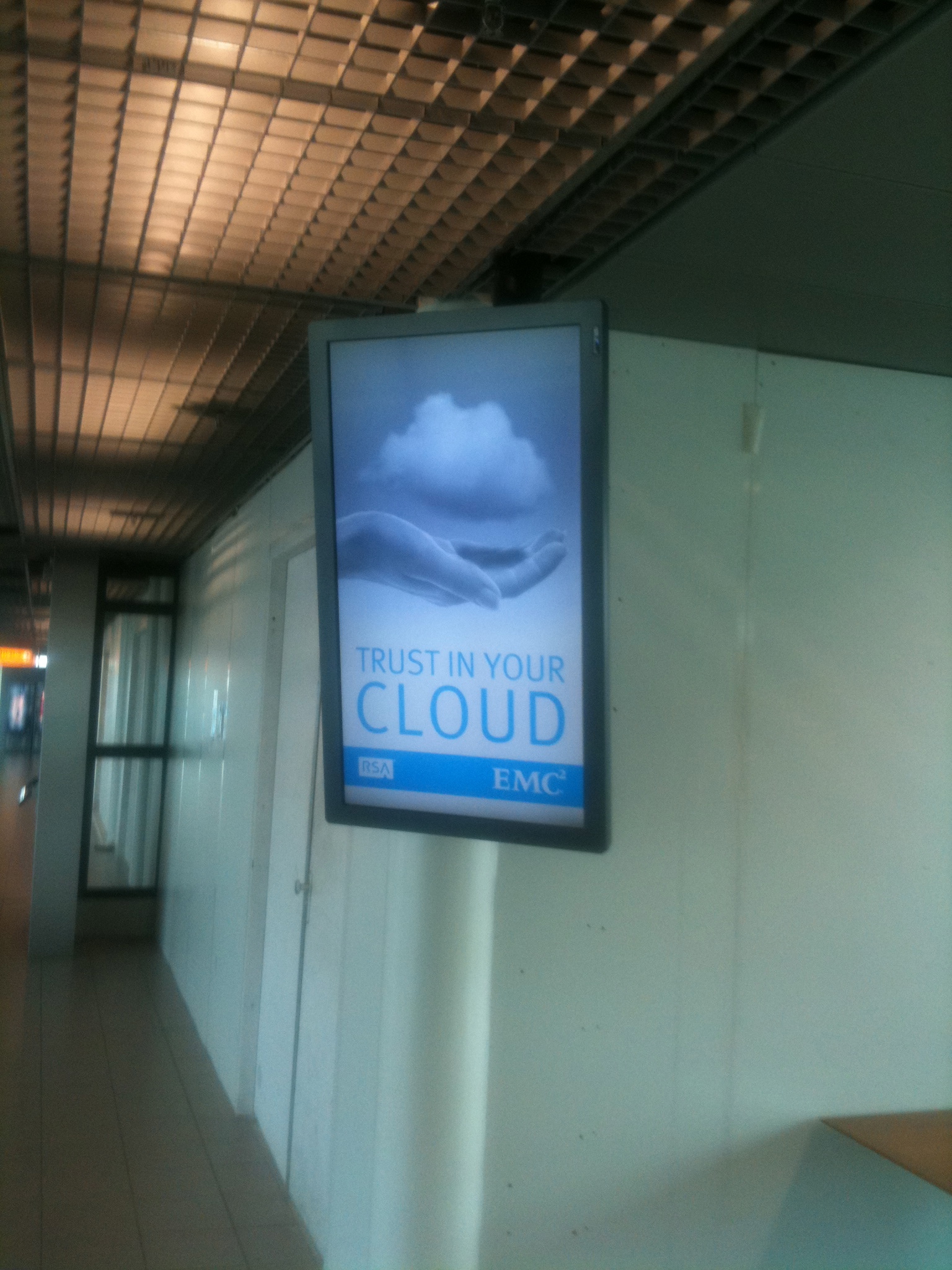
Cloud computing takes trust - and energy
Living Mediations: Hastac Forum on art, science, technology
The people organizing HASTAC forums kindly invited me to participate in their new topic “Living Mediations: Biology, Technology and Art“. It touches not only on “biomedia” but more widely in the co-expansion of the biological and the technological/mediatic that we are witnessing as part of regimes of cognitive/affective capitalism (as I would see it). This is where the various meanings of the notion of “medium” come to play, and are investigated – media as technologies, but also as milieus, and interactions of the living. It is through this individuation that any medium/milieu itself is born – not as pre-existing background, but as the vibrant and changing milieu in which we too take place – and take displace. Such milieus are material, and some have used the notion of affect to understand this material, even visceral nature of mediatic milieus of contemporary culture. Affect – as we know from a variety of writers from Massumi to Shaviro – is itself a notion through which to understand the constitution of the pre-individual as shared, circulating, dynamic and I would say mediatic. As such, it expands much beyond bodies, as its a concept to understand their interrelations, and thus also the dynamic change of relations between bodies. For me, the intriguing bit is how such notions both help to think relations and changes in relations between bodies, but also as concepts travel (slightly in the manner of Mieke Bal’s traveling concepts) between regimes of knowledge production: media, scientific apparatuses and knowledge, labour, etc.
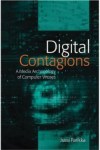
Insect Media fits into this double articulation that the forum proposes – but so does Digital Contagions I would say in the manner it looks at the constitutive mediation not only of computer viruses as a specific phenomena, but how virality itself is at the core of mediation (and is itself, mediatic). Contagious, just like affect is.
Read the entries, and participate in discussions here!







 Machinology