Out of our heads, in our media
I am off to Berlin Transmediale 2012-festival soon — excited as always. Giving there two talks; the latter one on Sunday on a panel organized by Tim Druckrey on methods for media art histories — I guess an unofficial media archaeology panel with Siegfried Zielinski, Wolfgang Ernst and Inke Arns!
And something different already on Friday; a performance with Julio D’Escrivan, mixing media theory and live coding… part of the Uncorporated Subversion-panel! Here is a short summary, but for the whole effect…be there on Friday. Should be worth the while, I promise…even though, in terms of the theme of “cognitive capitalism” that the paper touches a bit; I am not at all uncritical towards it, and agree it misses several key points. However, the notion is good, I would say, as a way to continue such investigations as Jonathan Crary has started into the ways in which cognition in a very wide sense, embrasing embodied, affective being, perception, sensation, is constantly articulated “out of our heads” (Alva Noë) — but in our media; a media ecology of production of perceptive, thinking, remembering subject. The collaborative form between me and D’Escrivan has itself been again a great way to work together. Last year we tried out similar things with Garnet Hertz (also with our Transmediale theory prize nominated paper on Zombie Media), and now through the performance.
This presentation can be best approached as an experiment in theory-code-collaboration, through live coding (D’Escrivan) and some speculative media theory (Parikka) concerning techniques of the cognitive. With some minor notes that reflect live coding as a practice, the focus is more or less on the notion of cognitive capitalism. What the talk/performance presents are some tentative steps towards a media archaeology of cognitive capitalism. In other words, what are the supportive, sustaining and conditioning techniques that contribute to the cerebral? In this context, we propose to step away from a cognitive as understood as immaterial or as inner life, and towards a cognitive that is distributed, supported, relayed and modulated continuously in a complex information ecology. We are interested in investigating forms of collaboration between code and sonic arts, and media theory, and investigate collaboration as a form of (extra-)institutional practice in contemporary arts and education field.
Launch of Winchester Centre for Global Futures in Art Design & Media
This is our new centre (where I am a Senior Fellow). All welcome!
Launch of Winchester Centre for Global Futures in Art Design & Media
Wednesday 1 February 2012, 5:00 p.m. to 8:00 p.m.
Lecture Theatre A (above the WSA Gallery; Westside Building)
University of Southampton
Park Avenue, Winchester, Hampshire, SO23 8DL
WSA is very proud and excited to announce the launch of its new research centre: the Winchester Centre for Global Futures in Art Design & Media.
To mark this occasion, the Centre will be hosting an evening of talks on Wednesday, 1st February 2012, 5:00pm to 8:00pm. Speakers will include Winchester Centre’s newly appointed Professor, Turner Prize nominated artist Jake Chapman, artist and Head of School Bashir Makhoul, and art historian Jonathan Harris, Director of Research at WSA.
Newcastle University’s Professor of Cities and Society, Stephen Graham will also speak on the topic of ‘Cities Under Siege: The New Military Urbanism,’ which explores the import of visual technologies and practices in the complex intersection of urbanism, militarisation and artistic practice. Professor Graham will be introduced by Winchester Centre Co-Director Ryan Bishop, who will explore the links between Graham’s theoretical work and Makhoul’s upcoming solo exhibition at the Yang Gallery in Beijing this spring.
A drinks reception will follow the talks in the WSA Gallery.
Winchester Centre embodies the ethos of research-led practices in Art, Design and Media at Winchester School of Art. The Centre highlights historical, contemporary and future roles for art, design and media within globalization. Its members build sustained collaborations with international partners in public service, the creative industries and civil society. Critically concerned with art and design practices of making, thinking and representation, the Centre actively engages in education and enterprise, exploring the contribution of media, materials and technologies to the improvement of human societies globally.
Led by recently appointed professors Ryan Bishop, Sean Cubitt, Jonathan Harris and Bashir Makhoul, Winchester Centre will make a decisive contribution to the work of WSA and the University at large, as well as to the larger communities of Winchester, Southampton and Southeast England.
More information about the Winchester Centre’s activities, research interests and events can be found at http://www.soton.ac.uk/wrc
Admission is free and all are welcome.
Complicity with Anonymous Media
Thomas Pynchon’s Gravity’s Rainbow (1973) and its paranoid military-scientific worlds of technology, sexuality and hallucination became one inspirational figure for a whole wave of media theory. What could we do with Reza Negarestani’s Cyclonopedia (2008) then, which seems to include some similar stylistic elements, of transdisciplinary writing that wanders across rats and soil, petrol(ology) and archaeology to understand Middle-East? From Pynchon’s WWII Europe, to Negarestani’s Middle-East, politics of petrol.
The archaeological method of Negarestani’s Cyclonopedia represents a theory-fiction alternative for media archaeology too. What if we employ the same hallucinatory, inspiring way of investigating the subterranean, the secret, the ground that is not defined by stability but dynamic flux of sediments alive, burrowed by rats, worms and archaeologists? We can call this investigation new materialist because it believes in agency of matter, and multiplicity of things both organic and non-organic. What does this multiplicity mean? It means a microworld that unravels when you zoom close: close enough, and the skin is not a unity, but porous folding, layered, and filled with bacteria. The soil is not stable, but a constantly slowly pulsating topology, with its own affordances, and indeed, again, bacteria and other forms of life. Same applies to everything, even metal, or as Deleuze and Guattari would say, especially to metal. In their metallurgical thinking, it is the body without organs, here better understood through the idea of what flows through everything – metallurgical cosmology. This is why they insist on the relatedness of machinic phylum and metal – and why they say that everything is a machine (not because it would be modelled on any already existing machine or technology!)
“Even the waters, the grasses and varieties of wood, the animals are populated by salts or mineral elements. Not everything is metal, but metal is everywhere.” (DG)
In Cyclonopedia, the character Parsani calls the approach to the subterranean “bacterial archaeology” – an archaeology that starts from the non-human agents and microscopic attraction points within matter. And the matter extends to politics, society, and power:
“Bacterial Archeology. It is imperative for Parsani, in his approach to the Middle East, to make clear that everything related to the Middle East emerges, moves, diffuses, escalates and engenders itself through and out of the holey Hezar’to (A Thousand Insides; the Persian word for labyrinth) and the Petrologies of Bacterial Archeology.’”
The earth moves, and hums.
The methodology is that of exhuming, which both archaeologists and rats share.
“If archeologists, cultists, worms and crawling entities almost always undertake an act of exhumation (surfaces, tombs, cosmic comers, dreams, etc.), it is because exhumation is equal to ungrounding, incapacitating surfaces ability to operate according to topologies of the whole, or on a mereotopological level. In exhumation, the distribution of surfaces is thoroughly undermined and the movements associated with them are derailed; the edge no longer belongs to the periphery, anterior surfaces come after all other surfaces, layers of strata are displaced and perforated, peripheries and the last protecting surfaces become the very conductors of invasion. Exhumation is defined as a collapse and trauma introduced to the solid part by vermiculate activities; it is the body of solidity replaced by the full body of trauma. As in disinterment — scarring the hot and cold surfaces of a grave — exhumation proliferates surfaces through each other. Exhumation transmutes architectures into excessive scarring processes, fibroses of tissues, membranes and surfaces of the solid body.”
Just for speculative reasons, let’s use the same logic of thought to our technological excavations and use this as inspiration to think of the exhuming we do with media cultural topics – or machines themselves. One cannot help relating this to the epistemology and hallucinatory methods of Microresearch Lab, where the processes of soil and nature already technological are excavated in order to proliferate new surfaces – like the skin of the machine, that does not stop at the visible surface (interface/cover). It is topological, and folds in to a multiple surfaces, some inside, some abstract, some irrational.
In terms of animality, Cyclonopedia talks about rats as one agency of exhuming, parallel to archaeologists. How about then: Rats as archaeologists, or rats as media theorists? Such animals work less as metaphors than as vectors to think through the non-human force of analysis. To actually end up somewhere else than with more human focused vocabulary of cultural theory and methodology.
Furthermore, can we even extract ideas for archaeological politics – a politics for the military-industrial complex in the age of advanced science and technology?
“Parsani claims that ‘archeology, with it’s ingrained understanding of Hidden Writing, will dominate the politics of future and will be the military science of twenty-first century’.”
The Age of Selection
Capitalism. Think of it as a military drill operation. In order for us to be consumers and subject to advertising, we need to be trained. We need to realize choice, we need to understand selection, and we need to be trained to realize that advertising…is only for our benefit. Right?
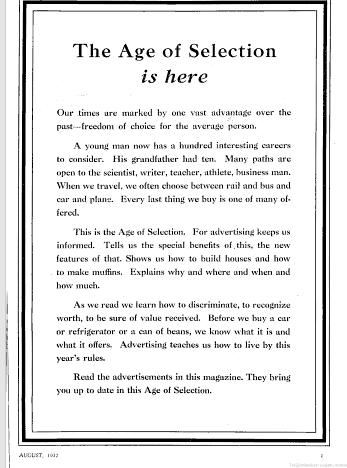
From Popular Science, 1932
Ooops
Based on this year´s blog statistics, a guaranteed way to drive up traffic is to either to write about Friedrich Kittler (after he is dead) or about Object Oriented Philosophy. The latter of these two, my previous posting gathered an awful lot of commentaries, including for me really useful feedback, so thanks to all for contributing. But it also reminded me that mentioning OOO/OOP is the guaranteed way to raise big emotions — reminding me why I never wanted to dip into those conversations. That does not mean that there is awful lot of good ideas there, but I just don´t want to get drawn into such heated discussions.
Here is Graham Harman´s mention of the discussion, also calling for more “productive debate”. I was not able to leave a comment on his blog and continue that debate so wanted just to briefly flag a couple of points here.
Firstly, for me, my blog post was not meant to poke at anyone just to irritate. I was merely interested, after reading and following debates, in some of the core questions from my perspective. I did not realize they were unproductive, and feel slightly paranoid now how my texts can be suddenly turned as part of some bigger academic catfight to which I have no desire to be part of.
Secondly, I am not interested in general debates “object” vs. “process”. Neither answers what I am after, and that is to map the specificities of technical media culture. Hence, I cannot decide beforehand whether I am dealing with object, process or something else. I am too much of a cultural historian, or a media archaeologist even, and interested in mapping/using the heterogeneous sources through which to understand technical media culture, from its technico-scientific roots to various imaginaries; political economy to political ecology; the ethico-aesthetico to aesthetico-technical. But that’s me. Others can and are (take for instance Bryant, Bogost or Paul Caplan) are doing really interesting things with OOP and media, even if I might differ on various points. I am interested in materiality, and also politics of matter(ing) – Braidotti, Grosz, Barad, Parisi, Terranova, post-fordist political theory – where questions about the real or new materialism are mobilized in so many differing, often also conflicting ways. But that’s another story.
Thirdly, in relation to Harman´s post — of course I would be saying critical things about OOP; saying critical things is just taking an interest in something. I think that is better than not saying anything critical. I have not wanted to say anything too publicly because I have felt and always added that I am not qualified to do that, and that I will leave OOP-discussions to others. So be it from now on as well, as the some of the repercussions and comments are getting too weird, already now. It’s not a very welcoming debate.
Fourthly, what I have probably said about Simondon is that he solves more problems for me than does OOP, and feels closer to the fields I am tackling with. For me, in a Kittlerian fashion, I want to articulate the double bind of philosophy and its relation to technical media — both historicized. I am a pragmatist in this way — perhaps sharing a bit of similar ground as Bogost mentioned in one of his comments to the post: interesting to see what we can do with different theories.
And btw. on top of my reading list, Bogost´s Alien Phenomenology, as soon a its out. And a couple of months after that, Braidotti´s The Posthuman. Oh the bliss of non-human world. And hats off to so many theorists of the non-human.
OOQ – Object-Oriented-Questions
I can’t claim that I know too much about object oriented philosophy. It’s often more about my friends or colleagues talking about it, enthusiastically for or against. Indeed, I have been one of those who has at best followed some of the arguments but not really dipped too deeply into the debates – which from early on, formed around specific persons, specific arguments, and a specific way of interacting.
Hence, let me just be naïve for a second, and think aloud a couple of questions:
– I wonder if there is a problem with the notion of object in the sense that it still implies paradoxically quite a correlationist, or lets say, human-centred view to the world; is not the talk of “object” something that summons an image of perceptible, clearly lined, even stable entity – something that to human eyes could be thought of as the normal mode of perception. We see objects in the world. Humans, benches, buses, cats, trashcans, gloves, computers, images, and so forth. But what would a cat, bench, bus, trashcan, or a computer “see”, or sense?
– Related to this, what if the world is not an object? What if the non-humans it wants to rescue are not (always) something we could with good conscience call objects? I guess OOP wants to treat everything as an object – across scales, genres and epistemological prejudices – and hence bring a certain flatness to the world – to treat humans and non-humans on equal footing, a project which I am in complete agreement with – but does this not risk paradoxically stripping entities, the world of specificity? For instance, in mediatic contexts, what if we need to account for the non-object based realities of such media technological realities as electromagnetism – that hardly could intuitively be called an object. Would treating such entities as objects be actually just confusing, and lead to imagined concretenesses? This question is motivated by some recent arguments in media theory, insisting that we need more careful vocabularies of the non-object nature of media; for instance Wolfgang Ernst and his discourse concerning time-criticality; Mark B.N. Hansen and his recent ideas stemming from the direction of Whitehead, in connection to ubiquitous media.
– Some people are enthusiastic because object oriented philosophy seems at last to offer a philosophical way of treating the non-human (animals, technology, etc.) on an equal footing to the human. Agencies are extended to a whole lot of entities. But such claims, whether intentionally or not, forget that there is a whole long history of such thought; the most often forgotten is the radical feminist materialism of figures such as Rosi Braidotti and Elizabeth Grosz; this goes nowadays often by the name of new materialism.
– Just a thought: The real is not the same thing as matter. Matter is not always about objects. In an interview, Grosz has briefly hinted that she is not that interested in the concept/category of the real, because that still concerns more closely epistemology. Instead, what concerns her is matter.
– Is object oriented philosophy more akin to epistemology, an operationalization of the world into modular units through which we can question human superiority– instead of it being an ontology? If we want to pay more philosophical respect to the world of non-humans – chemicals, soil, minerals, atmospheric currents and such – should we not read more of scientific research that constantly is the one who talks of such worlds, and actually offers insights into different worlds of durations and stabilities from that of the human? Don’t get me wrong – I might be a naïve observer but not that naïve: of course I know that a lot of sciences are not able to be that self-reflexive, and constantly smuggle in a huge amount of conceptual and other material that makes their epistemology infected with the human/the social, and that science is not a neutral cold gaze that just registers the world. I guess I am just interested in the world – an empiricism, transcendental, radical.
These thoughts are indeed just self-reflections of an amateur while reading object-oriented philosophy, or listening people talk about it – I think I am just trying to figure out why people are so enthusiastic about it.
Winchester Centre for Global Futures in Art Design & Media

I am now officially a member of the new Winchester School of Art Research Centre — a Senior Fellow at the Winchester Centre for Global Futures in Art Design & Media — and yes, all part of the University of Southampton!
The Centre is led by professors Jonathan Harris, Ryan Bishop and Sean Cubitt, and outlines its mission as follows:
The Winchester Centre for Global Futures in Art Design and Media highlights historical, contemporary and future roles for art, design and media within globalization. Its members build sustained collaborations with international partners in public service, the creative industries and civil society. Critically concerned with art and design practices of making, thinking and representation, the Winchester Centre actively engages in education and enterprise, exploring the contribution of media, materials and technologies to the improvement of human societies globally.
On Borrowed Time – Lazzarato and Debt
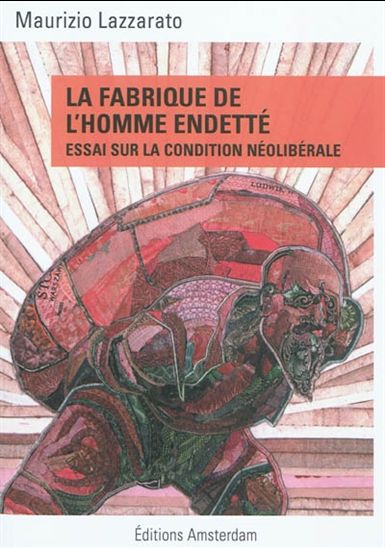 Maurizio Lazzarato’s new book La fabrique de l’homme endetté is another fabulous, lucid and inspiring account from the Italian philosopher. The short book is, as the subtitle promises, an essay on the “neoliberal condition”, which in this case encompasses an analysis of debt. It could not be timelier. This is an obvious statement but the importance of debt from the macroeconomic level of public sector national crises in Europe and US to the microeconomic subjectivity of the individual agents cannot be overestimated. Indeed, what Lazzarato offers is a philosophico-historical analysis of the debt condition via Nietzsche, Marx, Deleuze & Guattari and Foucault.
Written in an accessible style, Lazzarato’s argument is easily summarized. What grounds the economic relation is not exchange as so often assumed in classical economic theories but the credit-debt relationship. This, in other words, is a relation of asymmetric power, which is the fundamental starting point for what is followed up by economic and political contexts (two tightly related fields, argues Lazzarato distinguishing himself from Badiou and Rancière’s argument concerning the autonomy of the political from the economic). Debt as a feature of neoliberalist policies affecting exactly the diminishment of the public sector gradually from the 1970s onwards is what Lazzarato insists as a better way to understand contemporary capitalism than talk of financial capitalism. With the creditor-debt relation he is able to talk of the subjectification process inside capitalism.
Lazzarato proceeds in a clear fashion, first taking aboard Nietzsche’s genealogy of morality and explication the debt relation as one of guilt. The relation of debt is one of morality and hence encompasses the social relation before establishing the economic. The precondition for debt is that you are able to make promises, project to the future, and establish a relation of future promises made now. This temporality is a significant feature in terms of how debt attaches to the morality, the embodied subject of capitalism that Lazzarato insists is not only cognitive. Indeed, in more than one passage he argues that the theses concerning cognitive capitalism are insufficient to understand the whole relation. The investment in the cognitive, and the cognitive as the motor of contemporary production is just one modality in a wider context. Indeed, later he goes on to elaborate what he calls a more “existentialist” mode of subjectivity at the centre of this neoliberal condition. Yet, this is not Sartrean existentialism, but one that comes from William James. The cognitive is only a small part of subjectivity that more fundamentally includes more intimate things – passions, impulsions, beliefs and desires. Hence, in this mix of Nietzsche-James one is looking at more non-cognitive forces that relate to a relation to future. This futurity is something that in various different ways has been suggested as a way to understand contemporary powers of security-capital, from pre-emption (Elmer and Opel), premediation (Grusin) and futur antérieur (Massumi).
For Lazzarato, this is an articulation of belief and the necessary incertitude as its atmospheric context, which is all embedded in the wider culture of risk that we find from the discourses of entrepreneurship to work in general. Hence, Nietzschean genealogy of bodily feelings (or lets call them affect, even if Lazzarato does not really talk of affects) is one that lends itself to understand what is the social enabling the capital relation.
When bringing in Marx to his analysis, Lazzarato refers to a much less known text, “Credit and Bank” (1844). This is what Lazzarato calls the Nietzschean Marx; one who sees the condition of debt entirely attached to the subjectivity of the poor, the one who is on borrowed time (hence, applies to the rent relation as well…). Here, to paraphrase Lazzarato (p.45), the credit does not characterize only labour, but the wider work that goes into the self – instead of just investing into physical or intellectual capacities, credit/debt is something that attaches to the morality (the future-orientedness) of the subjectivity, and hence is a question of ethics. To continue with Lazzarato’s explication of Marx, this relates to a total alienation as it touches not only a specific part of the worker’s time (that of work) but the whole ethics of being as someone who is promising, bearing risks, and assuming a future. What is captured is the future-prospect, or something that Lazzarato calls as the debt-relations’ asphyxiation of futures.
Throw in Deleuze and Guattari for good measure. Obviously, so much of Lazzarato’s analyses has been already implicitly about Deleuze-Guattarian emphases that he explicates in the book. The “non-economic interpretation of economy” that DG’s emphasis of the production of the social brings in is again the point of asymmetry of power. As a certain anthropology of capital, it allows us to think, again, not exchange but debt/guilt/power as what enables the economy. The two monies of a) revenue/salary and b) capital need to be distinguished. The latter is what governs financial capitalism as a form of futurity (or pre-emption of futures) where the credit money is able to what kind of productions and products will actualize (and of course, one could add, it is not only about such but the constant deferral of the virtual money repackaged into new forms of debts – subprime).
To paraphrase Lazzarato (p.71), the approach he proposes is about the transversality of the debt/neoliberal condition. Employed, and unemployed, productive or unproductive, the state of debt runs through economic, political and social fields (ibid.). Picking up on Foucault’s points (and updating some others), Lazzarato reminds that the (neo)liberal condition is not about reduction of control and governing, as so often rhetorically claimed, but about emphasizing certain patterns of contradiction, accumulation of value and power, and minimizing the democratic possibilities of intervention (120).
For me, Lazzarato’s brilliant extended essay/book raises questions; for instance, how to elaborate the debt as embodied; Ie. what could be called, for the lack of a better word, “affective capitalism”, where the affect bit refers to the bodily and often non-cognitive states and excitations; of desires and impulsions; whether in the brain or in the gut. Could this be connected to the wider interest in brain sciences in the context of digital culture (interface design)? And the wider discourse of the brain – brain sciences in contemporary culture?
Could there be a mediatic way of continuing Lazzarato’s analyses, to connect the future-oriented subjectivity to analyses of the media technological condition of the human in contemporary neoliberalism?
Masterchef – or what you always wanted to know about desire
Everything you always wanted to know about the psyche but were afraid to ask Gregg, Monica or Michel Roux jr.
In other words, what explains the popularity of Masterchef (Professionals) is of course that it is primarily about the multiple layers of the psyche catered on our home screens, and featuring that intimate event of joy when something 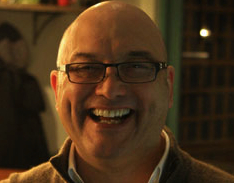 goes in before later coming out. Food.
Think of Masterchef as the structure of the psyche. It comes in three. What you have is the drooling, child-like, enjoyment – jouissance! – of Gregg, whose whole body vibrates when brought in proximity of sugary desserts. His face is the face of enjoyment, unhidden. He cannot, because that is his part, as the id, the primal orientation to joy/food/excess.
Take Monica then. The professional, cool, rarely smiling, more likely a slightly contempt-filled face of judgment: who is good enough for Michel. She judges according to the expectations of the one who is absent. She does not eat much – if she  does, it is only to evaluate, not to enjoy. She is empty, as she has to know what the Absent wants and act as the mouth of that. “This is not good enough for Michel”, is the cool, cruel judgment that lacks passion. (Yet, is she somewhere inside paranoid; what if she gets the judgment wrong?) She is impossible to please because she talks for someone else. She incorporates the function of the ego as a mediator.
Of course, Michel Roux jr. is not always absent – he does make himself visible at times. Still cool, but completely beyond the scale in comparison to others featured in the show, we are always almost double-guessing. What does he want? What does he really want? What else is that recurring ever-so-slightly missing bit but that lack that constitutes the unattainable? Hence, paranoia: the professionals who anyway have to work to please are here trying to mediate their actions in a situation of conflicting desires, ie the structures of the psyche, and finally the ever-so-slightly always missing bit what distinguishes the Absent one.
The Absent one does speak, of course: “So what is it that you want to show us?” The question of confession and subjectification. “Well, I want to be like you, Michel”. Of course, such a line never appears, would be blasphemy. Instead, what we hear time after time is “to see how far I can go.” And: “just to show what I can do”.
They are not there to enjoy the food (Gregg eats for all), but to enjoy the appreciation of the Ideal – Michel Roux Jr. (Mediated via Monica). Enjoyment comes via the Other.
So, of course, now the question is: which one do you identify with? The completely reckless hedonist Greg, or the cool evaluating and despising gaze of Monica – or the shaking, scared little competitors trying to mediate between the conflicting desires in their head externalized. As the absent one is, and remains, unattainable. And let’s not even talk about the Roux Sr.
(disclaimer: I am not and have never been a member of the Club Psychoanalytique and I read Žižek as a guilty pleasure, and never have claimed to offer accurate analyses. In other words, read this as tongue in cheek).
A Visual Teaser – What is Media Archaeology?
Just to offer the first glimpse of what’s to come. And what I was occupied with for the past 12-18 months.


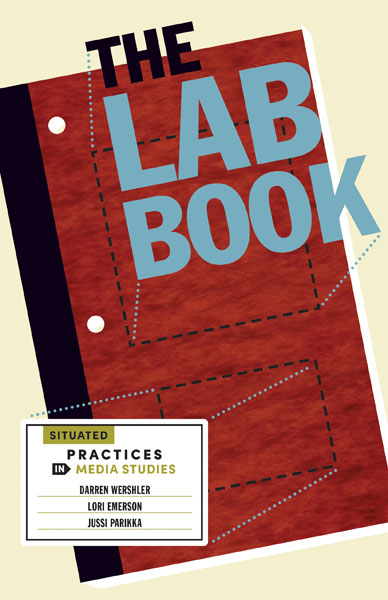











 Machinology