What is Media Archaeology? — out now
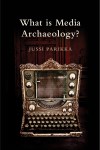
It’s out, and gradually in book stores — What is Media Archaeology? (Polity),
my new book about media archaeology (what a surprise)!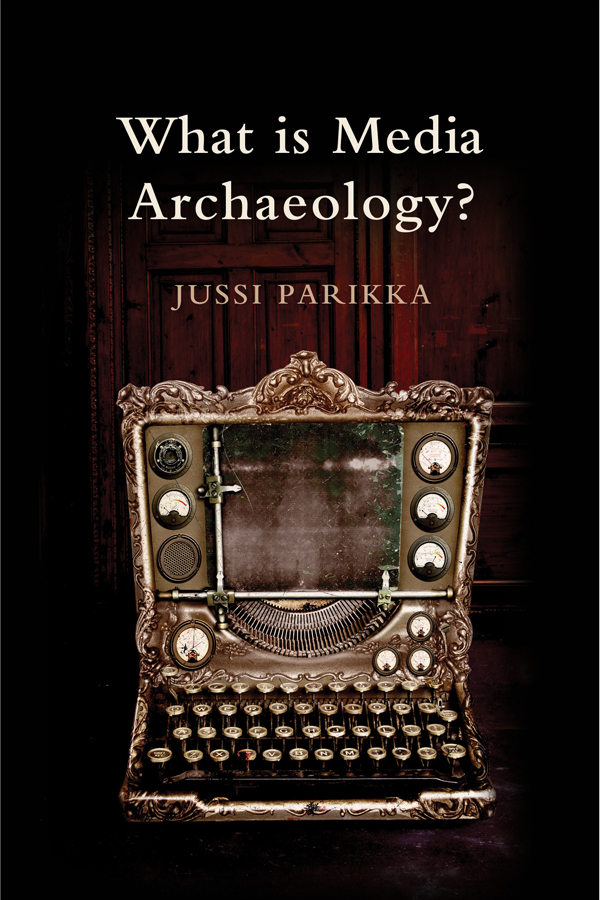
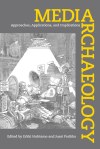
It picks up where the edited volume Media Archaeology: Approaches, Applications, and Implications (Huhtamo and Parikka) left off; this means the implications bit, and how media archaeology relates to other recent discussions in art, cultural and media theory: software studies, new materialism, archives, and more. In other words, it complements the earlier collection.
So in short,
1) What IS media archaeology?
– depends who you ask. If you ask Erkki Huhtamo or Siegfried Zielinski, you might get a different answer than from asking me. For Huhtamo, it is the recurring topoi/topics of media culture; for Zielinski, a poetic exploration of deep times and variantology; and so forth. For me, it is an exciting theoretical opening to think about material media cultures in a historical perspective. However, it expands into an experimental set of questioning about time, obsolescence, and alternative histories as well. In one way, it is about analyzing the conditions of existence of media cultural objects, processes and phenomena. It picks up on some strands of “German media theory”, but connects that to other debates in cultural theory too.I like what Bernhard Siegert has said about the early ethos of media archaeology being that of Nietzschean gay science — experimental, exploratory, radical. Perhaps in this vein, media archaeology is one answer to the need to think transdiscplinary questions of art, science, philosophy and technology.
2) Isn’t it just media history that tries to rebrand itself?
– No, not really. A lot of the media archaeological work expands to strong theoretical arguments as well as quite different sorts of historical inquiry than one recognizes in media historical work. Having said that, perhaps this is where the interesting connections are emerging; how media archaeology can contribute to media historical inquiry as well as to thinking about archives and cultural memory. There is one chapter on archives in this new book. A lot of media archaeology owes to earlier new cultural histories and new historicism, so the link is there.
3) Isn’t media archaeology only a footnote to Kittler’s work?
– That would be unfair towards a bunch of other theorists, German and non-German. Kittler himself denied being a media archaeologist, even if a lot of the stuff has taken much inspiration from him and the idea of looking at “conditions of existence” of cultural formations through (technical) media. Even Germany is filled with media archaeological work, since 1980s, and a lot of that expands to such new directions as Cultural Techniques (Siegert, Krajewski, Vissman, and others) as well as other media archaeologists — not least Wolfgang Ernst. In addition, the book offers an insight to other media archaeological theories, such as Huhtamo’s, Zielinski’s, new film history (Elsaesser et al) as well as the links to emerging media studies fields such as digital humanities (eg Kirschenbaum’s work).
4) Sounds like the book is all theory, huh?
There is more than just media theory — although I admit, that because of the nature of the book, was not able to work too much of new empirical material there. However, one key thing that pops up in the book is the use of media archaeology as an artistic method. There is a whole chapter dedicated to that. I think one of the most exciting directions is to see how these methodologies can be used in design, arts and other fields of creative practice that anyway are interested in themes of obsolescence, media and technological affordance, the environment and ecology, remix and for instance hardware (even analogue!).
5) What next?
– No more media archaeology for me. Well, I have jokingly promised that I won’t use the term anymore, even if I am interested in seeing where this term might take us. I will come up with a disguise, a theoretical disguise.
6) your chance to ask me a question!
– and I will answer, if I can.
Meanwhile, here is the info about the book:
(From the Publisher’s catalogue and website):
This cutting-edge text offers an introduction to the emerging field of media archaeology and analyses the innovative theoretical and artistic methodology used to excavate current media through its past.
Written with a steampunk attitude, What is Media Archaeology? examines the theoretical challenges of studying digital culture and memory and opens up the sedimented layers of contemporary media culture. The author contextualizes media archaeology in relation to other key media studies debates including software studies, German media theory, imaginary media research, new materialism and digital humanities.
What is Media Archaeology? advances an innovative theoretical position while also presenting an engaging and accessible overview for students of media, film and cultural studies. It will be essential reading for anyone interested in the interdisciplinary ties between art, technology and media.
And the blurbs:
‘Jussi Parikka offers a lucid, concise, and highly readable account of a new and exciting field – media archaeology. He demonstrates that contemporary media forms are rooted to the past by multiple threads – untangling them helps us understand the media frenzy that currently surrounds us.’
Erkki Huhtamo, University of California Los Angeles
‘A fabulous map of media archaeology that, as its subject compels, produces its territory anew.’
Matthew Fuller, Goldsmiths
‘The most comprehensive coverage to date of this fascinating area of study. Parikka’s book offers an excellent overview of connections between the material and social aspects of media technology. He provides a thorough review of the diverse and sometimes contrasting theoretical foundations and provides a host of concrete examples of media-archaeological practice that serve to bridge the gap between heady theoretical trajectories and the concerns of practicing artists, users and other readers who take their technology seriously.’
Paul DeMarinis, Stanford University
Table of Contents
Chapter 1
Introduction: Cartographies of the Old and the New
Chapter 2
Media Archaeology of the Senses: Audiovisual, Affective, Algorithmic
Chapter 3
Imaginary Media: Mapping Weird Objects
Chapter 4
Media Theory and New Materialism
Chapter 5
Mapping Noise and Accidents
Chapter 6
Archive Dynamics: Software Culture and Digital Heritage
Chapter 7
Practicing Media Archaeology: Creative Methodologies for Remediation
Conclusions: Media Archaeology in Digital Culture
Note: the book is hitting the bookstores now in the UK (May), and soon in North-America (June) and rest of the world.
WSAgmm — MA in Global Media Management
We are happy to announce the launch of #WSAgmm — or MA in Global Media Management! Thanks to the work by our developers Sean Cubitt and Paul Caplan, we got approval to run this starting from September 2012. At Winchester School of Art, of course.
Pretty exciting idea, to think global media but not only the corporate side — instead, developmental, NGO and open projects as constituting futures of global media – managed slightly differently than what the 20th century taught us.That gives us room to both tackle with critical approaches to media and develop those ideas through constant practical engagement with networks, organization and management.
For the best intro to the new course, here is Paul Caplan, the Pathway Leader for WSAgmm explaining:
More info…
On our webpage
On Facebook
On Twitter
Krems – A Teaching Gig
Imagine the title as a film title, a sort of an academic-action genre. In this case, it includes no high velocity chases, or submachine guns, but hopefully great students and good conversations. In other words, next weekend I am visiting Krems in Austria and teaching two half a day seminars. The first one is on Insect Media-related topics, the second day is more on Medianatures, ie. electronic waste and materiality.
More on the very cool MA in MediaArtHistories programme here. And soon to follow, another MA related notice but on our WSA new MA in Global Media Management!
Cultural Techniques of Things that Matter
One of the luxuries of being academic is that you should contradict yourself – on purpose and on a regular basis. Actually, when refined to its best, this can be an art of argumentation (and arguing) as in the wonderful public self-critique by Søren Kierkegaard. Writing under many aliases, he was his own fiercest critic. This might not be a contradiction, but let’s say a minor defense of something I have critiqued before.
As for me, promoting “primacy of non-humans” and being enthusiastic about “new materialism”, I find myself with this odd feeling that I have felt the need to defend “texts” and “discourse” as I have recently started to (well, kinda). Usually rather more being interested in post-representational thought (Thrift 2007) and indeed new materialism (Braidotti, Massumi, Delanda, Grosz, Barad, and many others) it has been for me much more interesting to think what takes materially place, how and when, than what things mean, signify, represent. Besides the enthusiasm for representations that took a central place in cultural studies vocabulary since the 1980s, or even with the performative that happens inside discourse, I did enjoy the idea that bodies have a materiality that is irreducible to such dimensions.
Now this brand of recent aberration from signification goes often under the name of anti-correlationism, and critique of such a modern framework of thought, indeed, which grabbed even a lot of post-structuralism. Quentin Meillaissoux’s texts, and especially mediation of such ideas in speculative realism or object-oriented-ontology, is of course central, even if I would claim his arguments are not completely unique.
A lot of this discourse (!) is well captured at the beginning of The Speculative Turn: Continental Materialism and Realism:
[In] ‘The Speculative Turn’, one can detect the hints of something new. By contrast with the repetitive continental focus on texts, discourses, social practices, and human finitude, the new breed of thinkers is turning once more towards reality itself. While it is difficult to find explicit positions common to all the thinkers… all have certainly rejected the traditional focus on textual critique… all of them, in one way or another, have begun speculating once more about the nature of reality independently of thought and of humans more generally (Bryant, Srnicek and Harman 2011: 3).
I am not disagreeing, of course, as this path articulated by Delanda, and what I wrote about in 2006 (Parikka & Tiainen 2006) with similar arguments (more in the context of cultural studies though, than philosophy) is what I still find necessary as a way to specify what we mean by critique. (One should at this point nod towards Latour 2004 for instance).
What I am however interested in adding is to point to the longer disciplinary histories of alternative, material takes on textuality and discourse (or let’s say, variations of such post-structuralist themes) as well as the theme of cultural techniques. Besides various cultural histories of reading and related practices (my own background training was in cultural history), one finds lots of strong theoretical takes on such matters.
Indeed, to think of something close to my own turf, German media theory has been for a longer time, since 1980s, been successful in turning for instance Lacan, Foucault and Derrida into historically contextualised and materialised sets of theoretical affordances. Their post-structural notions, at times indeed very textually oriented (and yes, it did always rub me the wrong way) are de-territorialized so as to become more suitable to understand the variety of material modalities of expression. For Kittler, it was a matter of taking Foucault but showing there are other things in the world besides books and textual archives; the world of machines, circuits, and computers.
Indeed, take Markus Krajewski’s (2011: 34) recent memoir of Kittler’s class from early 1990s:
“Kittler, […]pointed out what was required to attend and complete the class successfully: the minimum precondition for this course was the ability to handle the Linux free c compiler ‘gcc’ with all flags and options on the command line. Silence in the room. For those who were willingto learn directly how to handle the beast he would briefly give an introduction to this art. He, then, went to the chalk board and – with verve – wrote one line:
gcc -ansi -pedantic -Wall -Wextra -Werror -o myprog file1.c file2.c –lm”
Much more than textual critique, Kittler’s methodology in teaching and research related to understanding the materialities of the computer on various levels – from software (he wrote in low-level Assembler himself) to hardware (having built his own synthesizer in the 1970s).
For such as Bernhard Siegert, a lot of the discourse of Foucault but also for instance Derrida is taken only as a starting point to analyses that take more interest in materialities such as paper, or bibliographic and typographic details – like the point/full stop (Punkt). His Passage des Digital is such a rich body of work that spans different notation systems, materialities, elements (not least water!!) into a historically continuously specified argument.
A lot of such approaches go under the name of cultural techniques – an approach to investigate textualities, but also other forms of knowledge and expression.
Histories of knowledge, science and media are understood not through texts as semiotics, but texts as part of complex spatial and temporal knowledge systems, cultural techniques completely material where things from the material characteristics of the inscription surface (what kind of paper used) to the wider spatial and temporal infrastructures matters. In Passage des Digitalen, this task comes out as:
1) instead of semiotics, let’s focus on cultural techniques of reading, writing, signs and counting
2) not ideal objects, signs are actually in the world as res extensa; symbols are always machinated
3) Sign practices are specified to certain institutional spaces, of which for Siegert interest are the office, the ship, the atelier, the laboratory, the academia, etc. (this threefold definition loosely translated/paraphrased from Siegert 2003: 14)
In short, discourse is mobilized as material. Another simple, often quoted definition of cultural techniques goes like this:
“Cultural techniques—such as writing, reading, painting, counting, making music—are always older than the concepts that are generated from them. People wrote long before they conceptualized writing or alphabets; millennia passed before pictures and statues gave rise to the concept of the image; and still today, people sing or make music without knowing anything about tones or musical notation systems. Counting, too, is older than the notion of numbers. To be sure, most cultures counted or performed certain mathematical operations, but they did not necessarily derive from this a concept of number.” (Macho 2003: 179)
What this approach is useful for is indeed how far we can go with it. It does not make such strong claims of ontology as in some more recent philosophical debates, but tries methodologically to mobilize approaches that take into materiality. What this does is a more historically embedded understanding that we do things, and that things do us (?).
Besides the German heritage of materialist media theory, we can look at work that takes inspiration from science and technology studies as much as media studies. Jonathan Sterne is a perfect example here, of a mix of various traditions to highlight the complexity of such objects as Mp3 – part of cultural techniques non-reducible to the technological details, where however the latter afford specific bodily practices too. In other words, it’s not only about the human:
“Mp3 technology also has an interesting relationship with other bodily technologies of communication. The mp3 works automatically on the body. Mp3 listening might involve ‘practical knowledge’ (Bourdieu, 1990), where the body goes through routines that do not enter the conscious mind. Certainly, mp3 listening requires a whole set of bodily techniques, dispositions and attitudes. But the mp3 goes even further than this. The encoded mathematical table inside the mp3 that represents psychoacoustic response suggests less a ‘technique of the body’ as these authors would have it, than a concordance of signals among computers, electrical components and auditory nerves.” (Sterne 2006: 837)
Such objects as Mp3 are stretched across a variety of materialities, from bodily techniques to mathematics at the core of it as a technological artifact – a connection obviously to Meillassoux’s mathematical ontology. A weird object indeed (btw. Keep your eyes open to Sterne’s MP3 book coming out I believe soon).
Now it would be easy to counter that by saying that such approaches do not really tap into the reality of the objects – the non-human nature of objects outside the correlationist relation, and having an autonomy non-reducible to relations or practices.. Yet, this is where for me the notion of materiality is more useful than that of reality. As Grosz has pointed out, talk of realism – even non-human – is still tied to positions of epistemology, not ontology; she prefers to call herself a materialist even if soon using the term “real” to refer to dynamics of production: “I am much more interested in the dynamic force of the real itself and how the real enables representation and what of the real is captured by representation.” (Grosz in Kontturi & Tiainen 2007, 247) In any case, if we approach things through materiality, we might be closer to the dynamics of production of realities (sic), of relevance to issues historically significant from political, mediatic and economic points of view. Indeed, such an approach maintains closer ties with the longer traditions of historical materialism (thanks to Alex Galloway for the heads up on this, and his insightful articulation in another context on similar issues), and flags the difference between realism and materialism – and perhaps is able to take further some of the limitations of earlier traditions.
References:
Bryant, L., Srnicek, N., and Harman, G. (2011) The Speculative Turn: Continental Materialism and Realism, Melbourne: Re:Press.
Kontturi, Katve-Kaisa & Tiainen, Milla (2007) “Feminism, Art, Deleuze and Darwin: An Interview with Elizabeth Grosz” Nora—Nordic Journal of Women’s Studies, Vol. 15, No. 4, 246–256, November 2007.
Krajewski, Markus (2011) “On Kittler applied: A technical memoir of a specific configuration in the 1990s” Thesis Eleven 2011, 107: 33.
Latour, Bruno (2004) Why Has Critique Run Out of Steam? Critical Inquiry Volume: 30, Issue: 2: 225-248
Macho, Thomas (2003) “Zeit und Zahl: Kalender- und Zeitrechnung als Kulturtechniken,” in Bild-Schrift-Zahl, ed. Sybille Krämer and Horst Bredekamp (Munich: Wilhelm Fink Verlag, 2003), 179. (The passage translated by Geoffrey Winthrop-Young).
Parikka, Jussi & Tiainen, Milla (2006) “Kohti materiaalisen ja uuden kulttuurianalyysia, eli representaation hyödystä ja haitasta elämälle.” Kulttuurintutkimus 2/2006)
Siegert, Bernhard (2003) Passage des Digitalen. Zeichenpraktiken der neuzeitlichen Wissenschaften 1500-1900 (Berlin: Brinkmann & Bose)
Sterne, Jonathan (2006) “The MP3 as a Cultural Artefact” New Media & Society, Vol8(5):825–842.
Thrift, Nigel (2007) Post-Representational Theory (London and New York: Routledge)
The Anne Friedberg book award for Insect Media!
 Could not be any more excited to finally be able to publicize this:
Insect Media has won the Society for Cinema and Media Studies Anne Friedberg book award 2012 — awarded annually for Innovative Scholarship! Winning a book prize feels fantastic, but of the possible prizes, exactly the one that carries her name; remembering the inspiration her Window Shopping gave during my studies in the 1990s, and then later, The Virtual Window — all of her work pointing to the way we should be expanding media studies into new fields and investigations!
This sounds like an invented story but it is true: when I received the email about the happy news, I was indexing my forthcoming What is Media Archaeology?-book and only a couple of hours earlier had added the entry “Friedberg, Anne”…
The panel said this of my Insect Media:
“Combining philosophy, theory, history and archival research, Parikka presents, ‘forms of swarm culture in terms of new architectures to offer insights into networked media and the media environments we live in.’The book’s style and writing is energetic, cohesive and enlightening. Moving between early underwater films to cyber theory (biodigitality), the book is full of erudite reflections on Spinoza, algorithms, ticks, Umwelt, and contemporary culture.”
A huge thanks to all!
More about the Anne Friedberg Innovative Scholarship Award:
“The Anne Friedberg Innovative Scholarship Award recognizes the best new scholarly work that exemplifies rigorous, interdisciplinary and theoretical inquiry into issues of vision and visuality. Funded by a generous gift from her estate, the Anne Friedberg Award recognizes innovative work that expands the discipline of film and media studies, emphasizing its relationship to other visual fields, including architecture, art history, and digital media. Believing that “how the world is framed may be as important as what is contained within that frame,” Friedberg was known for her intellectually agile examination of the increasingly visual nature of contemporary culture and its representation on a gamut of screens: at movie theaters, on televisions and computers, on iPhones, BlackBerrys and other hand-held devices. The author of two books on these subjects, Window Shopping: Cinema and the Postmodern (1994) and The Virtual Window: From Alberti to Microsoft (2006), Anne Friedberg was President-Elect of the Society for Cinema and Media Studies before her untimely death in 2009.”
Inside Digital Life-interview
I was interviewed during my Barcelona visit by the nice people of CCCB.
Pushing the Limits of the Affective Workspace: Revolts, Absorption, and Ecologies of Waste
University of East London
Centre for Cultural Studies Research
Presents
Pushing the Limits of the Affective Workspace: Revolts, Absorption, and Ecologies of Waste
A symposium with Jussi Parikka, Stevphen Shukaitis and Tony D. Sampson
Chair: Jeremy Gilbert, CCSR
2:00pm-5:00pm
UEL Docklands Campus
Room EB.G.10
(ground floor, main building, turn left upon entering the main square after leaving Cyprus DLR
Cyprus DLR is literally situated at the campus)
Free, All welcome. No need to book.
The boundaries of capitalist workspaces are continuously stretched to new limits. Work is pushed into the home, the obsolescent and the unconscious. Focusing on affective labour, new materialism and neuromarketing, this seminar looks initially beyond the media screens of the digital industries to the wasteful ecologies of obsolescent technology. It then explores resistance to contemporary capitalism extending to, for example, the refusal of caring labour. Last, it repositions the attentive subject of cognitive capitalism in a neurological space of absorbent and mostly unconscious consumption.
Media Matters as Ecology
Jussi Parikka, Winchester School of Art (University of Southampton).
This talk investigates “new materialism” through the context of media ecology – but ecology understood literally and through electronic waste, and the various temporalities and materialities of obsolescence. It argues, following Sean Cubitt’s and German media theory lead, for such a focus to technical media that accounts not only what’s on the screen, but what enables “media” as content to exist. German media theory has been successful to track this back to the engineering and scientific roots of modern entertainment media, but this talk focuses on electronic waste, and its relation to information technology work, but from a slightly alternative perspective. As such, the talk also touches discussions of “affective labour” as well as non-representational approaches to contemporary media culture.
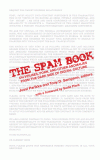
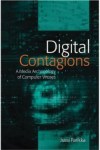
Jussi Parikka is Reader in Media & Design at Winchester School of Art (University of Southampton). His books include Digital Contagions (2007), Insect Media (2010) and the forthcoming What is Media Archaeology? (2012). He has co-edited The Spam Book (with Tony D. Sampson, 2009) and Media Archaeology (with Erkki Huhtamo, 2011).
Learning from Affective Revolts: Social Reproduction & Political Subjectiviation
Stevphen Shukaitis, University of Essex / Autonomedia
Despite the importance that autonomist feminism has played in the development of autonomist politics and struggles it is commonly relegated to little more than a glorious footnotes of figures emerging out of operaisti thought (such as Antonio Negri and Paolo Virno). Organizing around gender, affective labor, and issues of reproduction posed numerous important questions to forms of class struggle that focused exclusively on the figure of the waged industrial worker. Revolts of housewives, students, the unwaged, and farm workers led to a rethinking of notions of labor, the boundaries of workplace, and effective strategies for class struggles: they enacted a critical transformation in the social imaginary of labor organizing and struggle. By drawing on the history and of these struggles (such as the various Wages for Housework Campaigns and current organizing such as Precarias a la Deriva) and ideas of those involved (such as Silvia Federici, Leopoldina Fortunati, Mariarosa Dallacosta, and Alisa Del Re) this paper will explore some lessons that can be learned from these a(e)ffective insurgency. Taking seriously the questions posed by these struggles are extremely important because as Alisa Del Re argues, attempting to refuse and reduce forms of imposed labor and exploitation without addressing the realms of social reproduction and housework amounts to building a notion of utopia upon the continued exploitation of female labor. Furthermore the often cramped positions that organizing forms of affective labor and social reproduction (housewives, sex workers, etc) occupies becomes all the more important as these processes are further integrated into the composition of contemporary capitalism. How does one refuse caring labor? Strategies for organizing around affective labor, what Precarias a la Deriva have called a “very careful strike,” are important to learn from to find ways “not a high productivity of domestic labor but a higher subversiveness in the struggle.” (Dallacosta/James)
Stevphen Shukaitis is a lecturer at the University of Essex and a member of the Autonomedia editorial collective. He is the author of Imaginal Machines: Autonomy & Self-Organization in the Revolutions of Everyday Day (2009, Autonomedia) and editor (with Erika Biddle and David Graeber) of Constituent Imagination: Militant Investigations // Collective Theorization (AK Press, 2007). His research focuses on the emergence of collective imagination in social movements and the changing compositions of cultural and artistic labor.
Following the Glint in the Eye of the Consumer
Tony D. Sampson, University of East London
New developments in marketing techniques not only aim to sidestep the self-reporting of consumer experiences, but also look beyond the explicit cognitive realm of visual representation to exploit instead the implicit, unconscious affective systems of consumption. Like this, the neuromarketer measures the streams of affect the consumer somatically absorbs in the atmosphere. As the enthusiastic CEO of one US based neuromarketing company puts it, these techniques help the marketer to go beyond conscious consumer engagement with a product and actively seek out what unconsciously attracts them. “Absorption is the ideal,” he claims. This is because it “signifies that the consumer’s brain has not only registered your marketing message or your creative content, but that the other centers of the brain that are involved with emotions and memory have been activated as well.” Along these lines, persuasion and absorption seemingly involves priming the sensory experiences of consumption so as to achieve a number of design goals intended to influence purchase intent.
Tony D. Sampson is a London-based academic and writer. He lectures on new media at UEL where he also leads the new media degree programmes. He is the co-editor (with Jussi Parikka) of The Spam Book: On Viruses, Porn and Other Anomalies From the Dark Side of Digital Culture (Cresskill, Hampton Press, 2009) and the author of Virality: Contagion Theory in the Age of Networks (University of Minnesota Press) to be published later this year. His current research focuses on the latest applications of noncognitive psychology in studies of human computer interaction.
Exhumation as Artistic Methodology
This is the short intro/intervention, from my second Transmediale 2012-talk on the Search for a Method-panel, organized by Timothy Druckrey, involving in addition to me Inke Arns, Siegfried Zielinski and Wolfgang Ernst. The images are from the Crystal World workshop, also Transmediale 2012.
In order to kick off the panel and discussions, we were asked to pick examples of current media artistic practices, and proceed from there.
My thoughts were soon obviously on some themes and problems that I had been occupied with. More or less, such have included speculative materialities, work often dealing with the various spectra of hearing and seeing, of light and sound, of electromagnetism; works that map the non-solid based materialities that are increasingly important in order to understand how bodies react, and are governed, managed, experienced, in urban and technological settings.
Hence, I might have wanted to address Will Schrimshaw’s Atmospheric Research and Subliminal Frequencies. To me, the project is a mapping of the subconscious affective, embodied states where architectural arrangements are as important as the informational ecology; it maps the events that happen below the threshold of consciousness, for instance through ambient light as a regulator of “hormone secretion, body temperature, sleep and alertness”. As such, it is a practice based excavation into the physiological and technological constitution of experience, but also the possibilities of producing and governing experience; something related to my earlier talk on the “media archaeology of cognitive capitalism”.
Or then, another possibility would be to have looked at the various projects and the work of Critical Engineer, as expressed by Julian Oliver, in the manifesto co-written with Gordan Savičić and Danja Vasiliev. The notion of the artist-engineer might not be new, having a longer history in terms of media arts, but at the same time the manifesto and works capture something crucial about the methodology of such a practitioner, through an expanded understanding of what the machine is (across devices, bodies, agents, forces and networks, as the Manifesto lists) and how that expanded notion of the machine lends itself to a work of exposing; imbalance and deception become driving forces in a mapping of such relations, often in work that engages with wireless network technologies, rethinking visual and urban media, and more. The various projects at Weise7/Labor8 exhibition downstairs, at Transmediale 2012, are good examples.
Without being just software studies, such Critical Engineering engages with code, but in the manner how it regulates, governs, manages and in the right hands, distorts, perverts, misguides, cheats. This list that sounds a whole lot like from Matthew Fuller’s and Andy Goffey’s evil media theory.
So far, the two themes that emerge show the need to 1) account for such materialities that are not directly, necessarily humanly perceptible but completely real; and 2), the need to account for practices of perversion. Altering and corrupting as more interesting technical methods than just the smooth operationality often mistaken as the essence of technological practices.
Instead, I want to briefly to mention the work of Microresearch Lab/Martin Howse, Jonathan Kemp and Ryan Jordan, and especially the 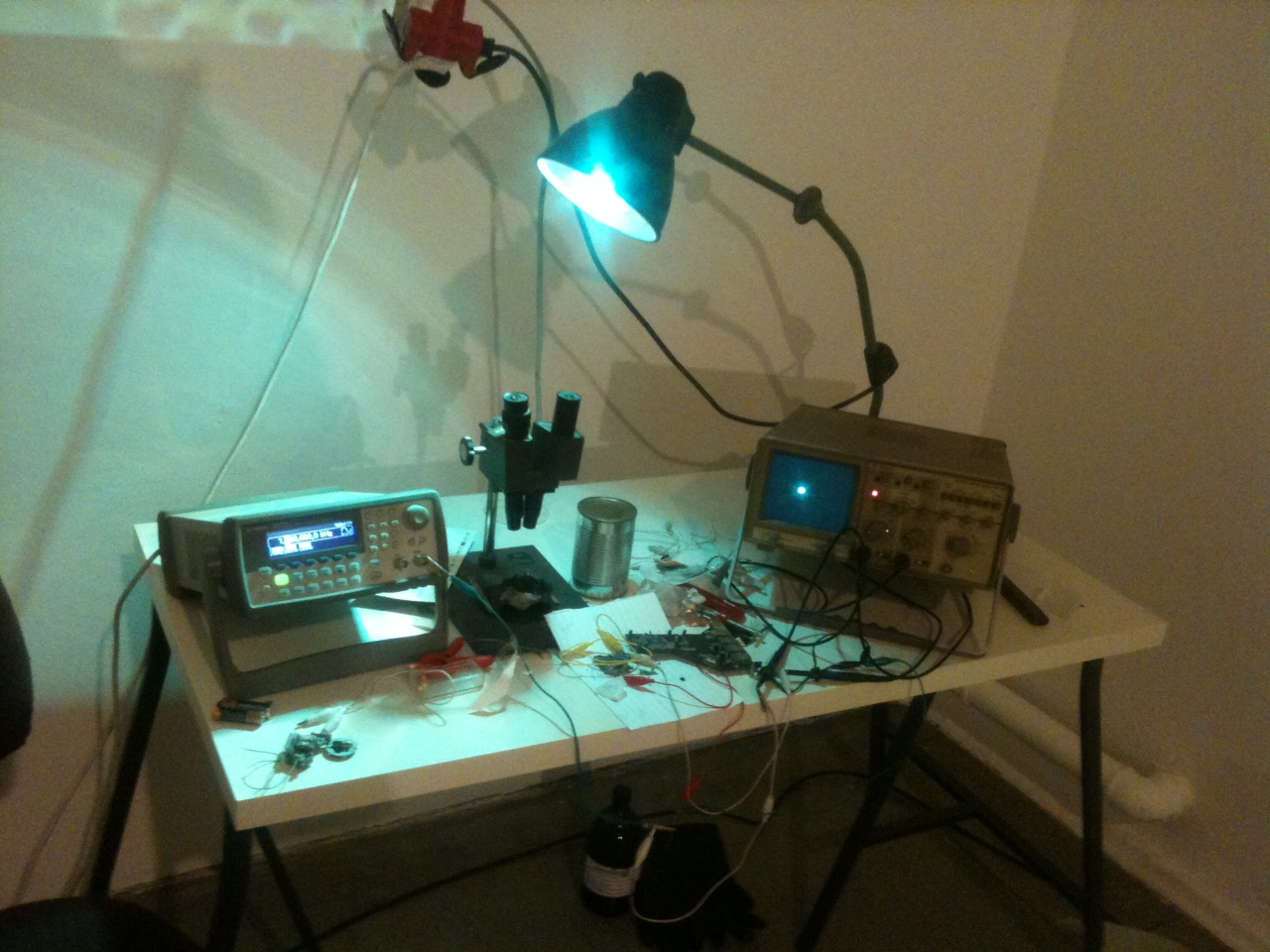 Recrystallization and Decrystallization workshops that took place in London and Berlin last year, and now during Transmediale The Crystal World Open laboratory.
The workshops used various methods to crack open and chemically process information technology in order to expose and address such constitutive processes what referred to as crystallisation. The term was partly adopted from J.G.Ballard, continuing an even earlier style of artistic practice of the Microresearch Lab, where software and hardware practices find a resonance with fiction, paranoid, speculative narratives of writers such as Thomas Pynchon (always dear to anyone interested in the 20th century articulations of power, science and engineering). As for crystallisation, with a nod towards Ballard indeed, the notion of the crystal becomes a conceptual lead in terms of a speculative materialism, described in these words:
“recrystallization was convened around the premise that while life itself starts from aperiodic crystals that encode infinite futures within a small number of atoms, the digital crystallization of the flesh by capital limits these futures to the point of exhaustion.
If computers and the minerals from which they are made are considered as equally crystalline, then their recrystallization is only possible through the introduction of vigorous and noisy positive feedback loops. “

In terms of media art histories, dead media and other theoretical and methodological approaches, the work of de- and recrystallization involved such techniques as “earth computing, mineral precipitation, high heat synthetic geology and inductive crystallography, DIY semi-conductor fabrication, water crystal cryptography, anthropocenic fossilizations, kirlian photography, hi-voltage fulgurite construction ”; Listing such, however, one however has to note quite soon that well, it is not exactly media archaeology as we used to think about it. Having said that, the notion of media archaeology in creative computing and related perspectives is taking us increasingly to such techniques as computer forensics, digital archaeology, and other modes of disgorging machines where art practices meet up with DIY and perhaps indeed critical engineering.
Speculative (media) archaeologies work crudely – but crude only in the sense of hacking open, disgorging, salvaging, melting, chemically processing in order to extract the minerals and such that on a material level compose our information technology. With an increasing political economic interest in the long networks of media production and discarded media, we have a better spatial understanding of the grim labour, electronic waste and other neo-colonialist emphasis of digital economy. The workshops tapped into this field directly as well, using such practices that mimicked human labour in extraction of valuable components and material from abandoned technology. What I want to propose is that such projects are emblematic of speculative media archaeologies and such artistic practices that combine a poetic-technological take on deep times, but ones that are such in a material sense too – not just written histories, but archaeologies of soil and history of the earth. Such speculative crypto histories of the earth refer to the concrete sedimentations of minerals and rocks, that act as re-sources for further development.
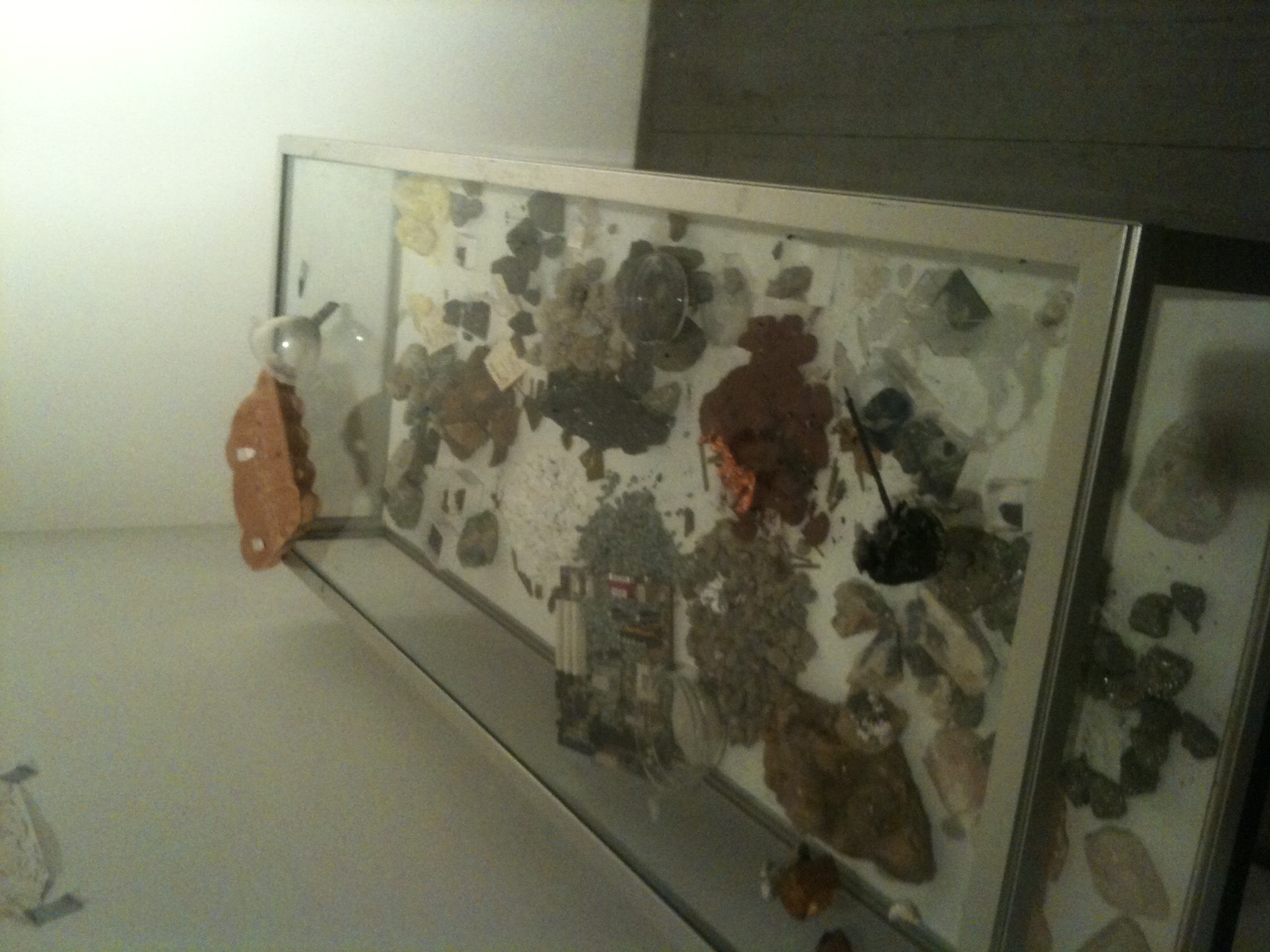
The Crystal World mineral cabinet
Where such methods fit in terms of media art vocabularies might remain unclear, but it is certain that they extend the practices often discussed in media art (histories) into a resonance with speculative materialism, new materialism, media archaeology but executed in highly original ways. We can talk of crystal materialities; materialities of minerals, information technology, and materialities of dangerous inhuman labour.
Indeed, to briefly elaborate on “exhumation” as a parallel concept to that more often mentioned of autopsy (also voiced by Tim Druckrey in his opening words) I will make a detour through Reza Negarestani. Cyclonopedia – a work of theory-fiction – speculates about the petropolitical deep layer, the living soil of Middle east, and we can point towards the work of Microresearch lab and these workshops as chemical and material deep layers that go two ways: not just the route of media archaeology interested in obsolescence, abandoned tech, and things old; but the other sort of descent too, to adopt Michel Foucault’s idea, perhaps implicitly part of some methodologies of media art histories and media archaeology. I am referring to a descent inside the machine, into the technical infrastructures, layers, city-like scapes of circuits and components. This kind of technical exposes a material, abstract level of connections, affordances and capacities. In such a methodology, the topology extends across materialities –from the fictional narrativisation to the hardware materiality and the long duration of mineral elements that entangle with that of human energy exploited for the excavation.
As a topological figure, and interested in this poetic and speculative materialism, allow me to end through a longer reference to Negarestani. What if such speculative media archaeologies and artistic methodologies are something that share methods with archaeologists but also with “cultists, worms and crawling entities”; not just a sublimated view of technological progress, but an interested in scars and half-lifes, of multiplication of surfaces, and creation of vermiculation; a new hole into solid, contained bodies of consumer technology.
“If archeologists, cultists, worms and crawling entities almost always undertake an act of exhumation (surfaces, tombs, cosmic corners, dreams, etc.), it is because exhumation is equal to ungrounding, incapacitating surfaces ability to operate according to topologies of the whole, or on a mereotopological level. In exhumation, the distribution of surfaces is thoroughly undermined and the movements associated with them are derailed; the edge no longer belongs to the periphery, anterior surfaces come after all other surfaces, layers of strata are displaced and perforated, peripheries and the last protecting surfaces become the very conductors of invasion. Exhumation is defined as a collapse and trauma introduced to the solid part by vermiculate activities; it is the body of solidity replaced by the full body of trauma. As in disinterment — scarring the hot and cold surfaces of a grave — exhumation proliferates surfaces through each other. Exhumation transmutes architectures into excessive scarring processes, fibroses of tissues, membranes and surfaces of the solid body.”
This transmutation, and distribution of new surfaces is where such familiar notions of art and culture theory vocabulary as trauma are transported into material methodologies in order to excavate the stratification of such as part of mixed materials. The “novel crystal earth geologies” extend the work of material recovery and reuse into “psychophysical distortions and contingencies” in a gesture which elaborates an enthusiasm for multiple ecologies. Media art practices that are not merely to be fitted into media art histories and genres, but themselves create new openings to times and spaces of media objects, components, times.








 Machinology