Thinkerer Simondon Builds a TV
There is a very nice brief biography of Gilbert Simondon online now. Besides shedding light on some aspects of his life, I was struck by this wonderful nugget of information. “In a technology workshop he created a television receiver in the basement of the school, which existed from 1953 to 1955.” We dont know if it worked, or to what channel Simondon tuned into but perhaps that is less of a concern.
What makes the case Simondon even more interesting is this involvement with hands-on tinkering. This was during his period as a teacher Lycée Descartes in Tours, where besides philosophy the thinker of individuation seemed to be interested in getting the channels in proper receiving order. What’s fascinating – and surely a good research topic for someone media archaeologically inclined – is this entanglement of philosophy with concrete technological practice in some thinkers’ lives. It was a surprise to some that Friedrich Kittler had built his own synthetiser in the 1970s but even more so one would imagine this piece of information about Simondon and TV.
With a bit of meditation, of course this is not so surprising. He was interested and researching various scientific topics, such as psychophysiology. He knew his mechanics and thermodynamics. And as we know, his philosophy is so centrally about technics. His research encompassed also more scientific aspects and he was able to install an electrocardiogram by himself. And yet, it was not that he was all completely about scientism. Quite the contrary, when you consider this lovely quote from him:
“At the level of method, science is never a feudal lord ruling over a vassal philosophy; rather, it is a relation between the spontaneous and the reflective. The spontaneous governs the reflective, as in scientism, only when the reflective activity is not contemporaneous with the spontaneous activity.”
But of course in the light of debates about knowledge and practice, we need to think what forms of alternative “philosophy” such experiments in technology could be. Can we think of extending philosophical investigations into practices of engineering and technology — with media archaeological inspiration for modern day critical engineers and circuit benders to be found in such philosophical tinkerers? Besides the focus on individuation as a key, leading theme of his writing, this attitude can also lead to insights on how to think technology. In his later research Simondon was engaged in laboratory work, where also issues of how to understand technology popped up. Besides his own extensive writings on the topic, consider then how the Lab definition of the term might be seen as a creative way of orienting ones thoughts:
““(…) This topic has been proposed for reflection by the members of the seminar to try to reach a logic of technology that is neither an empirical technique or a science, but an understanding of normal and accidental functional relationships.”
Perhaps there is something there already — in the idea of variation hidden inside that definition. Perhaps there is something in the logic of technology that resonates with the immanent conditioning forces of technology in relation to capacities of perception, sensation and memory – a whole field of interest not only the media archaeologist but also to the analyst of cultural techniques of cognitive capitalism.
Erkki Huhtamo once referred to Paul Demarinis as a thinkerer – a neologism that combines tinkering and thinking. I think the term could be broadened out to figures such as Simondon too: a thinkerer-media theorist.
Save as: Social Memory
 An event in Istanbul – welcome!
Save as: Social Memory
Convened by Burak Arıkan and Jussi Parikka, and in collaboration with SALT and support of Winchester School of Art.
June 26-27, 2013 19:00
SALT Galata Atelier IV, Istanbul
Participants: Burak Arıkan, Joasia Krysia, Nicolas Malevé, Ali Miharbi, Jussi Parikka
One of the major concerns during the Gezi resistance was how to keep our memories, our pain and grief, our anger, our gains, and our losses alive. We tried to preserve our experiences and present them in numerous media. However, we haven’t had the time and means to critically approach to the rapidly growing archives or to create technologically enhanced curated content.
This symposium brings together three artists, a curator, and an academic who works in the area of software art, archive, and media archaeology. Cultural practices that use the language of technology and digital born content from different perspectives of preservation and memory will be debated. How can we preserve the software itself along with the content it generates? In what way should we consider software itself as the creative archive, arche, of our digital culture? What new archival practices does technology-based art and culture present? How do software, social media, and network practices introduce a sphere of counter-representation which curate alternative narratives of the present? Panelists will discuss the topics of archiving the present as we live, algorithmic curating in crisis, critical collective intelligence, and language of technology as a thinking tool.
Programme schedule:
Wednesday June 26th
19:00 Introduction
19:15 Jussi Parikka – Media Archaeology: Archives of the Present
20:00 Nicolas Malevé – Sniff and sneak through my archives
20:45 Ali Miharbi – Language of technology as a thinking tool
Thursday June 27th
19:00 Joasia Krysia – Speculations on Algorithmic Curating
19:45 Burak Arıkan – Counter Collective Intelligence
20:30 Round Table
Abstracts and bios of speakers:
Jussi Parikka – Media Archaeology: Archives of the Present
Media Archaeology has emerged the past years as a dynamic theory about media culture. This refers to the impact it has had in giving a vocabulary for the material constitution of contemporary technical media culture. Media archaeology examines media technical conditions of existence of culture, and as such, is in a good position to frame the relevance of software for questions of the archive.
However, media archaeology is also a way to investigate the ontology of the present: it asks what sorts of mechanisms of inclusion and exclusion constitute what we perceive, and what remains unperceived? How is the network conditioning our sense of knowledge and our sense of the everyday? How will the speculative future archivist, looking back at June 2013, see and understand our events and networked condition, conditioned by software as well as its political context.
Jussi Parikka Bio
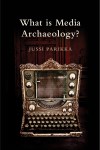
Dr Jussi Parikka is a media theorist who writes on media archaeology, digital culture and obscure topics from insects to viruses. He is Reader in Media & Design at Winchester School of Art, University of Southampton and author of various books, essays and other writings. His monographs include the award-winning Insect Media: An Archaeology of Insects and Technology, as well as the recent What is Media Archaeology? He blogs at http://jussiparikka.net
Nicolas Malevé – Sniff and sneak through my archives
‘(6/24/1996 9:44pm, Personal)”
Will she (either of them) share the love of pornography? Or at least, art? I shall present myself to both of them as a geniality self-flagellat%n machine. Just one bottle tonight, ok? I shall invite them on to my journey of change, showing the way ahead. Immortality. I will let them to sniff and sneak through my archives. (Erkki Kurenniemi, Newton diary, 1996).
The presentation will take as a point of departure the rich set of documents collected and created by Erkki Kurenniemi, Finnish pioneering electro acoustic musician and inventor of early synthesizers, who obsessively recorded his life. The talk will introduce to the different tools and methods we, Michael Murtaugh and Nicolas Malevé, members of the Belgian collective Constant, used to enter in dialog with the vast amount of unclassified documents that constitute the humus for an archive of Kurenniemi’s work.
These tools are our intermediaries, our extra senses to “read” the images, to “listen” to the sounds, to “watch” the videos. The algorithms we borrow, design or customize become our interlocutors. They report back from what they detect, correlate and connect in the different layers of data. They are different voices, each telling a its own story. Having presented these different voices, we will see what happens when other human agents (lawyers, archive institutions) join the dialogue between these intermediaries and ourselves.
Nicolas Malevé Bio
Since 1998 Nicolas Malevé, multimedia artist, has been an active member of the association Constant. As such, he has taken part in organizing various activities to do with alternatives to copyrights, such as Copy.cult & The Original Si(g)n, held in 2000. He has been developing multimedia projects and web applications for cultural organisations. His research work is currently focused on information structures, metadata and the semantic web and the means to visually represent them.
Ali Miharbi – Language of technology as a thinking tool
In this presentation I will sketch the potential of the language of technology as a tool to open up, enrich or simply illustrate our current discussions on social/political issues. Using examples of my work as points of departure I will touch on a variety of concepts like performativity, humor and the problem of representation.
Ali Miharbi Bio
Ali Miharbi (b. 1976) lives and works in Istanbul. He acquired a dual degree in Electrical & Computer Engineering (BS, 2000) and Art Theory & Practice – Painting (BA, 2000) at Northwestern University. In 2010 he completed his MFA from Virginia Commonwealth University. He opened his first solo exhibition at Interstate Projects, Brooklyn, NY. His recent group exhibitions include “Commons Tense”, Electriciteitsfabriek, The Hague (2012), “Turkish Art New and Superb”, TANAS, Berlin (2012), “Consequences are no coincidence”, Pilot Galeri, Istanbul (2012), “video_dumbo: Quasi Cinema”, Dumbo Arts Center, Brooklyn, New York (2011), “FILE 2011″, FIESP Cultural Center, São Paulo (2010), “When Ideas Become Crime”, Depo, Istanbul (2010). His work can take many forms from photographic, graphic or sculptural pieces to dynamic systems driven by live or stored data where he investigates mechanisms that underlie or are constituted by the flows of daily life.
Joasia Krysia – Speculations on Algorithmic Curating
Between the 1960s and 2005, Erkki Kurenniemi, the Finnish artist, scientist, futurologist and technology pioneer set out to document his everyday life with the intention to create a template for all human life that could be reenacted by algorithms to be written in a future quantum world (with the date 2048 in mind). In a wider sense Kurenniemi acted not only as an archivist of his life but also a kind of curator – working with materials not simply to collect and store but to shape using computational power once it is sufficient for purpose. In 2012 Constant Association for Art and Media began to develop some experiments, making programs to begin to understand Kurenniemi’s materials in ways that go beyond the traditional archiving procedures of ordering and classifying. I would like to argue that their approach is not simply archival either but curatorial in as much as they uncover aspects of what is not directly apparent in the material and produce meaning out of the work. This talk speculates further on this algorithmic approach and extend it to possibilities of thinking about the curatorial process in this way. I want to speculate on the use of algorithms in producing small curatorial experiments that begin to suggest new ways of understanding materials that are not directly apparent to human curators. Can we begin to think of curatorial processes and the production of curatorial knowledge that extends human agency and uncovers dynamic qualities of materials?
Joasia Krysia Bio
Joasia Krysa is Artistic Director of Kunsthal Aarhus (Denmark), and prior to this she was Associate Professor (Reader) in Art and Technology at Plymouth University, UK (2000 – 2012). She is co-founder of KURATOR, an association of curators and researchers interested in algorithmic culture, and was part of curatorial team for dOCUMENTA (13). She has a background in political sciences and cultural theory, and has PhD in the the field of curating. Her academic and curatorial work is located across contemporary art, digital culture, and critical theory.
She is series co-editor of the DATA browser books (New York), author of Ada Lovelace, notebook no 055 in the dOCUMENTA (13) series 100 Thoughts – 100 Notes (Hatje Cantz 2012) and the edited anthology Curating Immateriality (Autonomedia, 2006). She has contributed chapters to, amongst others, Software Studies: A Lexicon (MIT Press, 2008), and New Media in the White Cube and Beyond (University of California Press, 2008). Her current curatorial work include Systemic Series, a two year programme developed for Kunsthal Aarhus (2013-2014).
Burak Arıkan – Counter Collective Intelligence
Arıkan will pursue a traversal in his works, starting from MyPocket (2008) and raising questions on the preservation of immateriality; discussing Network Map of Foundations and Corporations in Turkey (2010) in relation to power and governence during the Gezi protests; narrating the collective network diagrams generated on the Graph Commons platform (2011-); and finally calling for action for a recent data research and mapping project, code named “Network of Dispossessions”, mapping of government-corporate partnerships in urban transformation.
Burak Arıkan Bio
Burak Arıkan is an artist working with complex networks. He takes the obvious social, economical, and political issues as input and runs through an abstract machinery, which generates network maps and algorithmic interfaces, results in performances, and procreates predictions to render inherent power relationships visible, thus discussable. Recent exhibitions include: Home Works 6 (2013), 11th Sharjah Biennial (2013), 7th Berlin Biennale (2012), and Nam June Paik Award Exhibition (2012). Arıkan is the founder of Graph Commons platform, dedicated to provide “network intelligence” for everyone.
Image: Network Map of Foundations and Corporations in Turkey-project by Burak Arikan.
tm14 Afterglow: trash and to trash
Transmediale has released its theme for 2014: afterglow. It refers to the feeling of “after”, “post” the digital enthusiasm that branded the past decades, and now somebody needs to pick up the trash. The theme summons connotations of trash, waste and other aftereffects of the digital, both material and immaterial.
Winchester School of Art is happy again to be official partner of the transmediale-festival and participate in curation of some of the academic content. Below more info on transmediale-theme – and a link to the call for works.
 afterglow
The digital revolution is over again and this time “YOU” lost.
In the wastelands of its aftermath, what is still burning?
With the theme afterglow, transmediale 2014 suggests that in a world where resources (human, bodily, material, environmental, economic …) are more and more used up, the digital does not any longer stand up to its promise of antiseptic high-tech worlds and opportunities for all. On the contrary, digital culture is more and more becoming a post-apocalyptic wasteland ruled by a few powerful clan leaders. Still, digital culture is full of things that shine and glow, both promising and uncanny: from social media to big data. On the one hand, this afterglow can be seen as an extreme expression of the wasteful state of digital culture (excess, overload, endless repetition, pre-emption of meaning, exploitation), but on the other hand, as “one man’s trash is another man’s treasure”, this afterglow is also providing the transition to new forms of being. If we are living in a post-digital culture, then afterglow is what characterises its aesthetics and politics during the transition to new cultural forms that are still unknown to us.
In the 2014 edition of the transmediale festival, the idea of an afterglow of digital culture is taken as an opportunity to speculate on positions that lead beyond the digital: not beyond the digital in a literal sense as in doing away with digital technology, but beyond the digital as a metaphysical character that overcodes all forms of existence. Even a supposedly critical term like “post-digital” is in this sense only promoting an idea of the contemporary and of the future as predetermined by the digital. Instead of revelling in the hypes of the post-digital, we invite the contributors of transmediale 2014 to reflect on this afterglow: to exploit our nostalgia for the pre-digital through the use of trashed technologies, ideas and narratives and/or to imagine new modes of existence and new modalities of critical intervention, by junking the afterglow of digital culture.
Breathless
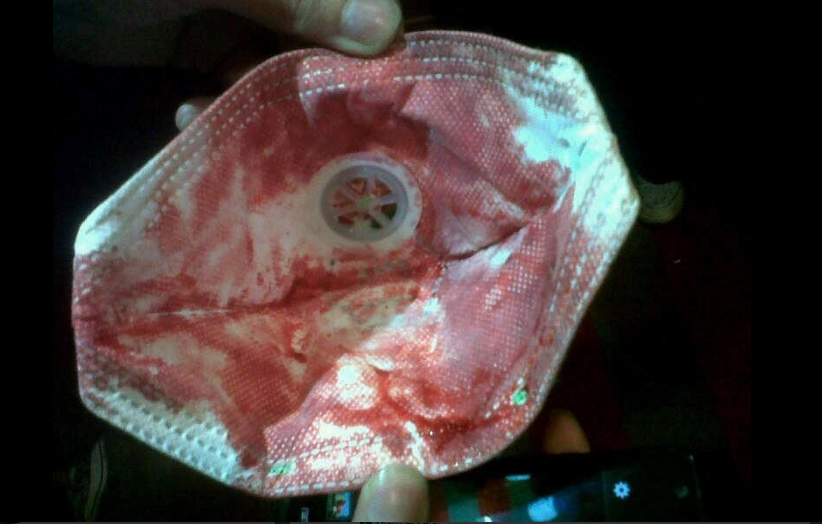
“My eyes were burning, and my nose running and my face was also burning”. These are ensations across the body, demonstrating the effectiveness of technologies of security. Your eyes and nose and mouth feel it. It burns across your body, an involuntary body panic from the fear of choking.

Gas is a rather peculiar weapon. It is atmospheric in the manner German philosopher Peter Sloterdijk talks about: it conditions the environment and breathing and as such invades one of the most intimate areas of our life: our lungs and sense of being alive. Naturally, this is not only a sense of being alive, but its very condition. Gas warfare is not only about biopolitical invasions but also the raw animal life being controlled: the zoe.
Gas is spatial and ephemeral at the same time. The wind can carry it across distances, although it is used as a very localized measure. It divides space in new ways: those able to breath with gas masks, and those suffocating, denied their participation in that space. You can control territories through a control of who is allowed to breath air in there. Tear gas, pepper gas, water cannons infused with chemicals: meticulous information on what the body can just about take. This information is always escorted by the possible deviations from the norm: for instance children’s lungs as well as elderly lungs.
Modern chemical attacks against humans date back to the first World War and the trench warfare. The Germans started using toxic clouds in April, 1915. As Sloterdijk notes, what makes this manner of suffering and even death more painful is how the suffocating is made to participate in his and her own condition: the body is made to turn against itself, gasping for breath, convulsions. The organic tissue becomes an archive of atrocities, a registering surface of the effects of modern science and technology employed in military and security regimes.
Of course you can shoot and aim with gas canisters, to ensure the good ol’ blunt hit. The effects of this hit can be rather horrific.
Considering gas, Sloterdijk speaks of “terror from the air”, and associates terrorism as a feature of modernity:
“It is crucial to identify terrorism as a child of modernity, insofar as its exact definition was forged only after the principle of attacking an organism’s , or a life form’s, environment and immune defences was shown in its perfect technical explication.”
There is a technological condition of this state of breathlessness and it has to do with the history of modern synthetic biology: the measurement of human capacities for breathing as well as the necessary measures for inhibiting the use of air for the organism.
And in Timothy C. Campbell’s words, referring to Sloterdijk, “terrorism is always ecologically directed”.
We need to turn meditations of air, soul and breathing into a bio- and zoepolitics of breathing and an analysis the systematic ecological and health abuses: from the minuscules particles of gas and dust, to how they constitute more abstract but as real security operations.
Sources:
Campbell, T. (2011) Improper Life. Technology and Biopolitcs from Heidegger to Agamben. University of Minnesota Press.
Sloterdijk, P. (2009) Terror from the Air. Semiotext(e).
Images via Twitter.
Istanbul: Becoming People
No smoke without fire, although with the tear gassed Istanbul, Ankara and numerous other cities, one should say: no smoke without tears.
While things are unfolding on the streets of Turkey, the international audience of the events are trying to figure out: what is going on. Who are the demonstrators? Hence, kicks in the usual suspects of repertoire of explanations: is this like Occupy Wall St.? Is this the Turkish version of Arab Spring? Are the demonstrators a vocal minority, and we are just misperceiving lots of social media traffic as a major event?
Perhaps the question itself should be differently posed. There are lots of great commentaries floating around, longer texts with already now some excellent contexts of the events. Some of it suggests in a rather good way that we need alternatives than just choosing one existing model of explanation.
Perhaps what is unfolding in front of the international community is what Turkish people already knew: a corrupted and authoritarian culture of politics and business where having firm relations with the ruling party AKP is a benefit for a variety of jobs and economic success for private sector companies (see here for some context); lack of transparency in political decisions that however affect the majority of the people, such as the building of the third bridge or for instance in this Istanbul case, the demolition of Gezi park. The sentiment of dissatisfaction was there already in a way that was not just about secular vs. Islamists.
What is already being voiced is that “This is not about secularists versus Islamists, it’s about pluralism versus authoritarianism,” (quoted in The Economist).
Besides internally about Turkey, the events reveal a lot about the logic of capital: it benefits from authoritarian state measures and tight security controls. As for the case of Turkey, things are supposed to be fine on the economic front.
Interestingly, The Economist writes:
“Like most people, Turks tend to vote with their pockets. A decade of AK rule has brought unprecedented prosperity. Per-capita income has trebled, exports have increased nearly tenfold and Turkish banks are in good health”
But the problem is how much of this growth is exactly focused on the banks as main benefactors and how much of the consumption and investments is done only on credit money. If there is a major economic (read: construction business) bubble growing in Turkey and it bursts, things might very soon be very different – economically and politically. Even a lot of the middle class is actually still, despite university degrees and stable jobs, in a precarious situation.
In any case, the question “Occupy or Tahrir” is actually: what is the specific case of Turkey? Besides revealing details of more global trends of how capitalism enjoys authoritarian regimes (see Zizek on this point) it demands the continuous question of what then is happening specifically in Turkey.
Discussing with my friends in Istanbul, one thing popped up when they narrate the events of the past days: even they, participating, just don’t know everything. They are not sure how things will develop, but they remain hopeful. There is a sense of momentum and an affect that binds across groups, but also the question “who are we”, referring to the protestors, is an open one. Perhaps it is open for a good reason, summarised in one of the placards from Istanbul.
It refers to the various attempts by the prime minister to publicly discredit the demonstrators. But it also gives an affective response, one example of the various texts and visuals that express a strong positive sentiment.
We are not sure who we are, but we will be the people.

A placard from Istanbul:
Day 1 we were the terrorists
Day 2 we were the provocateurs
Day 3 we were the protestors
Day 4 we became the people
Photograph by Baris Safran (via Jodi Dean).
Park Life: Occupy Istanbul?
It was summed up in a tweet: this could be the Turkish Spring. The person was referring to a CNNturk broadcast, which finally had picked up the story of the past days of occupation of the Gezi park in Istanbul and the following police violence. A peaceful protest turned into widely circulating images of tear gas, facial injuries, and a range of police measures that anyone seeing the pictures could not see as proportionate, despite some government officials trying to dismiss the events. Some tweeters escorted their images of tear gas filled Taksim with a reminder: “this is not Middle East, this is Istanbul”.

The occupations had to do with a tactical colonialisation of both hashtag space and real lived urban space. The fit to purpose and inevitable hashtags had already paved the way on Twitter: #Occupygezi and #Occupytaksim signalled the connection to the widely known occupation of the Zuccotti Park in New York that spread as model for global reappropriations: occupation of public streets as a form of reclaiming the commons. Such occupations were never really only about that particular space, but also more abstract but as real features: protests against the logic of financial capitalism and their relation to the securitization of public space.
The events at the Gezi Park might have started with protection of trees planned to be bulldozed to make space for yet another city mall, but they revealed much about the recent urban planning of Istanbul as well as global capitalism.
Istanbul had seen rather worrying street action the past months already: For instance the movement against the demolishing of the historical Emek film theatre was met by water cannons and tear gas. In less violent news, which however have to do with public space as well, the new legislation restricts retail sales of alcohol during the night and bans selling of alcohol near mosques.
Besides urban space, natural space has been another target. The plan to build a third bridge over Bosphorus has been fiercely criticized by a range of environmental and other groups for its clear madness: in addition to the massive cutting down of trees, such building projects including the new airport set to open in 2018 are a threat to the water resources of the area.

Of course slogans and hashtags matter in how they condense and collect a range of different images, narratives, participant accounts and political sentiments. Social media acted as a way to quick and dirty collating of material, not least images like on the tumblr site: http://occupygezipics.tumblr.com/ . Hence the reference to “Arab Spring” was something of a rather successful slogan. After all, Turkey was supposed to be the democratic moderate Muslim country acting as a role for the uprising Arab countries.
However, the past years have seen more of international attention to the range of human rights violations against journalists and activists. The events at Gezi Park are in this sense a rather logical continuation of control of public space that in Istanbul is paradoxically mixed with a political ignorance of specialist urban planners voicing their concerns. On the one hand, lots of the massive sizes building projects are short-sighted in terms of their implications for the environment and the long term future of the city. This includes lack of planning for instance for public transport, which in a city completely congested by millions of cars is not a minor feature. On the other hand, the police measures that restrict the public space and political protest are showing how the major financial investments and projects are tightly linked with authoritarian security.
Indeed, besides being able to tap into the past years of legacy of Occupy-movements as well as Arab Spring, the case for OccupyIstanbul is emblematic of bigger contexts. Like seemingly every contemporary struggle, the urban battle of Gezi park and the real-world struggle with capitalist development and authoritarian policing exists at in real spaces and commons and in digital hashtag spaces with established news agencies covering the former by following the latter.
But it also should be read again as part of a longer development: the exploitation of ecological resources and the public urban commons, and the connection between short-sighted economically driven planning with totalitarian security is something we should understand is not restricted to Istanbul.
People might be now wondering how can a city that is applying for the Olympics 2020 demonstrate such reckless behaviour. Unfortunately, this is actually not that contradictory. It also shows the capacity to control the public space, protect the commercial environments and brands and take necessary measures in construction projects to pave the way for global cultural events. In London, the Olympic year of 2012 London was also the year of Occupy movement camping front of St. Paul’s Cathedral. London 2012 might not have been a violent affair but it demonstrated a link between police-governed high tech security and global brands.
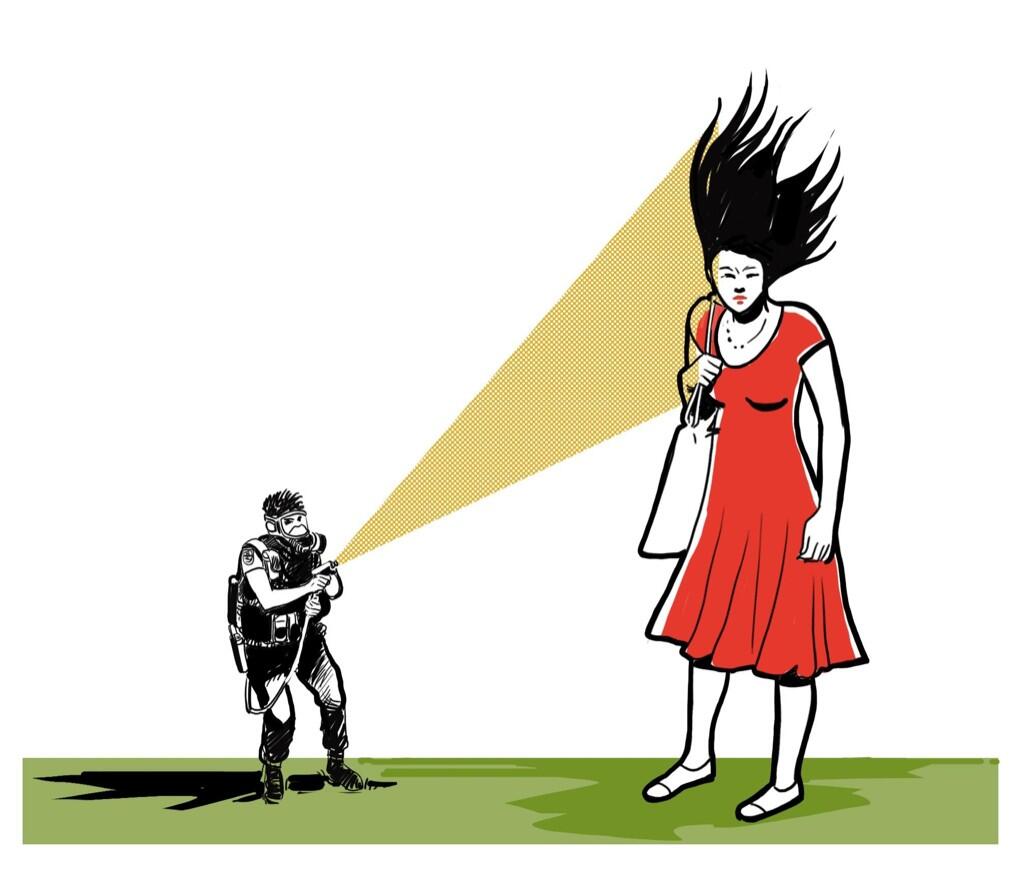
(images from Reuters and via Twitter. Thanks for feedback to Paul Caplan and for the constant stream of information to Emre Kizilkaya and dozens of others via Twitter…)
“We have never been human”
“We have never been human: between animality and techne” is the new special issue of Angelaki. It is released just now and features a range of exciting articles –  thanks to Ron Broglio for his work in getting this edited together.
I wrote a piece with a bizarre title “Insects and canaries” that has a certain sense of hybridity to it. It even started as one word, Insectcanaries (see also, Spiderpig).
More seriously, it is about visual and non-visual cultures of the eco crisis, and aesthetic epistemologies and ontologies of it all. It also elaborates on the term “medianatures” that I have been using recently. An abstract below.
This text focuses on how to think the visual culture of disappearance – more closely, disappearance of animals. It takes as its starting point the Ernst Jünger novel The Glass Bees from 1957 in order to start an excavation into obsolescence, animals and the ecological crisis. The aesthetic themes of visibility/invisibility are entangled with the ecological questions of disappearance and pollution. This sort of media ecological question is unravelled, furthermore, with examples concerning the mass extinction of bees, also discussed in Lenore Malen’s video installation The Animal That I Am (2009–10). In this way, it argues for a media theoretical understanding of the visual culture of ecocrisis as well as the complex question of epistemology of such a visibility/invisibility.
Moving Panoramas, Curiosity Cabinets
Huhtamo wrote a book on the moving panorama – Illusions in Motion – and here is an interview with him. So if media archaeology is what keeps you up all nights, dig in.
And if you are a lucky one, and in Paris, here is something connected. Below a press release of an exhibition endorsed by Huhtamo. The text below is from his keyboard.
Virtualia:
Where Curiosity Cabinets, Dioramas, and Augmented Realities Meet (Erkki Huhtamo)
If you happen to be in Paris between now and the end of June, make sure not to miss the exhibition Virtualia: Fééries Numeriques, an unusual event featuring works by Jean-Paul Favand, collector, artist, “natural magician,” and the founder of the Musée des Arts Forains (Museum of Fairground Arts, Paris – Bercy). For years, Favand has been designing extraordinary exhibits for his huge museum. Using original objects from his collection as backdrops and projection surfaces, he has been turning then into magnificent animated spectacles by means of digital projections, or “video mapping.”
With his team of technical experts, Favand has created an outstanding mastery in this emerging field. However, there has been a problem: Musée des Art Forains is a private museum. Although it is open for banquets and organized events all year around, the general public is only able to visit it a few times a year on special occasions. It is therefore not so easy to experience its sumptuous displays that combine traditional fairgrounds and digital magic in the spirit of the Cabinets Fantastiques of the past.
For the first time, Favand has brought his imagination out of the museum, displaying his creations at the Centre des arts d’Enghien-les-Bains near Paris (a 15-minute train ride from Gare du Nord). What one experiences at Enghien-les-Bains, an idyllic lakeside resort town that seems very far from the French capital, is a series of curious and inspiring works one is tempted to call media archaeological. Although they use ideas of Favand’s museum displays and exhibits, that are also entirely new.
At first look the exhibition seems eclectic, but one soon discovers the common spirit behind everything. There are found objects like a Japanese doll, unusual pieces of wood, and a Chinese stone slab inserted in a wooden frame, all animated by projections. There are also two unique diorama canvases from Favand’s collection. They were originally displayed by a nineteenth-century touring show named Théatre Mécanique Morieux de Paris. Its remains were discovered some years ago and bought by Favand. A once so popular but lost medium re-emerges at Enghien-les-Bains, restored by Favand’s team of experts. Already experiencing the dioramas and their effects is worth the visit.
But there is more: the exhibition also includes a mechanical spectacle named La Fete du Soleil (the Festival of the Sun), also from the repertory of the Théatre Morieux. Ingenious mechanical marionettes traverse the scene, brought to life by digital projections. It is not possible to discuss all the exhibits here, but I would like finish be mentioning a favorite of mine, an interactive display that allows the visitor to manipulate a digital 3D simulation of a seemingly ordinary stone, much like the stones that form the pavements of Village de Bercy, a popular destination in the heart of Paris. No-one seems to pay any attention to them, except Favand.
This exhibit takes us to the heart of Favand’s art: whether it uses antique objects, found pieces of naturalia, or digital and interactive displays, it constitutes an extended act of looking. Favand persuades the spectator to stop and wonder. He seems to say: there is nothing prosaic or boring; everything is saturated with meanings and experiences; the task is to stop, pay attention, and wonder. Virtualia does exactly that. Its exhibits are not as spectacular as the ones at his museum (the exhibition hall at Enghien-les-Bains is rather limited), but the spirit animating them is the same. Go and see yourself!
For more, see the website http://www.cda95.fr/fr/content/virtualia. The exhibition is open until June 30, 2013. See also: www.arts-forains.com, www.pavillons-de-bercy.com
New Materialisms – Round Four
Look at this range of topics and exciting themes: Movement, Aesthetics, Ontology at the University of Turku (my alma mater!).
We started the New Materialisms-events in Cambridge, at Anglia Ruskin and they are going strong: the events are extremely well attended and raise a lot of interest. I still remember a job interview I had in 2007 when one of the members of the interview panel asked me: ” So what’s the difference of this new materialism to the old materialism of Marx..?”
Over the past years, we have had a range of good responses to that question, while also reminding that in the midst of the current enthusiasm for the non-human, it was already in the first years of 1990s that Rosi Braidotti coined the term “neo-materialism” – a Spinozian version of monism of intensities, becomings and feminism.
There is sometimes a bit of an amnesiac tendency in philosophy discussions. One troubling phenomenon that Braidotti recently pointed towards was the writing out of feminist theory out of discussions concerning materiality and the non-human. Hence, let’s remind that even “new” materialism itself has longer roots, and the more recent discussions are rather late-comers when reminded that the term was used by Braidotti herself in the early 1990s in her Patterns of Dissonance and systematically ever since (see more in New Materialism: Interviews & Cartographies) . It is not reducible to her, but we need to compose our theoretical genealogies carefully.







 Machinology