Archive
Toilet Humour, or the History of Shit
Thanks to Robert Jackson, I was reminded of the existence of Dominique Laporte’s forgotten classic History of Shit – something I think I glanced at in the early 2000s when writing Digital Contagions. I never really dug into Laporte’s excavations of excrements, but was now reminded how wonderful and funny book it is. While offering a compelling (not without its problems in its strong reliance on psychoanalytic conceptual arsenal) multiple history of language/shit/public space/private individual as the modern ecology of subjectification, it talks as much about things that smell as it does about the various exercises to remove that inconvenient materiality. Stories of shit are about money, the subject, space, cleansing, materiality, toilets, makeup, privacy, urban design as well as, well, the thing itself.
See here for Jackson’s blog post about the book, and below a proof of its funny, quirky style and examples – as this letter from Madame la duchesse d´Orléans (1694) about the privileges and pleasures of the body – and its techniques, facilities.
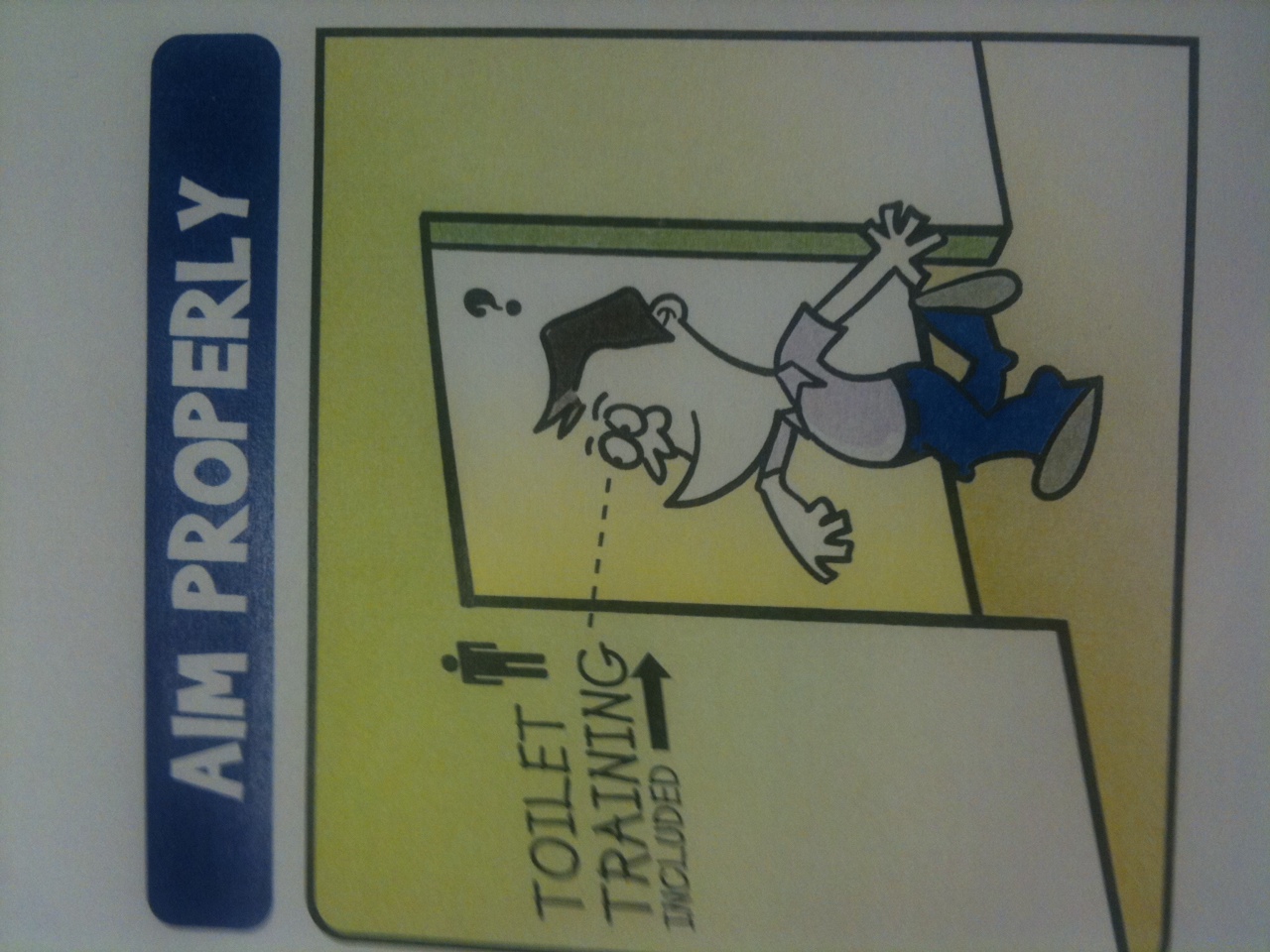
subjectification - toilet training
“Fontainbleau, October 9, 1694
To the Electress of Hanover
You are indeed fortunate to shit whenever you may please and to do so to your heart’s content! … We are not so lucky here. I have to h old on to my turd until evening; the houses next to the forest are not equipped with facilities. I have the misfortune of inhabiting one and consequently the displeasure of having to shit outside, which gravely perturbs me because I like to shit at my ease with my ass fully bared. Item all manner of people can see us shitting; there are men who walk by; women, girls, boys, abbeys, Swiss Guards… As you can see, there is no pleasure without pain , and if we did not have to shit, I would be happy as a fish in water here at at Fontainbleau.”
A Manifesto for Digital Spectrology
Digital Spectrology is that dirty work of a cultural theorist who wants to understand how power works in the age of circuitry. Power circulates not only in human spaces of cities, organic bodies or just plain things and objects. Increasingly, our archaeologies of the contemporary need to turn inside the machine, in order to illuminate what is the condition of existence of how we think, see, hear, remember and hallucinate in the age of software. This includes things discarded, abandoned, obsolete as much as the obscure object of desire still worthy of daylight. As such, digital archaeology deals with spectres too; but these ghosts are not only

From the Microresearch Lab project pages "Detection workshop"
hallucinations of afterlife reached through the media of mediums, or telegraphics, signals from Mars, the screen as a window to the otherwordly; but in the electromagnetic sphere, dynamics of software, ubiquitous computing, clouds so transparent we are mistaken to think of them as soft. Media Archaeology shares a temporality of the dead and zombies with Hauntology. Dead media is never actually dead. So what is the method of a media archaeologist of technological ghosts? She opens up the hood, looks inside, figures out what are the processual technics of our politics and aesthetics: The Aesthetico-Technical.
– inspired by the work of MicroResearchlab – Berlin/London, the short text was written for Julian Konczak/Telenesia.
Ghostly reincarnations: an interview with Katy Price
This one-question mini-interview with Dr Katy Price (Anglia Ruskin University) is a follow-up on the interview I did with Aleks Kolkowski. Katy has collaborated with Kolkowski on the old sound machine remediations, and has herself done various projects on sound and word art – as well as being a researcher interested in the interchanges between science and literature. I find her take on materialities, appropriation of science and tech, and experimental, playful and inventive take on these themes fascinating. I asked Katy to elaborate a bit how she sees working with obsolete technologies, and how does her word art intertwine with media archaeological themes and Kolkowski’s work with old recording tech:
Katy, you have recently collaborated with Aleks Kolkowski on a project that involves working with old media, appropriating old recording technologies such as Edison wax cylinder discs for creative practice, creative writing. Already before you have been interested in your word art (see for instance here) in working with sound, and creative music technologies, but what specifically makes working with these kinds of “obsolete” technologies interesting? Could you elaborate a bit on your artistic methodologies and interest in these themes (old media, co-curation with audiences as the project now with Science Museum, etc)?
Dr Katy Price: Thanks for asking about this Jussi. For me it is all about the relationship between our use of the latest consumer items and our making through history. A heightened awareness of this relationship – and ways to share this as entertainment.
The past informs how we use and think about our bodies and their companions or additions or substitutes. One way to experience this is through reading about the past and receiving inspiration from historians. Somebody like Paul Fussell points out that memory of the First World War – mud, wire, slaughter and filling in surreal forms – shapes everyone’s identities, even if we weren’t born yet. Or Paul Théberge traces how we assumed the identity and practices of consumers: not just of music but consumers in the act of music-making. All the way from the pianola to MIDI and sampling.
Those are both stories that begin around the start of the twentieth century and there is a great appeal for me in this period because you can almost see, taste, hear the past and the future washing up against each other on the street and in people’s homes: bowler hats and horse-drawn carriages collide with illuminated advertising, cinema, ‘noiseless’ typewriters. I think we would laugh so hard if we suddenly found ourselves on Piccadilly in 1925. And instantly want one of everything. People had a lot of hopes and vision – you could dream about inventing anything, from a new type of escalator to a new society. At the same time there was a lot holding people back – no such thing as maternity leave; lots of brothers, fathers, lovers, left behind in the mud in France or falling apart at home. Under those circumstances, dreaming about the future is both necessary and tough, even impossible. I think we could do with knowing how to be a bit like that now.
The audience for academic books is quite restricted and also the mode of experiencing messages from / about the past is limited to reading the book and perhaps making images in your mind or writing some notes. I found a different angle from the experience of musical artefacts on display and in performance. At the Science Museum in London there is a brilliant case in the Making the Modern World gallery. It is a jumble of items (actually organised by inspiration from a curious thinker called Patrick Geddes) and in one corner you have a Stroh violin next to an ammoniaphone – for use by opera singers and the clergy, to improve their voice before performance with a gust of ammonia – phew! Nearby there is a prosthetic arm. Because the case isn’t directly telling me how to relate these items or how to think of their place in history, I feel almost the privilege of having come across them in a curiosity shop.
But you can’t play with the items in the museum case, or see them in use.
Aleks Kolkowski has collected and restored the only working Stroh quartet: two violins, viola and cello. Instead of wooden bodies they have a metal horn (enormous on the cello). Completely mechanical: no electricity! The horn is attached to a diaphragm which picks up the sound – you play it with the bow as normal, but it sounds almost reedy, and much louder in the direction of the horn. It was used until the 1920s to make the strings audible on early gramophone recordings, before microphones. The group Apartment House played a concert on the Strohs in Cambridge a few years ago, including a piece by Aleks which incorporated two cylinder phonographs. They were all attached together with plastic tubes, which struck me as a mechanical parody of electronic connectivity. It got me thinking about how artefacts in performance can give the audience a chance to think about today’s technology in our lives by seeing an amusing or strange performance with obsolete items.
The next thing I saw was a concerto for Pianola and iPhone composed by Julio d’Escriván, which he performed with Rex Lawson. Rex is a great showman and he is happy to show the audience how the pianola works. Julio is interested in how audiences perceive the minimal gestures of laptop musicans, and he works with the iPhone in ways that make us aware of our own need for a correlation between gesture and output sound. The combination made me think that performances like this can invite us to see the new gadgets as artefacts for a moment.
I am now working a little bit with the Science Museum on how to use creative writing as part of the process of co-curation / co-creation. This means that audience groups are invited to select objects and tell stories about or through them, for display in an exhibition. So far we spent 2 days with a group of young people. Aleks showed them his phonographs and gramophones, and talked about these mechanical objects. I got them to write monologues and poems. For example: what the gramophone said to the ipod and the other way round. Then we recorded these works onto wax cylinders and gramophone discs. They were captivated by the items from Aleks’ collection: the look and feel, the sound of themselves coming back in this ghostly form. They found the mechanical process mysterious and intriguing – which it is. How can sound be captured and played back without electricity?They learned a bit about the history of sound recording and we had a lot of fun. Their writing was amazing and I think there is a lot more we could do with speaking through these artefacts: unlike other forms of object writing, you have the opportunity for double voicing when it is recorded and played back using this item.
Aleks is building up a phonograph archive of wax cylinder recordings of contemporary artists and musicians. I won’t say too much about this for now but prepare to be amazed when it is launched… I have heard some of the cylinders and the effects are stunning. They will be digitised and online soon. For the archive I wrote a poem in two voices: Thomas Edison and Charles Cros, who had the idea for the phonograph at the same time but Edison got it on the market first. We recorded one voice on the cylinder and the other one over the top, so that they weave in and out of each other. When Aleks told me about Cros, his interest in language and plans for communication with extra-terrestrials, I recognised him as one of those hopeful impossible figures of his time. He clearly deserved to be reincarnated on a wax cylinder, interfering with Edison’s confidence.
Metastable biomedia bodies: Paul Vanouse’s Fingerprints

The Suspect Inversion Center (SIC)
It is a beautifully created little exhibition; a dark room, three projects, all like spotlights into aspects where the biological is becoming media – and as such, part of the epistemic frameworks. These forms of mediated knowing are then of course themselves access points to a plethora of techniques of power, proof and aesthetics. Yet, as has been demonstrated the recent years in various bioart and biomedia-theoretical works, the biological just not is – but is created.
Hence, Paul Vanouse’s Fingerprints, curated by Jens Hauser, is one of such works that is able to extend the notion of “media” to processes deep inside the body, and yet abstract enough to encompass global transactions, economies, regimes of knowing. Exhibited at the Schering Stiftung, Berlin, three pieces (The Suspect Inversion Center, Relative Velocity Inscription Device, and Latent Figure Protocol) are on show. What Vanouse is able to show is the inherent instability, or perhaps metastability if we want to use concepts from Gilbert Simondon, of these constellations of production of “truth”. What kinds of truths? Truths about race, about culpability, about how DNA samples do not just stick to the body, or that the relation is fragile, sustained, maintained exactly by the techniques supposed to “find” them. This is basic stuff that Science and Technology Studies has given us: apparatuses, techniques and frameworks create, never just discover. The truths found are as much in the apparatus as in the body – and hence, more accurately in the various couplings of technologies, biological bodies, and the mentioned abstract frameworks.
It’s mediated, to amusing extents: From the mini-laboratories of Suspect Inversion Center that is an on-going performance aimed to demonstrate the manipulability of DNA samples and images (which involves a “becoming OJ Simpson” of Mr Vanouse’s DNA) to the game-like Relative Velocity Inscription Device where the DNA of four family members are staged to compete against each other in a race form (the pace of their DNA samples moving through the gel electrophoresis that is instrumental part of DNA imaging technologies).
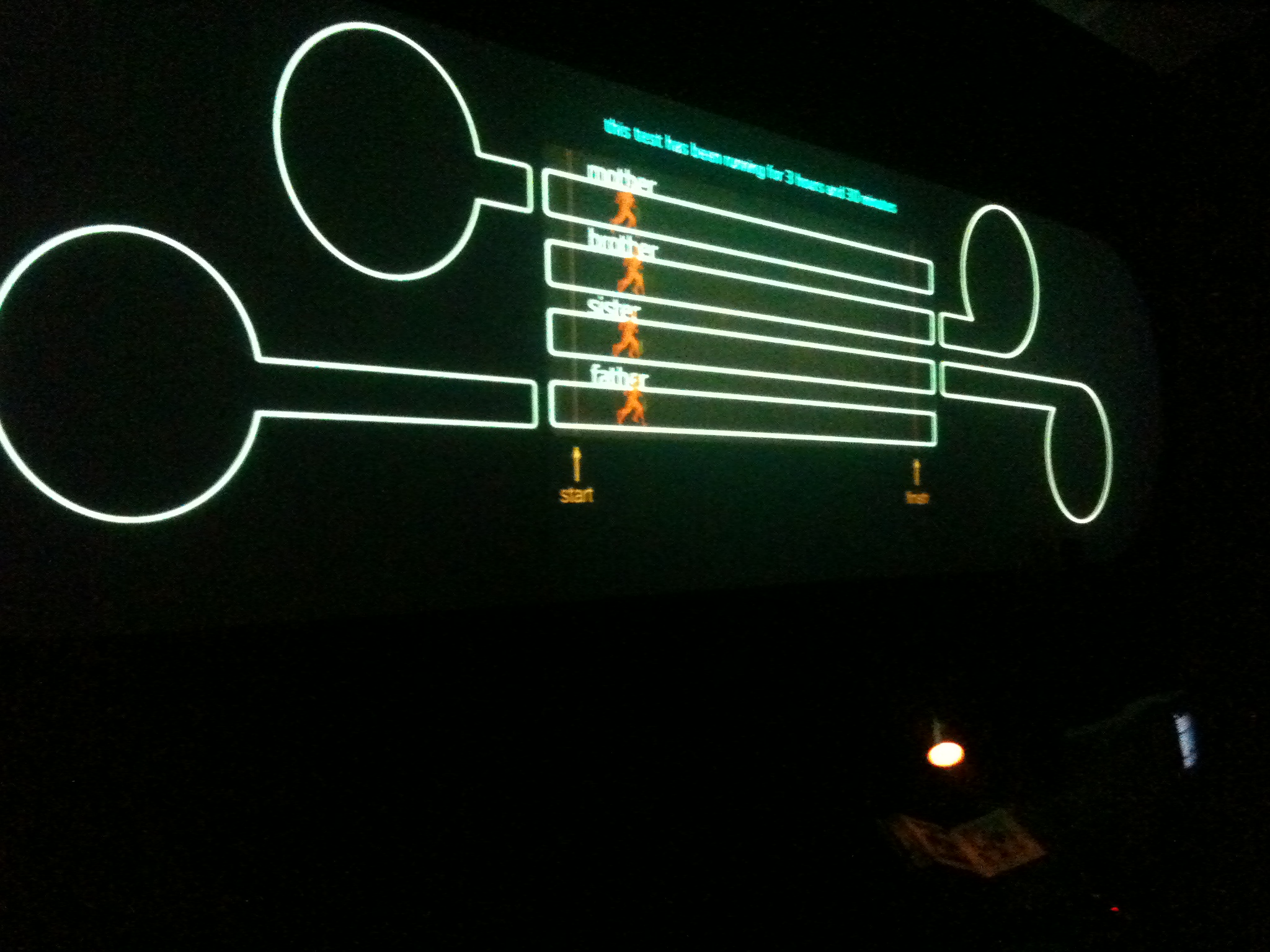
The Relative Velocity Inscription Device (RVID) - the biological body processes turned into a "game" for involuntary processes
Visible, invisible – or sustaining and stabilizing something that is dynamic in its radical temporality (such as the DNA in our bodies) as imaged is one of the most crucial questions for the interconnection of power/media (to modulate Foucault’s “power/knowledge-pairing). Such media and visual cultures are yet grounded in the wet fleshyness of the body, a further connection or demonstration of the idea of even biological bodies as media – and essential to mediated cultures. In this context, such pieces are to me much interesting than thinking them in terms of their genre of “bioart” – in the way they force us think nature-cultures, body-technologies, transversal links.
>Affect – start of the RIB and ArcDigital theme year
>What are affects good for? I am not referring to the stuff going through your body and your mind, but the concept. ArcDigital and RIBs (Representation, Identity and the Body) theme year on Affect was kicked off yesterday with discussions based on Nigel Thrift’s and Eric Shouse’s texts. Good points followed, so many I cannot summarize them here. But for me, its the possibility of tapping to various weird materialities that “affect” affords us. This ranges from the 0.5 second delay between event and consciousness Wundt talked about, the odd reactions that Reagan talking can have, the relationality of bodies in movement, as well as for example the software objects defined by their relations — i.e. also non-human affects being possible. Affects are the element of transformation, and transmission — of bodies relating and being in their relatedness. As Joss Hands pointed out, the danger of the concept is becoming too wide, too vague. Hence, there is no one big theory of affect, just good uses in contexts where we need to think beyond signification, representation and the human.
Affects are more — they are the primary surplus due to their by definition relational nature. This is where the connection to sensations might become clearer. To quote Massumi: “Sensation is the registering of the multiplicity of potential connections in the singularity of a connection actually under way. It is the direct experience of a more to the less of every perception.” (In Parables for the Virtual, p.92). What is the relation between sensation and affect? Definitely, in the Deleuzian inspired schemes, its not always clear. If affects include/are transitions, sensations travel as well. Consider Deleuze writing on Bacon: “Bacon constantly says that sensation is what passes from one ‘order’ to another, from one ‘level’ to another, from one ‘area’ to another. This is why sensation is the master of deformations, the agent of bodily deformations.”
Affects are less. They escape the conscious perception, flee and yet effect, impose on social interaction. Its the mentioned lost time, perhaps — in terms of capturing the possibility of tapping into the preconscious. We smile before the joke gets funny, we react before the person even starts to make sense, we feel it already before the actual meeting has started. Of course, so closely connected to feelings — they loop together, as Milla reminds us. It does not stay unnoticed by the intensive body that we engage continously with agendas, structures, classifications and so on of emotions. Affects produce emotions that are shared, but they feedback through various political and social acts of naming etc?
Are they tonalities? Yes, to an extent that tonalities are shared, or connect things/people/entities in time-spaces. Its the in between of perceiver and what is perceived. To again quote Massumi: “The properties of the perceived thing are properties of the action, more than of the thing itself. This does not mean that the properties are subjective or in the perceiver. On the contrary, they are tokens of the perceiver’s and the perceived’s concrete inclusion in each other’s world.” (again from Parables of the Virtual, p.90).
Vocabularies for weird materialities? This ranges from bodies in movements, of micromovements on the skin, such concrete inclusions of bodies sharing something and becoming together, of non-human objects/processes defining each other, of feeling the intensity of fastness, slowness, closeness, distance. Its what psychophysiology was keen on mapping in the 19th century in connection with the birth of modern media culture (as always, Jonathan Crary’s Suspensions of Perception is the book to read), and what biotechnologies, brain and cognitive sciences and even quantum physics inspect. It is also the regime of things such as somatosenses — proprioception, kinesthesia, the visceral…(Eleni Ikoniadou who is just finishing her PhD from UEL on rhythmic ontologies is working in this field).
In the midst of a panorama of approaches, what seems to become increasingly crucial is that we need new cartographies of affect — ones that don’t rely only on psychoanalysis etc., but inspect art/science/technology/philosophy as the source of innovation/invention.
To conclude, a good example of such interchanges: Christa Sommerer and Laurent Mignonneau’s Nano-Scape system from 2001.








 Machinology