Archive
Humm your code, “dah-dit-dah-dit”
Media amateurism has been an integral part of modern culture way before social media kicked in with its own DIY spirit. The electronic hobbyists and tinkerers of 1970s were themselves too preceded by so many earlier forms of learning communication and building circuits. Code-based culture does not then begin with software as we know it – from the emergence of computing and the much later emergence of computer languages as separate entities that relate to the mythologies of coders, hackers and controlling the hardware through the magical language of code (for a wonderful recent excavation into ontologies of software, see Wendy Chun’s Programmed Visions).
“Thousands of Radio Amateurs find it easy to Learn Code”, read a main title in Popular Science (March 1932), describing the process of getting a radio amateur license and the earlier technological discourse concerning machine-knowledge. Radio amateurism and wireless DIY of the earlier decades of 20th century represents itself perhaps one of the most important media archaeological reference points when thinking about contemporary technological DIY culture, and one can find interesting ideas from that discourse. The way knowledge about machines, code and the professionalism is standardized and practice is itself fascinating – DIY as a crash course into key scientific discoveries of modernity, practically applied. Electrical functions needed to be internalized into a hands-on skill, as the article describes: “You must first master the elementary principles of electricity as given in the simpler textbooks on the subject. Then you must apply the principles of magnetism and electromagnetic action plus an understanding of the radio vacuum tube to mastering simple radio transmitting and receiving circuits. […] You don’t have to know all the ins and outs of complicated radio broadcast transmitting circuits, nor do you require a detailed knowledge of elaborate receiving circuits such as the heterodyne.” (72)
This class of amateurs was however someone who was part of a nationally regulated standardization process flagging the importance of this system of transmission – this regulation had to do with technical knowledge, ethics and legalities as well as speed of communication, or skills more widely: The amateur operation license test was the way to become an operator – the mythical figure still living in such discourses as The Matrix-film(s), the one in charge of the communication field – what message goes where, interpreting of code, sending of things, packets, people to addresses.
But it was grey, this area of knowledge – or at least reading through the regulations. Take paragraph 9 of the Radio Division Regulations for Operators: “Amateur Class. Applications for this class of license must pass a code test in transmission and reception at a speed of at least 10 words per minute, in Continental Morse Code (5 characters to the word). An applicant must pass an examination which will develop knowledge of the adjustment and operation of the apparatus which he desires to use and of the international regulations and acts of Congress in so far as they relate to interference with other radio communications and impose duties on all classes of operators.” Speed – speeding up of communication as part of modernity – was something that was still tied to the skills of the operators, and slowed down by the human needing to be trained.
Code, as indicated in the passage, meant of course Morse Code. Dit-dit-dit-dah. A tip given in Popular Science relates to a sensory approach to code as not only abstract pattern but something that relates to your ears and mouths: “In memorizing the code, try to think of the letters as different sounds rather than as so many dots or dashes. Think of the letter C, for example, as “dah-dit-dah-dit” and as dash followed by dot, followed by dash, followed by dot.” (73) Carnal knowledge? Code in the flesh sounds much too poetic, but at least we could say, code in your mouth, ringing in your ears, feedback to your fingers tapping. Code, signal processing, transmission share so much with cultures of music, rhythmics, sound and voice.
(Forthcoming and related: a podcast interview with Paul Demarinis about hands-on, carnal knowing of technical media and media archaeological art.)
Streets, music are contagious
At the moment, I am trying to blog most of my media archaeology related notes and images on Cartographies of Media Archaeology (the work blog for my in-progress Media Archaeology and Digital Culture-book that I am writing for Polity Press). However, could not resist putting this up here – a short story and image from Illustrated London News, 19 December 1846.
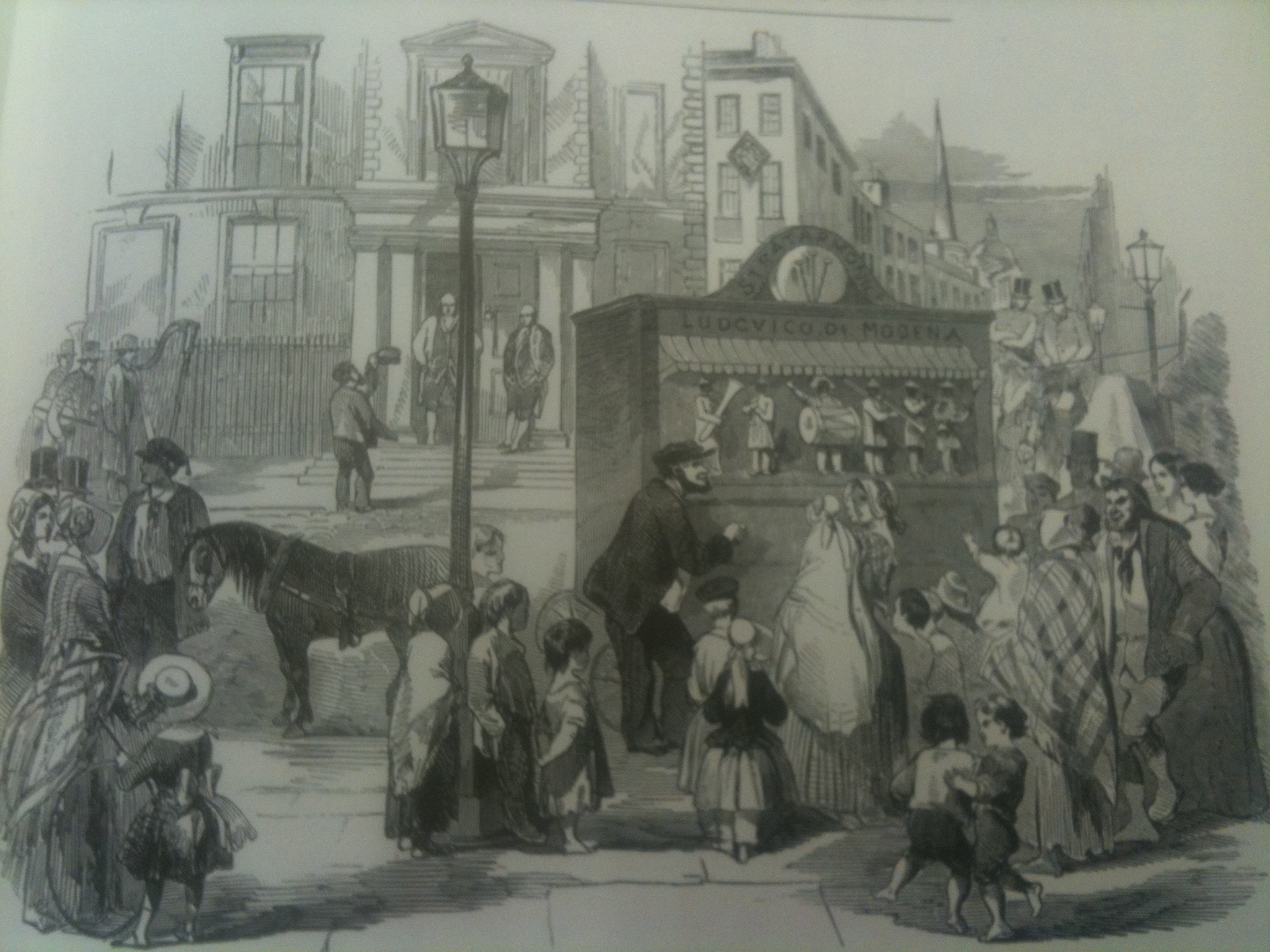
Illustrated London News, December 1846
“London Street Music” features the street musician as a performing artist, giving a glimpse both to the 19th century worlds of entertainment and performance of street life, but also the pre-post-fordist emphasis on performance and affect. What writers such as Paolo Virno have identified as the mode of production in aesthetizised regimes of work: the virtuoso, the performing artist, was already his focus in A Grammar of Multitude. As Raunig puts Virno’s position in a summarizing fashion, while also pointing towards the problematic of relience on language by Virno:
“In post-Fordist capitalism, labor increasingly develops into a virtuosic performance that does not objectify itself into an end product; at the same time, this virtuosic form of labor demands a space that is structured like the public sphere.”
In the 1846 short article, the almost dangerous powers of the street musician are described in how they can capture the affect life of the listeners in public sphere: “How many suicides have been committed under his melancholy has not yet been clearly ascertained; but the effects of the orgue de Barbarie on the nervous system have been well known since Hogarth gave to the world his ‘Enraged Musician’.”
The worlds of technology (the new special street organ that differentiates this new brand of talent from “amateurs and artists”) and the worlds of music, the ability to bring operatic cultures of Rossinian and Bellinian spheres to the wider public, make up this special brand of economies of cultural industry of affect. Naturally this reminds that the contagious force of affect has a longer history – in terms of the affect theories in music (baroque and the early 18th century for instance) as well as in social theory that emerged in the late 19th century where it was discussed in terms of public space, contagion, imitation and crowds.
The Creative Technologies Review-podcasts
One of the highlights of my pre-academia career as a freelance journalist when during a phone interview the interviewee, a female at a telecommunications company marketing department or something of approx. 35 years of age, interrupted me: “Oh I am sorry to interrupt the interview but I just have to say you have an amazing telephone voice.”
I blush, stutter, and for a second wonder if my future career is somewhere where I could put my voice into better use, such as in some of those dubious 0800-numbers that offer services of very wide variety.
Instead, I end up as an academic.
Despite the shortness of the flirtation with the idea of using my voice to make money, I have been drawn into something again where I need to talk – publicly. The shock horror at first, but then realizing its actually enjoyable despite the fact that there is always a tiny region in your brain that is probably trying to say something very inappropriate.
Anyhow, CoDE-institute and me with Julio D’Escrivan (whose original idea this was) present: the Creative Technologies Review-podcasting series that commenced in August 2010.
We label it as
“A podcast on technology and creativity, technology mostly misused, unintentionally artistic technology and music technology with the odd splattering of digital economies” and hope it to be usually a 30 min aberration into the interminglings of technology, net culture, a slight dash of political economy, academic stuff and lots of media arts.
It features interviews of creatives, techs and academics, and aims to throw a spotlight both on the work done at CoDE institute in Cambridge but also more widely (as in globally) on creative technology and arts. I am suspecting it turns out to be quite focused on sound, knowing Julio’s interests and expertise in sound art, sonicity, but it will definitely splash into other fields of expression too and I am sure to throw in a nice dose of media theoretical meditation.
Its hopefully soon available on Itunes, but meanwhile episodes can be downloaded here.
Please get in touch if you have feedback, or suggestions for themes, sites, projects, etc. to be featured!
Culture Synchronised: Remixes with Nick Cook and Eclectic Method

The room Hel 252 is starting to have good karma as the remix-class room at Anglia Ruskin. Not because its equipped with computers, editing equipment or such, but because it is starting to have a good track record as the room where we have now hosted both the screening and discussion of RIP: Remix Manifesto with Brett Gaylor, and now also discussed the work of Eclectic Method — one of the most well known remix-acts.
Geoff Gamlen, a founding member of Eclectic Method, visited us in the context of Professor Nicholas Cook’s talk on musical multimedia. Professor Cook continued themes that were addressed already in his 1998 book on the topic and now followed up in the form of a new book project that 
deals with performance. With a full room of excited audience, Cook gave a strong presentation on hot topics in musicology and the need to move to new areas of investigation, as well as showing how such ideas relate to the wider field of cultural production in the digital age. Remix-culture is not restricted to music but where such examples as Eclectic Method (or we could as well mention for example Girl Talk) are emblematic of software driven cultural production that ties contemporary culture with early 20th century avant-garde art practices, and shows how political economy of copyright/copyleft, of participatory and collaborative modes of sharing and producing, of aesthetics of image/sound-collages and synchronisations, all are involved in this wider musical assemblage. What Cook argued in terms of musicological approaches that, in my own words, are suggesting “the primacy of variation” was apt. Such performance practices as Eclectic Method’s are important in trying to come up with up-to-date understanding of what is performance, what is the author, and how performance practices relate to wider media cultural changes that are as much about the sonic, as they are about pop cultural aesthetics — hence the examples on Tarantino were apt in the presentation. We need to move on (whether in terms of the epistemic frameworks or the legal ones) from the 19th century romantic notion of the Creator as the source of the artwork to what I would suggest (in a kinda of a Henry Jenkins sort of way) to an alternative 19th century of folk cultures where sharing and participating was the way culture was distributed, and in continuous variation. Despite the increasing amount of skeptics from Andrew Keen to Jaron Lanier (and in a much more interesting fashion Dmytri Kleiner), who also rightly so remind us that Web 2.0 is not only about celebration of amateur creativity and sharing but a business strategy that compiles free labour through website bottlenecks into privatized value, I would suggest that there is a lot to learn from such practices of creation as remixing and their implications for a theoretical understanding of musical and media performance.
Eclectic Method’s work…range from political remixes…
…to pop/rock culture synchronisations…
>Nick Cook talk on Beyond reference: Eclectic Method’s music for the eyes
>Another ArcDigital and CoDE talk coming up…
Professor Nicholas Cook, Cambridge University:
Beyond reference: Eclectic Method’s music for the eyes
Date: Tuesday, 11 May 2010
Time: 17:00 – 18:15
Location: Anglia Ruskin University, East Road, Cambridge, room Hel 252
Screen media genres from Fantasia (1940) to the music video of half a century later extended the boundaries of music by bringing moving images within the purview of musical organisation: the visuals of rap videos, for example, are in essence just another set of musical parameters, bringing their own connotations into play within the semantic mix in precisely the same way as do more traditional musical parameters. But in the last two decades digital technology has taken such musicalisation of the visible to a new level, with the development of integrated software tools for the editing and manipulation of sounds and images. In this paper I illustrate these developments through the work of the UK-born but US-based remix trio Eclectic Method, focussing in particular on the interaction between their multimedia compositional procedures and the complex chains of reference that result, in particular, from their film mashups.
Professor Nicholas Cook is currently Professor of Music at the University of Cambridge, where he is a Fellow of Darwin College. Previously, he was Professorial Research Fellow at Royal Holloway, University of London, where he directed the AHRC Research Centre for the History and Analysis of Recorded Music (CHARM). He has also taught at the University of Hong Kong, University of Sydney, and University of Southampton, where he served as Dean of Arts.
He is a former editor of the Journal of the Royal Musical Association and was elected a Fellow of the British Academy in 2001.
http://en.wikipedia.org/wiki/Nicholas_Cook
The talk is organized by the Cultures of the Digital Economy Institute at Anglia Ruskin University and the Anglia Research Centre in Digital Culture (ArcDigital).
The talk is free and open for all to attend.
>First ArcDigital talk of the Semester: Dr Joyce Shintani
>A big thanks to Dr Joyce Shintani for kicking off ArcDigital talks for this semester! We started these lectures last academic year in order to excavate the interzone between theory and practice of/in digital culture, the trandisciplinary zones often left untouched by the established disciplines of academia. Last year we had a range of excellent speakers from Espen Aarseth to Steven Shaviro and Gary Genosko (and a number of others!), and this year we continue from Shintani to Greg Elmer, Wolfgang Ernst, Richard Grusin…and so on.
Shintani’s talk focused on music and sound in recent media art — and she presented an overview of s ome of the themes in recent exhibitions such as Art Basel, Ars Electronica and Sonar (Barcelona). By focusing on the element of music, Shintani was touching on such regimes of sensibility too often left untouched by the visual emphasis of media art/theory — an idea that resonates strongly with such claims for a “sonic turn” in cultural theory. Turn or not, such a multimodal perspective is much needed to understand multimedia as something more than just multiple media put together. Indeed, its not only sound and something else, but a focus on sound that deterritorialises our perspective on works of art from visual screen based to installations. Its not only about music per se, in that sense, but about sound as an attraction point for the user and for the analyst. Shintani pointed to some implications:
– music has been built upon the centrality of the word (as already Adorno argued); hence a much more multimodal approach is needed — media is not only literature based, but interfaces of direct bodily sensations, musical expectations etc. demand a different focus
– This has implications in terms of institutions from teaching to performance
– a post object-subject approach demands a much more refined idea of embodiment and interaction than has been catered in the word-biased approaches.
All this is clear and stems from what she identified as current “trends” — not in terms of fashionability but the singularity of some of the works she is interested in;
– Increasing minituarization
– Enabling ease of access to sound/music — i.e. a certain DIY approach
– cooperation and collaboration in the process of art making
– “sophistication” of interactivity in connection with easing of access
– a strong focus on mixed media — “Continuation of breaking down of barriers, mixing of media that stems from Adorno’s “Verfransung” — a wandering crossover, aberrant paths of and in media production).
In this context, Shintani is working on her new project: “Embodiment and “the Other”. A multidisciplinary Comparison of Changing Aspects of the Subject in Musical Multimedia Works.







 Machinology