Archive

Archive for the ‘new materialism’ Category

>A media archaeological day at the cellar

>


Visiting the cellar of Humboldt University does not sound to many the perfect holiday treat, but I have certainly had worse holiday days in my life. I was given a quick tour of the media archaeological labs or what I could perhaps call “operative archives” that lie at the cellar of the Sophienstrasse 22a address in Berlin. Courtesy of professor Wolfgang Ernst, it reinforced again that the things done at Berlin Medienwissenschaft are amazing and would merit much more attention.

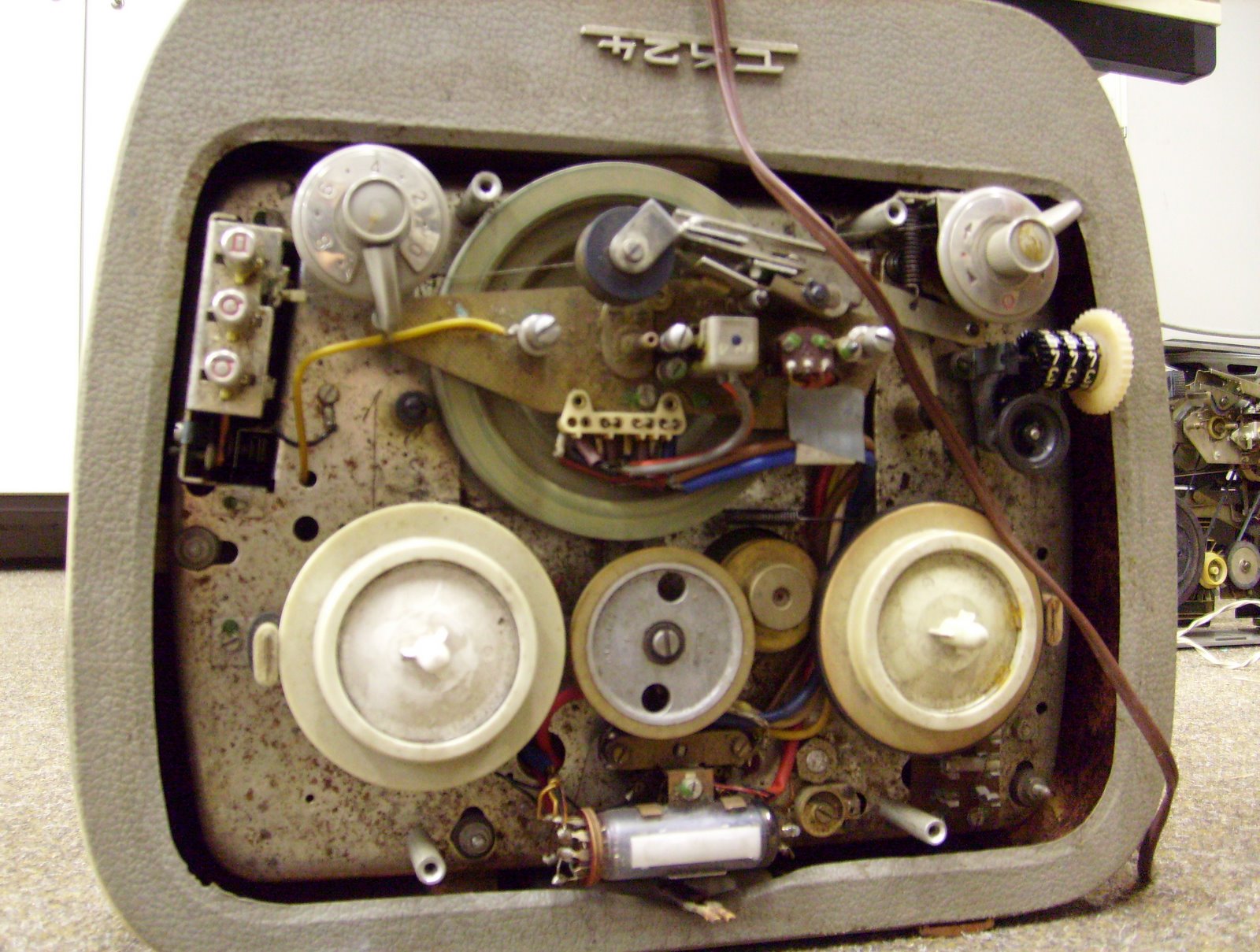
In short, Wolfgang’s way of doing media archaeology distances itself from more Anglo-American approaches. Media archaeology is about the actual “live” or “operating” technologies of the past that still work and hence are far from dead media. Or perhaps we could call them “zombie media” in these of technologies that perhaps have lost their mass media function, but still are functional in the technological sense – like an old military radio that still receives transmissions, or old analogue computers that can be wired up and made to work. The media archaeology archive/lab they have then consists of equipment primarily collected by Wolfgang and then fixed to work. This collection ranges from computational media to oscilloscopes, radios, visual media based in the Nipkow principles etc. One of the intriguing footnotes was a radio that was exactly the same model that Heidegger had in his remote place in the 1960s – at the time of the Cuban missile crisis, apparently one of the rare times he wanted to be reliant on mass media. (Wolfgang had interviewed Heidegger’s sons about this radio and then found exactly a similar copy for the collections.)

The key things that Wolfgang keeps on emphasizing and I find characteristic of his theoretical work are then:

media archaeology looks not (only) at the macrotemporalities of media history. It is more interested in the microtemporal functionalities of technical media, and hence “opening up” media technologies to track down how they work.

Media archaeology is then much more about the internal operating principles than about e.g. design – the cover, so to speak. Hence, this archive differs from museums in the sense that the technologies are not “closed” behind glass vitrines, but they depend on their “use-value”; how they exist in time, and remodulate, recirculate time-critical processes.

Media technologies can then be seen as “”synthesizers” of various temporalities in their own right. Media consists of various technologies that are able to function as a coherent assemblage (well, when it works) and also across time – like an old educational computer from the GDR era that Wolfgang had sitting on his desk, with instructions how to “program” it for specific tasks.

Media archaeology does then focus on such frequencies and layers that are not reducible to the human cultural semantics. There is much more to media – as physical, material instruments, apparata, mediators. Media archaeology is in this mode as much about wiring and programming as it is about writing.

Media archaeology is then less about textual/discursive as it is about investigating the very concrete signalling work at the heart of technical modernity. I find this bit the fascinating one – and in my reading, I try to see it only entangled with the discursive/historical themes (an assemblage approach of sorts).

Now for me, one of the questions of future is to map how this fits – how it converges and diverges – with “new materialist cultural analysis”. Meanwhile, it made me really think about getting down and dirty and tinkering with such technologies; would be amazing to get research projects like that going…

For anyone wanting to read more about “time critical media studies/archaeology”, see Axel Volmar’s (ed.) Zeitkritische Medien-book.

Below, a sample of the zombie media sitting at the cellar of Humboldt’s media studies; photos used with permission from Lina Franke (also the photographer) and Wolfgang Ernst. Unfortunately no image of “Heidegger’s radio” yet, but that will follow.

Apparatus theory of media á la (or in the wake of) Karen Barad

>

Reading through Karen Barad’s Meeting the Universe Halfway is a rewarding but time-consuming event. A very durational event, at least for me. Summer is usually the time of metaphysics and other stuff that cannot be subsumed in the 1 hour slots one has between teaching etc. during term time; hence, I have ended often carrying Whitehead, Simondon and now Barad with me to the beach and other places more suitable for Ruth Rendell’s etc.

Writing the draft version of my text for Fibreculture Media Ecologies-issue and reading Barad at the same time produced this very short, but I think fascinating realisation; what Barad says about the apparatus in quantum theory and specifically Nils Bohr’s philosophy of quantum theory is actually something I try to touch in thinking through what media is in the text ( a certain kind of milieu theory of media). In short, Barad outlines Bohr’s stance how practices embody theories and more dynamically, how practices are specific practices in time that enact and differentiate theories in their work. In this context, Barad produces this six-part summary of what apparatuses are – especially in the context of physical measurements and laboratory work but something I would suggest you to read as media theory as well. In other words, replace in the text below quoted from Barad (Meeting the Universe Halfway, 2007, p. 146) every word “apparatus” with “media” – I find it a very good and material-dynamic way to understand the ontology of media technologies.

“1) apparatuses are specific material-discursive practices (they are not merely laboratory setups that embody human concepts and take measurements); 2) apparatuses produce differences that matter—they are boundary-making practices that are formative of matter and meaning, productive of, and part of, the phenomena produced; 3) apparatuses are material configurations/dynamic reconfigurings of the world; 4) apparatuses are themselves phenomena (constituted and dynamically reconstituted as part of the ongoing intra-activity of the world); 5) apparatuses have no intrinsic boundaries but are open-ended practices; and 6) apparatuses are not located in the world but are material configurations and reconfigurings of the world that re(con)figure spatiality and temporality as well as (the traditional notion of) dynamics (i.e. they do not exist as static structures, nor do they merely unfold or evolve in space and time).”

Of course, the full impact of this idea is hard to grasp outside the context of Barad’s intriguing book. And I am sure she would not mind my appropriation of her ideas to media theory as well; after all, she herself is reading quantum theory as offering the key challenges towards rethinking key notions of subjectivity, agency, causality, etc. in feminist cultural theory. (And anyway, reading laboratory apparatuses etc. in the context of media history has been done before anyway, from Jonathan Crary to Henning Schmidgen etc.)

This idea offers a fascinating “new apparatus theory” of media – that differs from what is usually referred to as apparatus approaches in film studies.

>“Radical Temporality and New Materialist Cultural Analysis”

>

Inspired by some of the discussions in Utrecht, I thought to remind myself of an article I need to write. We did a piece on “neomaterialist cultural analysis” with Milla already in 2006 for the Finnish journal of Cultural Studies – Kulttuurintutkimus — but never found time after that to produce anything similar in English. We had the idea of writing a short book on the topic but that’s also on ice due to lack of time. However, I believe that we should revisit again our article idea that could be something like “Radical Temporality and New Materialist Cultural Analysis.” Here an extended abstract/idea of something we would need to write with Milla.

In the midst of various “strange materialities” that we encounter through such crucial contemporary issues as ecocrisis, financial crisis, and more generally high tech network culture, an interest in what could be called new materialist cultural analysis has emerged. The interest in new materialist notions for cultural analysis can be connected to this horizon of contemporary culture where, to use Karen Barad’s idea, we need less critique than more creative modes of engagement with such issues. Ideas of new materialism can be connected to various sources and thinkers that range from Manuel DeLanda to Bruno Latour, materialist feminisms in the mode of Karen Barad to German media theory (e.g. Friedrich Kittler and Wolfgang Ernst) and from such nomadic perspectives as Rosi Braidotti’s to the earlier “spatial materialism” of Lawrence Grossberg. And then there would be a number of other people writing in this field as well, whether acknowledging themselves as “neomaterialists” but still clearly adopting such positions; e.g. Luciana Parisi, Tiziana Terranova and for example Tony D. Sampson whose non-representational Virality-book is coming out next year from University of Minnesota Press. So the list is not exhaustive, but does already point to the complexity of the notion itself. Is there even such a thing as “one” new materialist mode of cultural analysis? How do the various thinkers contribute to the notion? How do they develop such notions of materiality that move beyond both Marxist notions of materiality as analysis rooted in the material practices of reproduction of culture and philosophical notions of the material as a substance, distanced from “mind” or meaning, and in itself passive? As a pragmatic vehicle, neomaterialism provides both a spring board from “old” cultural studies to “new” cultural studies where thinkers that range from Deleuze and Guattari to Agamben and others are integrated in an increasing pace to the curricula of media and cultural studies as well as an important crossing between humanities and sciences/technology.

What we want to argue, and focus on here, is the move from spatial notions of materialism to “radical temporality” as a theme that connects various otherwise quite heterogeneous thinkers of the differing materialisms that characterise for example biodigital culture. In terms of temporality, we can tap both into the by definition temporal processes of network culture and computers, but it lends itself as much to a thinking of time-critical arts, such as performance and sonic arts where the philosophical grounding of the messy temporality can find concrete assemblages through which to illuminate further the philosophies. This does not mean a simple “applicability” but a mode of diffraction and entanglement directly with the material (Cf. Barad) as exemplified through embodiment, relations between bodies, and temporality as the connecting concept.

In other words, the focus is going to be on Karen Barad’s quantum physics orientated feminist materialism that feeds both into new notions of temporality as a continuous reiterative reallocation; on the inhuman temporal perspectives that are crucial to take into account in a consideration of the non-human ecological contexts of subjectivity; the process ontological perspectives that offer a way to think such ecologies (whether of the psyche, the social, the natural or of medial kinds) as ones based in such milieus that are primarily time critical and hence dynamic.

However, despite the role such notions of new materialist brand have played in contexts of science and technology – and quite understandable so –we want to point towards its usefulness also in art contexts. Curiously the radical temporal new materialism finds here a common ground with Massumi and Manning’s own radical empiricist and Whitehead inspired accounts of how to approach art and movement as a continous transition and displacement – the primacy of movement. Hence, radical temporalities can be found through singing bodies, performing bodies, and other such assemblages of art.

The idea needs of course much work, but I think it should focus primarily on temporality as the defining theme, and thought through such time-critical arts as sonic and performance arts. Here the link to work, creativity and post-fordism could be explicated (and has been noted by Nigel Thrift) but that is outside this article; we actually touch on that theme on another text that should be coming out this or next year in a book on new materialism edited by Barbara Bolt and Estelle Barrett.

Categories: barad, new materialism

>Karen Barad and the entanglement of physics with feminism — Utrecht Feminist Research Conference

June 6, 2009 1 comment

>Karen Barad did just one of those lectures of which you are not sure which end to start. Conducted in an interview format with Rick Dolphijn and Iris van der Tuin, she was able to elaborate on a range of her key concepts, basics of quantum physics and some entry points to neo-materialism. As Iris pointed out at the beginning, Barad’s work bears strong resonances with Manuel Delanda and others — for example Bruno Latour’s name popped up every now and then, and indeed she used a lot of Latourian concepts. But its not only that — the neomaterialism that stems from a reading of certain feminists such as Haraway or philosophers such as Deleuze, but the dual-role, the two hats she is wearing; between physics and feminist theory. Naturally, this was one of the things she tried to articulate; how the two hats are not necessarily that separate after all, in a similar manner that all attempts to bring humanities and sciences “back” into contact have to take into account the way they have been entangled all along.

What was refreshing was Barad’s insistence on the mode of “critique” as harmful for contemporary cultural analysis. It does not provide the solutions we need, or is not useful as a tool to tackle the problems we face. I agree completely. We need accounts of the “weird materialities” that haunt technical media culture; biodigital lives; ecocatastrophy; etc. — accounts that do not rely on a) mode of reflection/representation as the key “method” or assumption, b) and hence do not rely on dualist ontologies but acknowledge how such issues as ethics are distributed on all levels of being, so to speak. Of course, these point resonate strongly with the points re. vitalism that Colebrook and Braidotti talked about yesterday.
Key notions that hence emerged were: entanglement (of matter and meaning); agential realism (that I would see as a relevant partner for ecological ontologies in the manner of e.g. Matthew Fuller’s media ecologies etc); scientific literacy that should not only be a literacy of the scientists and engineers; complex notions of temporality that do not rely on the past presence of pastness, and the coming arrival of future but in a continuous relocation and reiterative reconfiguration of temporalities (sounds very Serresian). Barad’s brilliant quantum physics example demonstrated this well. (I won’t even dare to try to explicate that). Also the notion of diffraction was continous on the table, so to speak. Diffraction is an alternative concept to that of reflection, and hence a good vehicle for a post-representational cultural analysis. Barad produced this useful division:
Reflection/mirrors:
– geometric optics
– knowledge based on distancing the knower from the object
– and hence the division of subject vs. object
– objectivity based on such notions
Diffraction
– physical optics (based on a different distribution of differences)
– quantum physics
– knowing is about direct material engagement
– subjects and objects are intertwined, entangled
– objectivity is about accountability to the marks on the body; responsibility to the entanglements of which we are a part.
What is remarkable to my eyes is that these ideas can be made resonate very strongly with research that deals with actual cultural practices. Even without direct references to Barad, for example Katve-Kaisa Kontturi is doing work with visual arts that takes into account such modes of knowing that the “model” (excuse me for calling it a model) is suggesting; Milla Tiainen is doing similar stuff with performance and vocality; both of them involving ethnographic methods in their neomaterialist works. As well I could imagine Barad’s ideas’ usefulness for considerations of network culture, with its heterogeneous assemblages that cannot be reduced neither to any human agencies nor to the various layered technicalities of protocols, hardware, software, networks, etc. (And I guess the fact that her talk was a video lecture, streamed live from California testifies to the modes of transition, connectivity, etc she talked about ). Instead, we are dealing with such ecological agencies that involve the various parts in a mutual becoming that I have so far tried to open up with notions such as “assemblage”, or ethologies, but increasingly aware that for example Whitehead or Barad might give as interesting clues.
As my computer battery is dying the death, I need to finish early. Through some of the discussions, its still clear that some of the feminist thinkers are way ahead of their time (if such an idea of “ahead of time” can be said to exist after Barad’s talk!) in rethinking the practices and discourses that are crucial not only for particular politics of gender but also for the wider ecological contexts (whether ecologies of nature, or of the subject/psyche). Another thing is the question whether such huge conferences are necessary, or good for the psyche. Or whether anyone should be booked to stay at Ibis Hotel Utrecht. But then again, perhaps that’s just my personal bitterness.
Categories: barad, new materialism, utrecht

>New Materialism, a-signification

>As the publisher is slow — metaphysically slow, of cosmic proportions — getting out our Spam Book, I spend time reading others book. As if I would not otherwise. Well, after finishing Shaviro’s excellent book of Whitehead that convinced me that I need to rethink my ideas re. ethologies of software from a Whiteheadian perspective, I reserved a bit of time for Gary Genosko’s Félix Guattari – A Critical Introduction. Not able here to give a full-fledged review of the book, I just want to point towards the themes that I found really useful.

I am not sure whether it will work as an introduction per se; it does offer good contextualisation to certain key concepts through an eye on the concrete contexts where the concepts emerged. That’s why the chapter on La Borde was useful, and the explanation of Guattari’s involvement in the youth hostel movement etc. The concept of transversality becomes clear at least, and its usefulness underline: I love the concrete, situated edge the concept has.
Then the individual, “like a transit station for changes, crossings, and switches.” Genosko well points towards the usability of the machinic ontology/ecology.
Most importantly, Genosko’s book offers tool for “new materialist cultural analysis”, an ongoing project of mine (and Milla’s), especially in terms of a-signifying semiotics and the notion of part-signs. I love the examples that point towards the multilayered ecological ontology of contemporary culture of software — from the concrete relays of software connected to the abstract relations of capitalism, exemplified through the plastic cards/magnetic stripes. Indeed, in such a situation, hermeneutic tools for cultural analysis fail short, as “there isn’t any room for interpretation in the strings of numbers and characters on a typical magnetic stripe”. Genosko continues who the magnetic stripes and a-signifying signs are not to be understood through any meanings they might have (they don’t) but they “operationalize local powers” (95).
In terms of aesthetics and new materialism, Genosko refers to part-signs and a-signifying fragments; colours, non-phonic sounds, rhythms, faciality traits — something that in Deleuzian circles has gone under the umbrella of intensities. What is interesting them in terms of new materialism is that the notion allows a certain autonomy of the intense materiality; they are much “more” than the traditional notions of ideology would assume and represent the beyond-norm, or beyond-code which still causes a lot of grey hair to old-school cultural studies approaches (representation analysis, etc.).