Archive
OOO, OOP and OOMT (?)
Levi Bryant at Larval Subjects gives a good heads up on the link between Object-Oriented-Philosophy and John Johnston’s fabulous The Allure of Machinic Life — and that way hints of the still quite implicit links between such modes of philosophizing and contemporary media theory. For me, Johnston’s work became familiar through his editorial work with Kittler’s writings, and as such, The Allure is for me a work that is branded by that way of thinking the material media culture. Kittler and others for instance in “German media theory” rarely talk about objects – but of networks, inscription systems, materials of communication – but I can see where some of the arguments might resonate. In terms of links between the various theory scenes, some people such as Paul Caplan at The Internationale are picking up related themes, combining media archaeology with OOP/OOO (never sure which one to call it), and discussing the logic of technical media objects (in this case, the JPEG protocol) through Harman and others.
For me, the so-called material media theory lends itself to “new materialism”, and the material assemblages, networks, dynamic embodiments and intensive becomings investigated there. Whereas the relations between new materialisms and the speculative realism as well as object oriented philosophy are still to be investigated I guess, so are the possibilities that media theory offers too.
Related to such discussions, I learned from somewhere that Speculations – Journal of Speculative Realism is reviewing my Insect Media in its issue no 2, which also scares me – while of course finding it intriguing how it is going to be received on that side. I share a lot of the same references from Deleuze to Delanda to Latour, but never explicitly link up to any of the speculative realist discussions, nor object oriented philosophy.
(My short review of Johnston’s The Allure-book is found here.)
Oh and the title of the post? Clarification of terms:
OOO= Object Oriented Ontology
OOP = Object Oriented Philosophy
OOMT= Object Oriented Media Theory
New Materialism: Naturecultures in Utrecht
I will be giving two talks in Utrecht in April (6-7) – one based on Insect Media and more specifically on Roger Caillois (read as a media theorist of embodiment, psychastenic spatiality, mimicry), and the other one as part of the New Materialisms: Naturecultures-event. It follows up some of the themes of our last year’s symposium that we organized in Cambridge with Milla Tiainen – and now again with a wonderful line of speakers, including Donna Haraway.
My talk will touch on how to think the materialism of media in its specificity – and how to expand from German media theoretical materialism of for instance Friedrich Kittler’s work to medianatures. So I will probably will end up touching some of the media ecological themes I have been writing about recently. Below a short blurb about the event, and below that, my abstract for the event.
One of the conceptual innovations stirred by debates in contemporary cultural theory that want to rewrite the linguistic turn concerns ‘naturecultures’. This concept is created by Donna Haraway in The Companion Species Manifesto (2003) in order to write the necessary entanglement of the natural and the cultural, the bodily and the mind, the material and the semiotic, et cetera. ‘Naturecultures’ offers us an important route to rewrite these modernist oppositions in such a way that rather than representing parts of the world, a transcription with the world is being proposed. Concepts thus do not capture or mirror what is ‘out there’, but are fully immersed in a constantly changing reality. ‘Naturecultures’ rewrites not only femininity but in the end all subversive material practices as an ethical break through of for instance phallologocentrism. Karen Barad would call this ‘ethico-onto-epistemological’.
This conference uses ‘naturecultures’ as a point of departure. We intend to study conceptual innovation in contemporary cultural theory from seemingly different ‘disciplinary’ and ‘paradigmatic’ angles in order to demonstrate how similar movements in thought are at work in the emerging paradigms of new materialism, post-humanism, agential realism, and in fields ranging from philosophy to the humanities and to the natural sciences.
The first ‘New Materialism’ conference took place in June 2010 at Anglia Ruskin University in Cambridge, the UK. Organized by Dr. Jussi Parikka and Dr. Milla Tiainen, several scholars came together to discuss new materialism and digital cultures. This second conference is an initiative of the Center for the Humanities, the Graduate Gender Programme, and the Department of Media and Culture Studies, all located at the Faculty of Humanities of Utrecht University. It is funded by these three partners, as well as by the Netherlands Organisation for Scientific Research, the Center for the Study of Digital Games and Play (Utrecht University), and the Posthumanities Hub (Tema Genus, Linköping University).
And my abstract:
Media Milieus, or Why Does Nature Do It Better?
In terms of material media analysis, the German media theoretical directions at least since Friedrich A. Kittler’s influential writings have introduced an important agenda to think the specificity of media. In what could be termed the Kittler-effect in media theory (in Winthrop-Young’s words), the materially meticulous readings of technical media have forced a whole generation of new media studies to think through the technical and scientific specificity of contemporary media – beyond meaning, representation and the human body, the fact that technical media engage in such processes, speeds, and phenomena that escape the phenomenological human register per se. Media often hear more, see more and memorize much more than us humans.
Yet, I want to point towards a different kind of reading of media materiality, one that touches on the symposium theme Naturecultures more directly. We can question the notion of specificity and argue that there are various specificities to which we could tap into. While German media theory has been insisting on drawing on materialities that can be directly connected to the important scientific contexts of technical media, we can insist on what could be called a milieu theory of media: how media establish but also draw on nature, animals and other non-human intensities, forces and potentialities. Instead of thinking nature here in terms of the metaphorics it has offered for a long time for media cultural phenomena, and avoiding proposing any form of purity of nature, I want to look at the continuums of not only naturecultures, but medianatures that is slightly different from the emphasis of media cultures as the “new” environment for us human beings. Instead we approach medianatures as affordances, as intensities, as regimes of affects and relations and as processes of mediatic nature that offer a non-human view to new materialist media theory.
Media studies – studies of relations, ecology, waste
The best way for media studies to really make sense is to think outside media – of where it expands, takes us, if we persistently follow its lead. So far, for a long time, it took us to think about humans, human relations, intentions, unconscious desires, economics as much as politics as power. Such paths need to take us to the other direction too; to things less intentional, but as important; to nature, bacteria, chemicals, forms of life outside our headspace but inside our gut; to milieus of living in which our conscious agency is only a minor part of what matters. To such time scales which take into account uses and practices, but as part of larger concert where some things last thousands, millions, billions of years.
Just like humanities more widely, media studies needs to be transversal – perhaps a concept we can tightly link to “transdisciplinary” as well.
To quote Félix Guattari:
“Now more than ever, nature cannot be separated from culture; in order to comprehend the interactions between ecosystems, the mechanosphere and the social and individual Universes of reference, we must learn to think ‘transversally.’” (Three Ecologies, 2000:43).
The biggest reason why we should be worried about death and finitude is less in the existential manner, or even what makes our Dasein authentic, but in the way that milieus of life are dying. This relates to fears about “the sixth mass extension” of species, this time caused by humans. The only death we need is that of the subjectivity that cements the economic, political and aesthetic practices that kill nature. This is as much a question for the sciences and engineering, as it is for media theory, arts and humanities.
As Guattari argues, talking about ecosophy, we need to reinvent a multitude of relations where economic struggles, political struggles and struggles of representation, as well as aesthetics, are those that expand the horizon to nature. Hence, media – both in terms of the technologies that return to nature as heavy metals and toxins and as mediators of the mental ecologies in which our destructive tendencies are sustained – is surprisingly close to this problem too.
The affective regimes of media are affective in terms of the relations they sustain – relations between humans, but also to ecosystems, mechanospheres and more. Media studies is thus in a good position to really develop itself into a study of relations, of mediations in that much wider sense.
Whitehead into media theory
Complementing the biomedia-theme of the conference (Response:ability) of this year, the final panel of Transmediale 2011 featured two important writers in media theory and arts: Marie-Luise Angerer and Mark B.N. Hansen. Angerer was very interesting in her presentation that focused on the notion of affect, talking about Massumi, the disappearing half a second in registration of sensations, and dance, but I want to mention here especially Hansen (partly because of the selfish reason of having been recently occupied with the idea of time-critical media, and microtemporality).
Amusingly introduced in the programme as the other Mark Hansen – who teaches statistics at UCLA – this Mark Hansen at Transmediale is of course the author of New Philosophy for New Media and Bodies in Code; both important, interesting books in embodiment and the media artistic cultures of perception. As was pointed out during the session, partly by Hansen himself, his theoretical trajectory has moved in new directions during these years: from a very strong phenomenological focus influenced by Maurice Merleau-Ponty, to a much more Gilbert Simondon influenced Bodies in Code, and now he is framing his project through A.N.Whitehead. This is interesting, as it shows yet another contemporary cultural and media theorist moving in that direction. Well known are the Whitehead writings of Massumi and Manning in Montreal, and of course the recent Whitehead writings of Steven Shaviro, the debates around object oriented philosophy that take a lot aboard from Whitehead, and naturally the ideas of such pioneers as Isabelle Stengers and Bruno Latour. So Hansen as well has joined this crew enthusiastic about the superject instead of subject, and the distributed field of prehensions instead of the primacy of the human body and sensory system as the focal point in aesthetics.
Hansen’s current project is more generally framed as a move from objects to processes. Hansen argues that so much of media theory (including his own work) has been focusing on objects as the primary, uhm, object of media theory. Instead, contemporary culture of distributed ubiquitous media environments demands something else. The presentation itself was packed full of theoretical arguments that are hard to unpack in a good brief way, but I just want to point towards some key concepts.
Hansen argues that this new media culture demands new concepts – a new culture of media processes has to be complemented by a specificity paying attention to how it happens on such levels that are not always directly registered on the human sensorium. Interestingly, he pointed towards Guattari as well, even if not so strongly as talking about Whitehead. In short, the indebtedness to Guattari could be summarized through the idea that machines talk to machines before talking to us. Hansen takes this concretely, in a similar manner to Wendy Chun, and pays attention to how much happens in our media machines (take smart phones that all the time are connected due to the GPS system etc) before we actively use them. The sensibilities inherent in such regimes of software cultures are indeed beyond the normal accounted for 5 senses that media theory has traditionally recognized. And here kicks in Whitehead.
Instead of the body focus of previous (new) media theory, Whitehead offers ways to rethink embodiment. The body is in such a theoretical frame “a vast set, a society of sensibilities.” Similarly Whitehead complicates the notion of perception by two important specifications: perception as presentational immediacy, as it has been understood in so much of history of philosophy and perception as causal efficacy. Without me being able to go into enough detail here, causal efficacy points towards the way Whitehead wants to take into account the way actual entities in the world are created through their relations to other entities, preceding them, and in midst of which entities are determined. It points towards the processual nature of perception being born – not the end result, but the “sensory processes leading up to and informing perception.”
When Shaviro asked the question of how would contemporary cultural theory look like if we had focused more on Whitehead, instead of Heidegger as the 20th century philosopher, Hansen seems to ask: how could we bend Whitehead into a media theorist? Whitehead hardly wrote anything related to media or technology per se (even if writing lots on science which we can argue of course being of huge importance to any understanding of media culture). For Hansen, the key point is how Whitehead’s perspective affords us to think about nonperceptual sensation. It gives agency to the environment instead of the focal subject effected and affected by that environment, and offers the perspective of the superject for media theory: how the individual is the end result of the environmental datum prehended by this focal point.
This in a way pairs up with the nature of the processual environments – that when we need to talk about processes as the central “object” of media studies, we need to see this both in the sense how e.g. Whitehead can offer such theoretical perspectives (causal efficacy) as well as how the distributed, ubiquoitous software environments are processes, unfolding in their nature. This is where Hansen’s perspective ties together with the recent debates concerning time-critical perspectives that especially the Berlin Humboldt media theorists have promoted (again, see Axel Volmar’s Zeitkritische Medien, 2009, as well as Wolfgang Ernst’s writings). Yet, there is an important difference as Hansen seems to argue that it’s only the recent new media has made the processual approaches crucial. But is this not already the case for such earlier media as wireless, cinema even, and for example television? Hansen does not fully address why the earlier media of signal processing of various forms does not qualify for the microtemporal ideas he is arguing for, where the circulating nature of the electric, electromagnetic, and then electronic signal is processual. I would argue that here some media archaeology should step in and offer a broader perspective concerning technical media and time, affect of technological relations, and process.
>Wirelessness – radical empiricism in media theory

Adrian Mackenzie captures something extremely essential and apt in his fresh book Wirelessness – Radical Empiricism in Network Cultures (2010). Besides being an analysis of an aspect of contemporary “network” culture so neglected by cultural analysers, it offers a view into how does one conduct post-phenomenological analysis into the intensive, moving, profiliterating aspects of experience in current media culture. So much of what seems wired is actually wireless; so much of what seems experienced, is actually at the fringes of solid experience, which is why Mackenzie sets out to use William James’s exciting philosophical theories of radical empiricism as his guide to understanding wirelessness.
Let’s define it, or let Mackenzie define it:
“The key claim of the book is that the contemporary proliferation of wireless devices and modes of network connection can best be screened against the backdrop of a broadly diverting and converging set of tendencies that I call ‘wirelessness’. Wireless designates an experience trending toward entanglements with things, objects, gadgets, infrastructures, and services, and imbued with indistinct sensations and practices of network-associated changed. Wirelessness affects how people arrive, depart, and inhabit places, how they relate to others, and indeed how they embody change.” (5)
Indeed, Mackenzie does not remain content to just stick to the techy details or the phenomenology of how it feels to be surrounded by wireless devices and discourses, but sets out to treat these as a continuum. This too follows from James. Things go together well with our minds/brains. Thoughts are very much things even if at the other end of the spectrum than the more seemingly solid things of the world. Thinking and things cannot be separated. Mackenzie quotes James: “Thoughts in the concrete are made of the same stuff as things are.” The stuff of continuum.
Hence, what follows is also methodologically exemplary treatment of this weird phenomena of wireless communication. Already in its early phase, the fact that communication started to remove itself from solid bodies and the messaging human body, was a topic of awe and wonderment. James was roughly a contemporary to the buzzing discourses of electromagnetic fields and experiments in wireless communication closer to the end of the 19th century by such figures as Preece, Willoughby Smith and of course Marconi; this media archaeological aspect is not so much touched upon by Mackenzie. In any case, one would do well to look at it’s 19th century radical empiricist discourses as well, to examine the way bodies, solids, experience and media were being rethought in those early faces, here described in the words of one pioneer and early writer Sir William Crookes:
” Rays of light will not pierce through a wall, nor, as we know only too well, through London fog; but electrical vibrations of a yard or more in wave-length will easily pierce such media, which to them will be transparent.” (quoted in J.J.Fahie, Wireless Telegraphy, 1838-1899, p.197).
Even if not transparency, wirelessness affords new senses of mobility. For us, wireless is heavily an urban phenomena (even if touches on how rural areas are being connected, peripheries harnessed, and now, also, the human body and its organs individually connected to the internet with new wireless device surgery). For Mackenzie, the mobility relates to “transitions between places” and how such hotspotting of for example the urban sphere creates new forms of intensity that are not stable. In his earlier book Transductions Mackenzie was using Simondon’s vocabulary which offered the idea of the primacy of metastability, now James is doing the same trick with offering a conceptual vocabulary for an experience that is distributed, diffuse and coming and going.
What is fascinating is how Mackenzie moves between the various scales, and still is able to keep his methodology and writing intact. In addition the fact that the urban ex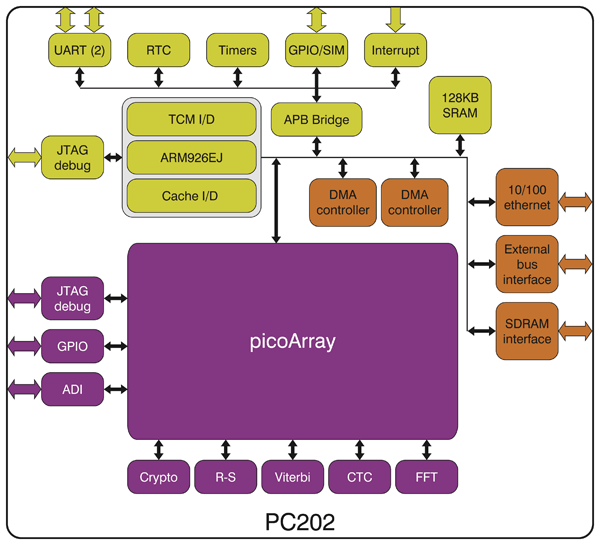 periences of humans is being enabled by the variety of wireles devices, networks, accesses, and so forth, he is after such radical technological experience where hardware and software relations within technology matter as well. Talking about chipsets such as the Picochip202, Mackenzie compares these to cities: “The ‘architectures’ of chipsets resemble cities viewed from above precisely because they internalize many of the relational processes of movement in cities.” (65).
The way bodies were moved and managed in urban environments has now been transposed as a problem on the level of chips and other seemingly “only” technical solutions. Yet, what Mackenzie does succesfully is to show how we need insights into such biopolitics that engage not only with human phenomenological bodies, but biopolitics of technological bodies too. This is what I find a very exciting and necessary direction, and while I know some of the great work done in Science and Technology studies, more media studies work in this direction of new materialism is very much welcome.
So now that we got talking about technological bodies in relation, and probably going soon so far that we could say that they have affects, would some critic say, does this not mean that we losing our grip on politics — that technology is such a crucial way of governing our worlds, offering meanings, and is itself embedded in a cultural field of representation and such?
Mackenzie does not however neglect representations, or the variety of materials of which the experience of wirelessness consists; from wireless routers to marketing discourses and adverts, the ontological claim that thinking and things do not differ work also as a methodological guideline for rigorous eclectism. Similarly, Mackenzie shows how his methodology and writing lends itself also to postcolonial theory in chapter 7 “Overconnected worlds”. Here, the claim is consist with a radical constructedness inherent in how transnationality and the global are created, not received, structures of experiencing; here, various wireless projects offer such platforms for both belief as well as physical connection.
Wirelessness overflows individual bodies and act as a catalyzer, intensifier, a field for experience perhaps in the sense as electromagnetic fields afford the technical signal between devices. What the book does as well is overflows in its richness – but it is clear that it is so rigorous in its take that media theory benefits from this for a long time. It picks up on some of the same inspiration that has been catalyzed into more philosophical takes on communication and contemporary culture by Brian Massumi, but is one of the first ones to take this mode of analysis of lived abstractions into concrete media analysis – similarly as he did with Simondon already in Transductions.
What is New Materialism-Opening words from the event
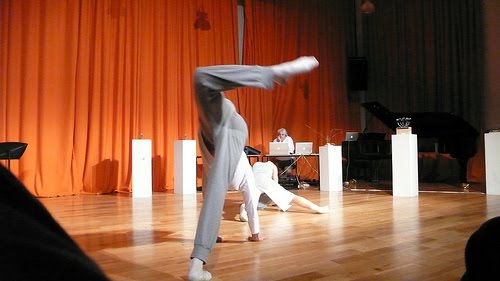
As promised, please find below the opening words to the recent New Materialisms and Digital Culture-event by Milla Tiainen and me. The event was filled with great talks by a range of scholars with differing disciplinary backgrounds, and ended up with the dance/technology-performance Triggered (composed by Cheryl Frances-Hoad, Tom Hall and Richard Hoadley, choreography by Jane Turner). In the midst of the text, images (taken by Tim Regan) from the performance and the conference. A warm thank you to all speakers, performers and our great audience in both parts of the day!
 NEW MATERIALISMS AND DIGITAL CULTURE
Anglia Ruskin University
CoDE: Cultures of the Digital Economy –research institute and Dept. of ECFM, convened by Milla Tiainen and Jussi Parikka
21-22 of June, 2010
Milla Tiainen and Jussi Parikka
Opening words: What is New Materialism?
I
As stated in the programme we’d like to begin by just briefly engaging with one of the key components, or actants, of the symposium’s setup: the concept of “new materialism.” The purpose of this is definitely not to identify a stable referent for that term so much as to point towards some of the problems it arguably connects with. Whereas I will in few words consider the concept’s broader resonances across current cultural, social and feminist theory, Jussi will subsequently comment on ‘new materialist’ modes of questioning in conjunction with digital media culture.
Aptly, there are three books forthcoming soon whose respective titles include the concept “new materialism”—while it in each case links with varying further concepts and associated planes. “New Materialisms: Ontology, Agency, and Politics”, to be published by Duke, features such writers as Rosi Braidotti, Sara Ahmed and Jane Bennett; the essay collection “Carnal Knowledge: Towards a New Materialism through the Arts” is edited by Barbara Bolt and Estelle Barrett and involves contributions by Australian and European scholars including a chapter by Jussi and myself; and two of the speakers of this symposium, Iris van der Tuin and Rick Dolphijn, are currently working on a book on philosophy of science that is entitled “New Materialism” and will come out later this year. Thus, as these particular ‘capturings’ of ongoing research for their part evidence, the concept of new materialism is increasingly partaking in the flows of language and thought of specific areas of cultural and critical thought; its “rhythms of arrival and departure”, to borrow Brian Massumi’s expression (Parables for the Virtual 2002, 20), as well as connections with various other concepts are becoming growingly regular and rich in intensity within these flows. A momentum of at least some intensive magnitude is gathering round “new materialism.” Or, perhaps better put, the concept is being utilized so as to try and couch such a momentum which is unravelling transversally across fields of inquiry whilst at the same time displaying a notable degree of consistency in terms of the implicated topics of concern.
What, then, are the problems that would lend “new materialism” its meaning or usefulness? Evidently, the precise configurations of sense and effect that the concept invokes are singular to its every usage along with being more generally in the making within the debates involving it. At its broadest, nonetheless, new materialism can be said to concern a series of questions and potentialities that revolve round the idea of active, agential and morphogenetic; self-differing and affective-affected matter. Indeed, this summary would probably be endorsed by most proponents and sceptics of new materialisms alike. To be sure, this ideational assemblage or its part-problems have also already inspired incisive critique from prolific scholars. These critics remain unconvinced about both ‘new materialism’s attempts to reconfigure the persistent dichotomies of nature/culture, body/thought, concrete/abstract etc. and the allegedly dubious politics of the category of the ‘new’ in the concept of new materialism. To paraphrase one prominent critic, Sarah Ahmed (it will be interesting to see what her contribution to the New Materialisms essay collection looks like!), the new materialist conceptions of dynamic human and non-human materialities that acquire shapes, operate and differentiate also beyond human perception and discursive representational systems are, at least within feminist new materialisms, in danger of positing matter as an it-like fetish object precisely because of their insistence on its ontological distinctiveness (Ahmed, “Imaginary Prohibitions: Some Preliminary Remarks on the Founding Gestures of the ‘New Materialism’” 2008, 35). This fetishizing is moreover enabled, according to Ahmed, by strategic amnesia regarding the previous rich engagements with biology, the body and matter that were carried out within science and technology studies and other areas of human and social sciences (again her focus lies mainly in feminist genealogies). Ahmed therefore concludes that despite intentions to the contrary many new materialist gestures actually solidify rather than ‘fluidify’ the boundaries between nature/culture and matter/signification. At the same time these projects’ declarations of the newness of their endeavours conveniently conjure up an image of theorists who embark “on a heroic and lonely struggle” (32) against the collective non- or anti-materialism of former cultural and social-theoretical stances.
Now unhinging and confounding habitual dual oppositions remains undoubtedly a challenge for any ‘new materialist’ (as well as a theoretically differently oriented) project. Yet in order to end my part of these opening words I would like to point out three aspects that go some way in responding to the criticisms Ahmed presents—along with hopefully resonating with the talks of today.
Hence:
1) First of all, one of the signalling features that cuts across the heterogeneous projects we would like to propose as new materialist is their sustained commitment to developing models of immanent and continuously emergent relationality. Through insisting on the felt reality of relations for instance in the wake of William James, on the irreducibility of the in-betweens to the connecting terms, and on the intensive topological spaces of co-affectivity these models, we would argue, provide some of the most effective means on offer at the moment for thinking past the traditional rigid dualisms of nature/culture, subject/object and so on and for articulating the intuited processual co-substantiality of these facets.
2) Secondly and connectedly, the notion of the outside or virtual, which within new materialist undertakings relates or overlaps with such more specific concepts as affect, potential and variation, certainly diminishes the risk of ending up with a re-essentialized and reified conception of matter.
3) Thirdly and finally, we would like to think that the newness in the ‘new materialism’ refers less to a discrete stage let alone a point of culmination on a teleological line of theoretical understanding than to a multiplicity of attempts to live with newly composed problems whilst refreshing the vocabularies of cultural, artistic and feminist theory with “conceptual infusions” (Massumi 2002, 4) from hitherto overlooked or presently rediscovered sources.

II
In the context of digital media culture, the notion of “materiality” occupies a curious position in itself. As observed by Bill Brown in his entry for the recent Critical Terms for Media Studies (Chicago UP, 2010), our understanding of the media historical modernity has been infiltrated early on with the idea of “abstraction” — abstraction as a driving force (as with standardization of techniques, processes, and messaging) and an effect (represented in forms of power, subjectivities, cultural practices) of modernity. Recognized by a range of different writers from Karl Marx to Debord and Baudrillard, such a process has been influential in forcing us to rethink not materiality but dematerialisation as crucial to understanding the birth of technical media culture. Regimes of value, and regimes of technical media share the same impact on “things” – homogenisation, standardisation, and ease of communication/commodification in a joint tune with each other are in this perspective, and a perspective that branded critical theory for a long time, crucial aspects in any analysis of media culture’s relation to materiality.
Hence, the move from the critical evaluation of emergence of capitalist media culture seemed to flow surprisingly seamlessly as part of the more technology-oriented discourse concerning “immateriality” of the digital in the 1980s and 1990s. Here, in a new context, materiality was deemed as an obsolescent index of media development overcome by effective modes of coding, manipulating and transferring information across networks that become par excellence the object of desire of policies as much cultural discourses.
Yet, the recent years of media theory introduced an increasingly differing elaboration of how we should understand the notion of “medium” in this context. Instead of being only something that in a Kantian manner prevents access to the world of the real or material, or things (Brown, p.51) the medium itself becomes a material assemblage in the hands of a wave of German media theorists, who have develop a unique approach to media materialism, and hence new materialist notions of the world. Here the world is not reduced to symbolic, signifying structures, or representations, but is seen for such writers as Friedrich Kittler (and more recent theorists such as Wolfgang Ernst in a bit differing tone under media archaeology) as a network of concrete, material, physical and physiological apparatuses and their interconnections, that in a Foucauldian manner govern whatever can be uttered and signified. This brand of German media theory came out as an alternative exactly to the Marxist as well as hermeneutic contexts of theory dominating German discussions in the 1960s-1980s, and carved out a specific interest to the coupling of the human sensorium with the non-human worlds of modern technical media. In this insight, and ones shared by writers such as Jonathan Crary, on the one hand, the birth of modern media culture owed to the meticulous measuring of the human sensorium in various physiological settings and extending to experimental psychology labs in the late 19th and early 20th century. On the other hand, modern technical media showed such wavelengths, speeds, vibrations and other physical characteristics in itself that it escaped any phenomenological analysis, and hence tapped into a material world unknown per se to humans.
Without wanting to sound too reductionistic, I believe this is one of the key directions where media theory more recently has developed its own enthusiasm concerning a new more material understanding of media. Naturally filtered into new contexts, and transforming the way it works, such directions have however inspired also in the Anglo-American world new directions, new interests in material constellations of “platforms, interfaces, data standards, file formats, operating systems, versions and distributions of code, patches, ports and so forth”, to paraphrase Matthew Kirschenbaum. Naturally, post-representational approaches are present in a wide range of work and other thinkers, from the Deleuze-inspired cinematic philosophies of Steven Shaviro to sociological ideas of Nigel Thrift, the new materialist mappings of subhuman bodies such as blobs by Luciana Parisi to the politically tuned analyses of network culture of Tiziana Terranova — and the range of theories and theorists we are able to enjoy today.
Indeed, if I would be forced to summarize the intimate link between the analytical perspectives that go under the general umbrella term New Materialism and media theory and digital culture, it would have to do with at least three directions
1) The seemingly immaterial is embedded in wide material networks; information is informed by the existence of material networks, practices, and various entanglements, that expand both to the materiality of political economy of ownership, access and use, but also to the material assemblages which govern the way we are in media milieus.
2) Yet, technical media is also defined by non-object based materialities, which makes it slightly more difficult to conceptualise. As a regime of electromagnetic fields, of pulsations, electricity, and such fields as software, technical media and digital culture escape the language of solids.
3) The intimate connection between the dynamic human/animal body and media tech, which since the 19th century and for example experimental psychology labs has now extended to the various design practices in HCI and such that tap into the physiological thresholds of the human being in novel ways – hence the interest in affect, emotion, non-conscious and s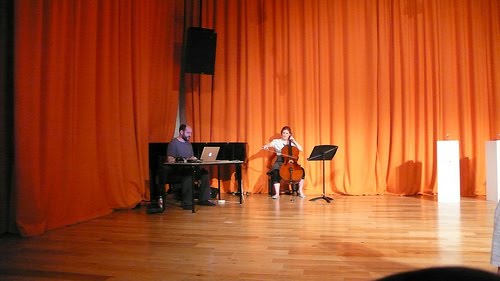 omatic levels of the human body, and emergence of various forms of interfacing, whether from the consumer tech of Kinect-gaming body-in-movement-meets-Xbox interface to still very aspirational Brain-2-Brain, B-2-B, networking and such. Its here that the knowledge about the kinetic, dynamic, and relational body feeds into understanding the moving-situatedness of us in mobile network cultures.
>New Materialism abstracts
>
David M. Berry: Software Avidities: Latour and the Materialities of Code
The first difficultly in understanding software is located within the notion of software/code itself and its perceived immateriality. Here it is useful to draw an analytical distinction between ‘code’ and ‘software’. Throughout this paper I shall be using code to refer to the textual and social practices of source code writing, testing and distribution. In contrast, I would like to use ‘software’ to include products, such as operating systems, applications or fixed products of code such as Photoshop, Word and Excel and the cultural practices that surround the use of it. This further allows us to think about the hacking as the transformation of software back into code for the purposes of changing its normal execution or subverting its intended (prescribed) functions. However, this difficulty should not mean that we stay at the level of the screen, so-called screen essentialism, nor at the level of information theory, where the analysis focuses on the way information is moved between different points disembedded from its material carrier, nor indeed at the level of a mere literary reading of the textual form of code. Rather code needs to be approached in its multiplicity, that is as a literature, a mechanism, a spatial form (organisation), and as a repository of social norms, values, patterns and processes. In order to focus on the element of materiality I want to use Latour’s notion of the ‘test of strength’ to see how the materiality of code, its obduracy and its concreteness are tested within computer programming contests. To do this I want to look at two case studies: (1) the Underhanded C Contest, which is a contest which asks the programmer to write code that is as readable, clear, innocent and straightforward as possible, and yet it must fail to perform at its apparent function. To be more specific, it should do something subtly evil; and (2) The International Obfuscated C Code Contest, which is a contest to write the most Obscure/Obfuscated C program possible that is as difficult to understand and follow (through the source code) as possible. By following the rules of the contest, and by pitting each program, which must be made available to compile and execute by the judges (as well as the other competitors and the wider public by open sourcing the code), the code is then shown to be material providing it passes these tests of strength.
Rick Dolphijn: The Intense Exterior of Another Geometry
Eleni Ikoniadou: Transversal digitality and the relational dynamics of a new materialism
The relationship between digital technology and matter has preoccupied media and cultural theorists for the last two decades. During the 90s it was articulated through a celebration of the disembodied, immaterial and probabilistic properties of information (cybercultural theory). More recently, it has been asserted through a reliance on sensory perception for the construction of a predominantly observable, otherwise void, digital space (digital philosophy). However, alternative materialist accounts may be able to offer more dynamic ways of understanding the heterogeneity, materiality and novelty of digital culture (Kittler, 1999; Mackenzie, 2002; Fuller, 2005; Munster, 2006). Following on their footsteps, this presentation will aim to rethink the ontological status of the digital as immanent to the flows of a ‘new materialism’. The latter is understood as a transversal process that cuts across seemingly distinguished fields and disciplines, such as the arts and sciences, establishing new connections between them. New materialism, then, becomes a concept and a method proper for investigating digital media and their tendency to bring together different aspects of the world in new ways. The paper discusses how an abstract materialist new media theory can enable transversal relations between science studies, philosophy and media art, as well as between the actual and the virtual dimensions of reality; allowing the emergence of heterogeneous digital assemblages of material, aesthetic and scientific combination.
Adrian Mackenzie: Believing in and desiring data: ‘R’ as the next ‘big thing’
How could materialist analysis come to grips with the seeming immateriality of data network media? This paper attempts to think through some of the many flows of desire and belief concerning data. In the so-called ‘data deluges’ generated by the searches, queries, captures, links and aggregates of network media, key points of friction occur around sharing and pattern perception. I focus on how sharing and pattern perception fare in the case of the scripting language R, an open source statistical ‘data-intensive’ programming language heavily used across the sciences (including social sciences), in public and private settings, from CERN to Wall Street and the Googleplex. R, it is said, is a ‘next big thing’ in the world of analytics and data mining, with thousands of packages and visualizations, hundreds of books and publications (including its own journal, /R Journal/) appearing in the last few years. In this activity, we can discern vectors of belief and desire concerning data. The tools and techniques developed in R can be seen both intensifying data, and at times, making the contingencies of data more palpable.
Stamatia Portanova: The materiality of the abstract (or how movement-objects ‘thrill’ the world)
Anna Powell: Affections in their pure state? The digital event as immersive encounter
Iris Van der Tuin: A Different Starting Point, A Different Metaphysics: Reading Bergson and Barad Diffractively
Across scales, contagious movement
I wrote this short text as a response, inspired by Stamatia Portanova’s recent introduction to her concept of movement-object…published on the In Medias Res-website.
Why is global capitalism so interested in dance? Why is it so interested in flexible, able, creative bodies that show virtuosity and skill? It seems that the emblematic body of contemporary network(ed) capitalism of creative industries and digital economy is that of the dancer, the performer, what Virno referred to as virtuosity; not solely the individual performer however, but indeed a collective quite often. Its flash mobs on train stations, not the worker at the conveyer belt; indeed, train stations instead of factories. What is being produced is movement, or perhaps, from a moving, creative, related set of bodies something emerges; what is that what interests capitalism in that sense? Of course, football is the great art of relationality (think of Douglas Gordon’s Zidane-film!) but as much a condensation of creative capitalism; a condensation of not only flows of skill, but flows of capital and profit. In South-Africa, at the moment, with the World Cup approaching, new territories of security are being created where wrong bodies (street kids, and other not-wanted-disturbances) are being cleaned out from the streets in preparation for the celebration of global society under the banner of football.
An excerpt from another text, forthcoming:
“Indeed, the dancing and moving body can be seen in historical terms as a specific form of knowledge production with an increasing economic importance. Dance is the perfect interface for cultural theories of movement (bodies in variation) to understand the complexity of interaction, an ethology of forces/bodies and the object of cultural industries of affect and experiences. Nigel Thrift writes: ‘[…] dance can sensitize us to the bodily sensorium of a culture, to touch, force, tension, weight, shape, tempo, phrasing, intervalation, even coalescence, to the serial mimesis of not quite a copy through which we are reconstituted moment by moment’ (2008: 140).”
“Not quite a copy” seems to be the contagious element of propagation.
You (referring to Stamatia) start with viruses, with bacteria, which is apt in terms of thinking the contagious nature of gesturality/movement (despite a post-fordist emphasis on flexible bodies, actually the mapping of the gestural, flexible body was part of the earlier phase of capitalism, the cinematic one already since he 19th century) and movement-objects as you call them. It seems to convey the idea of such objects themselves as condensations of intensities that can spread across levels, in this case from the thickness of the event/bodies performing in relation to e.g. algorithmic environments, digital techniques/milieus of creation. Indeed, its not only an abstraction of lived relations of organic kinds, but another scale of relations that is being superposed, or ties in with bodies, and that intertwining of scales and techniques interests me a lot. The digital object is far from static but incorporates too an intensity that stems from its relational status. We can also approach digital objects through the notion of affect whether on the level of design where e.g. object-orientated-design deals with such relations, or then more widely through the assemblage nature of digital nature. Digital objects, software and such, are, for me, characterised by their translational capacities. Not only that through algorithmic measures we are able to abstract etc. things into datasets, but that such abstractions return to organic bodies and their actions; they return as sounds and visions, as actions or frameworks for action (operating systems, bank cash dispensers, and such). This generative circuit that software participates in between a variety of bodies, this relationality, is how I would read also “movement-objects” circulating and distributing certain relations and gesturality even.
I think this multiplicity of ecologies is one thing that strikes me about your movement-objects; they always creatively “mediate” between scales; whether digital objects-organics, or then the idea about beats, where the beat-object is formed through combination of grains, as you put it following Alanna, and where on another scale of bodies’ beats create combinations; bodies pulsating together at a disco! Or again, at the train station as with flash mobs harnessed as part of mobile operator adverts! Its contagious, indeed, and again ties in these contemporary themes together with crowds, social imitation as creativity of bodies in concert, all symptomatic of modernity already in the sense Gabriel Tarde talked about (and more recently Tony Sampson has been interested in!).
New Materialisms and Digital Culture -symposium
 Please find below information and registration possibility for our symposium
on new materialist cultural analysis as well as info for the launch event of the
CoDE institute and the affiliated Digital Performance Laboratory.
An International Symposium on Contemporary Arts, Media and Cultural Theory
Date: Monday 21 June 2010
Time: 10:00 – 17.30 (18.00 Performance and CoDE Launch)
Venue: Hel 201, Anglia Ruskin University, East Road, Cambridge
Far from being immaterial, digital culture consists of heterogeneous bodies, relations, intensities, movements, and modes of emergence manifested in various contexts of the arts and sciences.
This event suggests “new materialism” as a speculative concept with which to rethink materiality across diverse cultural-theoretical fields of inquiry with a particular reference to digitality in/as culture: art and media studies, social and political theorising, feminist analysis, and science and technology studies.
More specifically, the event maps ways in which the questions of process, positive difference or the new, relation, and the pervasively aesthetic character of our emergences with the world have lately been taken up in cultural theory. It will engage explorations of digital culture within which matter, the body and the social, and the long-standing theoretical dominance of symbolic mediation (or the despotism of the signifier) are currently being radically reconsidered and reconceptualised.
The talks of the event will probe media arts of digital culture, sonic environments, cinematic contexts, wireless communication, philosophy of science and a variety of further topics in order to develop a new vocabulary for understanding digital culture as a material culture.
Speakers include: Dr David M. Berry, Dr Rick Dolphijn, Dr Satinder Gill, Dr Adrian Mackenzie, Dr Stamatia Portanova, Dr Anna Powell, Dr Iris van der Tuin and Dr Eleni Ikoniadou.
The academic programme will be followed by a physical computing and dance performance involving CoDE affiliated staff (Richard Hoadley and Tom Hall) along with choreographers Jane Turner, Cheryl Frances-Hoad and their dancers.
Following the symposium there will also be a short workshop for PhD students on Tuesday 22 June led by Van der Tuin and Dolphijn along with Milla Tiainen and Jussi Parikka. The aim of the workshop is to enable students to discuss and present brief intros to their work on the theme of new materialist analysis of culture and the arts with tutoring from the workshop leaders. The workshop is restricted to max. 10 students. Participation for the selected ten is include in the registration fee. If you are interested, please send an informal message to either milla.tiainen@anglia.ac.uk or Jussi.parikka@anglia.ac.uk along with a short (approx. 1 page) description of your PhD work and its relation to new materialism.
In addition, we are planning an informal introductory workshop for Tuesday afternoon on experimental performance and physical computing.
The event is sponsored by CoDE: the Cultures of the Digital Economy research institute and the Department of English, Communication, Film and Media at Anglia Ruskin University.
Please register your place here
Fee: £20
Programme
Anglia Ruskin University. East Road, Cambridge, UK, Helmore Building, room Hel 201
June 21, Monday
10.00 Welcome and what is new materialism, Milla Tiainen and Jussi Parikka
10.15 Anna Powell (Manchester Met): Electronic Automatism: Video Affects and The Time Image
11.10 Break
11.30 Iris van der Tuin (Utrecht): A Different Starting Point, a Different Metaphysics”: Reading Bergson and Barad Diffractively
Rick Dolphijn (Utrecht): The Intense Exterior of Another Geometry
12.30 Lunch
13.45 Stamatia Portanova (Birkbeck): The materiality of the abstract (or how movement-objects ‘thrill’ the world)
Eleni Ikoniadou: Transversal digitality and the relational dynamics of a new materialism
Satinder Gill (Anglia Ruskin/CoDE and Cambridge University): “Rhythms and sense-making in responsive dense-space’
15.20 break
15.40 David Berry: Software Avidities: Latour and the Materialities of Code.
16.10 Adrian Mackenzie (Lancaster) Believing in and desiring data: R as ‘ next big thing
17.00 closing and a break
18.00 Open launch and drinks event for the Digital Performance laboratory (CoDE, Music and Performing Arts, Anglia Ruskin) and a science-arts interdisciplinary performance Triggered. Recital-hall, Helmore Building (029), East Road, Anglia Ruskin, Cambridge.
‘Triggered’ showcases the results of a practice-as-research project into methods of interdisciplinary collaboration between a group of contemporary dancers, musicians and music technologists. The nature of this collaboration has allowed performance to emerge from artists and disciplines interacting and responding to each other. The bespoke technologies used in the project enable sophisticated dialogue between movement and sound, between music composition and choreography. The nature of interaction and narratives created are key areas of investigation and these areas will explored in a workshop on the second day of the conference. Performing, choreographing, composing and building the production are Cheryl Frances-Hoad, Tom Hall, Richard Hoadley, Jane Turner & dance company.
Day 2 (June 22)
10.00-12.30 Helmore 251
New materialism: art, science, media –workshop with selected PhD students with Dr Iris van der Tuin and Rick Dolphijn, along with Milla Tiainen and Jussi Parikka
12.30-14.00 lunch
14.00 an experimental performance/HCI workshop and interaction possibility with Jane Turner, Cheryl Frances-Hoad, Dr Satinder Gill, Dr Richard Hoadley and Dr Tom Hall.
>Affect – start of the RIB and ArcDigital theme year
>What are affects good for? I am not referring to the stuff going through your body and your mind, but the concept. ArcDigital and RIBs (Representation, Identity and the Body) theme year on Affect was kicked off yesterday with discussions based on Nigel Thrift’s and Eric Shouse’s texts. Good points followed, so many I cannot summarize them here. But for me, its the possibility of tapping to various weird materialities that “affect” affords us. This ranges from the 0.5 second delay between event and consciousness Wundt talked about, the odd reactions that Reagan talking can have, the relationality of bodies in movement, as well as for example the software objects defined by their relations — i.e. also non-human affects being possible. Affects are the element of transformation, and transmission — of bodies relating and being in their relatedness. As Joss Hands pointed out, the danger of the concept is becoming too wide, too vague. Hence, there is no one big theory of affect, just good uses in contexts where we need to think beyond signification, representation and the human.
Affects are more — they are the primary surplus due to their by definition relational nature. This is where the connection to sensations might become clearer. To quote Massumi: “Sensation is the registering of the multiplicity of potential connections in the singularity of a connection actually under way. It is the direct experience of a more to the less of every perception.” (In Parables for the Virtual, p.92). What is the relation between sensation and affect? Definitely, in the Deleuzian inspired schemes, its not always clear. If affects include/are transitions, sensations travel as well. Consider Deleuze writing on Bacon: “Bacon constantly says that sensation is what passes from one ‘order’ to another, from one ‘level’ to another, from one ‘area’ to another. This is why sensation is the master of deformations, the agent of bodily deformations.”
Affects are less. They escape the conscious perception, flee and yet effect, impose on social interaction. Its the mentioned lost time, perhaps — in terms of capturing the possibility of tapping into the preconscious. We smile before the joke gets funny, we react before the person even starts to make sense, we feel it already before the actual meeting has started. Of course, so closely connected to feelings — they loop together, as Milla reminds us. It does not stay unnoticed by the intensive body that we engage continously with agendas, structures, classifications and so on of emotions. Affects produce emotions that are shared, but they feedback through various political and social acts of naming etc?
Are they tonalities? Yes, to an extent that tonalities are shared, or connect things/people/entities in time-spaces. Its the in between of perceiver and what is perceived. To again quote Massumi: “The properties of the perceived thing are properties of the action, more than of the thing itself. This does not mean that the properties are subjective or in the perceiver. On the contrary, they are tokens of the perceiver’s and the perceived’s concrete inclusion in each other’s world.” (again from Parables of the Virtual, p.90).
Vocabularies for weird materialities? This ranges from bodies in movements, of micromovements on the skin, such concrete inclusions of bodies sharing something and becoming together, of non-human objects/processes defining each other, of feeling the intensity of fastness, slowness, closeness, distance. Its what psychophysiology was keen on mapping in the 19th century in connection with the birth of modern media culture (as always, Jonathan Crary’s Suspensions of Perception is the book to read), and what biotechnologies, brain and cognitive sciences and even quantum physics inspect. It is also the regime of things such as somatosenses — proprioception, kinesthesia, the visceral…(Eleni Ikoniadou who is just finishing her PhD from UEL on rhythmic ontologies is working in this field).
In the midst of a panorama of approaches, what seems to become increasingly crucial is that we need new cartographies of affect — ones that don’t rely only on psychoanalysis etc., but inspect art/science/technology/philosophy as the source of innovation/invention.
To conclude, a good example of such interchanges: Christa Sommerer and Laurent Mignonneau’s Nano-Scape system from 2001.









 Machinology