Archive
An Interview with Martin Howse
This is another interview, and audio recording now available, that I did in Berlin in 2011. It is my chat with Martin Howse, of microresearch, and the project(s) together with Jonathan Kemp and Ryan Jordan: decrystallisation, recrystallisation and the later Crystal Worlds in Berlin and London. We talk of what the crystal project means, ideas related to art methods, and ending up with evil media.
Related readings of The Crystal World exhibition: Howse and Kemp in Mute Magazine, and Matthew Fuller in the same magazine: “The Garden of Earthly Delights.”
Apologies for a bit lousy quality of the sound in my recording.
An Interview with Paul DeMarinis
I interviewed Paul DeMarinis in July 2011 in Berlin about his media archaeological art practices and methodology.
It was originally in the context of the Creative Technologies Review podcasts we did with Julio D’Escrivan, but the archives of those podcasts are not available so I wanted to share this interview (audio, mp3) for those interested.
Zombie Media in Leonardo
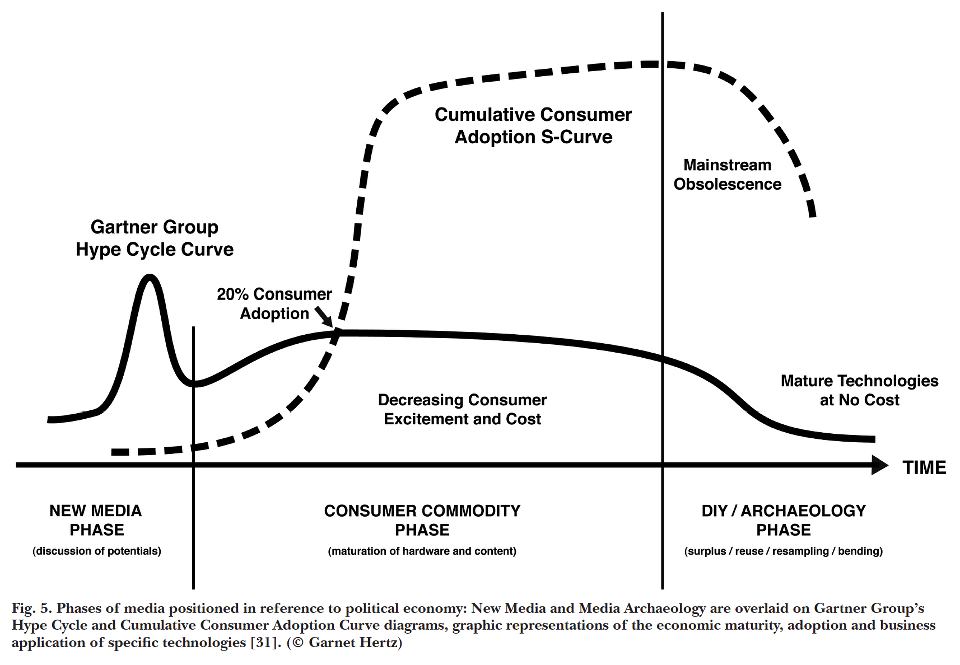
The circuit bended and definitely (re)modified fruits of our collaboration with Garnet Hertz are out. True, “Zombie Media” has been circulating as an unborn living dead text for a longer while, ever since it was part of the Transmediale 2010 Theory Award competition — but now it is finally officially out in Leonardo (vol. 45, no 5)!
Working with someone like Garnet is a pure joy, and demonstrates why collaboration is good for you: you learn a lot. A lot lot.
As a teaser to the longer “Zombie Media: Circuit Bending Media Archaeology into an Art Method”-article, please find below the short “manifesto” on “Five Principles of Zombie Media” we co-wrote for the Defunct/Refunct-catalogue (PDF).
———-
Zombie media addresses the living deads of media culture. As such, it is clearly related
to the earlier calls to investigate “dead media” by Bruce Sterling and others: to map
the forgotten, out-of-use, obsolete and declared dysfunctional technologies in order
to understand better the nature of media cultural development. And yet, we want to
point to a further issue when it comes to abandoned media: the amount of discarded
electronic media is not only the excavation ground for quirky media archaeological
interests, but one of the biggest threats for ecology in terms of the various toxins they
are leaking back to nature. A discarded piece of media technology is never just discarded
but part of a wider pattern of circulation that ties the obsolete to recycling centers,
dismantling centres in Asia, markets in Nigeria, and so forth – a whole global political
ecology of different sorts where one of the biggest questions is the material toxicity of
our electronic media. Media kills nature as they remain as living deads.
Hence, we believe that media archaeology – the media theoretical stance interested
in forgotten paths and quirky ideas of past media cultures – needs to become more
political, and articulate its relation to design practices more clearly. We are not the only
ones that have made that call recently – for instance Timothy Druckrey writes:
“The mere rediscovery of the forgotten, the establishment of oddball paleontologies, of
idiosyncratic genealogies, uncertain lineages, the excavation of antique technologies or
images, the account of erratic technical developments, are, in themselves, insufficient to
the building of a coherent discursive methodology.” [2]
We would want to add that in addition to developing discursive methodologies, we
need to develop methodologies that are theoretically rich as well as practice-oriented –
where ontologies of technical media meet up with innovative ideas concerning design
in an ecological context.
As such, the other part of the zombie media call is the work of reappropriation
through circuit bending and hardware hacking methodologies – to extend the media
archaeological as well as ecosophic interest into design issues. By actively repurposing
things considered dead – things you find from your attic, the second hand market, or
amongst waste – the zombiefication of media is to address the planned obsolescence of
media technologies which is part of their material nature. In reference to contemporary
consumer products, planned obsolescence takes many forms. It is not only an ideology,
or a discourse, but more accurately takes place on a micropolitical level of design:
difficult to replace batteries in personal MP3 audio players, proprietary cables and
chargers that are only manufactured for a short period of time, discontinued customer
support, or plastic enclosures impossible to open without breaking them. Whether you
can open up things – the famous black boxes of media culture characterized by iPhones
and iPads – is one of the biggest political and ecological questions facing our media
theory and practices too.
As a manifesto, five points of zombie media stand out:
1/ We oppose the idea of dead media. Although death of media may be useful as a tactic to
oppose dialog that only focuses on the newness of media, we believe that media never
dies. Media may disappear in a popular sense, but it never dies: it decays, rots, reforms,
remixes, and gets historicized, reinterpreted and collected. It either stays as a residue
in the soil and in the air as concrete dead media, or is reappropriated through artistic,
tinkering methodologies.
2/ We oppose planned obsolescence. As one corner stone in the mental ecology of
circulation of desires, planned obsolescence maintains ecologically unsupportable
death drive that is destroying our milieus of living.
3/ We propose a depunctualization of media and the opening, understanding and hacking
of concealed or blackboxed systems: whether as consumer products or historical
archives.
4/ We propose media archaeology as an artistic methodology that follows in the traditions
of appropriation, collage and remixing of materials and archives. Media archaeology
has been successful in excavating histories of dead media, forgotten ideas, sidekicks and
minor narratives, but now its time to develop it from a textual method into a material
methodology that takes into account the political economy of contemporary media
culture.
5/ We propose that reuse is an important dynamic of contemporary culture, especially
within the context of electronic waste. “If it snaps shut, it shall snap open.” We agree in
that open and remix culture should be extended to physical artifacts.
Torsten Lauschmann at Hansard Gallery
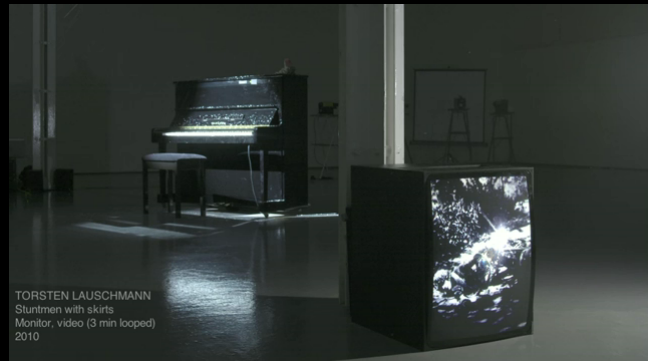
I recently gave a talk about Torsten Lauschmann’s art. This took place in Southampton, at the Hansard gallery with my great colleague prof. Ryan Bishop. In my quite informal presentation, I picked up on points such as… (excerpts to follow):
…
What several of Lauschmann’s pieces conjure is a different way of seeing media than just as communication. Media is trickery, a way of modifying realities, and has been for a long time; deceptions of the senses, of virtual realities and false impressions – this is the work of media, which brings it closer to the military psy-ops, and a history of hallucinations, other realities and indeed – magic. In other words, forget the idealistic notions of media as communication between people to exchange messages – instead, entertainment worlds are even down to their physiological effects about tricking the eye, the ear and the mind in ways that attract and affect the spectator. Media is sometimes closer to sorcery, It can conjure and produce realities in very effective ways – think of the long lineage from indeed magic and sorcery to current PR culture… (Fuller and Goffey, Evil Media).
…
What is significant is perhaps exactly this imagining a parallel world of media that borrows from past. But what is borrowed are perhaps not always very suitable ideas. Yet such can be employed as tools of investigation, critical ways to see our current media culture. It can also be about picking up individual motifs, minor details or ideas, and working them into the art piece, like Lauschmann seems often to do. More generally, in differing ways such works mix the way in which we understand media time – it is not only a progression from the old to the new, but how ideas got discovered and rediscovered, recycled, like concretely in some recycling based DIY art; or in the midst of our reborn enthusiasm for 8-bit pixelated aesthetics, vinyl music listening, of retrogames you remember from 1980s, also old technology presents itself as an alternative way of understanding the new: to take an old piece of technology, visual or audio, and try to think how it enables a different way of understanding media aesthetics.
Defective ideas and forms become standardized as our ways to think of time and media.
“We make our journeys out there in the low light of the future, and return to the bourgeois day and its mass delusion of safety, to report on what we’ve seen. What are any of these ‘utopian dreams’ of ours but defective forms of time-travel?” ( Pynchon, Against the Day, 2006)
Couldn’t we say the same thing about the past: journeys to the past that are like defective forms of time-travel? To past times when old technologies were once new too, and puzzled and awed, with their low lighting, crackling, noise, and pixelated style? The obsolescent entertainment device, the pianola, melancholicly playing its tune in the middle of the room reminds of such time-travels from which Lauschmann poached ideas and devices that trigger much more than nostalgia.
…
In his part of this double act, Bishop talked about Lauschmann in relation to histories of automation, labour and for instance mechnical music, including the player piano.
The Media That Therefore We Are – on Lenore Malen’s video installation
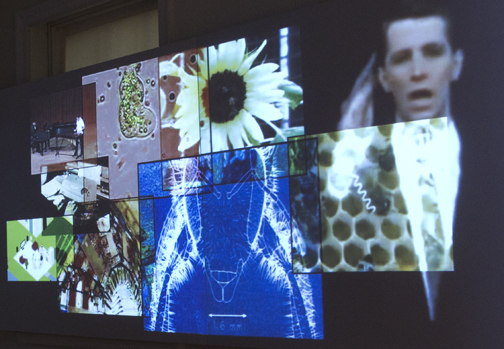
I wrote this short catalogue text for Lenore Malen’s I am the Animal — also included stills (courtesy of and permission from Lenore Malen) from the exhibition:
The Media That Therefore We Are
It’s a matter of scales. If you are far enough away, and your perspective is mediated by a layer of concepts, abstractions, and an organizational eye, you might indeed see them as models of ideal society. It’s all order. Everyone does what they are supposed to. There is one Queen. No wonder the protofascist Maya the Bee was an ideal cartoon character for 1930s national-socialist Germany. One is tempted to see the idea of a strong leadership to which everyone submits as an example of sovereign power per se, even if, to be honest, the Queen does not choose to execute power — it happens much more intuitively, almost in a subconscious way. Of course, when it comes to bees, there is no such talk of subconscious; instinct used to be the word in the 19th century for this near mystical mode of organization. This is evident in, for instance, Maurice Maeterlinck’s The Life of the Bee (1901), which refers to “the spirit of the hive.”
But on another scale, it looks very different. Look closely enough and they become the aliens they are: their weird compound eyes composed of thousands of lenses, their six legs, non-human movement, jerky, non-mammal insides folded out. This has been the other story since the 19th century and the birth of modern entomology: insects as aliens, otherworldly non-humans, often seem almost to possess technology in their capacities to see, sense, and move differently. The insects are the Anti-McLuhan; technics does not start with the human but with the animal, the insect, and their superior powers of being-in the- world (the allusion to Heidegger is intentional).
 Lenore Malen’s I Am The Animal intertwines the various histories, aesthetics, and idealizations of the bee community as well as the bee’s relations withbeekeepers. It’s all about relations, and establishing relations with our constitutive environments — including bees. Donna Haraway talks about companion species (specifically dogs, but other animals too) as formative of our being in the world; she discusses the ways in which those relations are formative of our becomings.
Our relation to insects is reflected in much more than the narrative aspect of Malen’s work. The immersive environment of the installation envelops the spectator in a milieu of becoming. The clips Malen uses are mini-thoughts, mini-brains, which are brought together with her digital software tools; the clips are memes that Malen excavates from online archives and audiovisual repositories, and composes into a three-channel envelope.
I Am The Animal poses the question: Can insects be our companion species? This is paradoxical in light of Derrida’s The Animal That Therefore I Am, to which Malen’s title refers. Derrida starts with the gaze of the animal — his cat, to be exact, lazily gazing at Derrida’s naked body. But catching the insect’s compound eyes is more difficult, if not impossible. For Malen, Derrida’s essay functions as a critique of subjectivity. Derrida continues to analyze how the cat does not feel its own nakedness, has no need of clothes, whereas we — as technical beings — surround our bodies, envelop ourselves in extensions, such as clothes. We are not only enveloped in cinema, media, and technology but in fundamental forms of shelter.
So do animals have technology? They might not plan buildings and produce external tools, but an alternative lineage claims that animals, insects and such, are completely technical. Henri Bergson was of such an opinion: even if humans are intelligent in the sense of being able to abstract, plan, and externalize their thoughts into tools, insects occupy technics in their bodies and embody intertwining with the world. The body itself is already technical. One could think of examples of insect architecture, of various stratagems of the body for defense or attack, of modes of movement, and of perception as media. If the body is media — as Ernst Kapp suggested in the 19th century and McLuhan later — then what kind of media does the insect suggest?
The three screens of I Am The Animal are rhythmic elements that deterritorialize our vision. A slowly progressing multiplication of viewpoints is the becoming-animal of perception that the installation delivers. The immersive space is also one of measured fragmentation into the compound vision of insects. Slow disorientation is one tactic of this mode of becoming; it points both to the world of insects and to the media in which we are immersed. The early avant-garde connection between the technical vision machine and the insect compound machine — in the words of Jean Epstein, “the thousand-faceted eyes of the insects” — creates a sense of space as split; perspective is multiplied into a variation. Malen’s I Am The Animal is about such forms of multiplicity.
The animal is incorporated into the machinated cultural assemblages of modernity; the disappearance of animals from urban cultures during the past couple hundred years is paralleled by the appearance of animals in various modern discourses from media to theory. We talk, see, incorporate animal energies. Akira Mizuta Lippit in Electric Animal (2000) writes how “the idioms and histories of numerous technological innovations from the steam engine to quantum mechanics bear the traces of an incorporated animality. James Watt and later Henry Ford, Thomas Edison, Alexander Graham Bell, Walt Disney, and Erwin Schrödinger, among other key figures in the industrial and aesthetic shifts of the late nineteenth and early twentieth centuries, found uses for animal spirits in developing their respective machines, creating in the process fantastic hybrids.”

Animals as well as media are elements with which we become. Matthew Fuller in his essay “Art for Animals” (2008) identifies a two-fold danger in relation to art with/about nature: that we succumb to a social constructionism or that we embrace biological positivism. And yet, we need to be able to carve out the art/aesthetic in and through nature and animals in ways that involve the double movement back and forth between animality and humanity. Art for animals is one way, to quote Fuller: “Art for animals intends to address the ecology of capacities for perceptions, sensation, thought and reflexivity of animals.” What kind of perceptions and sensations are afforded us by media/ nature? And conversely, what worlds do we create in which animals and nature perceive, live, and think?
WSA MA Degree Show 2011
My new job at Winchester School of Art – and the students graduating of the 2010-2011 courses – is having its annual Masters Degree show. Chuffed about this. Includes a wide range of expertise from fine art to communication design, (advertising) design management to fashion and textile design.The Degree show kicks of September 1st with a Private View.
WSAMA 2011 launch and private view = 01/09/11 1800-2000 HRS
(Warning: the video has strong flicker).
For more info (and no-flicker), see the blog at http://wsama.wordpress.com/.
The podcasts are back – with a Paul Demarinis interview
Creative Technologies Review
A podcast on technology and creativity, technology mostly misused, unintentionally artistic technology and music technology with the odd splattering of digital economies by Julio d’Escriván and Jussi Parikka.
The Creative Technologies Review podcasts are continuing: we have a new episode online and available on Itunes, and it ranges from discussion about kidneys to Antarctica – and yet, the highlight is the Paul Demarinis-interview. I interviewed Demarinis, well known and rewarded for his various electronic(s) art projects since the 1970s, in Berlin in July. We talked about media archaeology, artistic methods and a whole range of other topics.
What also merits mentioning is the fact that the podcast is now “sponsored” not only by the CoDE-institute but also Winchester School of Art (University of Southampton), who are my new employer. This also means future interviews with exciting artists, theorists and lecturers affiliated with WSA. However, next episode promises more Berlin: an interview with Martin Howse, from the Microresearch lab: so more media archaeological art on its way. Meanwhile, enjoy our chats on selling body parts, talking Antarctica, and Paul Demarinis.
MediaNatures-talk in Berlin (June 8)
I am giving a talk in Berlin as part of the MediaSoup-colloquium convened by Paul Feigelfeld (Institut für Medienwissenschaft at Humboldt University where I am a visiting research fellow for this Spring and Summer). On June 8, 6 pm (starts 6.15) I will be talking on MediaNatures, abstract below.
Place: Medientheater. Institut für Medienwissenschaft, Humboldt Universität Berlin, Sophienstraße 22A, 10178 Berlin.
MediaNatures
This talk riffs off from Donna Haraway’s influential concept of naturecultures which established one framework to think about the topological continuity from nature to culture. As such, it was an important spark for the discourse on “new materialism” in cultural studies, a form of rethinking materiality in new ways outside a Marxist or a representational framework. Naturecultures – also resonating with a range of positions such as Latour’s – is a way to think through the multiple materialities we encounter in terms of contemporary technological society.
The talk extends naturecultures into a more medium-specific direction with the concept of medianatures. By discussing media materialism and its relation to “new materialist” debates as well as “medium-specificity”, the talk addresses ways to think through the technical and scientific specificity of contemporary media – beyond meaning, representation and the human body, the fact that technical media engage in such processes, speeds, and phenomena that escape the phenomenological human register per se.
Yet, the talk points towards a different kind of reading of media materiality than often found in accounts for instance in media theory. We can question the notion of specificity and argue that there are various specificities from which we can draw upon. While German media theory (acknowledging that the term is in itself not very apt) has been insisting on drawing on materialities that can be directly connected to the important scientific contexts of technical media, we can think through a milieu theory of media: how media establish but also draw on nature, animals and other non-human intensities, forces and potentialities. Instead of thinking nature here in terms of the metaphorics it has offered for a long time for media cultural phenomena, and avoiding proposing any form of purity of nature, I want to look at the continuums of not only naturecultures, but medianatures that is slightly different from the emphasis of media cultures as the “new” environment for us human beings. Instead we approach medianatures as affordances, as intensities, as regimes of affects and relations and as processes of mediatic nature that offer a non-human view to new materialist media theory. Hence, we end up talking about minerals, waste and nature.
Unnatural (Media) Ecologies
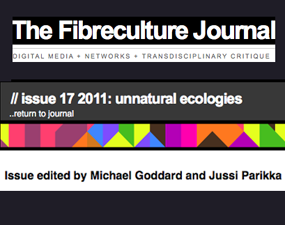 After a long wait, it’s out like nature itself! The Fibreculture-journal Media Ecology-special issue, titled “Unnatural Ecologies”, and edited by me and Michael Goddard.
The idea for a journal issue was picked up and continued from a panel organized for the MeCCSA conference in Bradford (2009) where I spoke with Matt Fuller and Michael Goddard on the media ecological approach in media and cultural studies. With Michael, we picked up on the idea of rethinking media ecology “after Matt Fuller’s work”, i.e. how we can transport the concept and practices into new directions that differ from those of the more classical media ecology work by (post-)McLuhan scholars. Hence, we ended up thinking more about Guattari’s three ecologies, Simondon, political and art practices, as well as nature itself as media. One of the leading ideas that Michael emphasized was how to think media ecology as a practice itself – how to understand it as a set of theories in practice.
Hope you enjoy the issue!
(My own text addresses “ecomedia”, nature as a communication framework [Harwood-Wright-Yokokoji and Mediashed art project] and extending that towards imaginary media as a reimagining how far back in time and as practices we can extend “media”.)
“Sonic Alchemy”: an interview with Aleks Kolkowski
“Sonic Alchemy” – an interview with Aleks Kolkowski on his media archaeologically tuned sonic art methods
London-based musician and composer Aleksander Kolkowski occupies himself with the sound of the obsolete. This means working both with techniques and technologies of sound recording from past times, as well as investigating the nature of sound cultures through creative clashes between the old and the new. He has a long and extensive career as musician and performer, and has recently in his performances engaged with such technologies as Stroh instruments, wind-up Gramophones, shellac discs and wax-cylinder Phonographs. Aleksander Kolkowski also ran workshops at the Science Museum as part of the Museum’s Oramics-project.
The interview (March 2011) w as conducted to elaborate Kolkowski’s artistic methods and interests, especially in relation to “media archaeology” as a creative form of crossbreeding and producing hybrids from old and new media innovations and artistic experiments. Juss i Parikka was affiliated with the Science Museum early this year as a short term research fellow, working on his new book on media archaeological theory and methods.
Jussi Parikka: Aleks, a big thank you for having the time to this interview. I am fascinated in how your work is very much embedded in old media – an inventive engagement with old recording technologies from wax-cylinders to gramophones and with instruments such as the Stroh violin. Why engage with old media? Can you tell a bit more about your “artistic methodology”?
Aleksander Kolkowski: Thank you for asking. I’m reminded of a quote by David Tudor, the New York avant-garde musician and John Cage’s muse, who in response to being asked about the then late ’80s electronic music scene said ” if you look at the background of the analog technology, there are marvellous things from two centuries ago that are worthy of being investigated.” For creative musicians, old recording technologies and related instruments are rich veins from which to draw from, but this has as much to do with current artistic practices and handling of modern technology as it has to do with an interest in the past.
In today’s culture, computers, turntables, electronic devises and smartphones can all be considered as ‘instruments’ for music-making, that’s to say they are being played with or manipulated, rather than passively emitting or processing sounds. Additionally, the noises produced by altered or malfunctioning media, be it hacked electronics, feedback, scratched records or skipping CDs, have been used as material by artists for sometime now. It’s in this same spirit of actively engaging and interfering with media technology and re-purposing it, rather than merely consuming it, that we can re-examine the media technology from the distant past and use it creatively. I’ll add that this has nothing to do with nostalgia, but with a belief that we can use these bygone technologies to offer an alternative perspective in our digital media-fixated society – to listen to the present through the pioneering audio technologies from well over a hundred years ago.
While there is a delight in playing with old machines and instruments, bringing them ‘back to life’ and engaging with the past through a mixture of research and practical experience, there is a feeling that this somehow challenges the very notion of their obsolescence. It has something to do with a reaction to consumerism and to the disposable nature of current media technology, its intangibility and limited shelf-life.
I began this work twelve years ago and I suppose it started as a personal response to the techno-fetishism that was prevalent in much of the experimental music-making at the time. Instead of electronic interfaces, I performed with wind-up gramophones, phonographs, and a mechanically amplified violin in unusual ways to make what sounded like contemporary electronic music, but using no electricity whatsoever. Since then I’ve been incorporating modern digital as well vintage analogue electronics in my work. Software programs have become important tools in my recent compositions and installation work where the historic and the modern are combined.
In a way, you work as a creative researcher, a historian, or an archaeologist, then?

Research played a part from the very beginning, investigating the origins of the Stroh violin is what really got me started on this journey. So histories to do with sound recording and its reproduction and early recordings became integrated in the fabric of the work I’ve produced at every level, from the concept stage, as narratives to provide structure right to the actual content itself, be it treating the first ever recordings of music as the basis for acoustic and electronic explorations or using the first morse code telegraph message to create rhythmic structures in a composition.
These creatively inspired explorations have actually led, in recent years, to more conventional, academic research (at Brunel University) into little known forms of mechanical amplification and an involvement with artefacts from museum collections in the UK and abroad.
You do not only tinker with old technologies but perform music with them live as well. How do people react to your work and instruments?
The reaction of audiences has had quite an important effect on my work. I found that people would marvel not only at the sight of these splendid old instruments and machines, but where captivated by the sound in interesting ways. Playing back a newly recorded wax cylinder on a phonograph to a modern audience is taken by many as a kind of sonic alchemy, and it requires a very different kind of listening than what we’ve all become used to. Rather than hearing a virtual copy, it’s closer to a memory of something. So it seemed possible to work with the relationship of sound and temporality by ‘ageing’ sounds using old technology, to be transported back in time, then forward to the present through the sound recording media of the past.
Do you think there is currently a wider artistic and sonic interest in going back to the pre-electronic age?
Probably not to the same extent as in literature, film or fashion, that’s to say the Steam Punk movement which has more to do with fantasy and science fiction. There are musicians releasing limited edition cylinder records, artists building machines, and composers utilising the pianola, but I’d mention the sound art of Paul DeMarinis to do with ‘orphaned technologies’ from the pre- and early electronic era as being the most significant example I can think of in this field. He is a true scientist of sound who has delved into seemingly obscure forms of communications technology and created some highly interesting and accessible works.
Certainly a lot has been published over the past few years concerning 19th century science, histories and theories of technology and communication, especially with regard to sound and the history of recording, which must be indicative of something, so yes, there is a wider interest, but then artists have always foraged the past. What’s special at this point in time, is the speed and severity at which digital media is replacing the analogue and which is conversely breathing new life into all forms older physical media, be it film, chemical photography, the cassette tape and even the wax cylinder.
I saw you recently (February 2011) do a workshop with the Science Museum together with Katy Price (Anglia Ruskin University). The workshop was part of a Science Museum Youth and Public Engagement to support their Oramics (Daphne Oram) project. Could you tell a bit more about this and the workshop where you recorded short pieces of creative fiction written by the students onto Edison cylinders and other old media?
In this case it was to show that the origins of Daphne Oram’s sound painting can be traced back to 19th century advances in capturing, visualising and reproducing sound through the phonoautograph and subsequently the phonograph and gramophone. We were also treating groove-based sound recording as a form of inscription, as sound-writing. It seemed fitting that the creative writing resulting from Katy’s sessions around the Oramics Machine and related artefacts in the Science Museum collection should be rendered onto physical storage media in this way. They could then be played back on the same cylinder phonographs and gramophones the participants had written about and even become objects that furnish an exhibition.
The fundamentals and science of sound recording are vividly demonstrated through mechanical devices, through objects you can touch and sound inscriptions you can see and hear played back via styli, vibrating diaphragms and horns. As well as showing how our forefathers experienced recorded music, it also offers us a different kind of listening experience as I’ve mentioned before. It helps us to examine our relationship to recorded sound, the antiquated sound-engraving processes add distance to the newly recorded voices, allowing us to reflect more profoundly on what we hear.






 Machinology