Archive
Kurenniemi – A Man From the Future
Erkki Kurenniemi is a curious case in media art history. He is the “Finnish hybrid of Stockhausen, Buckmister Fuller and Steve Jobs” who offers an alternative insight to past decades of interactions between art, science and technology.
He was featured at Documenta 13, part of a great exhibition at Kunsthall Aarhus, and now Kiasma (Helsinki) is running an exhibition focusing on his technological art practice.
With Joasia Krysa, we are preparing an edited collection for MIT Press on Kurenniemi’s work.
However, today is published a nice little collection of writings (in English) on Kurenniemi’s character and work: Erkki Kurenniemi – A Man From the Future! Do read and dip into an alternative insight to post World War II artistic cultures of science and engineering.
Kurenniemi: Electronics in the World of Tomorrow (1964)
From Turing to Abbey Road, Kentish Radar Stations to Bletchley Park
I am writing a chapter for the Routledge Companion to British Media History. It’s on media archaeology, and I try to offer some insights to how we can decipher British media history through contemporary media arts. This is what I call a minor perspective to media history of Britain – often such a glorified master narrative.
This is just a brief glimpse to the beginning of the chapter. The book should be out in 2014.
Media Archaeology: From Turing to Abbey Road, Kentish Radar Stations to Bletchley Park
British media history has many great stories to tell. It has been one of the biggest inspirations for a range of accounts and for scholars that have tried to decipher the main trends of the media of modernity; from the nineteenth century establishment of standardized mail to the twentieth century Britain of the BBC that, for instance, for this author became a central symbol when he turned on the television in 1980s Finland. BBC content traveled across national boundaries, both in the structural form it provided for public broadcasting as well as through Bergerac and the FA Cup Finals over the years. British exports from television to microcomputing continued, and have established such a status that writing Britain into media history is rather redundant. It is already there, and always was there; even before actual media technologies became subsumed into the consolidated consensus about media as mass media emerged. Indeed, Britain was already there with its investment in transatlantic cables as well as pioneering scientific inquiries, in electricity and electromagnetism, prehistories of computing from Babbage to Turing and so forth. Early on, British media history was already transnational, like the transatlantic cables and telegraph clicks. It is irreducible to a simple national story, and more like something that presents an interesting case for consideration in relation to both the master narratives and the minor themes of media history.
Speculative Scenarios for Digital Art
There is a new book on digital art, archives, preservation and memory out now. Edited by Annet Dekker, Speculative Scenarios, or what will happen to digital art in the (near) future? is an interesting and again timely take on some of the issues that connect media studies with archival specialists, cultural heritage with contemporary digital art practices. There are several great writers in the collection. You can find it online here and a printed version is out soonish too.
On the publisher website, the book is described as follows:
“There is a growing understanding of the use of technological tools for dissemination or mediation in the museum, but artistic experiences that are facilitated by new technologies are less familiar. Whereas the artworks’ presentation equipment becomes obsolete and software updates change settings and data feeds that are used in artworks, the language and theory relating to these works is still being formulated. To better produce, present and preserve digital works, an understanding of their history and the material is required to undertake any in-depth inquiry into the subject. In an attempt to fill some gaps the authors in this publication discuss digital aesthetics, the notion of the archive and the function of social memory. These essays and interviews are punctuated by three future scenarios in which the authors speculate on the role and function of digital arts, artists and art organisations.”
I was interviewed for the book and I talked about topics from zombie media to media archaeology & time, from the media archaeological fundus in Berlin to issues of the social. “In a way, practices – or one could say cultural techniques – of memory are actually what create the social. Perhaps the social doesn’t even exist without the various ways in which memory is sustained, articulated, archived, controlled, passed on, distributed, received, and remixed.”
Deep Times and Geology of Media
“Yes I will” – “No, it is not something worthwhile”.
I’ve been going back and forth for a while whether I will try to expand my ideas concerning “geology of media” into some sort of a book or not. Without having reached a conclusion, I have however been giving talks on the topic the past times. Here is one – as video – from Bochum from the very good General Ecology-event Erich Horl organised.
Interactive Art and Embodiment
 Nathaniel Stern’s book Interactive Art and Embodiment is out! If you want a one-liner what the book is about, this does the job effectively: “How do interactive artworks ask us to perform rigorous philosophies of the body?”
It already reveals the maint thrust of the book, having to do with practices of contemporary digital art and theoretical insights into embodiment – for instance the concept of the implicit body.
Endorsements:
Nathaniel Stern’s book is a marvellous introduction to the thinking and practice of this innovative new media artist, and to the work of others in the same field. Philosophically informed and beautifully written, it is sensitive to the many complex issues involved in making such work. –Charlie Gere is Professor of Media Theory and History in the Lancaster Institute for Contemporary Arts, Lancaster University, and author of Digital Culture, Art, Time and Technology, and Community without Community in Digital Culture.
In Nathaniel Stern’s Interactive Art and Embodiment, Stern develops a provocative and engaging study of how we might take interactive art beyond the question of ‘what technology can do’ to ask how the implicit body of performance is felt-thought through artistic process. What results is an important investigation of art as event (as opposed to art as object) that incites us to make transversal linkages between art and philosophy, inquiring into how practice itself is capable of generating fields of action, affect and occurrence that produce new bodies in motion. –Professor Erin Manning, Concordia Research Chair, Faculty of Fine Arts, Concordia University, author of Relationscapes: Movement, Art, Philosophy, Director of the SenseLab and series co-editor of Technologies of Lived Abstraction.
In his very intelligent book, Nathaniel Stern shows how dynamics work: he mobilizes a range of theory and practice approaches so as to entangle them into an investigation of interactive art. Stern maps the incipient activity and force of contemporary art practices in a way that importantly reminds us that digital culture is far from immaterial. Interactive Art and Embodiment creates situations for thought as action. –Dr Jussi Parikka, media theorist, Winchester School of Art, author of Insect Media.
Save as: Social Memory
 An event in Istanbul – welcome!
Save as: Social Memory
Convened by Burak Arıkan and Jussi Parikka, and in collaboration with SALT and support of Winchester School of Art.
June 26-27, 2013 19:00
SALT Galata Atelier IV, Istanbul
Participants: Burak Arıkan, Joasia Krysia, Nicolas Malevé, Ali Miharbi, Jussi Parikka
One of the major concerns during the Gezi resistance was how to keep our memories, our pain and grief, our anger, our gains, and our losses alive. We tried to preserve our experiences and present them in numerous media. However, we haven’t had the time and means to critically approach to the rapidly growing archives or to create technologically enhanced curated content.
This symposium brings together three artists, a curator, and an academic who works in the area of software art, archive, and media archaeology. Cultural practices that use the language of technology and digital born content from different perspectives of preservation and memory will be debated. How can we preserve the software itself along with the content it generates? In what way should we consider software itself as the creative archive, arche, of our digital culture? What new archival practices does technology-based art and culture present? How do software, social media, and network practices introduce a sphere of counter-representation which curate alternative narratives of the present? Panelists will discuss the topics of archiving the present as we live, algorithmic curating in crisis, critical collective intelligence, and language of technology as a thinking tool.
Programme schedule:
Wednesday June 26th
19:00 Introduction
19:15 Jussi Parikka – Media Archaeology: Archives of the Present
20:00 Nicolas Malevé – Sniff and sneak through my archives
20:45 Ali Miharbi – Language of technology as a thinking tool
Thursday June 27th
19:00 Joasia Krysia – Speculations on Algorithmic Curating
19:45 Burak Arıkan – Counter Collective Intelligence
20:30 Round Table
Abstracts and bios of speakers:
Jussi Parikka – Media Archaeology: Archives of the Present
Media Archaeology has emerged the past years as a dynamic theory about media culture. This refers to the impact it has had in giving a vocabulary for the material constitution of contemporary technical media culture. Media archaeology examines media technical conditions of existence of culture, and as such, is in a good position to frame the relevance of software for questions of the archive.
However, media archaeology is also a way to investigate the ontology of the present: it asks what sorts of mechanisms of inclusion and exclusion constitute what we perceive, and what remains unperceived? How is the network conditioning our sense of knowledge and our sense of the everyday? How will the speculative future archivist, looking back at June 2013, see and understand our events and networked condition, conditioned by software as well as its political context.
Jussi Parikka Bio
Dr Jussi Parikka is a media theorist who writes on media archaeology, digital culture and obscure topics from insects to viruses. He is Reader in Media & Design at Winchester School of Art, University of Southampton and author of various books, essays and other writings. His monographs include the award-winning Insect Media: An Archaeology of Insects and Technology, as well as the recent What is Media Archaeology? He blogs at http://jussiparikka.net
Nicolas Malevé – Sniff and sneak through my archives
‘(6/24/1996 9:44pm, Personal)”
Will she (either of them) share the love of pornography? Or at least, art? I shall present myself to both of them as a geniality self-flagellat%n machine. Just one bottle tonight, ok? I shall invite them on to my journey of change, showing the way ahead. Immortality. I will let them to sniff and sneak through my archives. (Erkki Kurenniemi, Newton diary, 1996).
The presentation will take as a point of departure the rich set of documents collected and created by Erkki Kurenniemi, Finnish pioneering electro acoustic musician and inventor of early synthesizers, who obsessively recorded his life. The talk will introduce to the different tools and methods we, Michael Murtaugh and Nicolas Malevé, members of the Belgian collective Constant, used to enter in dialog with the vast amount of unclassified documents that constitute the humus for an archive of Kurenniemi’s work.
These tools are our intermediaries, our extra senses to “read” the images, to “listen” to the sounds, to “watch” the videos. The algorithms we borrow, design or customize become our interlocutors. They report back from what they detect, correlate and connect in the different layers of data. They are different voices, each telling a its own story. Having presented these different voices, we will see what happens when other human agents (lawyers, archive institutions) join the dialogue between these intermediaries and ourselves.
Nicolas Malevé Bio
Since 1998 Nicolas Malevé, multimedia artist, has been an active member of the association Constant. As such, he has taken part in organizing various activities to do with alternatives to copyrights, such as Copy.cult & The Original Si(g)n, held in 2000. He has been developing multimedia projects and web applications for cultural organisations. His research work is currently focused on information structures, metadata and the semantic web and the means to visually represent them.
Ali Miharbi – Language of technology as a thinking tool
In this presentation I will sketch the potential of the language of technology as a tool to open up, enrich or simply illustrate our current discussions on social/political issues. Using examples of my work as points of departure I will touch on a variety of concepts like performativity, humor and the problem of representation.
Ali Miharbi Bio
Ali Miharbi (b. 1976) lives and works in Istanbul. He acquired a dual degree in Electrical & Computer Engineering (BS, 2000) and Art Theory & Practice – Painting (BA, 2000) at Northwestern University. In 2010 he completed his MFA from Virginia Commonwealth University. He opened his first solo exhibition at Interstate Projects, Brooklyn, NY. His recent group exhibitions include “Commons Tense”, Electriciteitsfabriek, The Hague (2012), “Turkish Art New and Superb”, TANAS, Berlin (2012), “Consequences are no coincidence”, Pilot Galeri, Istanbul (2012), “video_dumbo: Quasi Cinema”, Dumbo Arts Center, Brooklyn, New York (2011), “FILE 2011″, FIESP Cultural Center, São Paulo (2010), “When Ideas Become Crime”, Depo, Istanbul (2010). His work can take many forms from photographic, graphic or sculptural pieces to dynamic systems driven by live or stored data where he investigates mechanisms that underlie or are constituted by the flows of daily life.
Joasia Krysia – Speculations on Algorithmic Curating
Between the 1960s and 2005, Erkki Kurenniemi, the Finnish artist, scientist, futurologist and technology pioneer set out to document his everyday life with the intention to create a template for all human life that could be reenacted by algorithms to be written in a future quantum world (with the date 2048 in mind). In a wider sense Kurenniemi acted not only as an archivist of his life but also a kind of curator – working with materials not simply to collect and store but to shape using computational power once it is sufficient for purpose. In 2012 Constant Association for Art and Media began to develop some experiments, making programs to begin to understand Kurenniemi’s materials in ways that go beyond the traditional archiving procedures of ordering and classifying. I would like to argue that their approach is not simply archival either but curatorial in as much as they uncover aspects of what is not directly apparent in the material and produce meaning out of the work. This talk speculates further on this algorithmic approach and extend it to possibilities of thinking about the curatorial process in this way. I want to speculate on the use of algorithms in producing small curatorial experiments that begin to suggest new ways of understanding materials that are not directly apparent to human curators. Can we begin to think of curatorial processes and the production of curatorial knowledge that extends human agency and uncovers dynamic qualities of materials?
Joasia Krysia Bio
Joasia Krysa is Artistic Director of Kunsthal Aarhus (Denmark), and prior to this she was Associate Professor (Reader) in Art and Technology at Plymouth University, UK (2000 – 2012). She is co-founder of KURATOR, an association of curators and researchers interested in algorithmic culture, and was part of curatorial team for dOCUMENTA (13). She has a background in political sciences and cultural theory, and has PhD in the the field of curating. Her academic and curatorial work is located across contemporary art, digital culture, and critical theory.
She is series co-editor of the DATA browser books (New York), author of Ada Lovelace, notebook no 055 in the dOCUMENTA (13) series 100 Thoughts – 100 Notes (Hatje Cantz 2012) and the edited anthology Curating Immateriality (Autonomedia, 2006). She has contributed chapters to, amongst others, Software Studies: A Lexicon (MIT Press, 2008), and New Media in the White Cube and Beyond (University of California Press, 2008). Her current curatorial work include Systemic Series, a two year programme developed for Kunsthal Aarhus (2013-2014).
Burak Arıkan – Counter Collective Intelligence
Arıkan will pursue a traversal in his works, starting from MyPocket (2008) and raising questions on the preservation of immateriality; discussing Network Map of Foundations and Corporations in Turkey (2010) in relation to power and governence during the Gezi protests; narrating the collective network diagrams generated on the Graph Commons platform (2011-); and finally calling for action for a recent data research and mapping project, code named “Network of Dispossessions”, mapping of government-corporate partnerships in urban transformation.
Burak Arıkan Bio
Burak Arıkan is an artist working with complex networks. He takes the obvious social, economical, and political issues as input and runs through an abstract machinery, which generates network maps and algorithmic interfaces, results in performances, and procreates predictions to render inherent power relationships visible, thus discussable. Recent exhibitions include: Home Works 6 (2013), 11th Sharjah Biennial (2013), 7th Berlin Biennale (2012), and Nam June Paik Award Exhibition (2012). Arıkan is the founder of Graph Commons platform, dedicated to provide “network intelligence” for everyone.
Image: Network Map of Foundations and Corporations in Turkey-project by Burak Arikan.
Media & Materiality: A New Issue of Artnodes
The new issue of Artnodes is dedicated to matter. In the wake of different discussions concerning new materialism, speculative realism, objects and processes, I am glad to see this issue out: it takes a more mediatic and experimental view to some of these theoretical themes! Thanks to Jamie Allen and Pau Alsina for getting it done and published.
The issue papers are in Spanish, Catalan and English.
My little text on “new materialism of dust” is a follow-up and extension of the one in Depletion Design. It continues the same theme, and now has inspired me to write a longer essay on dust that will be published in Russian as a stand-alone booklet. The English draft of that is available on Academia.edu.
WSA and transmediale partnership
Winchester School of Art, and our research centre in Global Futures is happy to announce a new partnership with the transmediale-organisation and festival in Berlin! This coming year’s theme is Back When Pluto Was a Planet (BWPWAP) and we are besides participating with a panel and a range of other talks also already thinking ahead to the future years with the great folks of tm. They have a great track record of working with universities, including Aarhus and now Leuphana. I could not be more excited about this link to Berlin – tm has been one of those festivals /conferences that get my mind actually working. And it’s socially such a good spot to catch up with lots of people. One of the most exciting things happening in our field of critical arts/media/practice/theory at the moment. And Berlin is great.
Below the more official press release.
WSA to collaborate with a leading European festival for art and digital culture
The Winchester School of Art (WSA) has formed a new partnership with the organisers of one of Europe’s most significant festivals for art and digital culture.
The WSA, part of the University of Southampton, will engage academics and students in a wide range of activities with transmediale, the world-renowned festival and year-round project based in Berlin.
From Winchester, the key activities will be co-ordinated through the WSA’s Centre for Global Futures in Art Design & Media which shares a number of areas of mutual interest with transmediale across the fields of media arts, cultural theory and politics, aesthetics and digital culture.
Future activities linking the WSA and transmediale related to these shared interests shared research projects, joint workshops, curatorial developments related to transmediale and its all-year platform “reSource transmedial culture,” various educational platforms and events, and WSA’s participation in the planning activities and events leading towards transmediale festivals and the reSource activities.
Academics and students are already making plans to participate in transmediale from February 2013. WSA and transmediale are also keen to involve students as an active part of the partnership and establish a long-term link that represents the Winchester scholars’ interest in digital culture, media and critical contemporary arts. It also consolidates important high-level links the School has with Europe.
“We’re very excited by the prospects and benefits that working with transmediale will bring to the Winchester School of Art,” said Professor Ryan Bishop, Co-Director of the Winchester Centre for Global Futures in Art Design & Media. “The activities supported by transmediale offer an important interface between academic research, the arts and the general public which creates a perfect fit with the ethos and activities of our own Centre. In return, the WSA is perfectly positioned to facilitate additional collaborative links across partner institutions, providing a dynamic network of researchers working on related and complementary concerns which we believe will benefit everyone involved in organising and participating in transmediale each year.”
The artistic director of transmediale, Kristoffer Gansing reinforced this perspective by saying that “For transmediale, the collaboration with WSA and the Centre for Global Futures represents a great opportunity to develop new activities within a burgeoning international research setting. “ Stressing the transdisciplinary nature of the festival, “the combination of art and research is central to our critical approach to media art and digital culture” Gansing continued, adding that he is “hoping for new creative approaches to joint presentations of artistic and academic research between the two institutions.”
Each year, transmediale presents new positions in the fields of art, culture and technology to an audience of more than 20,000 visitors who experience an extensive range of exhibitions, conferences, screenings, performances and publications. transmediale’s broad cultural appeal and high artistic quality is recognised by the German federal government which supports the festival through its programme for beacons of contemporary culture.
Critically concerned with art and design practices of making, thinking and representation, the WSA engages in education and enterprise, exploring the contribution of media, materials and technologies to the improvement of human societies globally. In addition to producing world class research and engaging in educational possibilities, the WSA’s Centre for Global Futures hosts a wide array of issue-based activities that centre around globally relevant topics such as the environment, society, politics, art and demographics. By involving high profile academics, artists, curators and filmmakers, the Centre is creating a platform for the local and regional communities to engage in these areas.
The Photosculptural Hypothesis
 3-2-1- A whistle blows and 24 shutters go “click”. Again, with a different model, head help up straight and still by a support.
3-2-1 the whistle blows. Click-click-click-click…
It’s image making but not just photography – instead, it provides an alternative route for histories of media; instead of a preference for the centrality of the seriality of the moving image, try starting from the cybernetic. “The cybernetic hypothesis”, as Alex Galloway coined it in his talk at the Winchester Centre for Global Futures that was a kick-starter for the project.
The whistle, the 24 cameras, set around a circular studio, a rotunda on which a stool for the model – an assemblage that connects the early 1860s with the 2012 reconstruction inside which I too sat to be photographed, and to be sculpted from those 24 shots. Originally this was Francois Willeme’s photosculpture, a curious arrangement and a patent from 1860s Paris that defined what Galloway calls one early model for parallel media.
Winchester School of Art Fine Art undergraduate students took up the original blueprints and the idea as their own model for a project led by Ian Dawson and Louisa Minkin and produced a fantastic remake of the Willeme-device. Inspired by Alex Galloway’s talk, and partly framed as a media archaeological project, it presents indeed a very inspiring way to address sculpture, parallel imaging and informational culture. Like so many media archaeological art works, it suggests how you can presence old media ideas – often not very mainstream – in current settings; like taking an alternative viewpoint not only to media art history, but also to current image cultures.
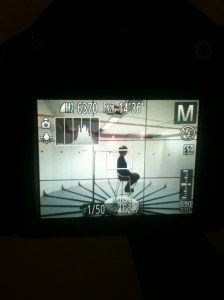
The photosculpture – which indeed as sculptural mediates the imaging into physical three dimensional objects and presents a sort of an archaeology of 3-D digital imaging/modelling – shifts our perceptual coordinates. It forces itself as a rather (in a good way) weird part of the cultures of digital imaging with its historically “out-dated” way of understanding media. That is the beauty of the device and the arrangement; it is a historical and media archaeological exercise in practice-led activity that investigates the conditions of visuality and perhaps even cybernetic culture, as Galloway claims.
“A sculptor and the sun will become collaborators working together to fashion in 48 hours busts or statues of a hitherto unknown fidelity of such great boldness in outline and admirable likeness.” Those were the words of the journalist Henri de Parviel, describing the original piece by Willeme. You can see how it describes the emerging business in quickly produced, sculpted visuality – a bust in “admirable likeness” in no time! The WSA project taps into the way in which visual technologies were starting to be mobilized into consumer products and services, but old media ideas can be cheap R&D too (to use the phrase by Garnet Hertz) for artistic ideas and reappropriations, and engage with the multiple medialities that our media technologies consist of: it’s not only about the photographic visuals, nor just sculpture, nor just a genealogy of the informatics, but a folding of various medialities. Even a single technological assemblage and practice can contain so much, as the project demonstrated. Media are never about single objects, devices or apparata – but a multiplicity of techniques and technologies assembled. Hence, a hands on assembling is itself a process of thinking through this multiplicity of media and arts apparata in order to get a sense of the delicate materialities and techniques which they enable, and how they are themselves enabled.
(For further reference, a film from 1939 from the Pathe archives, with Marcus Adams in his studio demonstrating the photosculpture)
Renew — a CFP: Media Art Histories 2013
Media Art Histories-events are warmly recommended — so heads up for Riga 2013. The themes revolve around obsolescence, media archaeology, environment as well as archives. I am glad also to sit on the Advisory Board of the event!
Call for Abstracts:
Media Art Histories 2013: RENEW
The 5th International Conference on the Histories of Media Art, Science and Technology
Riga, October 8 – 11, 2013
The 5th International Conference on the Histories of Media Art, Science and Technology, Renew, will be hosted by RIXC and held in Riga, Latvia, October 8 – 11, 2013, coinciding with the international festival for new media culture Art+Communication. It will host three days of keynotes, panels and poster sessions on the histories of networked digital, electronic and technological media arts.
Besides general topics of the call, the theme of Renew, Media Art History 2013 addresses current tendencies in sustainability quests from various perspectives. As media art is based on increasingly out-dating technology and it is dependent on energy (electricity) the conference will discuss sustainable approaches towards the issues of producing, preserving and representing media artworks – how to ‘renew’ them through both – tools and histories. By focusing on networked media arts, the Renew conference will cover a broad range of topics to include early communication art (mail, fax, radio, satellite, etc.), net.art and net.radio, open source and network culture, locative media and wireless communities, hybrid networks and electromagnetic art, and last but not least – artistic investigations in sustainability, and future visions of art within the convergence of information and energy technologies.
Proposed topics:
* Histories of networked art and media technologies
* Archiving, preserving and representing new media art
* Media archaeology
* Paradigm shift – from new media to post-media conditions in art
* Writing histories of media art across Eastern Europe and the Baltics
* Revising the geospatial aspects – for writing comparative media art histories
* Resilient networks and emerging ‘techno-ecological’ art practices
* Multifarious potential of expression in media art – ‘new imagery’ of our times
* * *
DEADLINE for abstract proposals: January 25, 2013.
Notification of acceptance will be announced in March 25, 2013.
Individual proposals should consist of a 250-word abstract with title.
Proposals and inquiries regarding submissions should be made on www.mediaarthistory.org web-site.
* * *
Selected papers from the conference will be published in Acoustic Space and other venues. Founded in 1998 by E-Lab as artistic journal for sound art, networked audio experiments and new media culture, since 2007 Acoustic Space comes out as peer-reviewed journal for transdisciplinary research on art, science, technology and society, published by RIXC & Art Research Lab of Liepaja University.
* * *
The conference will be complemented by a variety of affiliated events, including the Art+Communication festival, with a thematically related media art exhibition, experimental film and video screening programme, live performances, concerts and workshops.
* * *
MAH 2013 Renew Conference Chair: Rasa SMITE and Raitis SMITS
Honorary Board: Jasia REICHARDT, Itsuo SAKANE, Peter WEIBEL, Douglas DAVIS, Robert ADRIAN
Renew Conference Advisory Board: Erik KLUITENBERG, Armin MEDOSCH, Inke ARNS, Andrey SMIRNOV, Jussi PARIKKA, Edwin van der HEIDE, Mark TRIBE, Gediminas URBONAS, Marko PELJHAN, Nishant SHAH, Edward SHANKEN, Darko FRITZ, Tatiana BAZZICHELLI, Frieder NAKE






 Machinology