Archive
Transmit, Process, Store: Launch of Media Archaeology and Goodbyes to Sophienstrasse
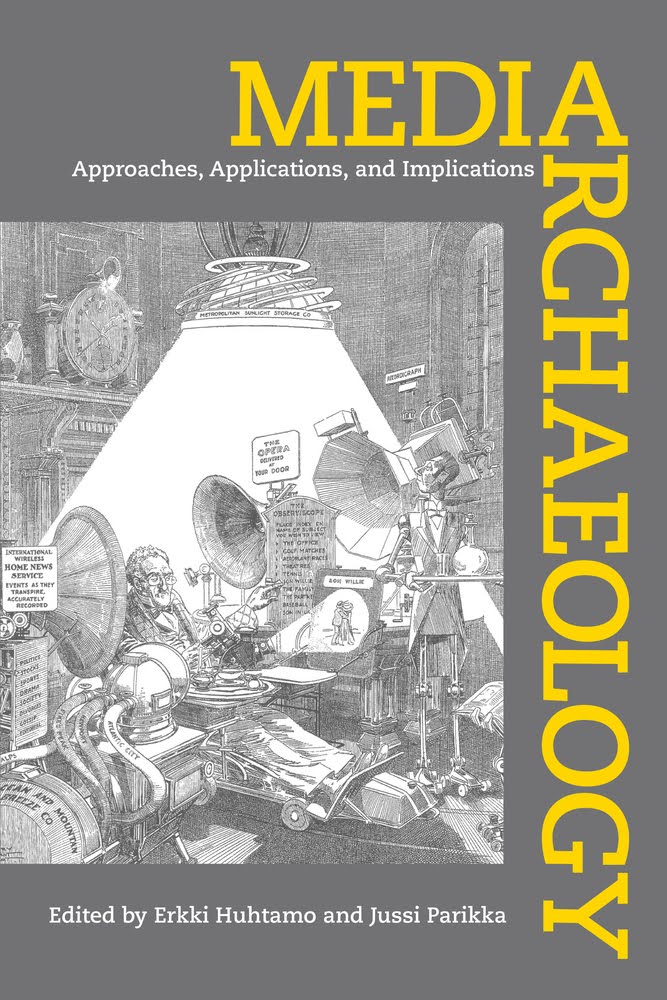 Welcome to our July 15 event at Institute of Media Studies, Humboldt University in Berlin – where we are both celebrating the launch of Media Archaeology and even more importantly, processing (excuse the pun) the closing of a certain era of German media theory. The by now legendary address of Sophienstrasse 22 is closing down and the institutes are moving premises. This is the address where Friedrich Kittler worked, and a whole generation of German media theorists can consider their alma mater…
TRANSMIT, PROCESS, STORE
Goodbye Sophienstrasse – Book presentation Media Archaeology
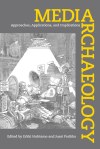
On the 15th of July 2011, the time of the Institute for Media Studies at Sophienstraße 22a is coming to an end and together with the other institutes, we will relocate to the Pergamon Palais on Kupfergraben, on the site of Hegel’s house. This transmission marks an occasion to bring together teachers, researchers, students and friends of Sophienstraße to process and store the times and ideas which emerged in this spot, in order to duly celebrate our farewell. Furthermore, we will present the new volume Media Archaeology, edited by our current research fellow Jussi Parikka together with Erkki Huhtamo.
We cordially invite you to join us in talks, discussion and celebration on Friday, July 15th 2011, starting 4 p.m. Berlin’s best book store Pro qm will be present with a book table.
Program:
Location: Medientheater (ground floor of Sophienstrasse 22a):
4 p.m.
Welcome: Prof. Dr. Wolfgang Ernst, Paul Feigelfeld und Dr. Jussi Parikka
4.15 – 5.45
Contributions by: Prof. Dr. Friedrich Kittler, Prof. Dr. Wolfgang Ernst, Prof. Dr. Claus Pias, Prof. Dr. Wolfgang Hagen
5.45
Book presentation “Media Archaeology” (University of California Press), edited by Jussi Parikka and Erkki Huhtamo. Talks and discussion with Jussi Parikka, Claus Pias, Wolfgang Ernst and Anthony Enns.
Followed by drinks and music, until security shuts us down.
OOO, OOP and OOMT (?)
Levi Bryant at Larval Subjects gives a good heads up on the link between Object-Oriented-Philosophy and John Johnston’s fabulous The Allure of Machinic Life — and that way hints of the still quite implicit links between such modes of philosophizing and contemporary media theory. For me, Johnston’s work became familiar through his editorial work with Kittler’s writings, and as such, The Allure is for me a work that is branded by that way of thinking the material media culture. Kittler and others for instance in “German media theory” rarely talk about objects – but of networks, inscription systems, materials of communication – but I can see where some of the arguments might resonate. In terms of links between the various theory scenes, some people such as Paul Caplan at The Internationale are picking up related themes, combining media archaeology with OOP/OOO (never sure which one to call it), and discussing the logic of technical media objects (in this case, the JPEG protocol) through Harman and others.
For me, the so-called material media theory lends itself to “new materialism”, and the material assemblages, networks, dynamic embodiments and intensive becomings investigated there. Whereas the relations between new materialisms and the speculative realism as well as object oriented philosophy are still to be investigated I guess, so are the possibilities that media theory offers too.
Related to such discussions, I learned from somewhere that Speculations – Journal of Speculative Realism is reviewing my Insect Media in its issue no 2, which also scares me – while of course finding it intriguing how it is going to be received on that side. I share a lot of the same references from Deleuze to Delanda to Latour, but never explicitly link up to any of the speculative realist discussions, nor object oriented philosophy.
(My short review of Johnston’s The Allure-book is found here.)
Oh and the title of the post? Clarification of terms:
OOO= Object Oriented Ontology
OOP = Object Oriented Philosophy
OOMT= Object Oriented Media Theory
New Materialism: Naturecultures in Utrecht
I will be giving two talks in Utrecht in April (6-7) – one based on Insect Media and more specifically on Roger Caillois (read as a media theorist of embodiment, psychastenic spatiality, mimicry), and the other one as part of the New Materialisms: Naturecultures-event. It follows up some of the themes of our last year’s symposium that we organized in Cambridge with Milla Tiainen – and now again with a wonderful line of speakers, including Donna Haraway.
My talk will touch on how to think the materialism of media in its specificity – and how to expand from German media theoretical materialism of for instance Friedrich Kittler’s work to medianatures. So I will probably will end up touching some of the media ecological themes I have been writing about recently. Below a short blurb about the event, and below that, my abstract for the event.
One of the conceptual innovations stirred by debates in contemporary cultural theory that want to rewrite the linguistic turn concerns ‘naturecultures’. This concept is created by Donna Haraway in The Companion Species Manifesto (2003) in order to write the necessary entanglement of the natural and the cultural, the bodily and the mind, the material and the semiotic, et cetera. ‘Naturecultures’ offers us an important route to rewrite these modernist oppositions in such a way that rather than representing parts of the world, a transcription with the world is being proposed. Concepts thus do not capture or mirror what is ‘out there’, but are fully immersed in a constantly changing reality. ‘Naturecultures’ rewrites not only femininity but in the end all subversive material practices as an ethical break through of for instance phallologocentrism. Karen Barad would call this ‘ethico-onto-epistemological’.
This conference uses ‘naturecultures’ as a point of departure. We intend to study conceptual innovation in contemporary cultural theory from seemingly different ‘disciplinary’ and ‘paradigmatic’ angles in order to demonstrate how similar movements in thought are at work in the emerging paradigms of new materialism, post-humanism, agential realism, and in fields ranging from philosophy to the humanities and to the natural sciences.
The first ‘New Materialism’ conference took place in June 2010 at Anglia Ruskin University in Cambridge, the UK. Organized by Dr. Jussi Parikka and Dr. Milla Tiainen, several scholars came together to discuss new materialism and digital cultures. This second conference is an initiative of the Center for the Humanities, the Graduate Gender Programme, and the Department of Media and Culture Studies, all located at the Faculty of Humanities of Utrecht University. It is funded by these three partners, as well as by the Netherlands Organisation for Scientific Research, the Center for the Study of Digital Games and Play (Utrecht University), and the Posthumanities Hub (Tema Genus, Linköping University).
And my abstract:
Media Milieus, or Why Does Nature Do It Better?
In terms of material media analysis, the German media theoretical directions at least since Friedrich A. Kittler’s influential writings have introduced an important agenda to think the specificity of media. In what could be termed the Kittler-effect in media theory (in Winthrop-Young’s words), the materially meticulous readings of technical media have forced a whole generation of new media studies to think through the technical and scientific specificity of contemporary media – beyond meaning, representation and the human body, the fact that technical media engage in such processes, speeds, and phenomena that escape the phenomenological human register per se. Media often hear more, see more and memorize much more than us humans.
Yet, I want to point towards a different kind of reading of media materiality, one that touches on the symposium theme Naturecultures more directly. We can question the notion of specificity and argue that there are various specificities to which we could tap into. While German media theory has been insisting on drawing on materialities that can be directly connected to the important scientific contexts of technical media, we can insist on what could be called a milieu theory of media: how media establish but also draw on nature, animals and other non-human intensities, forces and potentialities. Instead of thinking nature here in terms of the metaphorics it has offered for a long time for media cultural phenomena, and avoiding proposing any form of purity of nature, I want to look at the continuums of not only naturecultures, but medianatures that is slightly different from the emphasis of media cultures as the “new” environment for us human beings. Instead we approach medianatures as affordances, as intensities, as regimes of affects and relations and as processes of mediatic nature that offer a non-human view to new materialist media theory.
Kant the Media Critic
While reading the new Kittler translation of Optical Media (trans. Anthony Enns), I found this little quote that originates from Critique of Judgment, by Immanuel Kant.
Read this as his form of media criticism — criticism of media and power. No, its not Adorno or any of the other writers of the broadcast era, but a writer of a much earlier media sphere:
“[W]here the senses see nothing more before them, and the unmistakable and indelible idea of morality remains, it would be rather necessary to moderate the impetus of an unbounded imagination, to prevent it from rising to enthusiasm, than through fear of the powerlessness of those ideas to seek aid for them in images and childish ritual. Thus governments have willingly allowed religion to be abundantly provided with the latter accompaniments, and seeking thereby to relieve their subjects of trouble, they have also sought to deprive them of the faculty of extending their spiritual powers beyond the limits that are arbitrarily assigned to them and by means of which they can be the more easily treated as mere passive beings.”







 Machinology