Archive
The Anne Friedberg book award for Insect Media!
 Could not be any more excited to finally be able to publicize this:
Insect Media has won the Society for Cinema and Media Studies Anne Friedberg book award 2012 — awarded annually for Innovative Scholarship! Winning a book prize feels fantastic, but of the possible prizes, exactly the one that carries her name; remembering the inspiration her Window Shopping gave during my studies in the 1990s, and then later, The Virtual Window — all of her work pointing to the way we should be expanding media studies into new fields and investigations!
This sounds like an invented story but it is true: when I received the email about the happy news, I was indexing my forthcoming What is Media Archaeology?-book and only a couple of hours earlier had added the entry “Friedberg, Anne”…
The panel said this of my Insect Media:
“Combining philosophy, theory, history and archival research, Parikka presents, ‘forms of swarm culture in terms of new architectures to offer insights into networked media and the media environments we live in.’The book’s style and writing is energetic, cohesive and enlightening. Moving between early underwater films to cyber theory (biodigitality), the book is full of erudite reflections on Spinoza, algorithms, ticks, Umwelt, and contemporary culture.”
A huge thanks to all!
More about the Anne Friedberg Innovative Scholarship Award:
“The Anne Friedberg Innovative Scholarship Award recognizes the best new scholarly work that exemplifies rigorous, interdisciplinary and theoretical inquiry into issues of vision and visuality. Funded by a generous gift from her estate, the Anne Friedberg Award recognizes innovative work that expands the discipline of film and media studies, emphasizing its relationship to other visual fields, including architecture, art history, and digital media. Believing that “how the world is framed may be as important as what is contained within that frame,” Friedberg was known for her intellectually agile examination of the increasingly visual nature of contemporary culture and its representation on a gamut of screens: at movie theaters, on televisions and computers, on iPhones, BlackBerrys and other hand-held devices. The author of two books on these subjects, Window Shopping: Cinema and the Postmodern (1994) and The Virtual Window: From Alberti to Microsoft (2006), Anne Friedberg was President-Elect of the Society for Cinema and Media Studies before her untimely death in 2009.”
The Media That Therefore We Are – on Lenore Malen’s video installation
I wrote this short catalogue text for Lenore Malen’s I am the Animal — also included stills (courtesy of and permission from Lenore Malen) from the exhibition:
The Media That Therefore We Are
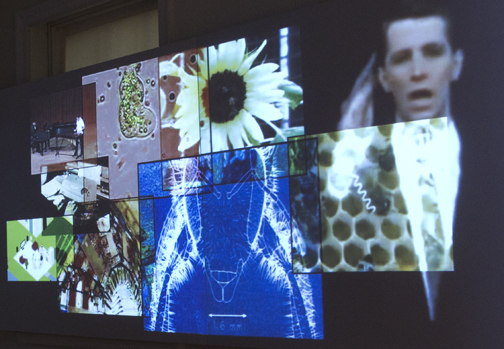
It’s a matter of scales. If you are far enough away, and your perspective is mediated by a layer of concepts, abstractions, and an organizational eye, you might indeed see them as models of ideal society. It’s all order. Everyone does what they are supposed to. There is one Queen. No wonder the protofascist Maya the Bee was an ideal cartoon character for 1930s national-socialist Germany. One is tempted to see the idea of a strong leadership to which everyone submits as an example of sovereign power per se, even if, to be honest, the Queen does not choose to execute power — it happens much more intuitively, almost in a subconscious way. Of course, when it comes to bees, there is no such talk of subconscious; instinct used to be the word in the 19th century for this near mystical mode of organization. This is evident in, for instance, Maurice Maeterlinck’s The Life of the Bee (1901), which refers to “the spirit of the hive.”
But on another scale, it looks very different. Look closely enough and they become the aliens they are: their weird compound eyes composed of thousands of lenses, their six legs, non-human movement, jerky, non-mammal insides folded out. This has been the other story since the 19th century and the birth of modern entomology: insects as aliens, otherworldly non-humans, often seem almost to possess technology in their capacities to see, sense, and move differently. The insects are the Anti-McLuhan; technics does not start with the human but with the animal, the insect, and their superior powers of being-in the- world (the allusion to Heidegger is intentional).
 Lenore Malen’s I Am The Animal intertwines the various histories, aesthetics, and idealizations of the bee community as well as the bee’s relations withbeekeepers. It’s all about relations, and establishing relations with our constitutive environments — including bees. Donna Haraway talks about companion species (specifically dogs, but other animals too) as formative of our being in the world; she discusses the ways in which those relations are formative of our becomings.
Our relation to insects is reflected in much more than the narrative aspect of Malen’s work. The immersive environment of the installation envelops the spectator in a milieu of becoming. The clips Malen uses are mini-thoughts, mini-brains, which are brought together with her digital software tools; the clips are memes that Malen excavates from online archives and audiovisual repositories, and composes into a three-channel envelope.
I Am The Animal poses the question: Can insects be our companion species? This is paradoxical in light of Derrida’s The Animal That Therefore I Am, to which Malen’s title refers. Derrida starts with the gaze of the animal — his cat, to be exact, lazily gazing at Derrida’s naked body. But catching the insect’s compound eyes is more difficult, if not impossible. For Malen, Derrida’s essay functions as a critique of subjectivity. Derrida continues to analyze how the cat does not feel its own nakedness, has no need of clothes, whereas we — as technical beings — surround our bodies, envelop ourselves in extensions, such as clothes. We are not only enveloped in cinema, media, and technology but in fundamental forms of shelter.
So do animals have technology? They might not plan buildings and produce external tools, but an alternative lineage claims that animals, insects and such, are completely technical. Henri Bergson was of such an opinion: even if humans are intelligent in the sense of being able to abstract, plan, and externalize their thoughts into tools, insects occupy technics in their bodies and embody intertwining with the world. The body itself is already technical. One could think of examples of insect architecture, of various stratagems of the body for defense or attack, of modes of movement, and of perception as media. If the body is media — as Ernst Kapp suggested in the 19th century and McLuhan later — then what kind of media does the insect suggest?
The three screens of I Am The Animal are rhythmic elements that deterritorialize our vision. A slowly progressing multiplication of viewpoints is the becoming-animal of perception that the installation delivers. The immersive space is also one of measured fragmentation into the compound vision of insects. Slow disorientation is one tactic of this mode of becoming; it points both to the world of insects and to the media in which we are immersed. The early avant-garde connection between the technical vision machine and the insect compound machine — in the words of Jean Epstein, “the thousand-faceted eyes of the insects” — creates a sense of space as split; perspective is multiplied into a variation. Malen’s I Am The Animal is about such forms of multiplicity.
The animal is incorporated into the machinated cultural assemblages of modernity; the disappearance of animals from urban cultures during the past couple hundred years is paralleled by the appearance of animals in various modern discourses from media to theory. We talk, see, incorporate animal energies. Akira Mizuta Lippit in Electric Animal (2000) writes how “the idioms and histories of numerous technological innovations from the steam engine to quantum mechanics bear the traces of an incorporated animality. James Watt and later Henry Ford, Thomas Edison, Alexander Graham Bell, Walt Disney, and Erwin Schrödinger, among other key figures in the industrial and aesthetic shifts of the late nineteenth and early twentieth centuries, found uses for animal spirits in developing their respective machines, creating in the process fantastic hybrids.”

Animals as well as media are elements with which we become. Matthew Fuller in his essay “Art for Animals” (2008) identifies a two-fold danger in relation to art with/about nature: that we succumb to a social constructionism or that we embrace biological positivism. And yet, we need to be able to carve out the art/aesthetic in and through nature and animals in ways that involve the double movement back and forth between animality and humanity. Art for animals is one way, to quote Fuller: “Art for animals intends to address the ecology of capacities for perceptions, sensation, thought and reflexivity of animals.” What kind of perceptions and sensations are afforded us by media/ nature? And conversely, what worlds do we create in which animals and nature perceive, live, and think?
A Billion Dollars of Insect Media
Bruce Sterling had briefly featured Insect Media on his Wired/Beyond the Beyond-blog. In his own inimitable style, Sterling writes, with a variation on that famous line from The Social Network…:
“You know what’s cool? A billion dollars of insect media.”
What a wonderful blurb that would make for the book!
Insect Media – live coding trailer
Courtesy of my friend and the creative music technology and coder wiz Julio D’Escrivan, a live coding sonic video-trailer for Insect Media…
New reviews of Insect Media
The new issue  of Speculations: The Journal of Speculative Realism is now out, and includes a nice review of my Insect Media. The issue (vol 2) can be downloaded as PDF from this page. The issue includes essays by Levi Bryant, Christopher Norris and for instance Robert Jackson.
And another review came out on Rhizome.org just recently. Thanks to both reviewers for perceptive comments and feedback.
New Materialism: Naturecultures in Utrecht
I will be giving two talks in Utrecht in April (6-7) – one based on Insect Media and more specifically on Roger Caillois (read as a media theorist of embodiment, psychastenic spatiality, mimicry), and the other one as part of the New Materialisms: Naturecultures-event. It follows up some of the themes of our last year’s symposium that we organized in Cambridge with Milla Tiainen – and now again with a wonderful line of speakers, including Donna Haraway.
My talk will touch on how to think the materialism of media in its specificity – and how to expand from German media theoretical materialism of for instance Friedrich Kittler’s work to medianatures. So I will probably will end up touching some of the media ecological themes I have been writing about recently. Below a short blurb about the event, and below that, my abstract for the event.
One of the conceptual innovations stirred by debates in contemporary cultural theory that want to rewrite the linguistic turn concerns ‘naturecultures’. This concept is created by Donna Haraway in The Companion Species Manifesto (2003) in order to write the necessary entanglement of the natural and the cultural, the bodily and the mind, the material and the semiotic, et cetera. ‘Naturecultures’ offers us an important route to rewrite these modernist oppositions in such a way that rather than representing parts of the world, a transcription with the world is being proposed. Concepts thus do not capture or mirror what is ‘out there’, but are fully immersed in a constantly changing reality. ‘Naturecultures’ rewrites not only femininity but in the end all subversive material practices as an ethical break through of for instance phallologocentrism. Karen Barad would call this ‘ethico-onto-epistemological’.
This conference uses ‘naturecultures’ as a point of departure. We intend to study conceptual innovation in contemporary cultural theory from seemingly different ‘disciplinary’ and ‘paradigmatic’ angles in order to demonstrate how similar movements in thought are at work in the emerging paradigms of new materialism, post-humanism, agential realism, and in fields ranging from philosophy to the humanities and to the natural sciences.
The first ‘New Materialism’ conference took place in June 2010 at Anglia Ruskin University in Cambridge, the UK. Organized by Dr. Jussi Parikka and Dr. Milla Tiainen, several scholars came together to discuss new materialism and digital cultures. This second conference is an initiative of the Center for the Humanities, the Graduate Gender Programme, and the Department of Media and Culture Studies, all located at the Faculty of Humanities of Utrecht University. It is funded by these three partners, as well as by the Netherlands Organisation for Scientific Research, the Center for the Study of Digital Games and Play (Utrecht University), and the Posthumanities Hub (Tema Genus, Linköping University).
And my abstract:
Media Milieus, or Why Does Nature Do It Better?
In terms of material media analysis, the German media theoretical directions at least since Friedrich A. Kittler’s influential writings have introduced an important agenda to think the specificity of media. In what could be termed the Kittler-effect in media theory (in Winthrop-Young’s words), the materially meticulous readings of technical media have forced a whole generation of new media studies to think through the technical and scientific specificity of contemporary media – beyond meaning, representation and the human body, the fact that technical media engage in such processes, speeds, and phenomena that escape the phenomenological human register per se. Media often hear more, see more and memorize much more than us humans.
Yet, I want to point towards a different kind of reading of media materiality, one that touches on the symposium theme Naturecultures more directly. We can question the notion of specificity and argue that there are various specificities to which we could tap into. While German media theory has been insisting on drawing on materialities that can be directly connected to the important scientific contexts of technical media, we can insist on what could be called a milieu theory of media: how media establish but also draw on nature, animals and other non-human intensities, forces and potentialities. Instead of thinking nature here in terms of the metaphorics it has offered for a long time for media cultural phenomena, and avoiding proposing any form of purity of nature, I want to look at the continuums of not only naturecultures, but medianatures that is slightly different from the emphasis of media cultures as the “new” environment for us human beings. Instead we approach medianatures as affordances, as intensities, as regimes of affects and relations and as processes of mediatic nature that offer a non-human view to new materialist media theory.
Insect Media interview and more
A big thank you goes to John Protevi for this interview that came out on the Art, Politics, Philosophy, Science (APPS) blog. We talk about Insect Media, and some of its contexts, and chapters — including the one on Roger Caillois, who I read as a media theorist. Not the Caillois we know from game studies, and as a typologist of different affective/genre-classifications of games, but as someone who through his writings on mimicry, the praying mantis and other surprising topics discussed spatiality, imitation and loss of individuality. Picking up Elizabeth Grosz’s thoughts, but continuing towards a slightly different direction of Post-Fordism and the contemporary affective capitalism of games, I find Caillois a great guide in thinking not so much cognitive capitalism, but the intensive affective capitalism working through media technologies such as gaming…
Another heads up: Insect Media was also the book of the week in the last week of February for P2P Foundation site. Also in that context I brand my book as an “Anti-McLuhan” take on media theory and history.
Launch events for Insect Media – Berlin and Cambridge
Now that Insect Media is out, I am organizing a couple of events sort of as book launches—with a little help from my friends!
One takes place in Berlin, at the Generalpublic.de cultural venue on Schönhauser Allee 167c ( 10435 Berlin) on March 4, Friday, 7 pm – Shintaro Miyazaki will be interviewing me , and hopefully with drinks and nibbles (there has been talk of some Japanese finger food!). Also the book is on sale there, with a small launch discount.
Even before that, in Cambridge, we are organizing a joint event with Joss Hands whose own book @ is for Activism came out in December as well! This takes place February 22, Tuesday, 5 pm at Anglia Ruskin University at 5 pm. The room will be Helmore 251.
Below, a short blurb about that event which we use to discuss more widely some interesting current and future directions of media studies as well:
‘New Directions in Media Studies: Questioning The Digital Turn’.
In their new books Anglia Ruskin lecturers Joss Hands (@ is for activism) and Jussi Parikka (Insect Media) address some of the pressing new issues in Media Studies emerging from the digital revolution in communication technology. This event will act as a book launch, but also offers the chance to address the relevancy of innovative cross disciplinary themes in contemporary Media Studies.
Both books are characterized by distinct theoretical and political perspectives on issues such as the impact of digital networks on collective action, the ontology of politics, economic production, the ‘post-human’ subject and science-arts interdisciplinarity.
Hands and Parikka will offer short introductions to key themes in their books and welcome questions and discussion over wine and nibbles.
The event is sponsored by CoDE – Cultures of the Digital Economy research institute at Anglia Ruskin, and the campus bookshop John Smith’s is offering both books to be purchased during the event.
Insect Media is out!

A great birthday present — an email from your publisher saying that the book is out! Two days later, i.e. today, I got my first copy of the book, and despite the fact that I barely dare to open it in case I realize the greatest idiocy somewhere on the pages, one has to feel quite happy about this: Insect Media is finally out! After a 1.5 years wait since I submitted the final version, I get to see it turn into a book with nice retro cover, and with the blurb from Eugene Thacker:
“With Insect Media Jussi Parikka offers a theory of media that challenges our traditional views of the natural and the artificial. Parikka not only understands insects through the lens of media and mediation, he also unearths an insect logic at the heart of our contemporary fascination with networks, swarming, and intelligent agents. Such a project requires the ability to interweave cultural theory with a deep understanding of the sciences—something for which Parikka is well-suited. Most importantly, Insect Media reminds us of the non-human aspect of media, communication, intelligence. Insect Media is a book that is sure to create a buzz.”
It was one of those projects really fun to write – even if raising a couple of eyebrows when trying to tell what it is about — to write modern media history from the point of view of these tiny animals. Not only a book about swarms, or recent years of media theory and media design that borrow from animal studies and understanding of insect life – but a wider take on the intertwining of animals and technology in modernity. A parallel methodology of theory in combination with cultural history, or let’s say “media archaeology”.
Hence, I came up with a summarizing way to describe what I am doing, and something that ended up as the opening words for the whole book:
“First, a practical exercise. Pick up an entomology book; something such as Thomas Eisner’s For the Love of Insects from a couple of years back will do fine, or an older book from the nineteenth century, like John Lubbock’s On the Senses, Instincts, and Intelligence of Animals with Special Reference to Insects (1888) suits the purpose as well. However, do not read the book as a description of the biology of those tiny insects or solely as an excavation of the microcosmic worlds of entomology. Instead, if you approach it as media theory, it reveals a whole new world of sensations, perceptions, movements, stratagems, and patterns of organization that work much beyond the confines of the human world.”
A big thanks to University of Minnesota Press, and Cary Wolfe, who accepted this to his Posthumanities-series…such an honour to be there, among so many fabulous academic writers.
Read like a cow
Oh we supposedly moderns, we actually think like insects and should read like cows: “…the requisite art of reading, a thing which today people have been so good at forgetting–and so it will be some time before my writings are readable–you almost need to be a cow for this one thing and certainly not a ‘modern man’: it is rumination…” (Nietzche, On the Genealogy of Modernity, Cambridge UP, 1994, 10).
We don’t only dream of animals, but we are caught in a delirium in which we are only part of them. Flying like insects, reading like cows, thinking like bacteria, we do not really have capacities of our own. Human is a fiction invented by the animals, by the soil, by the non-organic as well.








 Machinology