Archive
>CFP: Thinking Network Politics: Methods, Epistemology, Process
>
Call For Papers
Thinking Network Politics: Methods, Epistemology, Process
We invite the submission of abstracts for the first event of the AHRC funded networking project ‘Exploring New Configurations of Network Politics’. The event will combine a series of position papers followed by round table discussions and interventions exploring the issues and challenges raised by those papers.
The attempt to grasp the depth and breadth of network politics demands novel and transdisciplinary approaches not always native to the humanities and social sciences, such as graph theory and the study of code as cultural practice. Thus there is a drive to explore the broad spectrum of practices and discourses to help rethink the articulations of politics in network culture. New modes of political activity that take advantage of new platforms from Twitter to YouTube necessitate new conceptual positions for network culture, counter-power and resistance. The papers should work towards adapting concepts such as, for example but by no means exclusively, the Multitude, free and immaterial labour, emergence, swarms and ‘smart mobs’ and new forms of creation, activism and engagement in civil society. The aim is to rethink what we understand by politics. Further questions which need to be asked include: what kind of epistemologies do we need to incorporate into our analysis? How can we take into account the particularities of networks when approaching the elusive, ephemeral nature of politics of/in networks? These are just examples of the directions into which considerations of “network politics” might lead us. Because this is such a fast developing and challenging arena of research the event will aim to be open and fluid, encouraging engagement, conversation and innovation wherever possible, while focusing on this core problematic of the tools and processes for thinking network politics.
The papers for this event will thus ideally investigate the methods and innovative approaches to mapping and thinking such new network politics. The March event will thus aim elaborate on the nature of the network and forge new routes to thinking about the processual, dynamic nature of networks as well as the particular “objects” such approaches fabricate.
The papers should be in the format of short (10 min) position papers on key concepts or keywords that lead into group work and discussions into the questions of network politics and methods and approaches for analysis. Instead of normal academic papers followed by a short Q&A, we would like the event to encourage collaboration, collective discussions and agenda setting.
——————————————————————————————————————————————————
The event takes place in Cambridge, UK, Anglia Ruskin University, on Thursday 25 and Friday 26 March 2010.
Please submit your abstracts and any suggestions (max 300 words) by January 8, 2010 to
joss.hands@anglia.ac.uk and/or jussi.parikka@anglia.ac.uk.
The research project functions under the auspices of the Anglia Research Centre in Digital Culture (ArcDigital )
Reality Checkpoint
Cambridge is the academic Disneyland. It is screaming for its Ballard to write Super-Cambridge that maps the perverse libidinal economies (connected to the monetary economies) which circulate here.
One of the fascinating points, or lines in Cambridge is the so called reality checkpoint.
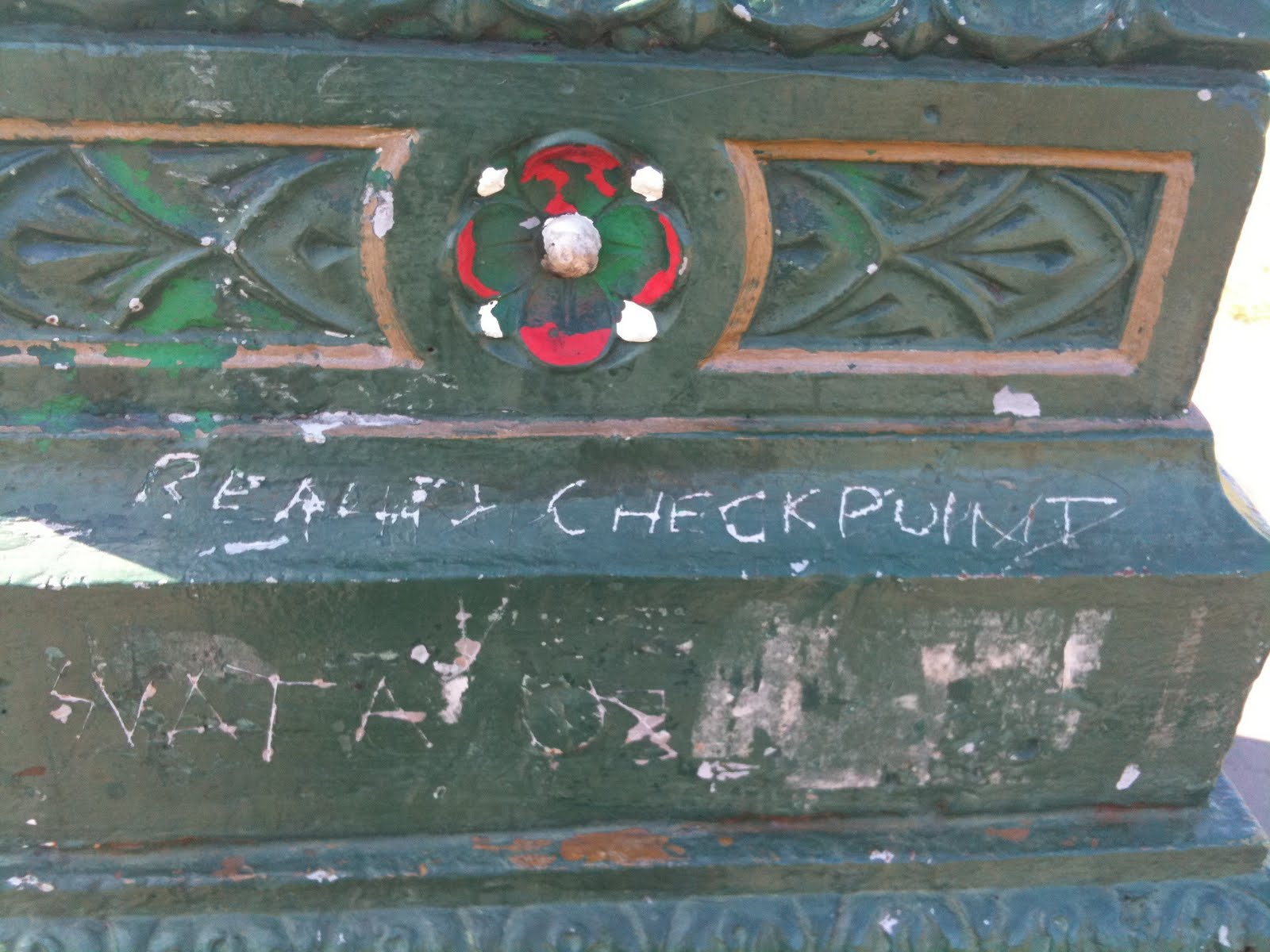
It has got a long history, partly documented already on Wikipedia as well but it captures so well on an affective level as well the fine divisions found in Cambridge. After crossing Parker’s Piece, heading towards the centre, you are warned of the approaching bubble disconnected from the real world (again: Academic Disneyland). Quite often the original 1970s context for reality checkpoint pointed towards the difference between Cambridge undergrads and the “normal people” of Cambridge, but as apt is the fact that it apparently was first scratched on the lamp post by CCAT — now Anglia Ruskin — student(s).
And I always add that the other university might have their Nobel Prize winners etc. ARU heritage comes with Pink Floyd members (David Gilmour and Syd Barrett studied at our predecessor).
Oh, would that be the day if we had a “David Gilmour chair in sonic media”, or a “Syd Barrett chair in experimental media studies.”
Super-Cambridge
It’s not the first time I have made the reference to J.G.Ballard while talking about Cambridge (UK). It somehow just seems to share the similar psycho-pathologies of middle-class that Ballard is continuously on about; all the innocent looking fronts, civilized habits, closed communities, and so on. Cambridge is the academic Disneyland that attracts tourists to marvel the 800 years of history of knowledge production — the sublime Western heritage of closed institutions, privileged few and the close link of money with information.
>Butler in Cambridge
>Just back from Judith Butler’s talk that was part of a symposium in honor of Juliet Mitchell’s retirement. First of all, I am not sure whether to be amused or angry of the “theme music” to the session which was Vivaldi’s music softly escorting the audience into what you would not expect to be one focusing on socialist feminism…but then again, that was Cambridge University, and indeed that is one way to just innocently remind the audience of the Prestige and Tradition of the place. I somehow wonder how any seminar so conscious of the roles of cultural practices in creating solidified and stratified notions of culture and relationships can tolerate such an “intro.”?












 Machinology