Archive
The Last Pokestop
One does not need an episode of Black Mirror to imagine this quiet future-now landscape: the smaller and smaller rural towns and villages in Finland, emptied of jobs, paper factories, community halls and services.
First came the replacement of the abandoned paper mills with international corporate data server facilities. Gradually the towns turned only into pokestops for the random visitors passing by.

The 21st century Finnish version of the lyrics “This town, is coming like a ghost town” is the ghostly presence of a pokestop that is too far away. The last pokestop.
Code and Labour
The new issue of Cultural Studies Review follows up from the 2012 Code-conference that was held in Melbourne, at Swinburne University. The event was marvelous, thanks to the organizers. And now, Esther Milne and Anthony McCosker have edited a lovely special issues Coding Labour. With a line-up including Anna Munster, Ned Rossiter, Mark Cote,Rowan Wilken and many more – as well as for instance Meaghan Morris in the same issue – one can expect much.
My own article is about the slightly heretic crossbreeding of German media theory and cognitive capitalism. It briefly discusses the notion of cultural techniques as a way to elaborate cognitive capitalism in the context of practices and techniques of software, code and labour. Hence it ends up in a curious short example from the 1970s, the management and organisational arrangement of metaprogramming, as a way to discuss how we might approach techniques of “creative” work in software culture.
You can find the text here and below a short abstract.
This article addresses cultural techniques of cognitive capitalism. The author argues that to understand the full implications of the notion of cognitive capitalism we need to address the media and cultural techniques which conditions its range and applications. The article offers an expanded understanding of the labour of code and programming through a case study of ‘metaprogramming’, a software related organisation practice that offered a way to think of software creativity and programming in organisations. The ideas from the 1970s that are discussed offer a different way to approach creativity and collaborative and post-Fordist capitalism. The author brings together different theoretical perspectives, including German media theory and Yann Moulier Boutang’s thesis about cognitive capitalism. The wider argument is that we should pay more attention to the media archaeological conditions of practices of labour and value appropriation of contemporary technological capitalism as well as the cultural techniques which include ‘ontological and aesthetic operations’ that produce cultural, material situations.
Architecture’s Underbelly
One of the low points of architecture in 2013 was architect Zaha Hadid’s football stadium in Qatar. Designed for the forthcoming games of 2022, the main part of the discussion has been about whether it resembles a vagina or not.

Besides reducing architectural discourse to a pretend shock about female genitalia, the case is emblematic of how design is detached from the actual world conditions. Instead of engaging in any way with the reports about abusive working conditions in the construction sites of such stadiums for Qatar 2022, we are left debating the building’s pinky Freudian connotations. Despite the pseudo-feminist debate it raised, a rather sad moment for design. It actually just flags detachment of both architectural popular discourse and architects such as Hadid from a connection with things that might have some material meaning or a meaningful impact for those whose lives this has a direct lived relation.
The underbelly of star designers are: “long working hours, hazardous working conditions, the workers being unpaid for months, had their passports confiscated, forced to live in overcrowded labour camps, denied the right to form unions, and without access to free drinking water in extreme heat”.
But the creative industries backed discourse of stars and creativity demands this underbelly of grey abusive low-paid and globally displaced hard work that is sustaining the fluffy public discourse about design.
The Elegance of Bureaucracy
I am reading a lovely book which in proper summer reading style is not directly linked to anything I am working on at the moment. It is more about the luxury of reading something interesting.
Jonathan Bloom’s Paper Before Print (ironically “out of print”) focuses on paper especially in the early Islamic world, and hence besides expanding the narratives of writing, textuality and mediality outside the usual story of the West, it also goes deeper into questions of materiality.
For us, the question of matter of media is one of chemicals and scientific processes. This also includes the story of paper, whcih besides the platform of modern bureaucracy is also one of environmental pollution and waste.
Bloom’s book is a great read and reminds of something rather pertinent, considering the book in relation to materiality of the medium of writing but also to the question of bureaucracy. Indeed, it was in the context of bureaucratic necessity that the Muslim world turned to paper – the increasing need to write things down. As such it relates to a longer history of cultural techniques of notating systems where the symbolic act of writing expands to the wider milieu in which writing can become possible – but it also expands to the cultural techniques of administration and bureaucracy.
So unlike our modern sphere of admin, Bloom reminds on one important thing. For instance in the growing bureaucratic mechanism of the Abbasid Empire since the ninth century, with its centre in Baghdad, administration was a style. It had to have style. In Bloom’s words, reminding of what we have lost in our repetitious, grey, in a different way standardised world of everyday writing: “In this bureaucratic world, official documents were increasingly judged not only by their contents but also by the elegance of the wording and the cleverness of hidden allusions in the text.” (106)
Imagine an admin email from the Faculty Human Resources written in astonishing beauty, and with that witty little allusion between the lines; imagine if there would be rhetorical style and the thrill of reading while indulging in Module Report Forms; what if your manager would next time surprise with such cunning puns that you could not but eagerly wait for the next top-down announcement?
Oh corporate bureaucracy. You are so horrible but why are you also dull and uninspiring?
Depletion Design
A collection that looks really exciting: Depletion Design: A Glossary of Network Ecologies, edited by Carolin Wiedemann & Soenke Zehle. I was happy to be involved with a tiny text on dust and new materialism. A lot of my recent writing and interests have had to do with depletion, exhaustion, and things dead or discarded – as with zombie media. More things (texts) grim and grey forthcoming.
You can download the book here. Below a blurb about its contents.
“We, or so we are told, are running out of time, of time to develop alternatives to a new politics of emergency, as constant crisis has exhausted the means of a politics of representation too slow for the state of exception, too ignorant of the distribution of political agency, too focused on the governability of financial architectures. But new forms of individual and collective agency already emerge, as we learn to live, love, work within the horizon of depletion, to ask what it means to sustain ourselves, each other, again. Of these and other knowledges so created, there can no longer be an encyclopedia; a glossary, perhaps.”
Contributors: Marie-Luise Angerer (Cyborg), Franco ‘Bifo’ Berardi (Exhaustion, Soul Work), David M. Berry (On Terminality), Zach Blas (Queer Darkness), Drew S. Burk (Grey Ecology), Gabriella Coleman (Anonymous), Heidi Rae Cooley (Ecologies of Practice), Sebastian Deter- ding (Playful Technologies, Persuasive Design), Jennifer Gabrys (Natural History, Salvage), Johannes Grenzfurthner & Frank A. Schneider (Hackerspace), Eric Kluitenberg (Sustainable Immobility), Boyan Manchev (Disorganisation, Persistence), Lev Manovich (Software), Sonia Matos (Wicked Problems), Timothy Morton (Ecology without Nature), Jason W. Moore (Cri- sis), Anna Munster (Digital Embodiment), Brett Neilson (Fracking), Sebastian Olma (Biopoli- tics, Creative Industries, Vitalism), Luciana Parisi (Algorithmic Architecture), Jussi Parikka (Dust Matter), Judith Revel (Common), Ned Rossiter (Dirt Research), Sean Smith (Informa- tion Bomb), Hito Steyerl (Spam of the Earth).
#code2k12
I am not the most qualified person to analyse the political economy and at times slightly exaggerated role of conferences; I do not really too often go to the big ones where the whole system of recruitment and other sort of social/affective work of academia happens. I am sure there are loads of management books on such topics and their importance. Not that I have anything against being social – just being a Finn you have to limit it a bit, not to get exhausted with the overwhelming number of people that would amount to the total number of a small Finnish village easily. However, at times events really strike a chord – like Code at the Swinburne University of Technology, Melbourne: a fantastic combination of academic quality and lovely people.

I am a firm believer in that the more interesting academic benefit of such events is not hearing someone speak, but that you are able to meet and talk outside the sessions; whether casual chattering or on the topic of the presentation. This is hardly a surprise. But it is not only the meet & greet networking silly management culture that we are persuaded to pursue, but actually having some affective pleasure from finding out that academics are not completely subsumed into corporate climb-the-ladder assholism.
Of course, talks can be really good in triggering ideas. What I mean by that is at least my own prespective that I have often trouble in immediately summarizing someone’s talk in its entirety, and instead I get nuggets, something that triggers an idea. In this sense as well, Code was a success.
The event was not focused down solely on software culture or critical code studies despite the frequent references to Chun, Galloway and Kittler – and some other usual suspects. I perceived something of an expanded notion of code in the sense that through the theme, a lot of presentations pointed to a broader context of materialities in which code takes place; logistics, management, intermedial relations, aesthetic, and non-computer placed coding of social actions/events like with the Human Fax Machine-experiment. Talks ranged from reddit to Ring(u), cars to Erica T. Carter, commandline to Google, and signal to Simondon. Code had already introduced its own approach to the idea even with a conference reading list!
Besides having the pleasure of listening to the fantastic keynotes by Anna Munster and Christian McCrea, for instance the plenary panel of Melissa Gregg, Ned Rossiter, Soenke Zehle and Mark Coté was the best one can hope for. Brilliant speakers all of whose I work admire a lot, and the topics were nicely resonating. For instance Gregg’s take on the Getting Things Done (GTD) software was something that illuminates what I tried to just briefly address in my own keynote on Cultural Techniques of Cognitive Capitalism (more on that later in a separate blog post): the entanglement of media, management, affect and modes of production in contemporary digital culture. Such practices, techniques and technologies frame the will for more time and freedom, as well as creativity, which ground notions such as cognitive capitalism, and in Gregg’s case she was able to show the deep layers of such ideas of “work smarter, not harder”. Exhaustion, tiredness and fatigue have not disappeared from the gendered worlds of management of office and post-office work. Such affect management and self control are excellent ways of articulating the curious emphasis on the cognitive and affective in relation to modes of production: they hover somewhere between of the tiring and energizing, of repetitive and creative. In this context, see also the Zooming Secretary game that Gregg started with — filing cabinets, telephones and coffee boosts; affective attunement.
It was also pleasure to hear Coté talk of his book project on Data Motility which is one of those great moments when we get someone with a fantastic knowledge of Italian political theory and current media theory talking about a topic of Digital Humanities. DH at times “forgets” the existence of media theory, as well as the longer history of humanities-technology partnering, but at the same time of course we need to be ready to update our theoretical perspectives in relation to new modes of quantities, qualities, and abstractions.
Coté ‘s book promises to be really exciting, offering an insight to data having a self-generated sense of movement as well as being the object of value creation: big social data is the sociality of the data for instance collected on social media, which highlights its polyvalence and social and economic valorisation. According to Coté big social data can be seen constituting a certain mode of humanness that humanities should tackle with. This sort of conditioning is the sort you get from the directions of Leroi-Gourhan and others. But it also points to the direction of debt, an interesting idea Coté suggests: what if we understand our relation with the data collected as one of debt, as analysed by for instance Lazzarato. Big social data in social media contexts is one of endless payments and demands of creating the social through actions, in order to justify our existence.
Both Rossiter and Zehle talked of logistics; Rossiter towards the worlds of media and management, transposition of labour to code & algorithms (which probably would resonate with some insights from Fuller & Goffey’s recent Evil Media) and Zehle in relation to gestures. Indeed, listening the two talks in the same panel made the audience aware of the multiscalar worlds of logistics – from human social affect and gestures, to the abstracted worlds of simulations and games in which management and logistics can be rehearsed.
Even if I mention only some of the papers here, throughout the conference I felt more inspired than in most of the events I visit. As said, this extends to the time outside the actual talks; people are engaged in several interesting projects, which made me actually, and without irony, feel rather ok about being an academic. And in that context, it was less painful to visit the other side of the world, Melbourne, and do two long haul flights within 10 days. I myself talked about some new things I am engaged in – a sort of a project pitch for something that might turn out to be a bigger project event – and gave a “master class” on Media Archaeology & Cultural Techniques.
The Age of Selection
Capitalism. Think of it as a military drill operation. In order for us to be consumers and subject to advertising, we need to be trained. We need to realize choice, we need to understand selection, and we need to be trained to realize that advertising…is only for our benefit. Right?

From Popular Science, 1932
On Borrowed Time – Lazzarato and Debt
 Maurizio Lazzarato’s new book La fabrique de l’homme endetté is another fabulous, lucid and inspiring account from the Italian philosopher. The short book is, as the subtitle promises, an essay on the “neoliberal condition”, which in this case encompasses an analysis of debt. It could not be timelier. This is an obvious statement but the importance of debt from the macroeconomic level of public sector national crises in Europe and US to the microeconomic subjectivity of the individual agents cannot be overestimated. Indeed, what Lazzarato offers is a philosophico-historical analysis of the debt condition via Nietzsche, Marx, Deleuze & Guattari and Foucault.
Written in an accessible style, Lazzarato’s argument is easily summarized. What grounds the economic relation is not exchange as so often assumed in classical economic theories but the credit-debt relationship. This, in other words, is a relation of asymmetric power, which is the fundamental starting point for what is followed up by economic and political contexts (two tightly related fields, argues Lazzarato distinguishing himself from Badiou and Rancière’s argument concerning the autonomy of the political from the economic). Debt as a feature of neoliberalist policies affecting exactly the diminishment of the public sector gradually from the 1970s onwards is what Lazzarato insists as a better way to understand contemporary capitalism than talk of financial capitalism. With the creditor-debt relation he is able to talk of the subjectification process inside capitalism.
Lazzarato proceeds in a clear fashion, first taking aboard Nietzsche’s genealogy of morality and explication the debt relation as one of guilt. The relation of debt is one of morality and hence encompasses the social relation before establishing the economic. The precondition for debt is that you are able to make promises, project to the future, and establish a relation of future promises made now. This temporality is a significant feature in terms of how debt attaches to the morality, the embodied subject of capitalism that Lazzarato insists is not only cognitive. Indeed, in more than one passage he argues that the theses concerning cognitive capitalism are insufficient to understand the whole relation. The investment in the cognitive, and the cognitive as the motor of contemporary production is just one modality in a wider context. Indeed, later he goes on to elaborate what he calls a more “existentialist” mode of subjectivity at the centre of this neoliberal condition. Yet, this is not Sartrean existentialism, but one that comes from William James. The cognitive is only a small part of subjectivity that more fundamentally includes more intimate things – passions, impulsions, beliefs and desires. Hence, in this mix of Nietzsche-James one is looking at more non-cognitive forces that relate to a relation to future. This futurity is something that in various different ways has been suggested as a way to understand contemporary powers of security-capital, from pre-emption (Elmer and Opel), premediation (Grusin) and futur antérieur (Massumi).
For Lazzarato, this is an articulation of belief and the necessary incertitude as its atmospheric context, which is all embedded in the wider culture of risk that we find from the discourses of entrepreneurship to work in general. Hence, Nietzschean genealogy of bodily feelings (or lets call them affect, even if Lazzarato does not really talk of affects) is one that lends itself to understand what is the social enabling the capital relation.
When bringing in Marx to his analysis, Lazzarato refers to a much less known text, “Credit and Bank” (1844). This is what Lazzarato calls the Nietzschean Marx; one who sees the condition of debt entirely attached to the subjectivity of the poor, the one who is on borrowed time (hence, applies to the rent relation as well…). Here, to paraphrase Lazzarato (p.45), the credit does not characterize only labour, but the wider work that goes into the self – instead of just investing into physical or intellectual capacities, credit/debt is something that attaches to the morality (the future-orientedness) of the subjectivity, and hence is a question of ethics. To continue with Lazzarato’s explication of Marx, this relates to a total alienation as it touches not only a specific part of the worker’s time (that of work) but the whole ethics of being as someone who is promising, bearing risks, and assuming a future. What is captured is the future-prospect, or something that Lazzarato calls as the debt-relations’ asphyxiation of futures.
Throw in Deleuze and Guattari for good measure. Obviously, so much of Lazzarato’s analyses has been already implicitly about Deleuze-Guattarian emphases that he explicates in the book. The “non-economic interpretation of economy” that DG’s emphasis of the production of the social brings in is again the point of asymmetry of power. As a certain anthropology of capital, it allows us to think, again, not exchange but debt/guilt/power as what enables the economy. The two monies of a) revenue/salary and b) capital need to be distinguished. The latter is what governs financial capitalism as a form of futurity (or pre-emption of futures) where the credit money is able to what kind of productions and products will actualize (and of course, one could add, it is not only about such but the constant deferral of the virtual money repackaged into new forms of debts – subprime).
To paraphrase Lazzarato (p.71), the approach he proposes is about the transversality of the debt/neoliberal condition. Employed, and unemployed, productive or unproductive, the state of debt runs through economic, political and social fields (ibid.). Picking up on Foucault’s points (and updating some others), Lazzarato reminds that the (neo)liberal condition is not about reduction of control and governing, as so often rhetorically claimed, but about emphasizing certain patterns of contradiction, accumulation of value and power, and minimizing the democratic possibilities of intervention (120).
For me, Lazzarato’s brilliant extended essay/book raises questions; for instance, how to elaborate the debt as embodied; Ie. what could be called, for the lack of a better word, “affective capitalism”, where the affect bit refers to the bodily and often non-cognitive states and excitations; of desires and impulsions; whether in the brain or in the gut. Could this be connected to the wider interest in brain sciences in the context of digital culture (interface design)? And the wider discourse of the brain – brain sciences in contemporary culture?
Could there be a mediatic way of continuing Lazzarato’s analyses, to connect the future-oriented subjectivity to analyses of the media technological condition of the human in contemporary neoliberalism?
Streets, music are contagious
At the moment, I am trying to blog most of my media archaeology related notes and images on Cartographies of Media Archaeology (the work blog for my in-progress Media Archaeology and Digital Culture-book that I am writing for Polity Press). However, could not resist putting this up here – a short story and image from Illustrated London News, 19 December 1846.
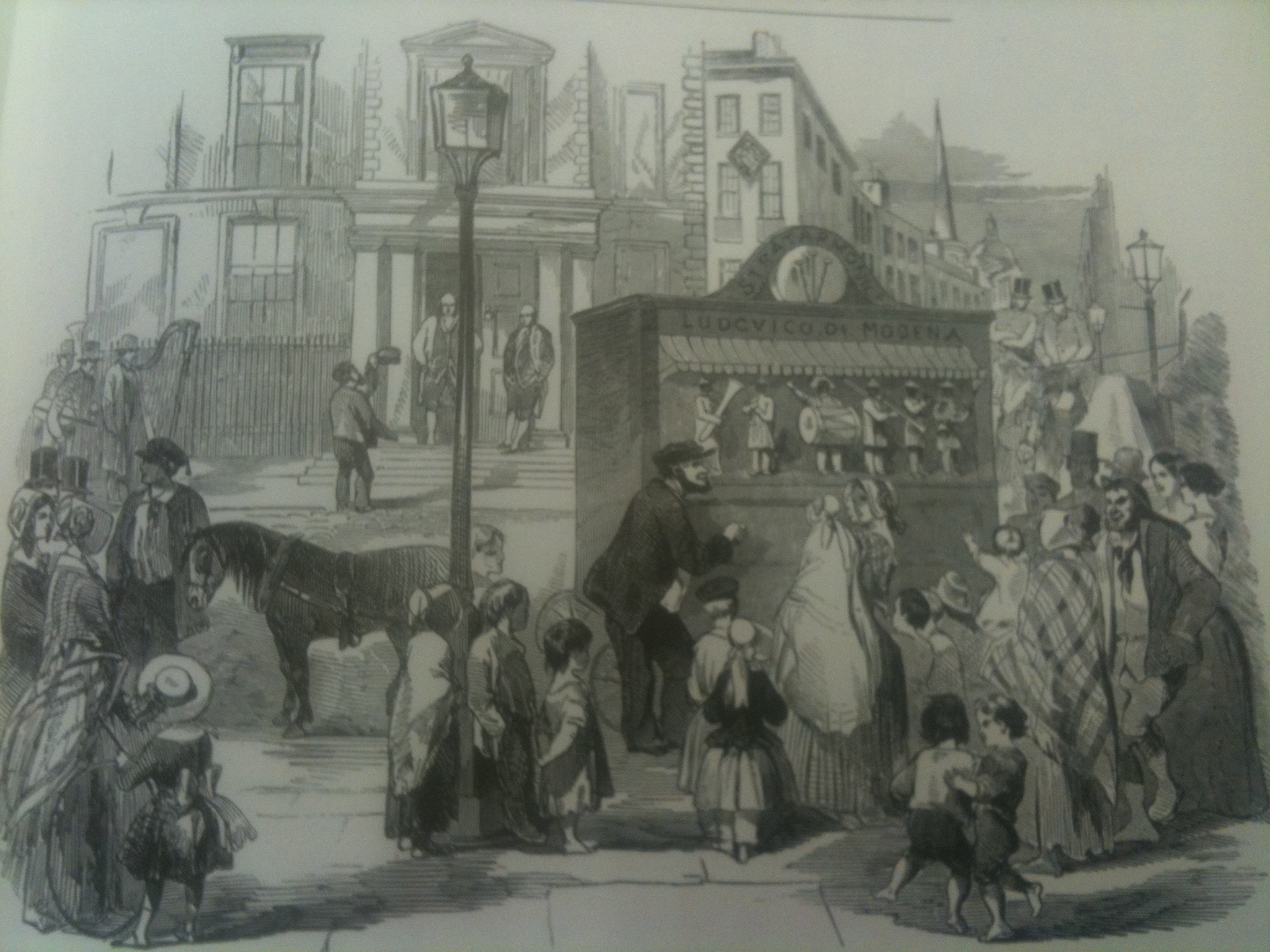
Illustrated London News, December 1846
“London Street Music” features the street musician as a performing artist, giving a glimpse both to the 19th century worlds of entertainment and performance of street life, but also the pre-post-fordist emphasis on performance and affect. What writers such as Paolo Virno have identified as the mode of production in aesthetizised regimes of work: the virtuoso, the performing artist, was already his focus in A Grammar of Multitude. As Raunig puts Virno’s position in a summarizing fashion, while also pointing towards the problematic of relience on language by Virno:
“In post-Fordist capitalism, labor increasingly develops into a virtuosic performance that does not objectify itself into an end product; at the same time, this virtuosic form of labor demands a space that is structured like the public sphere.”
In the 1846 short article, the almost dangerous powers of the street musician are described in how they can capture the affect life of the listeners in public sphere: “How many suicides have been committed under his melancholy has not yet been clearly ascertained; but the effects of the orgue de Barbarie on the nervous system have been well known since Hogarth gave to the world his ‘Enraged Musician’.”
The worlds of technology (the new special street organ that differentiates this new brand of talent from “amateurs and artists”) and the worlds of music, the ability to bring operatic cultures of Rossinian and Bellinian spheres to the wider public, make up this special brand of economies of cultural industry of affect. Naturally this reminds that the contagious force of affect has a longer history – in terms of the affect theories in music (baroque and the early 18th century for instance) as well as in social theory that emerged in the late 19th century where it was discussed in terms of public space, contagion, imitation and crowds.
War, scarcity and other playful things of life

Fun Inc. by Tom Chatfield was not as interesting as I hoped it is going to be. For most parts, it was telling what I already knew; that games are not played only by teenaged boys in their cellars, alone, with a blood-craving look in their eyes. No, instead they are social, reach various social layers, teach us a variety of skills from emotional to intellectual, and that also the army and the education institutions are interested in them. Fair enough, perhaps we still need such books to spread out the fact that games are not just games, but constitute a key feature of contemporary digital culture. Its not only “games” as objects or products but a whole set of patterns of behavior, gestures, affects and emotions that constitute a wider field of “gamelike” elements of which digital culture consists of. Hence, such seeming oxymorons as serious games (games used for learning or other “serious” activities like politics) are taking over. Or then casual games, used to fill in that 3 minutes you have of your personal time. I am still yet to see that perfect post-fordist analysis of the management of time and a care for the self in the context of casual gaming.
To be fair, Chatfield included some nice sections. His chapter on Second Lives pointed out the weird patterns of labour of social media platforms — from goldfarming to such original interventions as Jeff Crouse and Stephanie Rothenberg’s Invisible Thread’s project that staged a virtual sweatshop on Second Life.
Thinking about gaming cultures, I was reminded of (quasi-)Zizekian ideas concerning how people want their own slavery and such social media and game platforms are good examples of such. They are both able to articulate the real world cultures of scarcity, but at time same time showing how it seems impossible to even think/desire outside such modes of capitalist scarcity. Chatfield mentions one early virtual world The Palace (1995) that was supposed to introduce a world without real life limitations. As Chatfield writes, people were not however ready for such radical ideas, “People, it turned out, were extremely attached to scarcity. They liked it so much, in fact, that not only did they prefer virtual worlds in which there were strict limits on available resources over ones in which you would simply have anything you wanted; they were actually prepared to pay money to spend time in these scarce worlds.” (173) In Zizekian terms, even if such a world without limitations was somehow possible there, people did not find the needed cognitive and affective attitudes of how to cope with that. What to do with that lack of scarcity? In terms of how it articulates the artificial scarcity continuously maintained by neoliberalism, such virtual worlds become really interesting.
Finally, again from one of the better chapters, this one on the one on war, Chatfield seems to write suddenly like Friedrich Kittler. Hence, I could not resist quoting him in length (Chatfield that is):
“In this respect, it’s clear that being well prepared for modern warfare shares many elements with good preparation for modern life: you need to be able to live and breathe certain kinds of software and hardware. Most of your actions are mediated by complex machines, while your sphere of power and information extends well beyond the personal space you occupy. You are a networked individual, using multiple tools, often deluged with information and options.” (192-193)
Having just yesterday finally seen Gamer, something that Steven Shaviro has been going on about (and for a good reason), this description seems apt and accurate idea of some of the techno-affective links between gaming cultures and war; what Shaviro brings in his wonderful analysis of Gamer is of course neoliberalism. I cannot but warmly recommend his text on the topic.
















 Machinology